Takeaway Packaging in Food Service: EU Obligations 2026 at a Glance
Takeaway Packaging in Food Service: EU Obligations 2026 at a Glance

If you sell food or drinks to take away in the EU, two sets of rules apply to you. The first is the Single-Use Plastics Directive (EU) 2019/904 and the national rules that implement it, which already require measures to reduce the consumption of single-use plastic cups and food containers. The second is the new EU Packaging and Packaging Waste Regulation (PPWR), which applies from 12 August 2026 and sets a clear timetable: customers' own containers from February 2027, a mandatory reusable takeaway packaging offer from February 2028, and restrictions on single-use plastics for food and drinks consumed on the premises from 2030. This guide explains who the rules apply to, which packaging is covered, what the deadlines are and how to organise reusable packaging, single-use packaging and waste separation in your business.
In brief
- From 12 August 2026, Regulation (EU) 2025/40 on packaging and packaging waste (PPWR) applies directly in all member states. Obligations for food service businesses are phased in.
- From 12 February 2027, you must allow customers to receive takeaway food or drinks in their own container or cup, on the same terms as in single-use packaging.
- From 12 February 2028, you must also offer customers reusable takeaway packaging within an appropriate system and inform them clearly about it.
- From 1 January 2030, single-use plastic portion packs for sauces, sugar, cream and condiments are banned in restaurants, bars, cafés and hotels, and single-use plastics are restricted for food and drinks consumed on the premises.
- Rules on single-use plastics already apply today under the SUP Directive and national law, such as using alternative products, accepting customers' own containers and informing customers. Food containers and cups made of expanded polystyrene are banned.
Contents
- What is new in 2026: PPWR and existing rules
- Who the obligations apply to
- Which packaging is covered
- Reusable packaging: what you must offer
- Extended producer responsibility and records
- How to choose sustainable takeaway packaging
- How to reduce packaging waste in food service
- Separating and disposing of packaging correctly
- Our view: reusable packaging starts with purchasing
- Reusable cups, tableware and single-use products at Euronova
- FAQ: packaging in food service
- Sources
What is new in 2026: PPWR and existing rules
The European Union has overhauled its packaging rules with Regulation (EU) 2025/40 on packaging and packaging waste, PPWR for short. As a regulation, it applies directly in all member states from 12 August 2026, so it does not need to be transposed into national law. Member states still have to designate enforcement authorities and set penalties, and national rules on packaging and packaging waste remain in force where the PPWR does not replace them.
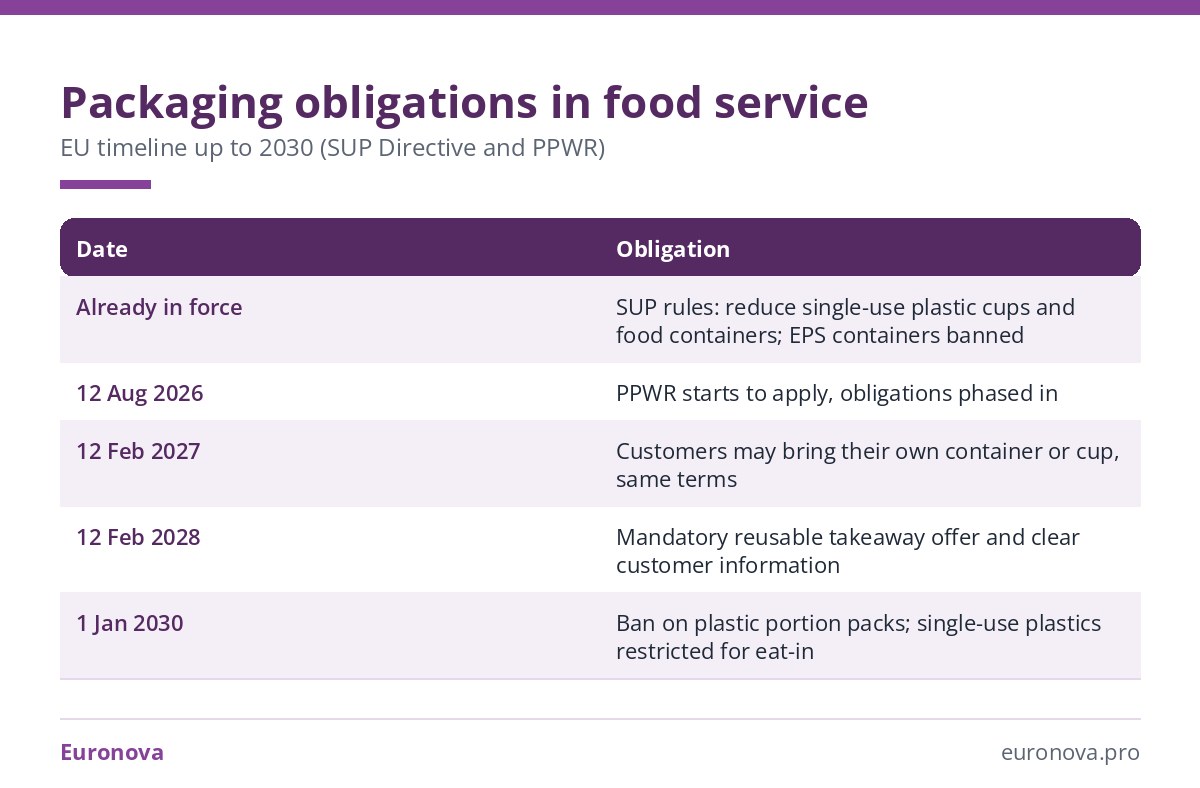
For food service, this means that the PPWR timetable is added to the existing obligations under the single-use plastics rules. According to the EUR-Lex summary of the regulation, the key dates for food service businesses are:
| Date | Obligation |
|---|---|
| Already in force | SUP Directive and national rules: measures to reduce consumption of single-use plastic cups and food containers |
| 12 August 2026 | PPWR starts to apply, obligations are phased in |
| 12 February 2027 | Customers may bring their own container or cup for takeaway, on the same terms |
| 12 February 2028 | Mandatory reusable takeaway packaging offer and clear customer information |
| 1 January 2030 | Ban on plastic portion packs on the premises, restriction of single-use plastics for on-premises consumption |
The PPWR also brings requirements on restricting hazardous substances and on recyclability, for example a ban on PFAS in food-contact packaging above certain limits. These requirements primarily concern packaging manufacturers, but you will still notice them when purchasing, because the range of single-use products will change over the coming years.
Who the obligations apply to
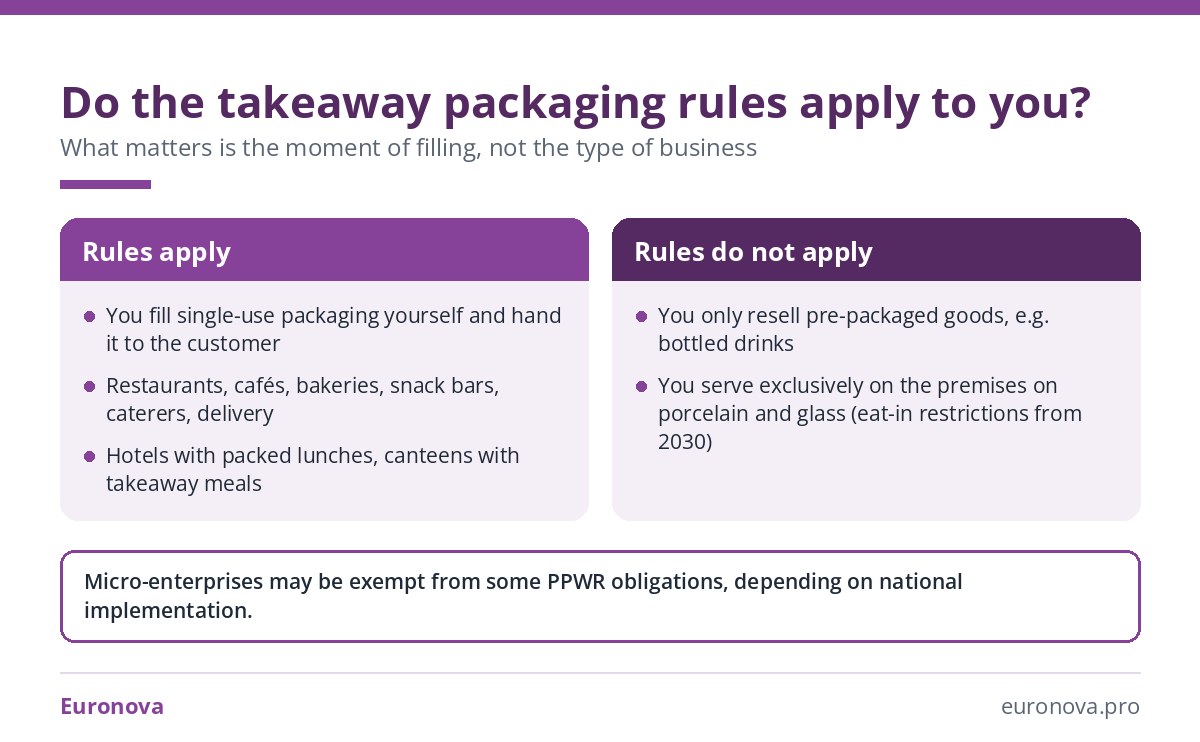
The obligations concern food and drink outlets that fill single-use packaging themselves and then hand it to the customer. These are restaurants, bistros, canteens, caterers, cafés and patisseries, and in practice also pizzerias with collection, snack bars, bakeries selling coffee to go, hotel bars with drinks to take away, and delivery services.
What matters is the moment of filling, not the type of business. A hotel preparing packed lunches in plastic boxes is affected just as much as a café. A school kitchen or care home also falls under the rules when it fills takeaway meals into such packaging. Businesses that merely resell pre-packaged goods, such as bottled drinks, do not have these obligations.
The PPWR provides for exemptions from some obligations for micro-enterprises, which member states can regulate in more detail. Keep an eye on how your country implements this through the competent environment ministry and your national hospitality association.
Which packaging is covered
Material causes the most uncertainty. The EU Single-Use Plastics Directive and the national rules based on it consider a product to be plastic even if it is only partly made of plastic. A plastic coating or inner lining is enough; plastic does not have to be the main material. A cardboard chip tray with a plastic coating is therefore covered just like a classic salad box with a clear lid.
| Packaging | Covered by the single-use plastics rules? | Note |
|---|---|---|
| Plastic box for salad, pasta or bowls | Yes | For food ready for immediate consumption |
| Cardboard container with plastic coating | Yes | The coating alone is enough |
| Cup for coffee, soft drinks, smoothies | Yes | Including lids |
| Pizza box made of pure cardboard | No | Applies only to packaging without plastic |
| Uncoated paper bag | No | For rolls, pastries, snacks |
| Food containers and cups made of expanded polystyrene | Banned | May no longer be placed on the market |
| Purchased pre-packaged drinks | No | Other rules apply to bottles and cans |
For food, what matters is whether it can be eaten straight from the packaging. Food that the customer still has to cook or reheat at home does not fall under this definition. For cups, a paper cup with a plastic lining is not a way out, as under the rules it is also a plastic product.
Reusable packaging: what you must offer
With the PPWR, existing measures become clear obligations. These five rules are recommended for implementation:
- Customers' own containers from 2027: from 12 February 2027, you must allow customers to receive food or drinks in their own container, on the same terms as in single-use packaging. Price and portion must not be worse.
- Reusable packaging from 2028: from 12 February 2028, you must also offer reusable takeaway packaging within an appropriate system, for example with a deposit and return.
- A deposit is allowed: you may charge a reasonable deposit. You refund it when the packaging is returned, so it does not count as a higher price.
- Visible information: the reusable option must be clearly indicated, ideally at the till, on the menu and for online orders.
- Cover all sizes: if you offer coffee in three cup sizes, all three should also be available as reusables.
Whether you use your own containers or join a shared system with return points across the city is up to you. Your own containers pay off especially if you have many regulars who come back anyway. A shared system is practical if customers change and want to return the container elsewhere.
Customers' own containers already today
Under the SUP Directive, member states must take measures to reduce the consumption of single-use plastic cups and food containers, and national rules in some countries already require food and drink outlets to accept customers' own containers, use alternative products and inform consumers about these measures. If you already fill customers' containers today, you will be ready for 2027 without major changes. Draw customers' attention to this option with a visible notice.
Extended producer responsibility and records
Besides offering reusable packaging, the second set of obligations relates to extended producer responsibility (EPR). For packaging that is only filled at the point of sale, such as takeaway coffee cups, carrier bags, pizza boxes, burger boxes or aluminium foil, a contribution towards packaging waste management is payable in many countries. For single-use plastic cups and food containers, the SUP Directive also requires an extended producer responsibility scheme, under which producers also contribute to the costs of cleaning up litter.
Here is what to do in practice:
- Check your stock: list all packaging you fill on the premises: cups, boxes, bags, foils, cartons.
- Ask your supplier: check whether the EPR obligation for your service packaging has already been met by the manufacturer or supplier.
- Keep the evidence: keep your supplier's confirmation. During an inspection, you must be able to show that the obligations have been met.
- Careful when buying abroad: if you buy packaging directly in another country, the obligations may pass to you. Check this with the competent ministry or a packaging waste compliance scheme.
As the PPWR brings new definitions of producer and records, it makes sense to check in 2026 whether anything has changed with your supplier or in national rules.
How to choose sustainable takeaway packaging
The most sustainable packaging is the one you use many times. Where single-use packaging is still needed, pure uncoated paper or cardboard is easier to recycle than composite materials.
When purchasing, look for these criteria:
- Dishwasher-safe and durable: reusable containers must withstand hundreds of cycles in a commercial dishwasher without cracking or discolouring.
- Food-safe and temperature-resistant: hot soups need different materials from salads or desserts.
- Tight closure: a lid that opens in transit costs you customers, whether the packaging is single-use or reusable.
- Stackable: saves space in the storeroom, the dishwashing area and the delivery vehicle.
- The right sizes: choose sizes that match your portions. Oversized containers waste material, and the food slides around in transit.
- Clearly marked: for drinks, cups with a fill line help you pour every portion correctly.
Reusable packaging on the premises: hygiene and procedures
Reusable packaging only works if the procedures work too. Containers must be durable and easy to clean, while proper procedures and a hygiene plan ensure safety. In practice, a clear separation works well: returned containers go into their own crate, straight into the dishwasher and only then are issued again.
For containers brought by customers: the container should be clean and must not pass over the counter into the preparation area. Many businesses fill it on their own tray or put the food in with a clean ladle. Describe the procedure in your HACCP system and brief the team. For open questions about your hygiene plan, the right contact is your local food safety authority.
Events, festivals and catering
At events, a particularly large amount of packaging waste is generated within a few hours. Reusable cups with a deposit have been tried and tested here for years: guests return the cup at the bar and the team washes up in between. If you cater for city events, trade fairs or corporate parties, include reusable tableware at the planning stage and agree it with the organiser. For larger events, it often pays to hire plates, glasses and cutlery instead of buying single-use products.
How to reduce packaging waste in food service
The law requires an offer, but how much waste you actually prevent depends on how you implement it. The following principles have proved themselves in everyday practice:
- Actively offer reusable packaging: the team asks with every takeaway order instead of automatically reaching for a single-use cup.
- Extras only on request: napkins, cutlery, sauces and bags only if the customer wants them.
- Serve on the premises: customers eating in get porcelain and glass, even if they ordered at the counter.
- Bundle orders: larger, combined orders save transport packaging and trips.
- Organise storage well: GN containers with lids in the kitchen replace cling film and single-use containers.
- Measure results: count for one month how many reusable containers you issue. This shows whether notices and prompting work.
Separating and disposing of packaging correctly
Whatever stays in circulation as single-use packaging should end up being recycled. The basic principle is separate collection of empty packaging according to your local collection system, typically glass, paper and cardboard, and other packaging made of plastic, metal and composites.
For the kitchen and dining room, this means:
- Empty, not washed: packaging must be empty; rinsing is not necessary. Food leftovers belong in organic waste or kitchen waste collection.
- Separate components: remove the plastic lid from a paper cup and the window from a box if it comes off easily.
- Soiled cardboard: a very greasy pizza box recycles poorly. Put clean parts in paper recycling and heavily soiled parts in mixed waste, as instructed by your waste collection provider.
- Labelled bins: place separate bins with clear symbols in the dining area. This greatly reduces incorrect disposal.
How collection is organised for businesses is determined by your contract and local authority rules. Agree with your waste collection provider which fractions it collects and how the containers should be filled.
Our view: reusable packaging starts with purchasing
We equip restaurants, hotels, cafés, bars, caterers and canteen kitchens. When it comes to switching to reusable packaging, we see the same thing again and again: businesses that plan reusables as part of their equipment have less work than those that only meet the legal minimum.
The reason is simple. Reusable tableware is then not a special item on the counter but part of the normal routine: glasses, cups, bowls and GN containers go through the same dishwasher and onto the same shelf as the rest of the tableware. If you coordinate porcelain, glassware and reusable cups, you need less single-use packaging and less storage space.
Our advice: start with what you hand out most often, usually drinks cups. Choose durable reusable cups in the sizes on your menu, clearly state the deposit amount and train the team to actively offer reusables. Bowls and food boxes follow. That way your reusable packaging offer grows step by step with your business, and the 2028 deadline will not take you by surprise.
— Rok
Reusable cups, tableware and single-use products at Euronova
In the Euronova range you will find equipment for both sides: reusable tableware for the offer required by the rules, and single-use products for the rest of your takeaway sales. For bars, cafés and events, reusable cups are available in many sizes, for example the Disco reusable cup 30 cl with a 0.2 l fill line, the Disco reusable cup 40 cl with a 0.3 l fill line or the Disco beer glass 56 cl. For receptions with sparkling wine, the reusable champagne glass 18 cl is a good choice.

In the kitchen, porcelain GN containers replace single-use containers for storage and on the buffet. For events, you can also hire plates, glasses and cutlery from us. You will find the full range in the Euronova online shop for catering equipment.
FAQ: packaging in food service
What does the EU PPWR change for restaurants and cafés?
Regulation (EU) 2025/40 applies from 12 August 2026, and the obligations are phased in. From 12 February 2027 you must let customers use their own containers for takeaway, from 12 February 2028 you must offer reusable takeaway packaging, and from 2030 restrictions on single-use plastics apply to food and drinks consumed on the premises.
Does a restaurant without takeaway have to offer reusable packaging?
No. The takeaway packaging obligations only concern food and drinks you hand out in packaging. If you serve exclusively on the premises on porcelain and glass, they do not apply to you. From 2030, however, restrictions on single-use plastics also apply to on-premises consumption, so it is worth planning reusable tableware now.
Is a paper cup enough instead of a reusable option?
No. Paper cups usually have a plastic lining and therefore count as a plastic product under the rules. The only exceptions are packaging made of pure paper or cardboard without a plastic coating.
Can I charge a deposit for reusable containers?
Yes, a reasonable deposit is allowed. However, the food or drink itself must not cost more in a reusable container than in single-use packaging. You refund the deposit when the customer returns the container.
Do I have to fill a customer's own container?
National rules in some EU countries already require food and drink outlets to accept customers' own containers. From 12 February 2027, the PPWR requires this explicitly, on the same terms as for single-use packaging. Describe the filling procedure in your HACCP system.
Sources
- EUR-Lex: Summary of the regulation on packaging and packaging waste from 2026
- Directive (EU) 2019/904 on the reduction of the impact of certain plastic products on the environment
- Your Europe: Single-use plastics