Correct Food Storage in Catering: Rules for Commercial Kitchens
Correct Food Storage in Catering: Rules for Commercial Kitchens

In a commercial kitchen, food is stored correctly when every product is kept at its own temperature, covered and off the floor, when raw and ready-to-eat food are strictly separated and when older stock is used first. Monitoring is part of it too: fridge and freezer temperatures are measured and recorded regularly. This guide shows which storage temperatures apply to meat, fish, dairy and deli products, how to organise a cold room sensibly, how to cool and hot-hold food safely, and which containers make daily work easier in restaurants, hotels, cafés and the kitchens of schools, nurseries and care homes.
Key points
- Temperature by food type: fresh fish 0 to +2 °C, poultry and minced meat up to +4 °C, other potentially hazardous chilled food (meat, dairy, deli products) below +5 °C, frozen food at -18 °C or colder.
- Order protects: nothing on the floor, everything covered, raw kept apart from ready-to-eat.
- FIFO and dates: first in, first out. Food you freeze yourself and opened packs also get a dated label.
- Cooling and hot holding: cool cooked food from 63 °C to 20 °C within two hours at most, then to 5 °C within a further four hours. Hold hot food at 63 °C or above until service.
- Records: measure and record temperatures every day. During an inspection, you can only prove what has been written down.
Contents
- Basic rules for every storage area
- Storage temperatures by food group
- How to organise your fridge and cold room
- Cooling, hot holding and the cold chain
- FIFO, labels and clear date marking
- “Best before” and “use by”
- Monitoring and recording temperatures
- The right containers for storage and service
- Our view: an orderly store is a question of equipment
- Food storage FAQ
- Sources
Basic rules for every storage area
Whether it is a dry store, a cold room or a chest freezer, some rules apply everywhere. Store food covered, protected from direct sunlight and never in direct contact with the floor. Vegetable crates, drinks cartons and flour sacks therefore belong on shelving, pallets or trolleys, never on the tiles.
In daily work, things most often go wrong in three areas:
- Separate storage: raw food and prepared dishes have their own zones. Where space does not allow this, sealed containers and a clear shelf order provide the separation.
- Closed storage: open goods absorb odours, dry out and can contaminate other products with drips or crumbs.
- Glass at the bottom: place food in glass containers on the lower shelves so that, if one breaks, shards do not fall into other goods.
Whatever is not eaten needs its own place as well. Collect kitchen waste in lidded bins and remove it from the work areas as soon as possible. Cleaning agents and equipment have their own closed area, separate from all food. If you are planning or refurbishing a kitchen, separate clean and dirty routes at the design stage, before registering the food business with your local food safety authority.
Storage temperatures by food group
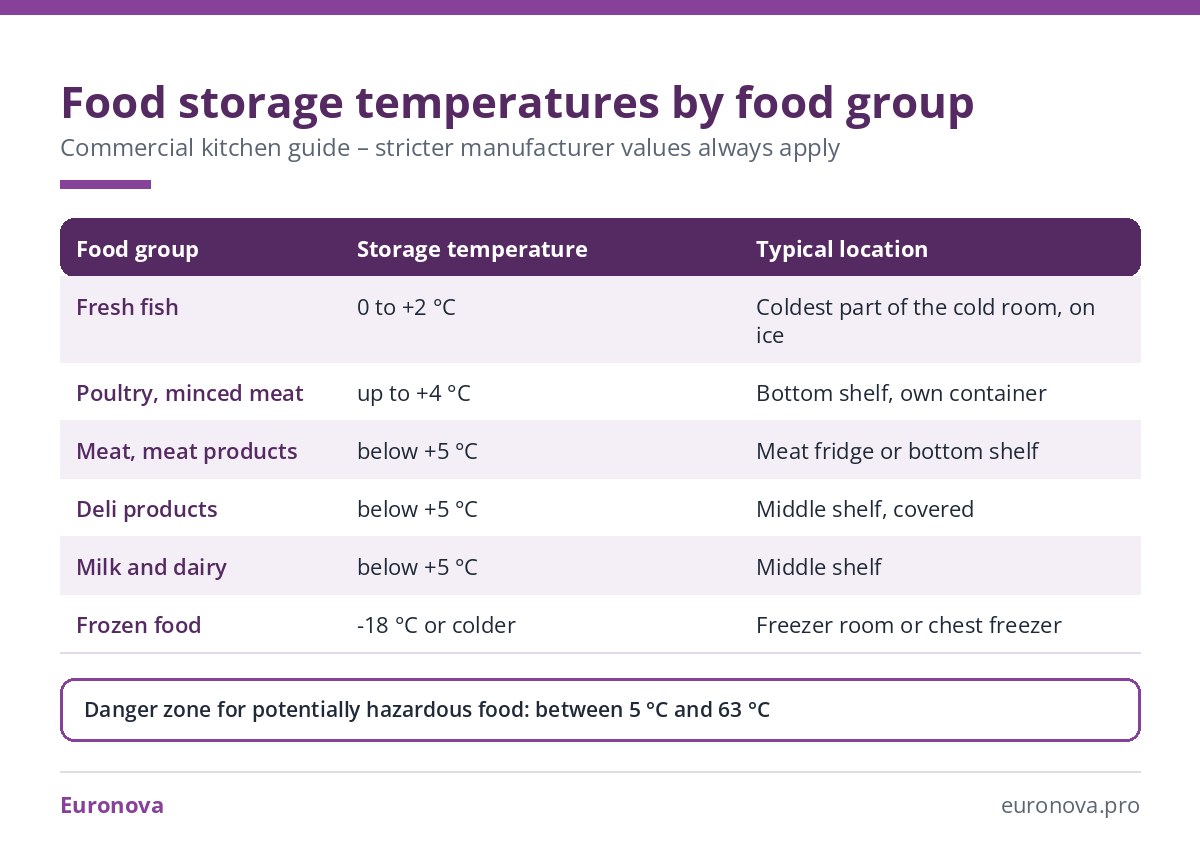
Temperature is the most important lever for safety and shelf life. The basic hygiene guidance of the Slovenian National Institute of Public Health (NIJZ), for example, states that potentially hazardous chilled food must be kept in the fridge below 5 °C and frozen food at -18 °C or colder; always check the requirements of your local food safety authority. For particularly sensitive food, even stricter values are used in practice:
| Food group | Storage temperature | Typical location |
|---|---|---|
| Fresh fish | 0 to +2 °C | coldest part of the cold room, on ice or in a fish fridge |
| Poultry, minced meat | up to +4 °C | bottom shelf, own container |
| Meat, meat products | below +5 °C | meat fridge or bottom shelf |
| Deli products (salads, dressings, cold cuts) | below +5 °C | middle shelf, covered |
| Milk and dairy products | below +5 °C | middle shelf |
| Frozen food | -18 °C or colder | freezer room or chest freezer |
If the manufacturer states stricter values on the packaging, those apply. The guidance also warns that the danger zone for all potentially hazardous food lies between 5 °C and 63 °C. In this range micro-organisms multiply fastest, so food should spend as little time in it as possible.
What to do if the cold room holds mixed foods?
In smaller businesses, fish, meat and dairy often share one cold room. In that case, set the temperature for the most sensitive item. The German engineering association points this out too in the VDMA information sheet on cold rooms and freezer rooms: with mixed contents, the storage temperature is set by the product with the strictest requirement. If fresh fish sits next to cheese, the fish value applies to the whole room.
Dry store for flour, rice, pasta and tins
Long-life stock needs no electricity, but it does need good conditions: cool, dry, well ventilated and dark. Moisture makes flour clump and go mouldy, while heat turns oils and nuts rancid. Opened sacks are best decanted into airtight containers labelled with the product and the opening date. This keeps pests out, and everyone in the team can see at a glance what needs to be used first.

How to organise your fridge and cold room
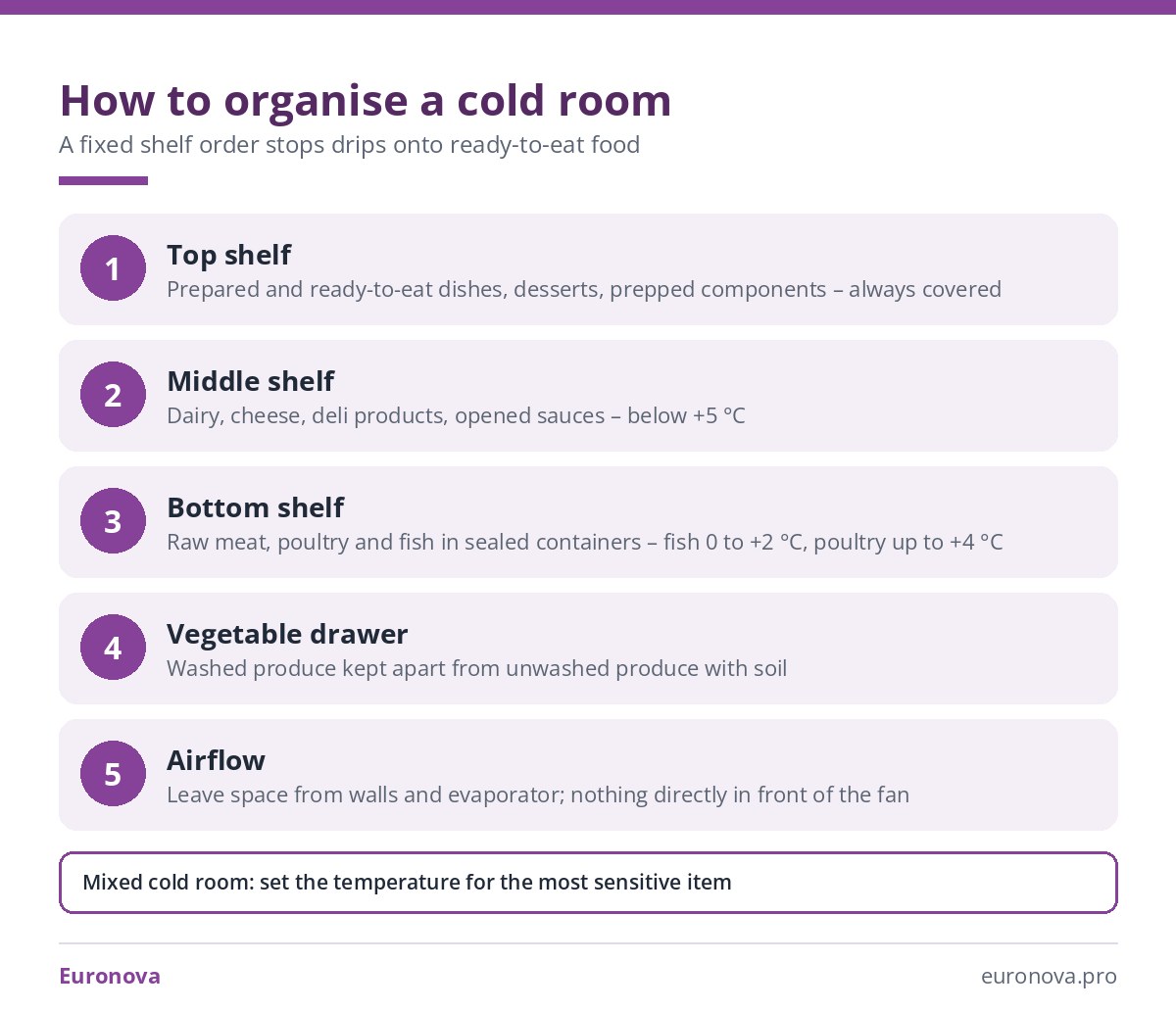
A fixed shelf order stops meat juices or condensation from dripping onto ready-to-eat food. In practice, this layout has proven itself:
- Top: prepared and ready-to-eat dishes, desserts, prepped components. Always covered so they do not dry out or absorb odours.
- Middle: dairy products, cheese, deli products, opened sauces.
- Bottom: raw meat, poultry and fish in their own sealed containers, so nothing leaks down or sideways.
- Vegetable drawer or dedicated shelf: washed fruit and vegetables, kept apart from unwashed produce that still carries soil.
Pay attention to airflow as well. A cold room packed to the last centimetre cools unevenly because cold air cannot circulate. Leave space from the walls and the evaporator, and do not place containers directly in front of the fan.
Cooling, hot holding and the cold chain
Critical moments rarely occur in the store itself, but before and after it: when receiving goods, when cooling freshly cooked food and during service.
Receiving deliveries
Check chilled goods immediately on delivery and put them away without delay. Cartons of yoghurt left standing in the corridor for half an hour have already broken the cold chain. The German Federal Institute for Risk Assessment BfR stresses that breaks in the cold chain must be avoided above all for food that is easily recontaminated after heat treatment, such as cold cuts or soft cheeses.
Cooling cooked food
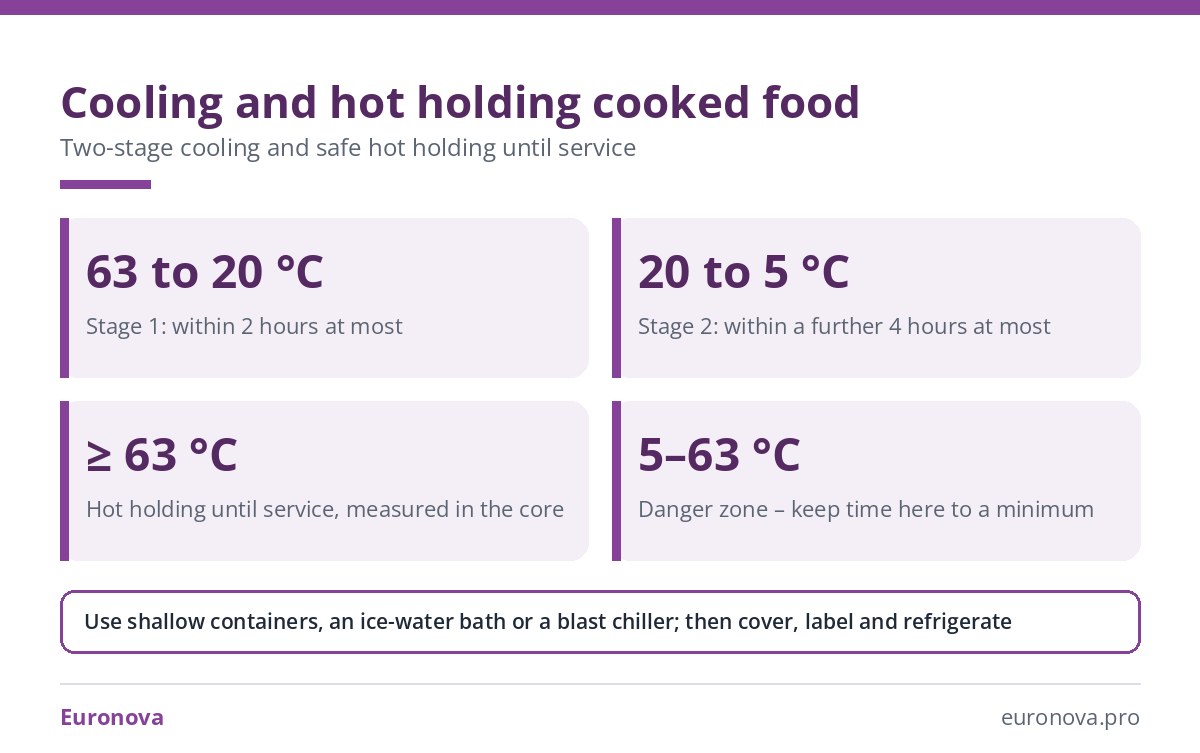
Anything you are going to store after cooking must be cooled quickly. Food hygiene guidance recommends two-stage cooling: from 63 °C to 20 °C within two hours at most, then from 20 °C to 5 °C within a further four hours at most. A rapid cooling unit is named as the better option. A large pot of goulash cannot manage this in the cold room on its own. These steps help:
- Divide the food into shallow containers. A low fill height releases heat much faster than a deep pot.
- Pre-cool the containers in an ice-water bath or a blast chiller.
- Only then place them in the fridge, covered, labelled and dated.
Hot holding until service
For buffets, banquets and serving counters, the opposite applies. Hygiene guidance requires a temperature of at least 63 °C for potentially hazardous food that has been cooked and is not served immediately. So measure in the core of the food, not just at the edge, and plan with a slightly higher value as a safety margin. If you are unsure how long a particular dish may be held hot, define it in your HACCP system.
FIFO, labels and clear date marking
An orderly store is not an end in itself. In its factsheet for caterers and kitchen staff, the German Environment Agency (Umweltbundesamt) recommends storing goods systematically according to the FIFO principle (First In, First Out) and shows that well-organised storage helps use food completely and waste less.
This is how to put FIFO into practice every day:
- New stock at the back or bottom, older stock at the front. Whoever puts deliveries away moves existing stock forward first.
- Uniform labels: product, date of preparation or opening, use-by date, staff initials. A colour code for each day of the week makes them even quicker to read.
- Label frozen food: food you portion and freeze yourself should carry a label with the freezing date.
- Fixed locations: every product group has its own place. New staff find their way immediately, and gaps in stock are spotted sooner.
The system pays off especially before holidays and festive menus, when a lot is prepared in advance: plan early, portion, label and use up in the order in which you prepared.
“Best before” and “use by”
These two labels on packaging are often confused, even though they mean different things. Under Regulation (EU) No 1169/2011 on the provision of food information to consumers, almost every prepacked food must carry one of the two dates.
- Date of minimum durability (“best before”): until this date, and if stored correctly, the manufacturer guarantees properties such as taste, colour and texture. After this date the product is not automatically spoiled.
- Use-by date (“use by”): mandatory for microbiologically highly perishable prepacked food, such as minced meat or poultry. After this date the food must no longer be used.
In food service there is an extra rule: once the pack is opened, the date printed on it no longer applies. From then on, your own label with the opening date decides how long the product may still be used. Define these times for each food group together with your team, write them down and display the list where everyone can see it in the kitchen.
Monitoring and recording temperatures
Correct settings only help if they are actually maintained. Regulation (EC) No 852/2004 and your HACCP system require chilling temperatures to be monitored and recorded regularly. A practical routine:
- Fixed times: read all refrigeration and freezing units at least once a day, ideally at the start and end of each shift.
- Your own thermometer: the unit's display often measures only the air near the sensor. A calibrated probe thermometer shows how cold the goods really are.
- Log sheet next to the unit: date, time, reading, initials. Paper on a clipboard or a digital solution – what matters is that there are no gaps.
- Record deviations: what happened and what did you do? Goods moved, technician called, product discarded.
- Review regularly: if you check the logs once a month, you will spot a unit that is struggling before it fails.
These records are not just for the inspector. Every spoiled carton shows up in your food costs. Up-to-date temperature logs and a well-organised store are the two simplest levers for controlling food costs.
The right containers for storage and service
Good storage starts with the container. It must seal tightly, be easy to clean, stack well and fit shelves, refrigerated counters and serving stations. That is why the Gastronorm system has become the standard in commercial kitchens: containers in standardised sizes such as 1/1, 1/2 or 1/3 go from the cold room through the combi oven to the buffet without transferring the food. Every transfer you save means less handling, less time outside refrigeration and less washing up.
Also important for storage:
- Shallow containers for cooling cooked food quickly.
- Lids or cling film for everything that would otherwise sit uncovered in the cold room.
- Food-grade paper for cheese, cold cuts and pastries that need to breathe.
- Small portion pots with lids for sauces, dips and prepped components, which then stay separate and labelled.
At Euronova you will find everything you need for organised storage and service: porcelain GN 1/1 containers, plus the matching GN 1/2 and GN 1/3 sizes, which can go straight from the cold room to the buffet.

For covering and wrapping, see our range of cling film and food-grade paper; for portions and dips, finger food pots with lids; and if you offer takeaway, you will find suitable takeaway food packaging. Browse the full range for the kitchen, store room and front of house in the Euronova catering equipment online shop.
Our view: an orderly store is a question of equipment
When we talk to head chefs, hotel purchasers and kitchen managers in schools or care homes, the question is rarely whether they know the rules. The temperatures hang on the wall in almost every kitchen. It gets difficult in everyday work, when service is in full swing at noon and nobody has time to decant a pot or hunt for a container without a lid.
That is why we are convinced that good storage starts with equipment. If you have enough containers in uniform sizes, with matching lids, film and labels in a fixed place, the right move becomes the easiest one. A Gastronorm system that runs from the cold room to the pass saves steps, washing up and arguments in the team.
Our advice: walk through your store once with fresh eyes. Where is something standing open, where is a lid missing, where do you decant only because the container does not fit? That is exactly where the investment pays off. With expert articles and a range that runs from kitchen containers through food storage to buffet equipment, we want to make exactly this purchasing easier for you.
— Rok
Food storage FAQ
What temperature should a commercial fridge be?
It depends on what is inside. Keep potentially hazardous chilled food below 5 °C, fresh fish at 0 to 2 °C, poultry and minced meat at up to 4 °C, and frozen food at -18 °C or colder. If the fridge holds mixed foods, set the temperature for the most sensitive item.
Can I use food after its best-before date?
Unopened goods are not automatically spoiled after this date, but you must check them carefully before use. Once a pack is opened, the printed date no longer applies and your own opening date counts. Food with a use-by date, such as minced meat, must not be used after that day.
How quickly must cooked food be cooled?
Food hygiene guidance recommends cooling from 63 °C to 20 °C within two hours at most, then to 5 °C within a further four hours at most. The easiest way is to use shallow containers, an ice-water bath or a blast chiller. Then cover, label and place the food in the fridge.
How often must fridge and freezer temperatures be checked?
Chilling temperatures must be monitored and recorded regularly. At least one reading a day has proven effective, and many kitchens check at the start and end of every shift. Set the exact frequency in your HACCP system.
Where should raw meat be stored in a cold room?
Raw meat, poultry and fish belong in sealed containers on the bottom shelf, separate from prepared food. This way meat juices cannot drip onto ready-to-eat food. Prepared dishes go covered on the upper shelves.
Sources
- NIJZ (Slovenian National Institute of Public Health): Basic hygiene guidance
- Regulation (EU) No 1169/2011 on the provision of food information to consumers
- VDMA: Merkblatt Kühl- und Tiefkühlräume
- BfR: Schutz vor lebensmittelbedingten Erkrankungen beim Heißhalten von Speisen
- Umweltbundesamt: Modern storage for caterers and kitchen staff