Choosing Restaurant Cutlery: A Set That Lasts for Years
Choosing Restaurant Cutlery: A Set That Lasts for Years

You choose good restaurant cutlery in four steps: start with the menu (which dishes you serve and in how many courses), then the material (stainless steel with a clear grade marking, most often 18/10 front of house and harder steel for knife blades), durability (thickness, balance, knife construction) and finally the number of pieces, with a reserve for items circulating through the dishwashing area. Below we go through each step the way we do with owners fitting out their dining room: with a table of the basic set, a sample quantity calculation and the washing rules that keep stainless steel shining for years.
Key points
- Start with the menu: a bistro is covered by the basic set, while a restaurant with a tasting menu needs a few extra pieces.
- For the dining room, choose stainless steel with the grade marked on the handle. 18/10 offers the best shine and resistance to acidic food; 18/0 is cheaper and performs well in high-turnover venues.
- You can recognise durability by the thickness of the handle, the balance in the hand and the knife construction – not just by the price of the set.
- Calculate cutlery per seat, not per table, and add a reserve for the time part of the sets is in the dishwasher.
- Wash, rinse and dry immediately after the cycle. Stains and discolouration are usually caused by moisture and food residue left on the cutlery.
Contents
- Which cutlery a restaurant really needs
- Stainless steel: what 18/10, 18/0 and 13/0 mean
- How to assess durability before you buy
- Steak knives: blade, handle and durability
- Serving utensils and buffet service
- How much cutlery to buy: a sample calculation
- Washing and care: how to prevent stains and discolouration
- How we choose cutlery for venues
- Cutlery and dining room equipment in one order
- Restaurant cutlery FAQ
- Sources
Which cutlery a restaurant really needs
A guest at an ordinary lunch does not need a row of forks on both sides of the plate. They need a set that matches what is on the plate. That is why we start the shopping list with the menu, not with the catalogue.
Almost every venue is built on five pieces: table knife, table fork, table spoon, teaspoon for coffee and tea, and a dessert set (dessert fork or dessert spoon). Everything else follows from the menu and the style of service.
| Type of venue | Basic set | Worth adding |
|---|---|---|
| Bistro, lunch restaurant, canteen | knife, fork, table spoon, teaspoon | sturdier soup spoon, more teaspoons for drinks |
| À la carte restaurant | knife, fork, spoon, teaspoon, dessert set | steak knives, fish cutlery, cream soup spoons |
| Steakhouse, grill | table knife and fork, teaspoon | sharp steak knives, larger meat forks |
| Pizzeria | table knife and fork, teaspoon | serrated pizza knives, pasta spoons |
| Café, patisserie | teaspoons, dessert forks | long spoons for lattes and sundaes |
| Hotel with breakfast buffet | full table and dessert set | serving utensils, ladles, tongs |
Two things are easy to overlook. First, spoons differ in depth: a deeper one works for soups and dishes with sauce, a shallower one for desserts and creams. Second, in a venue serving dishes from several cuisines, it is better to have one coordinated design line in several sizes than a mix of sets. A uniform pattern also makes ordering replacement pieces easier.
It is a good idea to match the style of cutlery to the tableware. Heavy, matt cutlery suits stoneware and rustic plates, while slim, polished cutlery goes with white porcelain and elegant interiors. If you are fitting out a dining room from scratch, choose cutlery together with the plates, because only side by side can you see whether the proportions work.
Stainless steel: what 18/10, 18/0 and 13/0 mean
Catering cutlery is almost exclusively made of stainless steel. The differences start with the composition, which is revealed by the marking usually stamped on the back of the handle. The first number gives the chromium content, the second the nickel content.
- 18/10. Steel with added nickel, which gives it a bright, deep shine and makes it better at handling contact with acidic food, vinegar or lemon. A good choice for à la carte restaurants, hotels and anywhere cutlery is part of the venue's image.
- 18/0. Nickel-free steel. It is magnetic, usually cheaper and still stainless, though less resistant to acids than 18/10. It performs well in canteens, quick-service venues and catering, where the price of the set matters across large quantities.
- 13/0 and similar hardened grades. Knife blades are usually made from this type of steel because it can be hardened, and a hard blade holds its edge longer. That is why a knife from an 18/10 set often has a blade made from a different steel grade than the handle. This is normal and indicates well-thought-out construction.
Cutlery without a marking is a warning sign. If the manufacturer does not state the steel grade, you do not know how the cutlery will behave after a few hundred dishwasher cycles.
Cutlery is a food contact material, so it must comply with Regulation (EC) No 1935/2004. If you buy from a supplier operating in the EU, you can request a declaration of compliance and have this question settled on their side.
How to assess durability before you buy
Restaurant cutlery goes through the dishwasher several times a day, lands in baskets, falls on the floor and ends up in containers with other metal objects. A set that looks great in the catalogue can be bent and dull after six months. Before you order the full quantity, take a sample in your hand and check a few things.
- Thickness and rigidity. Try gently bending a fork where the handle meets the tines. Good catering cutlery does not bend under hand pressure. Thin sheet metal is the main reason for bent forks after a few weeks.
- Balance. Rest the piece on your finger and find the balance point. In tests by America's Test Kitchen, cutlery whose centre of gravity was not too close to the head proved more comfortable, as it did not tip forward in the hand. Guests will not name it, but they will feel it.
- Edge finish. Run a finger along the edges and between the fork tines. Sharp burrs and uneven grinding are where dirt collects and corrosion starts.
- Knife construction. A knife made from one piece of metal has no joint where water can collect. If the handle is joined to the blade, the joint must be even and tight.
- Surface. A mirror polish is elegant but shows every scratch. A satin finish hides the marks of everyday use better, which matters under heavy use.
- Availability of replacements. Check whether the pattern is permanently in stock. Cutlery goes missing, and topping up a few dozen pieces of the same model after a year saves replacing the entire set.
Steak knives: blade, handle and durability
If steak, bone-in chops or ribs are on the menu, an ordinary table knife is not enough. A guest who has to saw through meat with a blunt knife will remember it more than the taste of the sauce. A steak knife is an investment in how the dish is perceived.
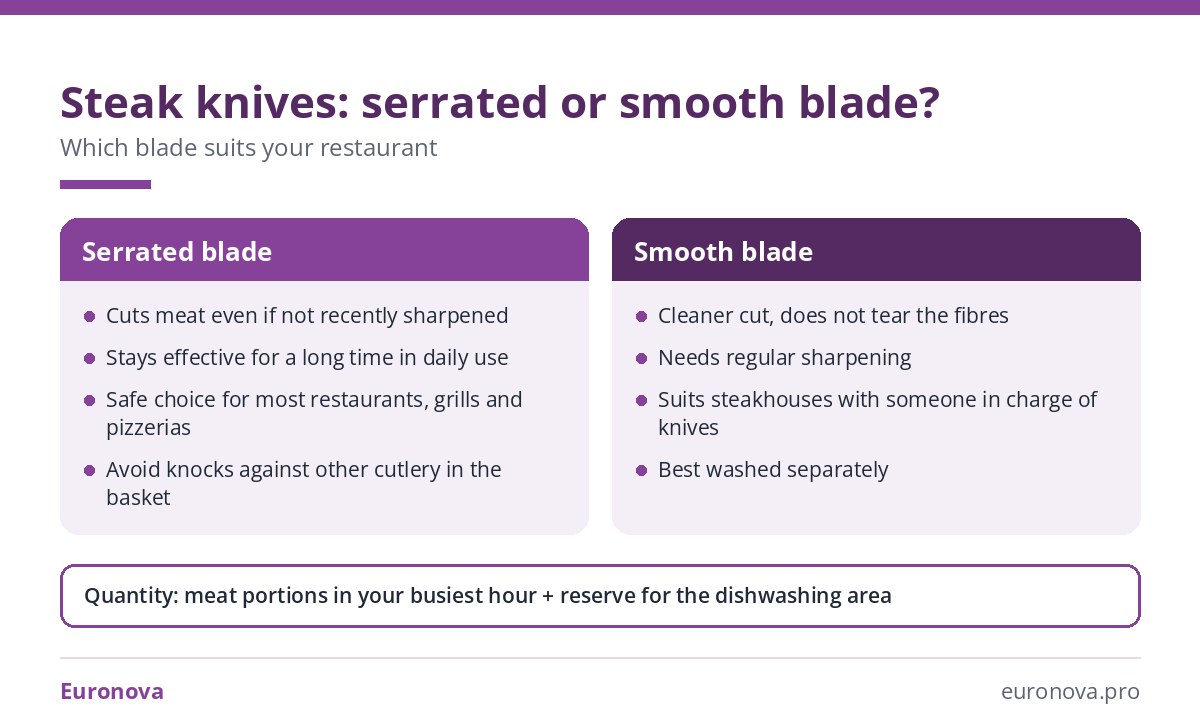
Serrated or smooth blade? A serrated blade cuts meat regardless of whether anyone has sharpened it recently and stays effective for a long time in everyday use. It is the safe choice for most restaurants, grills and pizzerias. A smooth blade gives a cleaner cut and does not tear the fibres, but needs regular sharpening, so it suits steakhouses where someone on the team is responsible for the knives.
Handle. A steel handle forms one design line with the rest of the set and stands up best to the dishwasher. Plastic or wooden handles give a warmer, more rustic character, but check whether the manufacturer allows machine washing.
Size and weight. A steak knife is usually heavier and longer than a table knife, and its blade has a pronounced point. Match it to the plate: on a large flat plate such as the Nacrous Gourmet 30 cm plate, a longer knife sits in proportion and does not slip off the rim.
How many steak knives should you buy? Count as many as the meat portions you can send out in your busiest hour, and add a reserve for circulation through the dishwashing area. They do not need to be laid at every cover; serve them together with the dish.
Serving utensils and buffet service
A hotel buffet, a guesthouse breakfast or wedding catering need a completely different set from a dining room with table service. Serving utensils work longer, in hot food and in many hands, so they must be sturdy and longer than table cutlery.
The basic buffet set:
- solid and slotted serving spoons (for dishes with sauce and for vegetables from water),
- serving forks for meat and cold cuts,
- soup ladles,
- tongs for bread, salads and pastries,
- cake and gratin servers,
- cheese and butter knives.
Count one utensil for each dish and at least one spare for every few dishes, because spoons fall into the containers and need changing during service. At the station with clean cutlery for guests, a deep GN container works well, for example a GN 1/4 container, 200 mm deep: the cutlery stands upright with the handles up, so guests do not touch the parts that go into the mouth.
How much cutlery to buy: a sample calculation
The most common mistake when opening a venue is buying sets for exactly the number of seats. In practice, at any moment part of the cutlery is on the tables, part is waiting to be washed and part is drying after the cycle.
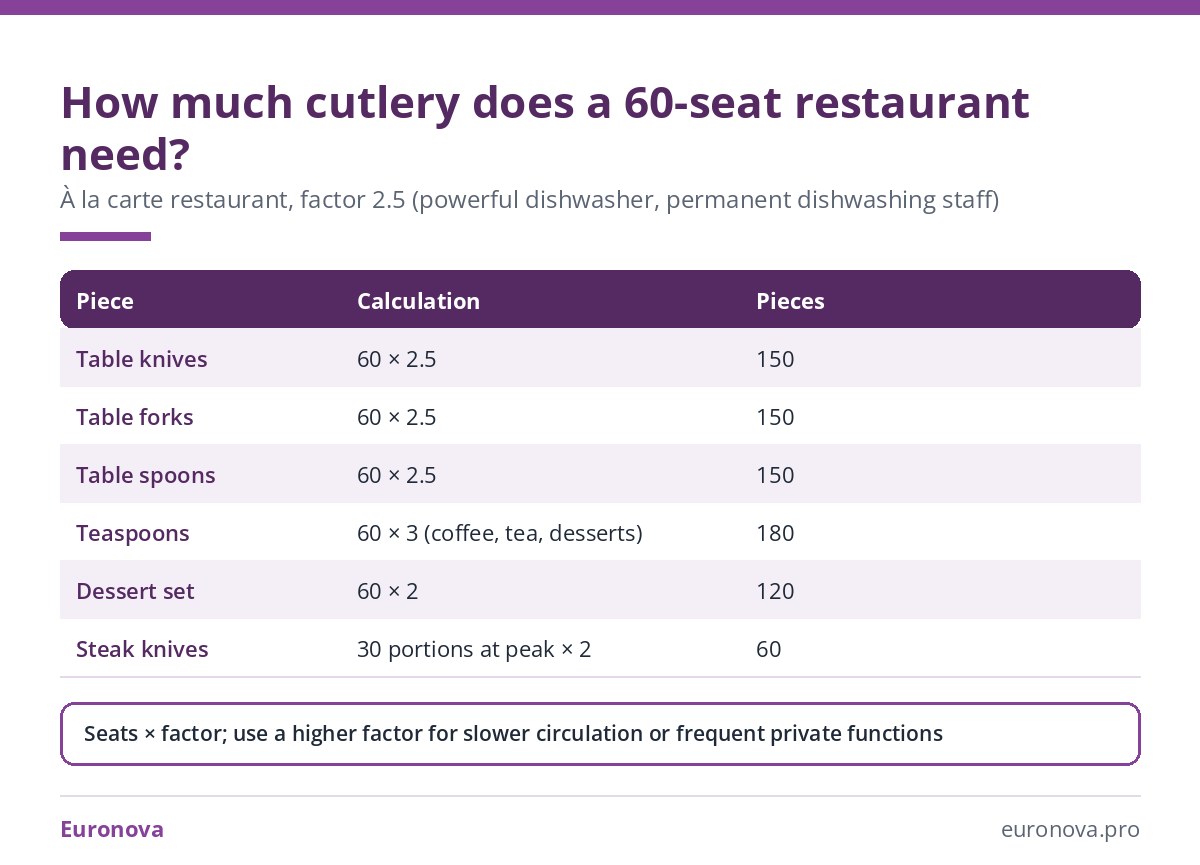
Use a simple model: the number of seats multiplied by a factor that depends on how fast you wash. In the example below we use a factor of 2.5, suitable for a venue with a powerful dishwasher and permanent staff in the dishwashing area. With slower circulation or frequent private functions, use a higher one.
Example for a 60-seat à la carte restaurant, with a factor of 2.5:
| Piece | Calculation | Number of pieces |
|---|---|---|
| Table knives | 60 × 2.5 | 150 |
| Table forks | 60 × 2.5 | 150 |
| Table spoons | 60 × 2.5 | 150 |
| Teaspoons | 60 × 3 (coffee, tea, desserts) | 180 |
| Dessert set | 60 × 2 | 120 |
| Steak knives | 30 portions at peak × 2 | 60 |
This is a starting point, not a norm. After the first month, check which pieces run out at peak times and which stay in the drawer, and top up what is really missing. Also add a few per cent as a reserve for losses: cutlery ends up in bins, leaves with guests and gets lost at functions.
Washing and care: how to prevent stains and discolouration
Stainless steel does not mean steel that nothing can harm. Most cutlery problems in restaurants come from what happens between the table and the drawer.
- Do not leave residue for long. Salt, vinegar, mustard and tomato sauces left on cutlery for hours can cause discolouration and pitting corrosion. Soak cutlery in water as soon as it is cleared from the table.
- Load the basket loosely. Tightly packed cutlery does not get washed where pieces touch. In the cutlery basket, handles go down and spoons should not nest inside each other.
- Match the chemicals to the water. Hard water leaves white marks. The right detergent, rinse aid and regular descaling of the dishwasher are the basics. Set the dosing with your chemical supplier, as it depends on the water hardness in your area.
- Dry and polish immediately. Wipe cutlery taken from the dishwasher with a clean, dry cloth while it is still warm. Droplets left to dry on their own leave marks.
- React to the first signs of rust. Isolated rust spots on stainless steel are often deposits from other items, not a fault in the cutlery. Remove them with a mild stainless steel cleaner and check what else goes into the same cycle.
Smooth-bladed steak knives are best washed separately and sharpened regularly. Serrated blades do not need sharpening for a long time, but they do not like knocking against other cutlery in the basket either.
How we choose cutlery for venues
From our point of view, the best cutlery set is the one nobody in the dining room notices, because it simply works: it sits well in the hand, cuts, does not bend and after a year looks almost the same as on opening day. That is why we always advise starting with the menu and the actual pace of the dishwashing area, and only then choosing the pattern.
We also see that venues buying cutlery together with tableware, glasses and GN containers achieve a coordinated dining room faster and find it easier to replace missing items. One place to buy means one list of models to reorder, instead of hunting for matching forks across several suppliers. We put together this kind of range for restaurants, hotels, cafés and catering companies, and wholesale prices make it possible to equip a dining room without compromising on steel quality.
In our opinion it makes sense to plan for a reserve from the start. A few dozen extra sets in the store room cost less than one evening of waiters waiting for washed forks.
— Rok
Cutlery and dining room equipment in one order
At Euronova you will find table cutlery and serving utensils alongside porcelain, glassware, disposables, kitchen cookware and catering appliances. You can put together the place settings for your entire dining room in one order and top up missing items in the same shop. For events, you can also hire cutlery.

Browse the cutlery category and current offers in the Euronova catering equipment online shop and choose the set for your menu.
Restaurant cutlery FAQ
Which cutlery should a new restaurant start with?
To start with, a knife, fork and table spoon, a teaspoon and a dessert set are enough, all from one design line. Add extra pieces such as steak knives or fish cutlery when your menu calls for them. Choose a pattern that is permanently in stock so you can replace missing pieces.
Is 18/0 stainless steel suitable for catering?
Yes, 18/0 steel is stainless and performs well in canteens, bars and catering, where the price per piece matters across large quantities. It is less resistant to acidic food than 18/10 and has a slightly duller shine. With careful washing and drying it will last a long time.
Can restaurant cutlery go in the dishwasher?
Stainless steel catering cutlery is designed for machine washing. Models with wooden or some plastic handles may be an exception, so check the manufacturer's recommendations. The key is removing food residue quickly, using the right chemicals and drying after the cycle.
Serrated or smooth steak knife?
A serrated knife cuts effectively for a long time without sharpening, which makes it practical for most restaurants. A smooth blade gives a cleaner cut through meat but needs regular sharpening. Choose smooth if someone on your team looks after the knives.
Sources
- Regulation (EC) No 1935/2004 on materials and articles intended to come into contact with food
- America's Test Kitchen: The Best Flatware Sets