HACCP in Food Service: Principles, Records and Food Safety Inspections
HACCP in Food Service: Principles, Records and Food Safety Inspections

HACCP in food service is a mandatory system. In it, you define what in your kitchen could harm a guest, where and how you control it, and you record the results. It applies to every restaurant, bar, café, pizzeria, hotel with a kitchen and catering company, as well as to school, nursery and care home kitchens. You do not need a certificate or an expensive consultancy for this. You need well-described procedures, people who know them, equipment that lets you follow them, and reliable records. Below we explain how to set all this up step by step.
Key points
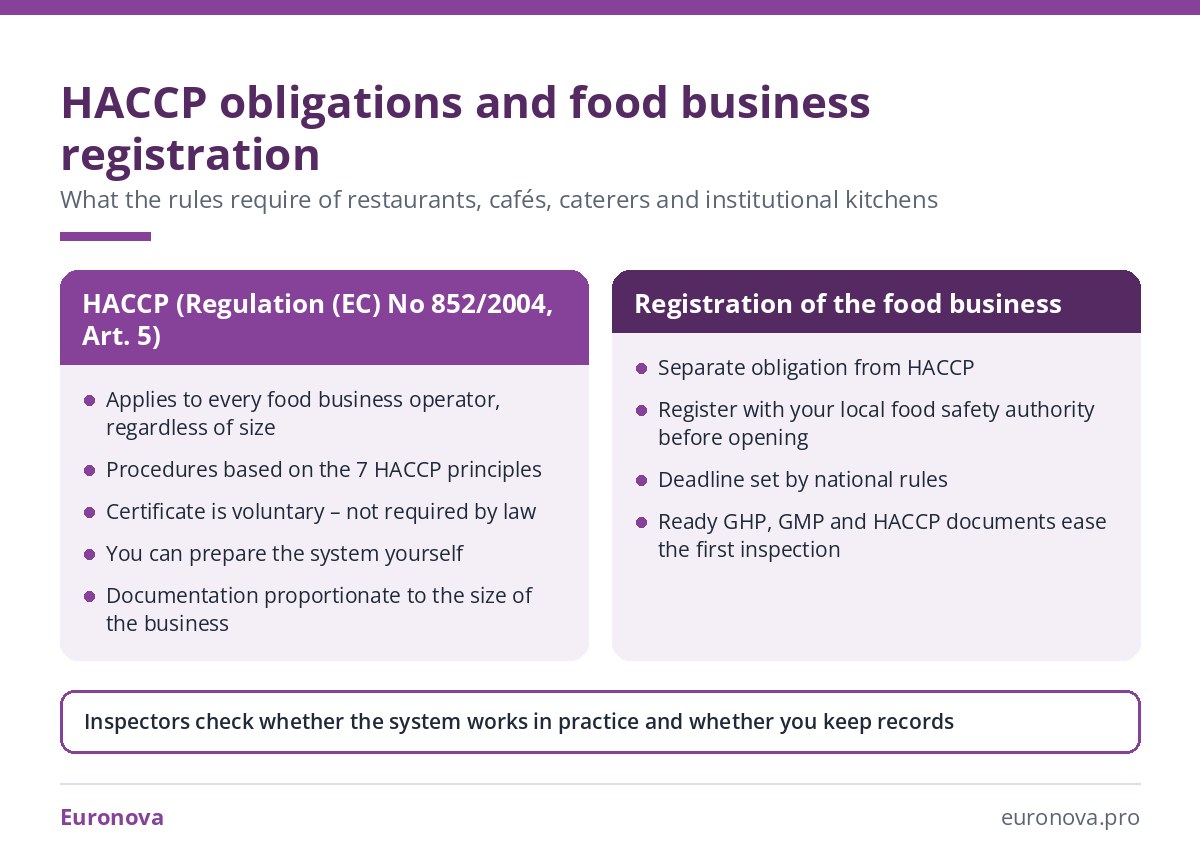
- HACCP stands for Hazard Analysis and Critical Control Points. Article 5 of Regulation (EC) No 852/2004 requires it of all food business operators, including food service businesses.
- A HACCP certificate is voluntary. The inspector checks whether the system works in practice and whether you keep records, not whether there is a diploma on the wall.
- The foundation is good hygiene practice (GHP) and good manufacturing practice (GMP). The HACCP plan is built on top of them following seven principles.
- Documentation should be proportionate to the size of the venue: a small café does not need a folder the size of a meat processing plant's.
- The right equipment – GN containers with lids, thermometers, separate chopping boards and knives – makes it easier to follow procedures every day.
Contents
- What is HACCP and what is it for in a restaurant
- Who must comply with HACCP and on what legal basis
- GHP and GMP: the foundation of a HACCP plan
- The seven HACCP principles in a real kitchen
- How to implement HACCP step by step
- Which HACCP records to keep
- Monitoring, deviations and corrective actions
- What the inspector checks
- Equipment that makes HACCP compliance easier
- Our view on HACCP
- HACCP in food service FAQ
- Sources
What is HACCP and what is it for in a restaurant
HACCP stands for Hazard Analysis and Critical Control Points. It is a food control system designed to ensure food safety by continuously monitoring biological, chemical and physical hazards during production, storage and distribution.
In everyday restaurant practice, these three groups of hazards look like this:
- Biological: bacteria, viruses and parasites, for example salmonella in incorrectly stored eggs or micro-organisms multiplying in soup that cools for too long in a large pot.
- Chemical: detergent residues on tableware, incorrectly labelled allergens, food in contact with a material not intended for it.
- Physical: glass splinters, pieces of packaging, fragments of chipped tableware, metal filings from worn tools.
The key difference from the old approach: instead of checking the finished dish at the end, you watch over every stage of its preparation. The system aims to eliminate the causes of hazards right where they arise. For a chef, this means concrete questions at every stage of work: when receiving deliveries, in the cold room, at the cutting station, during cooking, service and transport.
Who must comply with HACCP and on what legal basis
The obligation to put in place procedures based on the HACCP principles comes from Article 5 of Regulation (EC) No 852/2004 on the hygiene of foodstuffs. It applies to every food business operator that produces, processes or distributes food. In food service, that means restaurants, bars, pizzerias, cafés, patisseries, food trucks, catering companies, hotel kitchens and the kitchens and dining halls of institutions: schools, nurseries and care homes.
The food business operator, or a person they authorise, is responsible for implementation. You can prepare the system yourself; certification by external organisations or consultancies is voluntary. If someone offers you a "mandatory HACCP certificate for your restaurant", they are selling something the rules do not require.
HACCP is one thing, registering your venue is another. Before you open a bar, café or food truck, you must register the food business with your local food safety authority within the deadline set by national rules. Having your GHP, GMP and HACCP documentation ready also makes the first inspection easier.
GHP and GMP: the foundation of a HACCP plan
A HACCP plan does not work in a vacuum. It is based on prerequisite programmes known as good hygiene practice (GHP) and good manufacturing practice (GMP). This is the everyday hygiene of the kitchen, without which no control point makes sense. Sector guides to good hygiene practice are also available for food service and are a useful aid when writing your own instructions.
GHP covers, among other things:
- cleaning and disinfecting surfaces, equipment and tableware to a schedule,
- staff personal hygiene: handwashing, workwear, what to do in case of illness,
- a water supply that meets the requirements,
- pest control,
- waste management.
GMP concerns how you organise work with food:
- receiving deliveries and supplier control,
- storing raw materials and semi-finished products separately by group,
- separating dirty and clean areas, raw and prepared food,
- labelling containers with contents and preparation date,
- allergen management.
In its guidance on food safety management systems, the European Commission stresses that implementation can be flexible: in some cases good hygiene practice can replace the monitoring of critical control points. For a small venue with a simple menu this is good news, as solid GHP and GMP do much of the work.
The seven HACCP principles in a real kitchen
The HACCP system is based on seven principles. This is what each looks like in an ordinary restaurant kitchen.
- Hazard analysis. Map the route of each dish group from delivery to plate and ask at each stage what could go wrong. Example: poultry accepted at the wrong temperature, stored above salad vegetables, cut on the same board as tomatoes.
- Identifying critical control points (CCPs). These are the stages where you can eliminate a hazard or reduce it to a safe level and after which there is no other opportunity. Typical CCPs in food service are cooking, cooling dishes prepared in advance and keeping food at temperature during service.
- Setting critical limits. Each CCP gets a measurable limit: temperature, time or both. Take the limits from the good hygiene practice guides for your sector, from national public health and food safety guidance, and from the instructions of food and equipment manufacturers. Slovenian public health guidance (NIJZ), for example, sets at least 63 °C for hot holding and cooling from 63 °C to 20 °C within two hours at most.
- Monitoring. Define who measures, with what and how often. For example: the chef on shift checks the core temperature of every batch of roast meat with a probe thermometer and enters the result on the form.
- Corrective actions. Write down in advance what you will do when a reading exceeds the limit: reheat, extend cooking, discard the batch, call the refrigeration technician.
- Verification. Check periodically that the system really works: review the records, check thermometer calibration, talk to the team.
- Documentation and records. Keep documents and records proportionate to the nature and size of the business.
Examples of control points in a restaurant
| Stage | Hazard | What you monitor | With what | What to do if there is a deviation |
|---|---|---|---|---|
| Receiving deliveries | bacterial growth, damaged packaging | temperature of chilled products, packaging condition, dates | thermometer, visual check | reject the delivery, notify the supplier |
| Cold room storage | bacterial growth, cross-contamination | unit temperature, separation of raw and prepared food, container labelling | unit thermometer, labels | move the food, assess fitness for use, service |
| Cooking | survival of micro-organisms | core temperature of the product | probe thermometer | continue cooking until the limit is reached |
| Cooling | bacterial growth | cooling time and temperature | thermometer, time record | discard the batch, change the cooling method |
| Hot holding during service | bacterial growth | temperature in the bain-marie or food warmer | thermometer | reheat or withdraw the dish |
| Catering transport | temperature change | temperature at dispatch and on arrival, transport time | thermometer, transport sheet | change the container, withdraw the batch |
Enter the limits for each row in your plan, in line with the guidance for your sector. The table shows the logic, not ready-made values for every venue.
How to implement HACCP step by step
Implementation is similar in a restaurant, hotel, catering business or institutional kitchen. It differs in scope and the number of processes.
- Appoint a responsible person. In a small venue this is usually the owner or head chef. In a hotel or larger catering business it makes sense to form a team: kitchen, purchasing, maintenance.
- Describe the venue and the menu. List the dish groups, raw materials, suppliers, equipment and room layout. Draw a flow diagram: from the delivery door, through the store and cold rooms, to service and the dishwashing area.
- Write the GHP and GMP instructions. Cleaning, disinfection, staff hygiene, storage, allergens, waste, pests. Each instruction should say who does what, with what and how often.
- Carry out the hazard analysis and identify the CCPs. Go through the flow diagram stage by stage and apply the seven principles described above.
- Prepare record forms. Temperature forms, cleaning logs, delivery log, corrective action forms. They can be on paper or electronic.
- Train the team. Everyone must know which records they keep and what to do when something deviates from the norm. Document the training.
- Complete your equipment. Check that you have what you need to carry out the procedures: thermometers, containers with lids, colour-coded boards and knives, equipment for holding temperature.
- Launch the system and review it after a few weeks. Check the records, look for gaps, correct instructions that do not work in practice.
You can keep costs down. You can prepare the system yourself using the good hygiene practice guides for food service and the guidance of your national public health authority. If you prefer outside help, see a consultant as support, not a substitute: your team will work by these procedures every day.
Which HACCP records to keep
Documentation has two parts: what you describe once and update, and what you fill in as you go.
Permanent documents:
- GHP and GMP instructions,
- description of the venue and menu, and flow diagrams,
- hazard analysis with the list of CCPs, limits, monitoring methods and corrective actions,
- list of suppliers,
- training plan.
Ongoing records:
- temperature forms for cold rooms, freezers and hot-holding equipment,
- CCP readings, for example core temperatures of products,
- delivery receipt log,
- cleaning and disinfection log,
- corrective action records,
- verification and inspection reports,
- pest control certificates.
The plan is not a document for ever. The European Commission's 2022 guidance states that the HACCP plan must be updated when production changes. In food service, such a change is a new menu, a new combi oven, starting catering services or a new supplier of a key ingredient.
There is a specific obligation regarding staff. Under Regulation (EC) No 852/2004, the food business operator must ensure that food handlers are supervised and instructed and/or trained in food hygiene matters commensurate with their work activity. Anyone suffering from or carrying a disease transmissible through food must not handle food if there is a risk of contamination, and must report it; whether medical checks are required depends on your national rules. Keep evidence of training and show it to the inspector on request.
Monitoring, deviations and corrective actions
According to the European Commission's guidance, hazards at CCPs are monitored by observation or measurement. For each CCP you plan in advance what to do if the limit is exceeded, and you record the actions taken.
A good corrective action answers three questions:
- What about the food? Can it be brought back to a safe state, or must it be withdrawn?
- What about the cause? A faulty fridge, an overloaded cold room, portions too large to cool, insufficiently trained staff.
- Who decides and who records it? Name or position, date, time, what was done.
Example: in the morning the form shows that the temperature in the dairy fridge has exceeded the limit in your plan. The chef moves the products to another unit, the shift manager assesses whether they are fit for use, reports the fault to the technician and enters everything in the corrective action log. An inspector who sees such an entry knows that the system works.
Verification means checking that all this works. The guidance lists audits of the system and records, on-site checks, checking the calibration of measuring equipment and analysis of deviations. In a restaurant, this means for example a monthly review of temperature forms and regular thermometer checks.
What the inspector checks
Official controls under Regulation (EC) No 852/2004 check whether the food business operator meets the hygiene requirements and applies procedures based on the HACCP principles. Food service businesses are inspected by the food safety inspectors of the competent authority in your country. The inspector usually:
- asks for the GHP, GMP and HACCP documentation and compares it with what they see in the kitchen,
- reviews ongoing records, especially temperatures and corrective actions,
- checks evidence of staff training,
- inspects storage: whether food is covered, labelled and separated,
- assesses the condition of the premises, equipment and tableware,
- asks staff what they would do in a specific situation.
This list also applies to smaller operations, from a food truck to a bar counter at an event. Shortcomings can lead to orders, fines and, in the case of serious risk, a decision prohibiting the business from operating. The best protection is simple: a system that really works and records that prove it.
Equipment that makes HACCP compliance easier
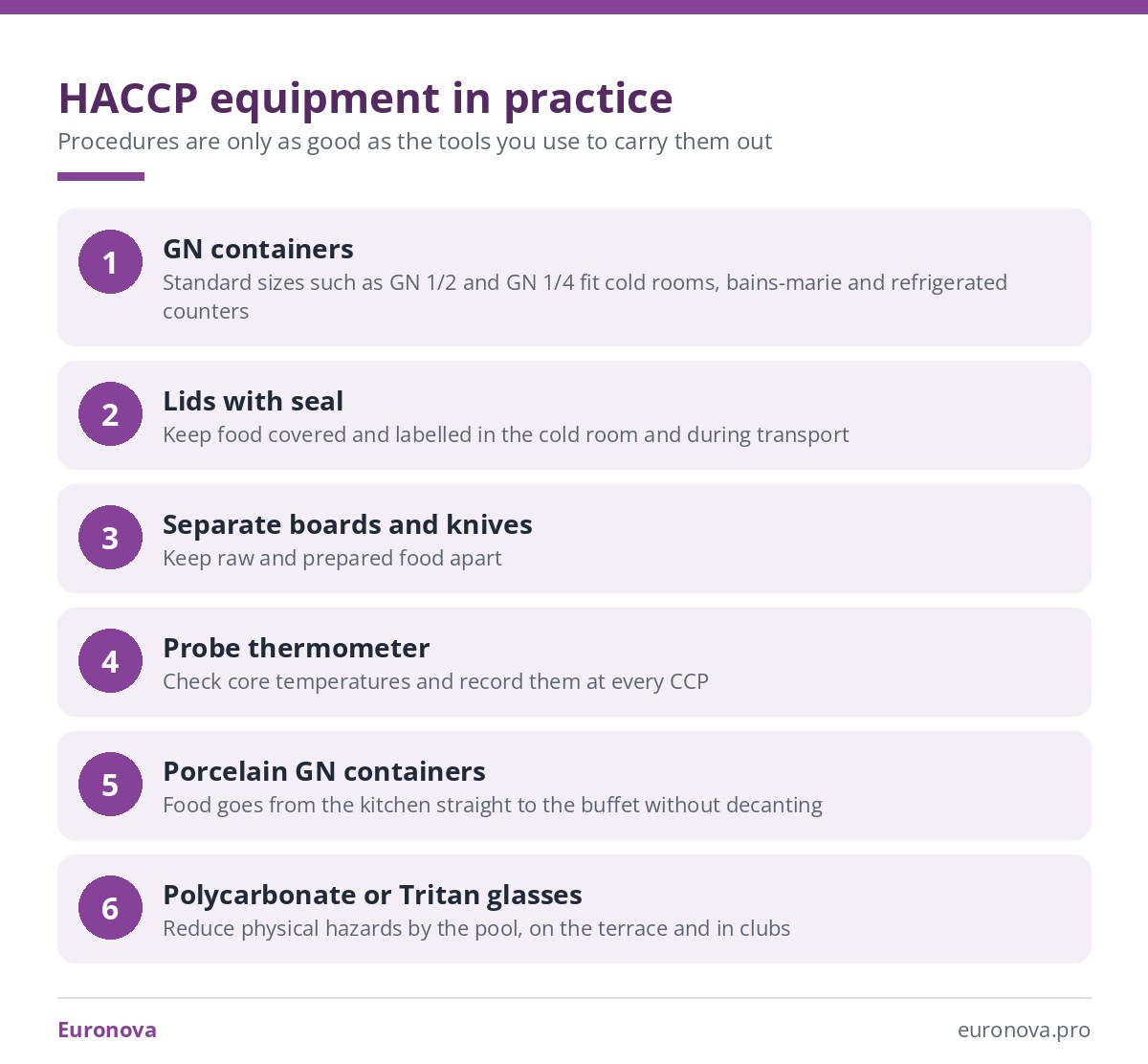
Procedures are only as good as the tools you use to carry them out. The instruction "store food covered and labelled" requires containers with lids. The principle "separate raw from prepared" requires separate boards, knives and space in the cold room. Reducing physical hazards behind the bar and by the pool starts with drinkware that does not shatter into tiny shards.
At Euronova we put together equipment that supports these procedures in daily work. Standardised GN containers, for example a GN 1/2 container, 150 mm deep or a GN 1/4 container, 200 mm deep, fit cold rooms, bains-marie and refrigerated counters. They are complemented by a GN 1/6 lid with seal, which protects the contents in the cold room and during transport. On the buffet, where food goes straight from the kitchen to the guest, a porcelain GN container works well.

In areas where glass breaks easily, such as by the pool, on the terrace or in a club, it makes sense to consider drinkware made from materials such as polycarbonate or Tritan, for example the Prisma polycarbonate glass. You will find the full range, from pots and knives to insulated food boxes for catering, in the Euronova online shop.
Our view on HACCP
Every day we equip restaurants, hotels, catering companies and institutional kitchens. We notice that venues that handle HACCP well have one thing in common: they start in the kitchen, not in the folder.
A procedure that cannot be carried out stays on paper. If the cold room is short of containers with lids, food sits in open bowls. If all the chefs use one board, separating raw from prepared is a fiction. That is why, when implementing HACCP, we advise walking through the kitchen with the plan in hand and asking at every point: what will we do this with?
Well-chosen, standardised equipment simplifies the work. GN containers in one sizing system go from the cold room to the oven and onto the buffet without decanting, which means less contact with food and fewer opportunities for mistakes. That is exactly why we build our range so that both a newly opened venue and a business with years of experience can put everything together in one place and at wholesale prices.
— Rok
HACCP in food service FAQ
Does a small café or food truck need HACCP too?
Yes. The obligation under Regulation (EC) No 852/2004 applies to every food business operator, regardless of size. However, the amount of documentation should be proportionate to the nature and size of the business, and with a simple menu good hygiene practice does much of the work.
Do I need a HACCP certificate?
No. Certification is voluntary. The rules require you to put in place and apply procedures based on the HACCP principles, and the food safety inspector checks on site that they work and that you keep records.
Can I write my own HACCP plan?
Yes. The obligation lies with the food business operator, and you can prepare the system yourself using the good hygiene practice guides for the hospitality sector. What matters is that the documentation describes your venue and your menu, not some random kitchen from a ready-made template.
How often should a HACCP plan be updated?
Every time production changes: a new menu, new equipment, a new process such as takeaway catering. In addition, review the system periodically as part of verification, at least once every few months.
How long should HACCP records be kept?
Set the retention period in your plan, taking into account the shelf life of your products and the guidance for your sector. Records must be available during an inspection, so keep them in an organised place, on paper or electronically.
Sources
- Regulation (EC) No 852/2004 on the hygiene of foodstuffs
- Commission Notice on the implementation of food safety management systems, including HACCP (2022)
- NIJZ (Slovenian National Institute of Public Health): Basic hygiene guidance