How to Choose Commercial Refrigeration for Restaurants and Catering: A Guide
How to Choose Commercial Refrigeration for Restaurants and Catering: A Guide

You choose the right commercial refrigeration for your venue based on your menu, not the catalogue. First decide what you store and at what temperature. Then work out how much of it builds up between two deliveries and where the chef needs it during service. Only at the end check the power supply, the room conditions and servicing. In this guide we go through every step in order: types of equipment, temperature zones, capacity in GN containers, and the requirements for electrics, hygiene and regulations. At the end you get a checklist for your conversation with the supplier.
Key points
- Start with a list of foods and their temperatures. Different food groups need different cooling zones, so one large unit is rarely enough.
- Calculate capacity in GN containers and according to your delivery schedule, not in litres from the brochure. Plan a reserve for weekends, peak season and events.
- Size the cooling capacity for the worst conditions: the hottest day, a hot kitchen, frequent door opening.
- Before buying, compare the available connected load with the consumption of all the equipment in your venue.
- Choose equipment that is easy to clean and has a clearly visible temperature display, and leave work on F-gas equipment to a certified technician.
Contents
- Starting point: menu, deliveries and workflow
- Types of refrigeration equipment in a commercial kitchen
- Storage temperatures: what goes in which zone?
- How to calculate the capacity you need
- Cooling capacity and operating conditions
- Electrics and installation: check before you buy
- Hygiene and HACCP: what the equipment must allow
- Refrigerants and servicing: what the EU rules say
- Checklist before you order
- Our view on refrigeration in food service
- Refrigeration and storage in one place
- FAQ
- Sources
Starting point: menu, deliveries and workflow
Before you start comparing models, answer three questions. They determine how many units you buy, which types and where they will stand.
What do you store? List the food groups: meat and meat products, fish, dairy, vegetables, your own semi-finished products, desserts, drinks, frozen food. A pizzeria needs a lot of space for cheese, sauces and dough balls. A bar chills mainly drinks and ingredients. A catering company must store prepared portions before delivery. A school or care home kitchen works with large batches prepared in one go.
How often do you receive deliveries? A venue with daily deliveries needs less capacity than one that orders twice a week. Calculate with the longest gap between two deliveries, usually the weekend, not with an average day.
Where is the food used during service? This question is most often overlooked, yet it has the biggest impact on how comfortable the work is. Stock can sit in the fridge in the store. But what the chef needs every minute belongs in a refrigerated counter or a refrigerated topping unit right next to the station. Every trip across the kitchen at peak time costs time and means opening the large fridge more often, and therefore a worse temperature inside.
On this basis, draw a simple plan: storage zone, preparation zone, pass and, if needed, a display zone for guests.
Types of refrigeration equipment in a commercial kitchen
Each of the units below has its place in a venue. In practice, most restaurants combine at least three types.
| Equipment | What for | Where it goes | What to look for |
|---|---|---|---|
| Commercial fridge | Storing stock and semi-finished products | Store room, kitchen | GN runners, number of doors, easy-to-clean interior |
| Upright freezer | Frozen food, ice stock, frozen semi-finished products | Store room | Defrosting, seals, ventilation space for the condensing unit |
| Refrigerated counter | Chilled worktop with drawers or doors | Cooking station, pizza station | Height, type of worktop, GN drawers |
| Refrigerated topping unit | Ingredients in GN containers on the counter | Pizzas, salads, sandwiches, burgers | Number and size of containers, lid |
| Blast chiller | Rapid cooling of cooked food | Kitchens that prepare in advance, catering | Capacity per cycle, core temperature probe |
| Cold room | Large stocks, pallets, crates | Hotels, large restaurants, catering, canteens | Condensing unit sized by cooling load calculation, engineering design |
| Refrigerated display case | Displaying cakes, desserts, sandwiches | Cafés, patisseries, buffets | Glass, lighting, temperature with frequent opening |
| Bar and under-counter fridge | Drinks, bar ingredients | Bar, café | Glass or solid doors, height for under-counter installation |
Commercial fridge: the basis of the store
A fridge is the first purchase in almost every kitchen. In professional models, the runners are designed for GN sizes, so food travels in the same container from the fridge to the counter and into the combi oven. A single-door fridge is enough for a small café; a double-door fridge is the typical choice for a restaurant. With two temperature zones, two smaller units pay off more than one large one: if one fails, the whole kitchen does not grind to a halt.
Refrigerated counter and topping unit: cooling where the work is done
A refrigerated counter combines a worktop with chilled storage. Next to the hot line it keeps portions of meat and fish within reach; on the cold line, sauces and vegetables. In a pizzeria, a counter with a refrigerated topping unit for GN containers is the heart of the station: cheese, tomatoes and toppings are to hand, and the dough waits in the drawers below.

Blast chiller: safety when preparing in advance
If you prepare stocks, sauces, goulash or sous-vide meat for several days, hot food must not cool slowly in an ordinary fridge. It warms up the interior and neighbouring food, and itself stays for a long time in the temperature range between 5 and 63 °C, in which bacteria multiply. Food hygiene guidance (for example from Slovenia's NIJZ) says food should be cooled from 63 °C to 20 °C within two hours at most, then to 5 °C within four hours at most. A blast chiller does this in a controlled cycle with a core temperature probe. For catering and large kitchens it is almost indispensable in practice, even if it is not at the top of the shopping list.
Cold room: when fridges are no longer enough
When three or four fridges stand in the store and deliveries arrive in crates and on pallets, it is time to calculate a cold room. Here the choice is an engineering task: it starts with a cooling load calculation, not with an equipment catalogue. The deciding factors are insulation, the quantity and temperature of goods brought in, lighting, people entering the room and the temperature of the space where the condensing unit stands. Such a system is designed and commissioned by a specialist refrigeration company.
Storage temperatures: what goes in which zone?
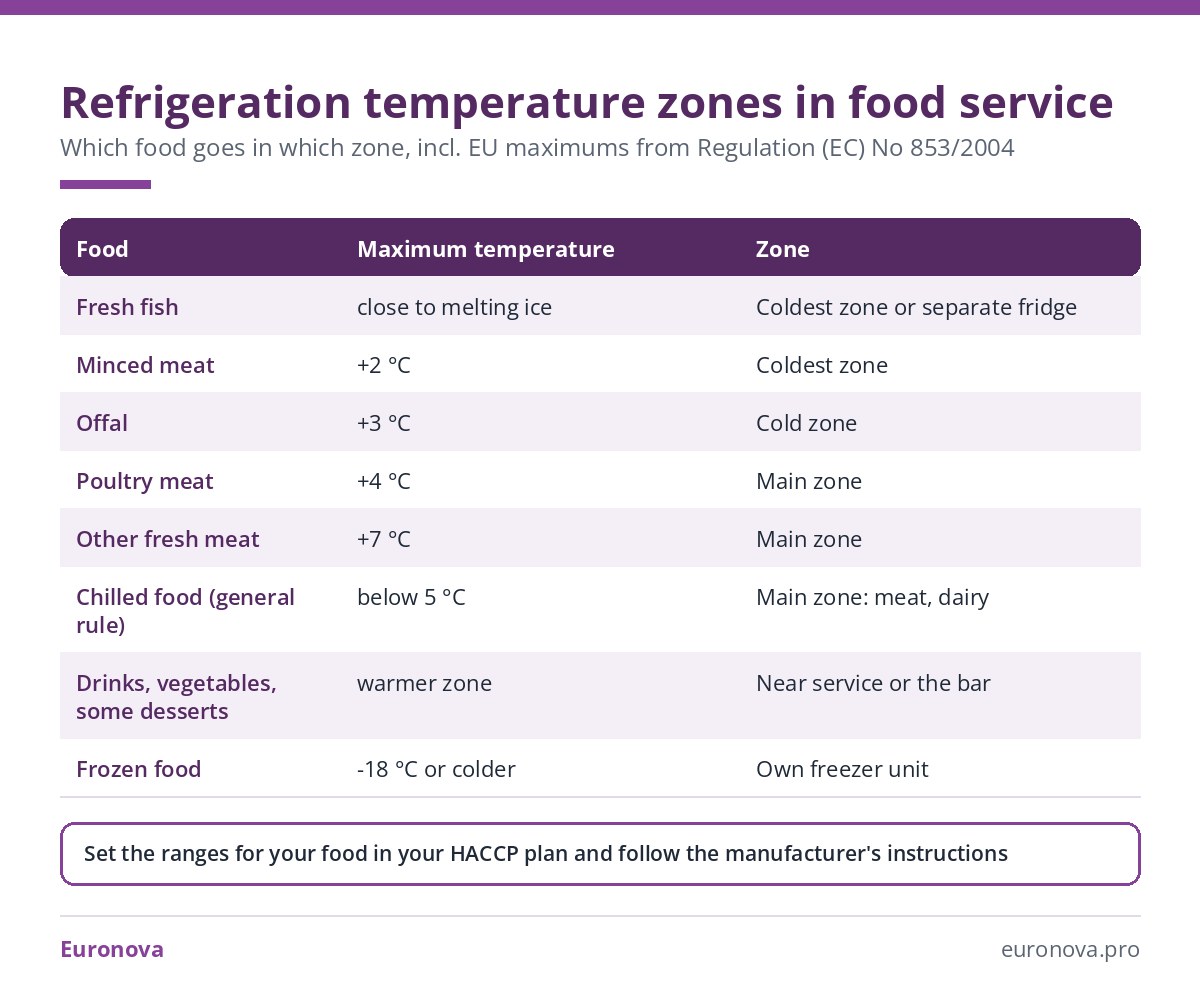
Different foods have different requirements, so the plan of temperature zones matters more than the capacity itself. A common general rule in food hygiene guidance is below 5 °C for chilled food and -18 °C or colder for frozen food. For some foods the limits are stricter.
For certain foods of animal origin, maximum temperatures are set by EU law. Under Regulation (EC) No 853/2004, which applies directly in all EU member states, the limits include: minced meat at most +2 °C, offal at most +3 °C, poultry meat at most +4 °C, other fresh meat at most +7 °C, and fresh fish at a temperature approaching that of melting ice.
What this means for your choice:
- Fish needs the coldest zone. If you serve a lot of fish, a separate fridge or a drawer set colder makes more sense than the bottom shelf of a shared fridge.
- Meat and dairy form the main zone, usually the largest by volume.
- Drinks, vegetables and some desserts can sit in a warmer zone, often closer to service or the bar.
- Frozen food belongs in its own unit, never as a compromise in the fridge.
Always set the temperature ranges for your food on the basis of your HACCP plan and the manufacturer's instructions. If you are unsure about a particular food group, consult a food technologist or your local food safety authority.
How to calculate the capacity you need
Litres on the data sheet say little. A kitchen does not store litres but containers, crates and trays. So calculate in the units you actually work with.
Step by step
- List the food for the longest period between two deliveries, for example from the Friday delivery to Monday.
- Assign a container to each item. Sauces in GN 1/4, portioned meat in shallow GN 1/1, vegetables in deeper GN 1/2.
- Count the containers per temperature zone.
- Convert into levels. One pair of GN 1/1 runners holds one 1/1 container, two 1/2 containers or four 1/4 containers, if the height between runners allows.
- Plan a reserve. Roughly a quarter to a third more than calculated is a reasonable safety margin for peak season, larger orders and goods that arrive early. A fridge filled to the last corner cools worse because air cannot circulate.
Example from a small restaurant
Take a 50-seat venue with a short menu. In the 2–4 °C zone for the weekend you need: 6 shallow GN 1/1 with portioned meat, 8 GN 1/2 with semi-finished products and 12 GN 1/4 with sauces and side dishes. Converted into "full 1/1 positions", that is 6 + 4 + 3 = 13 positions. With about 30% reserve, that makes 17 positions. If the runner spacing in the fridge lets you place shallow containers closer together and deep ones further apart, check this on the model's technical drawing before ordering. Add a refrigerated counter on the line with a second set of containers for ongoing service.
Take container height into account. A deep GN 1/4 container, 200 mm high holds 5.5 l, but needs much more vertical space than a shallow GN 1/4, 20 mm deep. Choose a matching set of containers and lids together with the fridge, as they determine the real capacity.
Cooling capacity and operating conditions
The unit has to hold its temperature not in a laboratory, but in your kitchen, in July, on a Friday at 8 pm. Cooling capacity is the rate at which the unit removes heat from the interior. How much you need depends on:
- Room temperature. A kitchen with a combi oven, fryer and grill is much warmer than a store room. Check which ambient conditions the manufacturer specifies for operation (the climate class in the documentation) and compare them with the actual conditions where the unit will stand.
- How often the door is opened. You open a refrigerated counter on the line dozens of times an hour, a fridge in the store a few times a shift. These are completely different loads.
- Temperature of the goods loaded. Hot food puts the most strain on the compressor. Cooling it is therefore a job for the blast chiller, not the fridge.
- Ventilation of the condensing unit. A unit with a built-in condensing unit releases heat into the room. In a narrow recess, next to the oven or without clearance from the wall, it runs longer, uses more electricity and wears out faster. You will find the installation clearances in the manufacturer's instructions.
For cold rooms and larger systems with a remote condensing unit, this analysis is carried out by a refrigeration engineer. For fridges and refrigerated counters, an honest assessment of the location and a conversation with the supplier about the model's test conditions are enough.
Energy consumption
Refrigeration runs day and night, so differences in energy consumption between models show up on your electricity bill over the years. In the EU, professional refrigerated storage cabinets carry an energy label. Compare the stated annual consumption at the same capacity and under the same test conditions. Use also affects consumption: clean condensers, intact seals, doors closed straight away and unobstructed vents.
Electrics and installation: check before you buy
This step surprises new venue owners most often. Before ordering a complete set of equipment, compare the contracted available connected load with the consumption of all the equipment. With higher consumption, the distribution board or supply may need upgrading, which takes time and an electrician.
In practice:
- add up the ratings of all equipment, not just refrigeration: combi ovens, dishwashers, coffee machines, fryers,
- check that suitable sockets and circuit breakers are in place at the planned locations,
- plan a condensate drain where the unit needs one,
- leave space for servicing: the technician must be able to reach the condensing unit without dismantling half the kitchen.
Have a qualified electrician inspect the electrical installation before ordering, not after delivery.
Hygiene and HACCP: what the equipment must allow
Refrigeration equipment is part of the food safety system in your venue. Under Annex II of Regulation (EC) No 852/2004, surfaces in contact with food must be in sound condition and easy to clean and, where necessary, to disinfect. You must also provide suitable conditions for maintaining and monitoring appropriate food temperatures, apply HACCP procedures and be able to demonstrate this.
Translated into choosing equipment:
- An interior without hard-to-reach corners. Rounded edges, removable runners and shelves, materials resistant to cleaning agents.
- A temperature display visible without opening the door. This makes daily entries in the temperature log easier.
- An alarm for temperature deviation or an open door. Especially for stock fridges that nobody checks for hours.
- Easily replaceable seals. A worn seal means lost cold and a place where dirt collects.
- Storage in closed containers. GN containers with a lid, for example a GN 2/3 lid with seal, reduce drying out, odour transfer and the risk of cross-contamination.
The rule for fridge layout: raw at the bottom, prepared at the top, everything labelled with a date. Write the detailed rules for your venue into your HACCP plan and, if necessary, agree them with your local food safety authority.
Refrigerants and servicing: what the EU rules say
Most refrigeration equipment runs on a refrigerant, and some of these are fluorinated greenhouse gases, known as F-gases. For a venue operator, the most important question is who is allowed to work on such equipment.
Regulation (EU) 2024/573 on fluorinated greenhouse gases applies throughout the EU. The minimum requirements for certifying persons and companies working on such equipment and its alternatives are set out in Implementing Regulation (EU) 2024/2215. The obligations of equipment operators and certified companies follow from the F-gas Regulation and are explained by the authority responsible for the environment in your country. Technicians servicing such equipment must hold an appropriate certificate, and companies carrying out leak checks and refrigerant recovery need a company certificate for this activity.
What this means in practice:
- when buying, ask which refrigerant the unit contains and in what quantity; this information is in the documentation and on the rating plate,
- have cold rooms or systems with a remote condensing unit installed, refrigerant circuits repaired and refrigerant recovered only by certified companies with certified technicians,
- ask the technician to show their certificate or the company certificate, and keep records of every intervention,
- for new equipment, ask the supplier whether the model meets the current requirements for the refrigerant concerned, as EU rules are being tightened gradually. Many self-contained commercial refrigeration units today run on natural refrigerants such as propane (R290).
Daily maintenance – cleaning, temperature monitoring and cleaning the condenser according to the instructions – is done by staff. Anything that requires opening the refrigerant circuit is a job for a certified technician.
Checklist before you order
Before you order, go through this list:
- I have a list of foods with assigned temperature zones.
- I have calculated capacity in GN containers for the longest period between two deliveries, with a reserve.
- I know which units will be in the store and which next to the workstations.
- I know the temperature and ventilation at the location of each unit.
- An electrician has confirmed that the connected load and installation are sufficient.
- The interior is easy to clean, and the temperature is visible without opening the door.
- I know the refrigerant and have a contact with a certified technician.
- I have ordered GN containers and lids that fit the runners.
Our view on refrigeration in food service
Every day we see how restaurants, hotels, pizzerias, catering companies and large kitchens are equipped. The most common refrigeration mistake is not about the unit itself, but about everything around it. A venue buys a good fridge, then stores food in random containers, without lids, on several levels at once.
That is why we always advise treating refrigeration as a system: unit, GN containers, lids, trays, insulated boxes for transport. When everything follows one standard, food travels from delivery into the fridge, from the fridge to the counter and from the counter into the oven or to the pass without decanting. This saves time and space and makes it easier to keep the order HACCP requires.
That is exactly why we have brought refrigeration equipment, catering containers, food storage and transport accessories and the rest of the equipment for kitchen and service together in one place. A new venue can put everything together at once, and an experienced one can quickly top up what is missing.
Rok
Refrigeration and storage in one place
At Euronova you will find HoReCa refrigeration equipment and everything that goes with it: GN containers in various sizes and depths, lids with seals, trays and insulated boxes for storing and transporting food. We offer competitive wholesale prices for professional buyers.

Start with a set of containers that fits your fridges and refrigerated counters, for example a GN 1/2 container, 150 mm deep for vegetables and semi-finished products. You will find the rest of the equipment in the Euronova HoReCa equipment online shop.
FAQ
What refrigeration equipment does a small restaurant need?
Usually a commercial fridge for the store, an upright or chest freezer, a refrigerated counter on the line and a bar fridge for drinks are enough. If you prepare food in advance, add a blast chiller. The exact mix depends on your menu and delivery schedule.
How do I choose a condensing unit for a cold room?
Sizing the condensing unit starts with a cooling load calculation: insulation, the quantity and temperature of goods brought in, how often the door is opened and the conditions where the unit is installed. This is a job for a refrigeration engineer. Systems containing F-gases may only be installed and commissioned by a certified company with certified technicians.
Is one large fridge better than two smaller ones?
For food with different temperature requirements, two units give you separate zones and back-up if one fails. One large fridge is suitable if you mainly store food with similar requirements. Decide based on your food list and the space available.
Can I repair a commercial fridge myself?
Staff may clean the unit, clean the condenser according to the instructions and replace door seals if the manufacturer allows it. Work on the refrigerant circuit of equipment containing F-gases, such as repairing leaks or topping up refrigerant, must be done by a certified technician. Keep records of every intervention.
Why do GN containers matter when choosing a fridge?
Commercial fridges and refrigerated counters have runners for GN containers, so the containers determine the real capacity. When choosing, check how many containers of which size and depth fit on one level. A common standard also makes it easy to move food between fridge, refrigerated counter and combi oven.
Sources
- EUR-Lex: Regulation (EC) No 852/2004 on the hygiene of foodstuffs
- EUR-Lex: Regulation (EC) No 853/2004 laying down specific hygiene rules for food of animal origin
- EUR-Lex: Regulation (EU) 2024/573 on fluorinated greenhouse gases
- EUR-Lex: Implementing Regulation (EU) 2024/2215
- NIJZ (Slovenian National Institute of Public Health): Basic hygiene guidance