Restaurant Equipment Costs in 2026: A Realistic Budget
Restaurant Equipment Costs in 2026: A Realistic Budget

Restaurant equipment typically costs from about €12,000 to €24,000 for a small bistro up to €47,000 to €106,000 for a venue with a full kitchen and a dining room seating a few dozen guests. According to estimates from the Polish trade portal ŚwiatHoReCa.pl, the kitchen alone (cooking equipment, refrigeration, stainless steel furniture, dishwashing area) costs roughly €24,000 to €71,000, and the dining room €12,000 to €35,000. We converted the figures in this article from Polish industry sources at an exchange rate of about 4.25 zloty to the euro, so treat them as a guide: prices in your country may well be somewhat higher, but the proportions between categories are similar. The final total depends on your menu, floor area, number of seats and whether you buy new or used. Below you will find ranges for different types of venue, a sample kitchen quote, a list of opening essentials and a method for working out your own budget.
Key points
- A restaurant kitchen usually costs around €24,000 to €71,000 and a dining room €12,000 to €35,000. A venue of about 100 m² at a mid-range standard typically needs €42,000 to €82,000 for equipment alone.
- Cooking equipment (combi steamer, ranges, fryers) and refrigeration take the biggest share. Together they often account for more than half of the kitchen budget.
- Tableware, glassware, cutlery, GN containers and small equipment look like cheap items, but added up they form a noticeable part of the investment. Plan for them from the start.
- Start with a kitchen design plan and a check of the utility connections, and add a 15 to 20% contingency to your quote.
- Before opening, buy what you cannot serve a dish without. Specialist equipment and décor can be added after the first few months of trading.
Contents
- How much does restaurant equipment cost: ranges by type of venue
- Where the money goes in the kitchen
- Dining room, bar and tableware: items that are easy to overlook
- What to buy before opening and what can wait
- New or used equipment, delivery, installation and financing
- How to build your equipment quote in 6 steps
- Our view on the equipment budget
- Dining room and kitchen equipment in one order
- FAQ: restaurant equipment costs
- Sources
How much does restaurant equipment cost: ranges by type of venue
There is no single price: a café with a coffee machine and a refrigerated display is a completely different investment from a restaurant with a 40-dish menu. The best starting point is to compare yourself with a venue similar to yours.
| Type of venue | Indicative equipment cost | What it usually covers |
|---|---|---|
| Takeaway coffee shop | €3,500–8,000 (equipment only) | coffee machine, grinder, refrigeration, barista tools |
| Café with seating and a full drinks menu | €7,000–16,500 (equipment only) | as above, plus a dishwasher, display counter, tableware and glassware for guests |
| Small bistro, small café | approx. €12,000–24,000 | basic cooking line, refrigeration, stainless steel furniture, tableware |
| Restaurant with a full kitchen | from approx. €35,000 | full cooking line, combi steamer, dishwashing area, dining room |
| Venue of approx. 100 m², mid-range standard | €42,000–82,000 (excluding refurbishment and marketing) | kitchen, dining room, bar, POS system |
The café ranges come from an overview by InfrastrukturaGastronomiczna.pl, and the range for a venue of about 100 m² from the GoPOS guide for 2026. Both sources are Polish, so check the figures for your own market against two or three quotes.
What pushes you towards the top of the range? Mainly three things:
- The menu. Every technique (grilling, frying, oven-baked pizza, desserts) means a separate appliance and a separate station. A 12-dish menu built on shared prepared components needs less equipment than a 40-dish menu.
- Number of seats and table turnover. More covers mean a bigger dishwasher, more tableware in circulation, more refrigeration and more GN containers for prepared ingredients.
- Condition of the premises. If you take over a site from another food business, some of the installations and furniture may stay. In an empty commercial unit you pay for everything from scratch, plus ventilation and utility connections.
Where the money goes in the kitchen
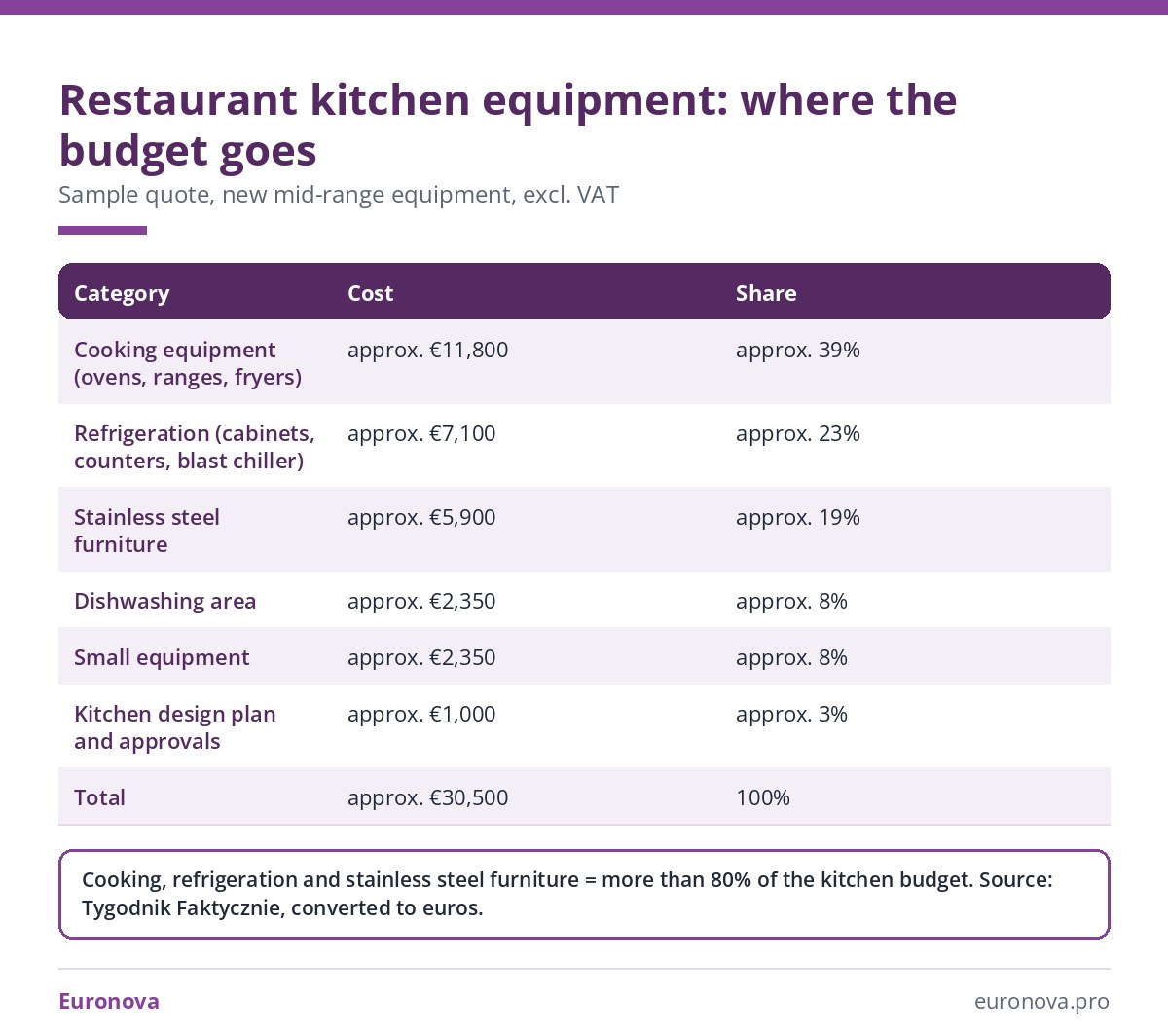
The clearest way to understand the budget is to split it by category. A sample quote published by Tygodnik Faktycznie for the standard option, i.e. new mid-range equipment, looks like this (converted into euros):
| Category | Cost excl. VAT | Share |
|---|---|---|
| Kitchen design plan and approvals | approx. €1,000 | approx. 3% |
| Cooking equipment (ovens, ranges, fryers) | approx. €11,800 | approx. 39% |
| Refrigeration (cabinets, refrigerated counters, blast chiller) | approx. €7,100 | approx. 23% |
| Stainless steel furniture | approx. €5,900 | approx. 19% |
| Dishwashing area | approx. €2,350 | approx. 8% |
| Small equipment | approx. €2,350 | approx. 8% |
| Total | approx. €30,500 | 100% |
These proportions are a good starting point for your plan. If refrigeration makes up 5% of your quote and cooking equipment 70%, it is worth checking whether you have missed something.
Cooking equipment
The most expensive single item is usually the combi steamer. According to the same overview, a mid-range model costs about €3,500 to €8,200, while premium models cost more than €9,400. The portal kuchnia-na-nowo.pl gives a wider range of roughly €4,700 to €14,100, depending on capacity and features. On top of that come ranges, hobs, fryers, grills and salamanders, in other words everything your menu requires.
Refrigeration
Refrigerators and freezer cabinets, refrigerated counters under the cooking line, sometimes a cold room and a blast chiller. The blast chiller is often missing from the first plan, yet in a kitchen that cooks ahead it quickly reduces food waste. In the Tygodnik Faktycznie overview, a financial auditor from the HoReCa sector estimates that such an investment usually pays for itself within 6 to 8 months.
Stainless steel furniture and dishwashing area
Work tables, shelving, sinks, extraction hoods and trolleys are a permanent part of any kitchen that meets hygiene requirements. Depending on the type (undercounter, hood-type, conveyor), a commercial dishwasher costs about €2,350 to €9,400, according to kuchnia-na-nowo.pl. Include a water softener and detergents in the quote, as the machine wears out faster without them.
Small equipment and kitchen cookware
Stockpots, saucepans, frying pans, lids, knives, colour-coded HACCP chopping boards, ladles, spoons, colanders, GN containers of various depths and insulated food boxes. Individually they cost little, but a kitchen needs dozens of them. The approximately €2,350 in the sample quote is a sensible minimum for a small to medium-sized kitchen.

Dining room, bar and tableware: items that are easy to overlook
Future restaurateurs usually calculate the kitchen equipment well but underestimate the cost of equipping the dining room. Yet guests judge a venue by what arrives at the table: the plate, the glass and the cutlery.
Include in the dining room budget:
- Furniture and lighting: tables, chairs, bar stools and, if needed, a seasonal terrace.
- Serving tableware: dinner, soup and dessert plates, platters, cake stands, bowls, cups and saucers.
- Glassware: water and soft drink glasses, wine glasses, carafes, jugs and, for the terrace or a cocktail bar, shatterproof polycarbonate or Tritan glasses.
- Cutlery: table, dessert and serving cutlery.
- Bar: shakers, jiggers, bar spoons, barista tools, straws, garnishes.
- Disposables: if you plan takeaway or delivery, packaging, cups, disposable cutlery and finger food containers are a regular monthly cost that is best planned before opening.
- Till systems: fiscal cash register, POS system, card terminal.
How to calculate tableware per seat
You do not buy tableware on a "one place setting per seat" basis. Some of it is in the dishwashing area, some on the tables, and something always gets broken. A practical method: count the seats, estimate how many times each one turns over in the busiest hour, and add a reserve for washing and breakage. For a 60-seat dining room you will therefore usually order several plate sets per seat, not one. Calculate the glassware reserve more generously than for tableware, as glasses break most often.
It also pays to choose ranges from the start that you will be able to top up in a year or two. A plate from a discontinued line means tables with mismatched patterns after a few months.
What to buy before opening and what can wait
The most common mistake at opening is tying up money in equipment that sits unused for the first few months. Magazyn Przedsiębiorcy advises starting with cooking and refrigeration equipment and basic tableware, and buying extra tools and specialist machines later.
| Buy before opening | Can be added after 3 to 6 months |
|---|---|
| Cooking equipment needed for every dish on the menu | Appliances for one or two dishes you are still testing |
| Refrigeration and freezing with capacity for full stock | Blast chiller, if you do not cook ahead |
| Dishwasher and stainless steel furniture | Extra shelving and transport trolleys |
| Tableware, glassware and cutlery with a reserve | Plates and cake stands for a seasonal or tasting menu |
| Pots, pans, knives, boards, GN containers | Specialist pastry or pizza tools |
| Cash register, POS, card terminal | Décor, terrace expansion |
After a few weeks of trading you will see which dishes sell best and where the kitchen gets stuck. Only then do you know what is really worth investing in next.
New or used equipment, delivery, installation and financing
The catalogue price is not the full cost. For every item, add transport, installation, connection, sometimes water filtration and training in how to use it.
Used equipment reduces the initial outlay, but the Tygodnik Faktycznie overview warns that it brings more frequent breakdowns and no warranty. A sensible compromise is used stainless steel furniture and shelving, which have no moving parts, and new appliances whose failure on a Friday evening would stop the kitchen: the oven, refrigeration and the dishwasher.
Tableware, glassware and small equipment are not worth buying used. Chipped porcelain and scratched glass are a problem for both hygiene and reputation, and the price difference is small compared with the overall budget.
Financing. More expensive appliances are often leased, which spreads the cost into instalments and leaves cash for working capital. Before signing, compare the total cost of leasing with buying outright, and ask your accountant how to account for it under your type of business.
Wholesale purchasing. It pays to order tableware, glassware, cutlery, kitchen cookware and disposables from one supplier in larger quantities. You save on price, on the number of deliveries and on time, which is most precious before opening.
How to build your equipment quote in 6 steps
- Write down the menu and the number of seats. The list of appliances follows from these. Before talking to a kitchen designer, prepare details of the menu, floor area, planned equipment, number of seats and condition of the premises.
- Commission a kitchen design plan. The plan helps you avoid buying appliances that do not match the capacity of the electricity and gas connections. The most expensive mistake is buying equipment before checking ventilation, connections and room layout. Also remember that a food business must be registered with your local food safety authority before it starts trading, as required by Regulation (EC) No 852/2004.
- Split the budget by category. The kitchen (cooking equipment, refrigeration, furniture, dishwashing, small equipment) separately from the dining room, bar, tableware and glassware, till systems and disposables.
- Get at least two quotes for every item, including transport and installation. Compare prices excluding VAT with prices excluding VAT, and prices including VAT with prices including VAT.
- Add a 15 to 20% contingency. That is what GoPOS recommends in its guide to opening costs. Fitting out the premises almost always reveals something that was not in the plan.
- Keep equipment separate from the rest of the start-up budget. Premises, fit-out, installations, opening stock, marketing and working capital for the first months are separate items. If you spend everything on equipment, you will run out of money for wages before the first profit.
Example: a 40-seat bistro
Take a bistro with a 15-dish menu, in premises previously used by another food business, with working ventilation. The kitchen in the standard option costs around €30,500 excluding VAT, as in the table above. The dining room with furniture, lighting, tableware, glassware and cutlery is at the lower end of the €12,000 to €35,000 range, say €14,000. On top of that come the cash register and POS. After adding a 15% contingency, the realistic equipment budget exceeds €50,000 excluding VAT. The same venue with partly used furniture may come in lower, while one in an empty unit that needs new ventilation will be considerably higher.
Our view on the equipment budget
Every day we equip restaurants, hotels, bars, pizzerias, cafés and catering companies across Slovenia, as well as kitchens in schools, nurseries and care homes. From that vantage point we see one thing: budgets are rarely broken by the big appliances, because everyone calculates those carefully. They are broken by hundreds of small items added in the last week before opening.
That is why we advise treating tableware, glassware, cutlery, kitchen cookware, GN containers and disposables as one full category of the quote, not as an afterthought. Ordered together at wholesale prices, they cost less and arrive in one delivery instead of ten parcels from different suppliers.
Our second tip: choose ranges you will be able to top up. A venue runs for years, while plates and glasses are replaced regularly. That is exactly why we keep our range continuously tailored to the needs of food service businesses, both newly opened venues and those with many years of experience.
— Rok
Dining room and kitchen equipment in one order
Whether you are equipping a venue before opening or refreshing an existing one, the Euronova online shop brings together porcelain, glassware, cutlery, kitchen cookware, cooking and baking tools, storage and transport containers, disposables and catering appliances in one place, at competitive wholesale prices.

To get started, take a look at Notte flat plates 27 x 25 cm, 36 cm oval platters, shatterproof 25 cl Tritan glasses for the terrace and bar, and a GN 1/2 container, 150 mm deep for the kitchen and buffet.
FAQ: restaurant equipment costs
How much does it cost to equip a small restaurant?
Equipping a small bistro or a café with seating usually costs around €12,000 to €24,000. A restaurant with a full kitchen starts at roughly €35,000. These figures come from Polish sources, so prices in your country may be higher. Add a 15 to 20% contingency plus non-equipment costs such as fitting out the premises and working capital.
What is the most expensive part of equipping a restaurant kitchen?
Cooking equipment costs the most, above all the combi steamer, followed by refrigeration and stainless steel furniture. In a typical quote these three categories together account for more than 80% of the kitchen budget.
Is it worth buying used catering equipment?
Partly. Stainless steel furniture and shelving can be bought used without much risk, but the oven, refrigeration and dishwasher are better bought new and under warranty, because a breakdown stops the kitchen. Always buy tableware, glassware and cutlery new.
How much tableware do I need per seat?
Always more than one set, because some of it is in the dishwashing area and some gets broken. Base the quantity on peak occupancy and the length of the washing cycle, and allow a larger reserve for glassware than for porcelain.
How much contingency should I leave in the equipment budget?
Usually 15 to 20% of the quoted total. The contingency covers surprises during the fit-out, extra connections, transport and the small items you only remember in the last week before opening.
Sources
- ŚwiatHoReCa.pl: Ile kosztuje otwarcie restauracji
- GoPOS: Ile kosztuje wyposażenie restauracji? Praktyczny poradnik
- GoPOS: Koszt otwarcia restauracji i planowanie budżetu
- InfrastrukturaGastronomiczna.pl: Wyposażenie gastronomiczne 2026
- Tygodnik Faktycznie: Ile kosztuje otwarcie restauracji?
- Kuchnia-na-nowo.pl: Wyposażenie kuchni restauracji, koszt
- Magazyn Przedsiębiorcy: Inwestycja w gastronomię