How to Serve Finger Food: Bowls, Platters and Packaging in Practice
How to Serve Finger Food: Bowls, Platters and Packaging in Practice

Serving finger food works when every bite reaches the guest in a vessel they can hold in one hand, and the buffet table looks just as good in the last hour of the event as in the first. In practice that comes down to three decisions: how many pieces to prepare per person, what to serve each type of bite in (bowl, tasting spoon, tiered stand, platter) and how to transport and display the food in line with hygiene rules. Below we go through all three, with figures, a serveware selection table and a checklist for off-site catering.
Key points
- For short drinks nibbles allow 4 to 6 pieces per person, for a cocktail-style lunch 10 to 14, and for an evening reception replacing dinner 14 to 18.
- Choose serveware by texture: sauces, creams and desserts in rimmed bowls, dry bites on tiered stands and platters, layered creations in clear verrines.
- Do not put everything out at once: divide the table into zones, display at different heights and replenish from GN containers behind the scenes.
- In transport, what counts is temperature (hot food at least 63 °C, cold food below 5 °C), HACCP records and food-contact materials.
- Single-use plastic cups and food containers are covered by EU consumption-reduction measures, so build reusable serveware into your catering offer from the start.
Contents
- What is finger food and when to serve it
- How many finger food pieces per person
- How to lay out a finger food buffet table
- Finger food bowls: what to choose for each bite
- Platters and tiered stands for finger food in restaurants
- Finger food packaging for catering and transport
- Single-use or reusable serveware: what EU rules say
- Hygiene and food safety when displaying finger food
- Our view on serving finger food
- Finger food equipment in one order
- FAQ: serving finger food
- Sources
What is finger food and when to serve it
Finger food means small bites eaten with the fingers, without cutlery, usually in one or two mouthfuls. Guests eat them with one hand while holding a glass in the other, so there is no need to seat them at tables. Classic examples are skewers, mini tartlets, canapés, wraps or vegetable crisps with a dip.
This format works best where guests move around and talk:
- conferences, training sessions and coffee breaks, when there are only a few minutes for a meal,
- networking and client meetings, when food must not require cutlery or lengthy service,
- venue and office openings, exhibitions, trade fairs, cocktail receptions,
- weddings and anniversaries, as a welcome reception bite or a midnight buffet,
- hotel receptions and corporate events in halls without a banquet layout.
For the organiser, logistics matter: at a standing reception the hall does not need to be rearranged into a banquet layout, and a single team can serve several hundred people.
How many finger food pieces per person
The number of pieces depends on whether finger food is an extra or replaces a meal. Event organisers at meetplace.pl give the following ranges:
| Type of event | Pieces per person | Example for 80 guests |
|---|---|---|
| Short drinks nibbles (up to about 1.5 hours) | 4–6 | 320–480 pieces |
| Cocktail reception instead of lunch | 10–14 | 800–1,120 pieces |
| Evening reception instead of dinner | 14–18 | 1,120–1,440 pieces |
The same piece count translates directly into your serveware order. If you serve 30% of the bites at a lunch for 80 people in bowls, you need from 240 to more than 330 pieces, plus a reserve for changeovers and possible losses. For single-use serveware add a 10 to 15% reserve; for reusable serveware plan how many sets must circulate between the table and the dishwashing area so that nobody waits for clean bowls.
The balance of the menu also affects the equipment. A commonly used rule is 60% savoury and 40% sweet bites, of which at least 30% hot. The hot part of the menu means chafing dishes or insulated food boxes; the sweet part usually means bowls, dessert verrines or small glasses.
How to lay out a finger food buffet table
A well-arranged finger food table guides guests by itself. This is the order we use when planning a display:
- Divide the table into zones. Cold bites, hot bites and desserts separately and, for larger numbers of guests, the same zones repeated on both sides of the table or in two places. A display divided into sections eases the queue.
- Vary the heights. Footed tiered stands, risers and platter stands make bites at the back of the table as visible as those at the front, and free up space on the table surface.
- Do not put everything out at once. Keep part of the portions on the table and the rest in the cold room or an insulated box. Replenishing in smaller batches keeps a fresh look and limits the time food stands at room temperature.
- Arrange one type per row. Guests immediately see what they are taking. Add clear labels for vegetarian, gluten-free or nut-containing bites.
- Leave space for returns. A small table or tray for used serveware, toothpicks and napkins in several places around the room. Without it, empty bowls end up on window sills.
- Plan the service route. A waiter with a full tray should reach the table without squeezing through the guests. At a reception with circulating waiters, prepare light trays and smaller portions.
The bite itself must also be "stand-up friendly". Oversized mouthfuls, crumbly pastry or too much sauce force guests to look for a plate or put the food down. This is where serveware helps: serve anything wet, runny or layered in a bowl rather than on a cracker.
Finger food bowls: what to choose for each bite
The simplest rule is: the runnier or more fragile the bite, the more the serveware has to "hold" it. The table below sets out the typical choices.
| Type of bite | Best serveware | What to watch for |
|---|---|---|
| Steak tartare, ceviche, salads, creamy spreads | small bowl, 180–200 ml | stable base, a rim that is easy to grip with the fingers |
| Cream soups, cold soups, shots | shot glass or small cup | volume for 2–3 sips, thicker walls for hot soups |
| Layered desserts, tiramisu, panna cotta | clear bowl or dessert verrine | visible layers, room for a spoon |
| Dressed salads, pasta, mini risotto portions | 250 ml bowl | larger volume for longer receptions and lunches |
| Skewers, tartlets, canapés, sushi | tiered stand, platter, board | large surface, contrasting background colour |
| Fries, calamari, fried snacks | paper cone or cup | grease drainage, served hot |
| Dips and sauces for snacks | small bowl or side plate next to the stand | a separate dish for each sauce |
When choosing serveware, a few things are worth watching:
- Volume. 180 ml is a typical "two-bite" portion at a short reception, 200 ml is the all-round size, and 250 ml works better when finger food replaces lunch.
- Shape. Round bowls are easy to hold and look neat in a row. Square shapes take up less space on a platter.
- Transparency. Clear serveware shows off layered creations and makes it easier for guests to choose without asking staff.
- Lid. For off-site catering and portions prepared in advance, a lid protects the food and lets you stack the bowls.
- Colour and style. Simple, neutral bowls suit any menu; the background colour comes from the stand or platter.
Our range includes round 180 ml finger food bowls and 250 ml bowls in packs of 30, the Disco 200 ml in packs of 30 and the Disco 200 ml with lid, in packs of 50, which is handy for portions prepared in advance and transported to the event.
For drinks and shots, glasses made of shatterproof materials work well, for example the Disco 22 cl polycarbonate glass or the frosted Disco 25 cl Tritan glass. At a garden event, by a hotel pool or on a terrace they are a safer choice than thin glass.
Platters and tiered stands for finger food in restaurants
In restaurants and hotels, finger food is usually served in three ways: on a buffet table, on trays carried by waiters, and as a sharing starter at the table. Each has different requirements.
Buffet and cocktail table. Here surface area and stability count. Oval porcelain platters hold rows of skewers or tartlets well and are easy to swap for full ones. A large 36 cm oval platter holds a few dozen small bites, while the smaller 29 x 17 cm platter works on a narrow table or for a table of 2 to 4. It pays to have two sets: one on the table and one being prepared in the kitchen.
Trays carried by waiters. They must be light, with a non-slip surface. Put bowls and tasting spoons on the tray rather than loose bites, because they hold the portion in place best while moving among guests. The waiter should carry napkins, and there should be a place in the room to leave used serveware.
Sharing starter at the table. Here finger food enters the menu as a board or a sharing plate. A small Bonna 17 cm side plate works well under a dip or as a separate plate for a portion, while a wider rimmed plate such as the Madera Banquet 28 cm holds several kinds of bites with a sauce in the centre.
Back of house and replenishment. The least visible but often the most important part is what happens behind the kitchen door. Store bites prepared in advance in the cold room in GN containers, for example a GN 1/2, 150 mm deep for larger quantities or a GN 1/4, 200 mm deep for sauces and fillings. The standard size means the container goes straight into a refrigerated cabinet, a warming cabinet or an insulated box.
Finger food packaging for catering and transport
Off-site catering adds a second challenge to the display: the food must arrive in the same condition as it left the kitchen. The choice of packaging depends on the type of bite:
- Wet, creamy and sauced bites: lidded bowls packed tightly on a tray or in a GN container so they do not slide during the journey.
- Layered desserts: clear lidded bowls or verrines, transported chilled and uncovered only on site.
- Dry bites and pastries: lidded platters or boxes in which nothing gets squashed.
- Hot bites: insulated food boxes and GN containers, with chafing dishes on site, as dried-out or cooled mini portions quickly lose their appeal.
Clear temperature rules apply to transport. Food safety guidance commonly sets hot holding of potentially hazardous foods at a minimum of 63 °C and chilling below 5 °C, treating the range between 5 and 63 °C as the danger zone. In practice this means: a thermometer in the insulated box, a temperature record at departure and on arrival, and the shortest possible time between loading and serving. Describe transport and procedures in your HACCP system and check the exact requirements with your local food safety authority.
If you only organise events occasionally and do not want to buy a full set of equipment, also take a look at our catering equipment hire, where you can rent plates, glasses and cutlery.
Single-use or reusable serveware: what EU rules say
Both options have their place. Reusable serveware, porcelain and glass, gives an elegant character to a reception in a hotel or restaurant with an on-site dishwashing area. Single-use serveware works for off-site catering, outdoor events, trade fairs and anywhere that speed of service and no return logistics matter.
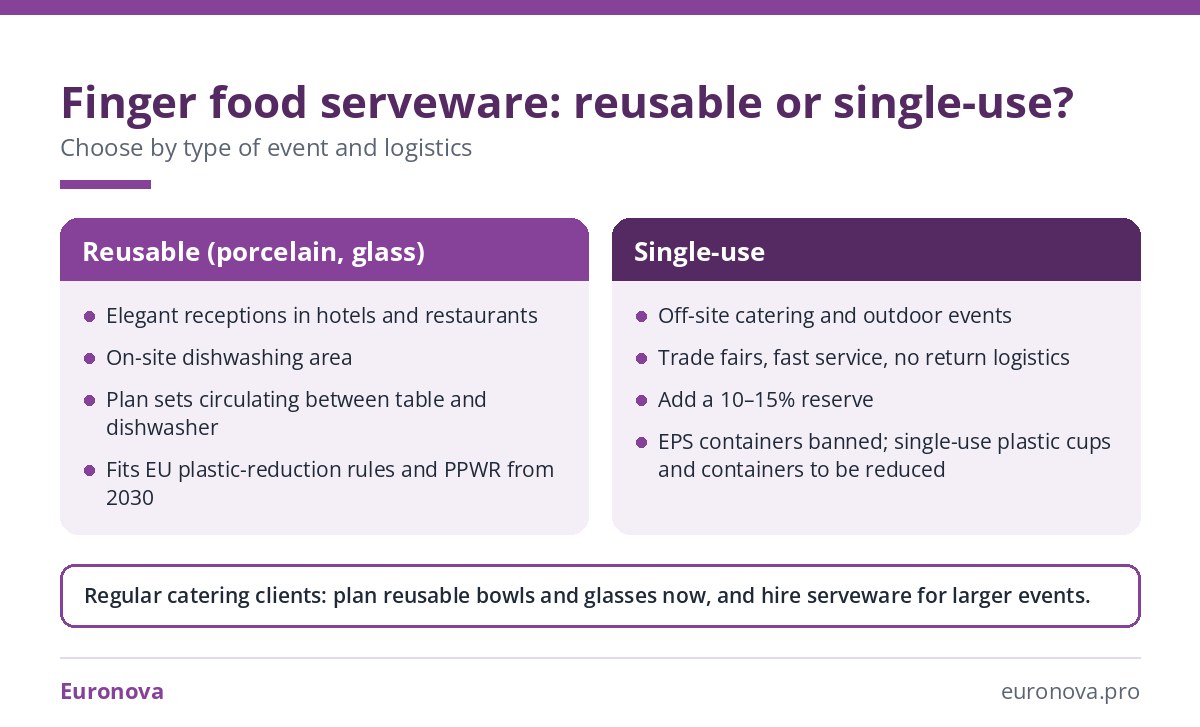
When choosing single-use plastic serveware, take the EU rules into account. The Single-Use Plastics Directive (EU) 2019/904 requires Member States to reduce the consumption of single-use plastic cups and food containers, and national rules may require food and drink businesses to take measures such as offering alternative products, accepting customers' own containers and informing consumers. From 2030 the EU Packaging and Packaging Waste Regulation (PPWR) further restricts single-use plastic for food and drinks consumed on the premises. For catering that customers order regularly, it therefore makes sense to plan for reusable bowls and glasses now, as well as serveware hire for larger events.
Hygiene and food safety when displaying finger food
Finger food stays on the table longer than a plated dish, and guests serve themselves. That makes hygiene essential. Catering is a food business under Regulation (EC) No 852/2004 on the hygiene of foodstuffs, which means a HACCP-based system in place and registration of the business with the competent food safety authority. Serveware and packaging must meet the requirements for food-contact materials (Regulation (EC) No 1935/2004).
What to watch for in the display itself:
- Time on the table. Put out smaller batches and swap whole stands rather than adding fresh bites to those that have been standing for an hour.
- Temperature. Keep hot bites in chafing dishes and cold ones on chilled platters or in limited quantities. Set out in your HACCP system how long each dish may stay on the table.
- Single portions. Bowls, tasting spoons and shot glasses with individual portions mean guests do not touch bites they will not take.
- Tongs and toothpicks. Provide tongs for bites on tiered stands and offer toothpicks in a separate holder.
- Allergens. Label bites that contain allergens. For questions about specific requirements or inspections, check your HACCP system or contact your local food safety authority.
- Clean serveware. Reusable serveware goes into the dishwasher after every use, and items ready for the next round are kept covered.
Our view on serving finger food
As a wholesale supplier to the food service sector, we see that finger food most often fails not in the kitchen but in purchasing. The menu is perfected, yet on the day of the event two hundred bowls are missing, or lids that fit the containers, or a second set of stands for changeovers.
That is why we always encourage you to plan the equipment together with the menu: pieces per person, the percentage of bites in bowls, the number of stands per table and GN containers for back of house. Once these figures are written down, the order takes minutes and is always in one place, from single-use serveware to porcelain, glassware and insulated food boxes.
Businesses that cater receptions regularly gain most from a fixed, repeatable set: the same bowl sizes, the same stands, the same containers. That makes it easier to restock and to keep a consistent standard of service.
— Rok
Finger food equipment in one order
Whether you are preparing a reception, adding finger food to your menu or restocking for the event season, Euronova brings together finger food bowls, porcelain tiered stands and plates, glassware, cutlery, GN containers, insulated food boxes and disposables in one place, at competitive wholesale prices for food service.

Start with our 180 ml finger food bowls or browse the full range of catering equipment and put everything for your reception in one basket.
FAQ: serving finger food
What is the best way to serve finger food at a standing reception?
Serve dry bites such as skewers or tartlets on tiered stands and platters, and anything wet, creamy or layered in small bowls of 180 to 250 ml. Drinks and cream soups work well in shot glasses. The rule is simple: guests must be able to eat the portion with one hand, without looking for a plate.
How many finger food bowls should I order for an event?
Work out the number of pieces per person (4 to 6 for drinks nibbles, 10 to 14 for a lunch, 14 to 18 for a dinner) and then decide what share of the menu goes into bowls. Add a 10 to 15% reserve to the result. For 100 guests, 12 pieces per person and a third of the menu in bowls, that is about 400 pieces plus the reserve.
Are there special rules for plastic finger food packaging?
Yes. Under the EU Single-Use Plastics Directive (EU) 2019/904, Member States must reduce the consumption of single-use plastic cups and food containers, and containers made of expanded polystyrene are banned. From 2030 the EU Packaging Regulation (PPWR) further restricts single-use plastic for food eaten on the premises, so it makes sense to plan for reusable serveware.
How do I transport finger food so it still looks good on arrival?
Transport wet bites and desserts in lidded bowls packed tightly into GN containers or onto trays, and hot food in insulated food boxes. Hot food must be kept at a minimum of 63 °C and cold food below 5 °C. Assemble the bites as close to serving time as possible.
Sources
- Co to jest finger food? (spoldzielniarownosc.pl)
- Przekąski na imprezy i finger food (Unilever Food Solutions)
- Finger food na event firmowy (goraco-polecam.pl)
- Co to jest finger food? Ile na osobę (meetplace.pl)
- Finger food na event firmowy: porcje, ekspozycja i serwowanie (Gazeta Polska)
- Regulation (EC) No 852/2004 on the hygiene of foodstuffs