Piping Bags for Commercial Kitchens: Choice, Use and Hygiene
Piping Bags for Commercial Kitchens: Choice, Use and Hygiene

In a commercial kitchen a piping bag has to do three things: hold the mixture securely, still handle well after the fiftieth dessert, and be cleaned in a way that fits your HACCP plan. For most food service businesses this means disposable piping bags for anything hygiene-critical and for frequent colour changes, and durable reusable bags made of coated fabric for heavy mixtures such as choux pastry or mashed potato. Add a well-organised set of stainless steel nozzles with a coupler. Below you can read which material and size suit which filling, how to combine disposable and reusable bags sensibly, which nozzles belong in a basic set, and how to clean and store bags during service.
Key points
- Disposable piping bags are the safest choice hygienically for whipped cream, creams containing eggs and dairy, and for stations with frequent changes of colour or product.
- Reusable piping bags made of coated polyester or nylon pay off for stiff, heavy mixtures and in kitchens with a clearly defined washing procedure.
- Size depends on the working quantity and level of detail: short bags for fine decoration, long ones for cakes, tray bakes and batch production.
- Stainless steel nozzles with a coupler cover almost every task: round, open star and closed star nozzles, ideally plus a leaf nozzle.
- Hygiene belongs in the business's cleaning plan: clean immediately, dry completely, store away from dirty dishes.
Contents
- Which piping bags work in food service
- Disposable or reusable: a fair comparison
- Size and material by filling
- Nozzles, couplers and useful accessories
- Hygiene: cleaning and storing piping bags correctly
- How to choose pastry equipment
- Our view from practice
- Complete pastry station equipment
- FAQ
- Sources
Which piping bags work in food service
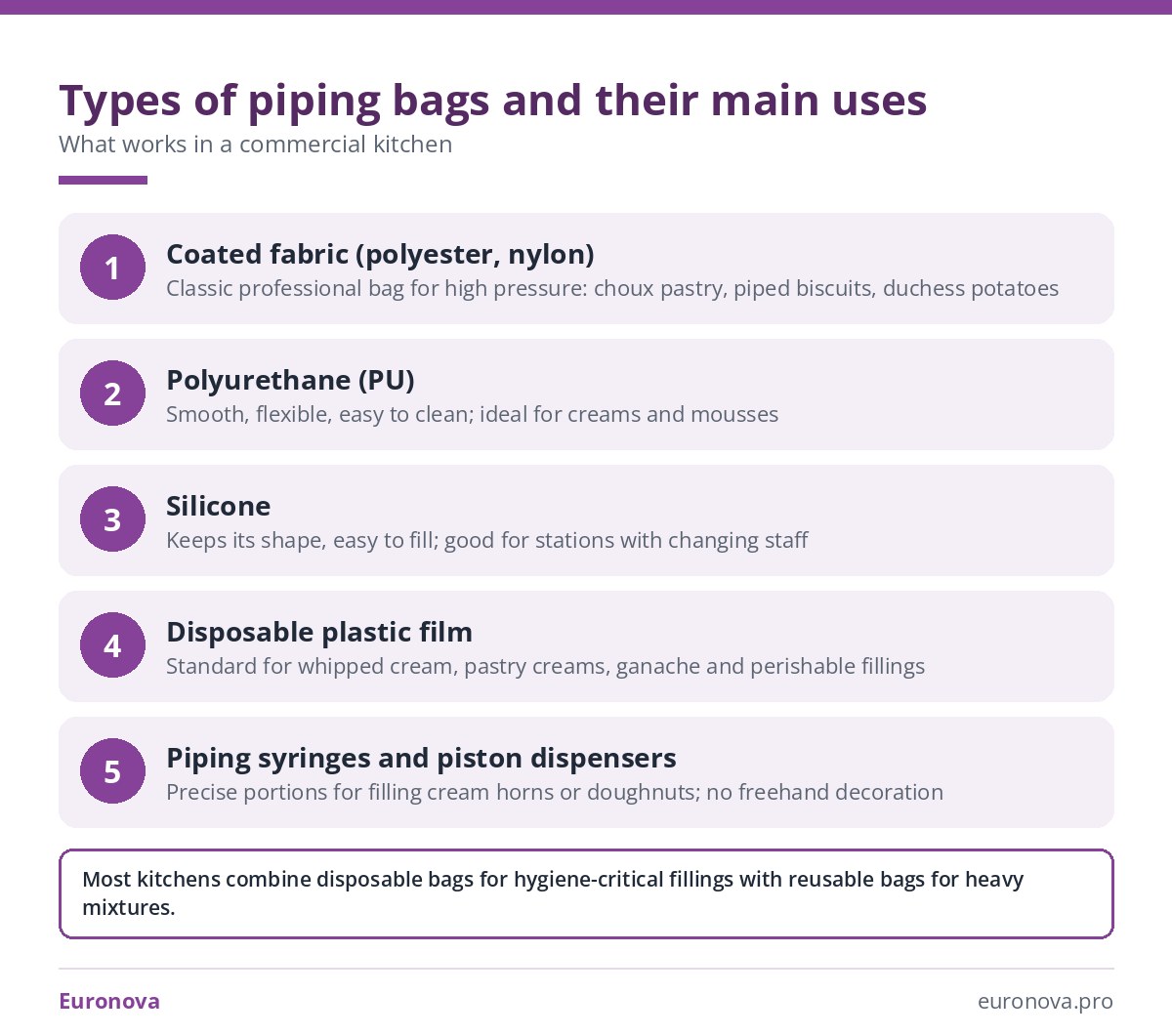
Piping bags come in four basic types. For home use almost any of them will do, but in a commercial kitchen the choice quickly narrows.
Coated fabric (polyester or nylon). This is the classic professional piping bag. The fabric is coated on the inside so that moisture and fat do not soak through. Good models have welded rather than stitched seams, a reinforced tip and a hanging loop for drying. They sit well in the hand, stay flexible even with cold buttercream or cream-based fillings, and withstand high pressure, for example with choux pastry, piped biscuits or duchess potatoes.
Polyurethane (PU). Slightly smoother and thinner than fabric bags, very flexible and easy to clean. Many pastry chefs value PU for creams and mousses, because the bag empties well and retains little residue.
Silicone. Silicone bags keep their shape, are easy to fill and often come with a coupler, an outlet stopper and a reinforced rim. They are a good choice for stations with changing staff, because they are easy to use. For very stiff mixtures they are often slightly less supple than fabric.
Disposable plastic film bags. Smooth or with a non-slip texture, mostly on rolls or in dispenser boxes. They are thrown away after use, which is why in many kitchens they are the standard for whipped cream, pastry creams, ganache and anything that can spoil quickly.
In addition, there are metal or plastic piping syringes and piston dispensers. They are practical for precise portions, for example when filling cream horns or doughnuts, but they do not replace a bag for freehand decoration.
Disposable or reusable: a fair comparison
This question comes up in almost every kitchen. The good news: you do not have to choose. Most professional kitchens work with both types and assign them to different tasks.
| Criterion | Disposable piping bag | Reusable piping bag |
|---|---|---|
| Hygiene | Highest level of safety, as it is discarded after use | Safe with immediate cleaning and complete drying |
| Suitable for | Whipped cream, egg-based creams, dairy, coloured icings, allergen-free production | Choux pastry, potato mixtures, piped biscuits, doughs, cold buttercream |
| Pressure resistance | Good with thick film, limited with very stiff mixtures | Very high, especially fabric with welded seams |
| Changing filling or colour | New bag, no washing | Washing and drying, or a second bag |
| Labour | No cleaning | Cleaning, drying, checking for cracks |
| Storage | Roll or dispenser box, saves space | Hung up, airy, away from dirty dishes |
| Typical use | Banqueting, catering, breakfast buffet, pastry counter | À la carte kitchen, bakery, patisserie with a warewashing line |
Our rule of thumb: anything involving eggs, cream or milk that is not used immediately goes into a disposable bag. Heavy mixtures that need a lot of pressure and are less critical go into a reusable bag. If you prepare allergen-free food or cook for nurseries and care homes, a disposable bag for every allergen-free variant is the safest option, because no residue from the previous batch can remain in the bag.
Size and material by filling
Piping bags are usually sold by length in centimetres. The basic rule is simple: smaller bags for fine decorations, larger ones for cakes, muffins or several desserts is the logic professionals also use to put their sets together. A bag that is too large tires the hand during fine work, while one that is too small means constant refilling and warms the mixture with your hand.
| Filling / task | Recommended bag size | Recommended material | Practical tip |
|---|---|---|---|
| Lettering, ornaments, chocolate decoration | Small | Disposable, thin film | Cut the tip close to the end first, trim further if needed |
| Whipped cream swirls, muffin toppings | Medium | Disposable | Keep the mixture cold, do not overfill the bag |
| Buttercream, ganache | Medium to large | Disposable or PU | Do not keep your hand wrapped around the bag all the time |
| Choux pastry, piped biscuits | Large | Coated fabric | Welded seams and a reinforced tip |
| Duchess potatoes, mash | Large | Fabric or thick disposable film | Warm mixtures, check heat resistance |
| Filling cream horns, doughnuts | Medium | Disposable or piping syringe | Use a long, narrow filling nozzle |
| Canapés, finger food, cream cheese fillings | Small to medium | Disposable | One bag per variety, good for buffet prep |
Two things are often overlooked when choosing:
Wall thickness of disposable bags. Thin film is enough for whipped cream, but bursts with cold buttercream or choux pastry. For heavy mixtures, thicker film or double bagging pays off.
Grip. A lightly textured surface prevents slipping, especially when hands are damp or greasy. At the tip, this decides whether the result is clean.
When decorating in the hot kitchen, what you pipe onto also matters: on glazed plates and in deep bowls you can place the decoration precisely, for example on a Gourmet Retro deep plate or in small finger food cups for the buffet.
Nozzles, couplers and useful accessories
The best bag is of little use without the right nozzles. For professionals, stainless steel is generally recommended, as it is stable, durable, taste-neutral and easy to clean. Plastic nozzles are lighter and cheaper, but deform sooner and absorb colour and fat over time.
A few shapes are enough for a basic set:
- Medium round nozzle for choux pastry, fillings, macarons and dots.
- Small round nozzle for lettering, lines and fine dots.
- Open star nozzle for rosettes, shells and classic whipped cream swirls.
- Closed star nozzle for finer, tightly ridged rosettes, for example on piped biscuits.
- Leaf nozzle for leaves, ruffles and ribbons on cakes.
If needed, add filling nozzles (long and narrow for filling pastries), multi-opening nozzles for grass and hair effects, and petal and rose nozzles for cake decoration.
Couplers are almost essential in food service. They allow you to change the nozzle quickly without emptying the bag. With a buffet of three desserts, that saves a noticeable amount of time and material.
Other accessories that prove their worth:
- Bag clips or ties so the mixture does not escape at the top during work
- A filling stand or tall container to hold the bag while filling
- A nozzle box with compartments so nozzles do not lie loose in a drawer and get bent
- Small brushes for cleaning the inside of nozzles
- A dough scraper for emptying the bag completely
Hygiene: cleaning and storing piping bags correctly
Piping bags are items in direct contact with food. The 2023 Listeria prevention guidelines of the German food industry association (Lebensmittelverband) treat such items as possible carriers of microorganisms and require them to be included in the business's cleaning and disinfection plan. Responsibility lies with the business itself: under Regulation (EC) No 852/2004, the food business operator bears primary responsibility for food safety, which it ensures through own checks based on HACCP principles.
For reusable bags, this procedure has proved effective:
- Empty immediately after use. Squeeze out the remains with a dough scraper and remove the nozzle and coupler.
- Clean mechanically. Clean the inside and outside with hot water and detergent. According to the German Federal Institute for Risk Assessment (BfR), detergents dissolve fat and protein soiling, which is exactly the residue left by whipped cream, buttercream and egg mixtures.
- Turn inside out and rinse. Residue builds up precisely at the tip and the seams. Fabric bags with welded seams have a clear advantage here.
- Dry completely. Hang the bag open or inside out on its loop until it is completely dry inside. Damp, folded bags are a breeding ground for microorganisms.
- Inspect. Before every use, check for cracks, open seams or discolouration. Remove damaged bags immediately and record in the plan when you replaced them.
- Store separately. Keep clean bags and nozzles protected and away from used dishes.
The last point is often underestimated. According to the BfR, cross-contamination occurs directly or indirectly via hands, equipment and work surfaces. In its hygiene rules for contract catering, the BfR stresses separating clean and dirty work processes, either by space or by time. For piping bags this means in concrete terms: used bags do not go next to clean nozzles, and the washing point for pastry tools is not on the return route for dishes from the dining room.
Disposable bags save you steps one to six. That makes them the safest solution if you work in contract catering for schools, nurseries or care homes, or if your washing capacity at peak times is limited. Here too: keep the bags in their original packaging or in a dispenser, not open on the work surface, and wash your hands before filling. A wall-mounted soap dispenser right next to the pastry station makes this much easier day to day.

Set out in your HACCP plan which detergents and disinfection procedures you use for tools. If you are unsure, contact your local food safety authority or a food hygiene consultant. Suitable products for the dishwashing area and work surfaces can be found among our professional cleaning products, and for stubborn fat and protein residues among our specialist cleaners.
How to choose pastry equipment
Anyone equipping a patisserie, a hotel pastry kitchen or a baking station in a restaurant rarely buys piping bags alone. These criteria help you put together a well-matched set of baking equipment:
1. Start from the product. Write down the ten items you make most often. That tells you which nozzles, moulds, rings and trays you really need. A kitchen making cream horns and éclairs needs different tools from one making tarts and gateaux.
2. Choose materials to suit your cleaning procedure. If you have a dishwasher, check that every item is dishwasher-safe. Stainless steel is the durable standard choice for nozzles, rings and frames. Silicone suits mats and moulds that need to be flexible.
3. Check suitability for food contact. Everything that comes into contact with food must be labelled as such. In the EU you can recognise this by the glass and fork symbol or by a corresponding statement from the manufacturer.
4. Rely on systems. Nozzles and couplers from the same range fit together. Gastronorm sizes for containers and trays ensure everything fits the refrigerator, the combi oven and the rack, for example porcelain GN 1/3 containers for prepared creams and fillings.
5. Plan your consumables. Disposable bags, baking paper, film and cake boards are running costs. Calculate them per portion, not per pack. Suitable cling film and food wrapping paper also belong in the store room, for covering prepared mixtures and keeping them fresh.
6. Do not forget ergonomics. Anyone who pipes for eight hours feels every badly designed tool. Test new bags and nozzles at one station first before ordering them for the whole team.
7. Keep a reserve. Nozzles go missing and bags tear. A second set of the most important parts prevents service from collapsing because of a missing star nozzle.
Our view from practice
We equip restaurants, hotels, cafés, catering companies and contract catering kitchens, and we notice a recurring pattern: the piping bag is treated as a minor item until it bursts during service or catches the eye during a hygiene inspection. Yet it is precisely this tool that decides whether a dessert at the pass looks like true craftsmanship.
So our recommendation is not "either-or". Equip every station with disposable bags for whipped cream and creams, and keep two or three durable reusable bags ready for heavy mixtures. Add a set of stainless steel nozzles with a coupler and define the cleaning procedure in writing in your HACCP plan. That way tools, consumables and cleaning are all aligned.
This is exactly what our range is designed for: kitchen utensils, pastry tools, disposables, cleaning products and the porcelain the dessert is finally served on, all in one place. Our expert articles help with the choice, so your purchasing team does not have to coordinate five suppliers.
Rok
Complete pastry station equipment
At Euronova, food service businesses can order kitchen utensils, pastry tools, disposables and professional cleaning products from a single shop, together with porcelain, glassware and serving cutlery.

Put your station together directly in the Euronova catering equipment online shop: from pastry consumables to the plate on which the dessert reaches the guest.
FAQ
Which piping bag is best for choux pastry?
Choux pastry needs a large, pressure-resistant bag. Reusable bags made of coated polyester or nylon with welded seams and a reinforced tip are the best choice. Thin disposable film bags quickly burst with a stiff dough.
Can reusable piping bags be used in food service?
Yes, provided they are included in your cleaning and disinfection plan. Immediate cleaning, complete drying and storage away from dirty dishes are what matter. For sensitive fillings such as whipped cream or egg-based creams, many kitchens still use disposable bags.
How often should reusable piping bags be replaced?
There is no fixed interval; condition decides. Check the bag before every use for cracks, open seams, discolouration or odour. As soon as any of these applies, replace it.
Which piping nozzles does a basic set need?
A medium and a small round nozzle, an open and a closed star nozzle and a leaf nozzle cover most tasks. For filling pastries, add a long filling nozzle. A coupler lets you change the nozzle without transferring the mixture.
Sources
- Lebensmittelverband Deutschland: Leitlinie für Gute Verfahrenspraxis zur Listerienprävention (2023)
- EUR-Lex: Regulation (EC) No 852/2004 on the hygiene of foodstuffs
- BfR: Verbrauchertipps zu Lebensmittelhygiene, Reinigung und Desinfektion
- BfR: Hygieneregeln in der Gemeinschaftsgastronomie
- test-stiftung.de: Spritztüllen Test & Ratgeber