Types of Cocktail Glasses: Which Glass for Which Cocktail?
Types of Cocktail Glasses: Which Glass for Which Cocktail?

Cocktail glasses fall into three families: stemmed glasses for drinks served without ice (martini glass, coupe, Nick & Nora), short and tall stemless glasses for drinks with ice (tumbler, highball, Collins) and speciality glasses for particular classics (margarita, hurricane and balloon glass, copper and tiki mugs). Which glass suits which cocktail comes down to three questions: Is there ice in the glass? How large is the drink? Is it carbonated? For bars, hotels and caterers there is a fourth: Which shapes do I really need, and in which material?
Key points
- No ice, short and strong: a martini glass or coupe, both well chilled.
- On the rocks, short: a tumbler (old fashioned, rocks glass) for a Negroni, Old Fashioned or Caipirinha.
- Long and carbonated: a highball or long drink glass for a gin and tonic, Cuba Libre or Mojito.
- Special cases: margarita glass, hurricane, balloon glass for a spritz, copper mug for a Moscow Mule.
- For hospitality, four to five basic shapes in sufficient numbers are enough, topped up with shatterproof versions for the terrace, pool and events.
Contents
- Three families of cocktail glasses
- Stemmed glasses: martini, coupe and Nick & Nora
- Stemless glasses: tumbler, highball and Collins
- Speciality glasses: margarita, hurricane, balloon and more
- Overview: which glass for which cocktail
- Cocktail glasses in hospitality: what to look for
- Our view from practice
- Order cocktail glasses from Euronova
- FAQ
- Sources
Three families of cocktail glasses
If you want to bring order to the variety of cocktail glasses, start with the shape. The division into stemmed glasses, stemless glasses and other drinking vessels can also be found in the overview of cocktail glasses on German Wikipedia, which also counts wine, sour, liqueur and Irish Coffee glasses among the stemmed cocktail glasses.
The logic is simple and practical:
- Stemmed glasses keep the warm hand away from the drink. They are meant for cocktails that are shaken or stirred, strained and served without ice, "straight up" in bar jargon.
- Stemless glasses stand firmly, have a heavy base and room for ice cubes or crushed ice. All drinks "on the rocks" and all long drinks belong here.
- Speciality glasses go with particular recipes or serving styles, often with high recognition value: the curved margarita glass, the bulbous hurricane, the copper mug.
In practice this means: if you sort the recipes on your menu by these three criteria (with or without ice, short or long, carbonated or not), you very quickly know which glass shapes you need.
Stemmed glasses: martini, coupe and Nick & Nora
Cocktails in stemmed glasses are generally served without ice in the glass and therefore without a straw. That is why it is usual to chill coupes before serving. In the bar this means: put the glasses in a glass chiller, or fill them with ice and water before mixing and empty them just before straining.
Martini glass
The martini glass is the icon among cocktail glasses: a conical, V-shaped bowl on a long stem. Classic martini glasses usually hold 150 to 200 ml, and the funnel shape has been widespread since the 1930s.
The V shape has a sensory reason: according to Schweppes Germany, the drink flows into the mouth in a wide stream, so the aromas open up well. The glass is therefore intended mainly for strong, classic recipes.
Typical drinks: Dry Martini, Manhattan, Gibson, Cosmopolitan, Appletini, Espresso Martini.
Serving tip: choose a slightly smaller martini glass. A large glass filled to the brim warms up faster than the guest drinks, and the wide bowl is unforgiving when carried.

Cocktail coupe (coupette)
The cocktail coupe, also called a coupette, has a round, wide-open bowl. It is smaller than many people think: coupes often hold no more than 100 ml of liquid, and rarely more than 200 ml measured to the brim. According to Schweppes Germany, it allows a slightly larger volume than the martini glass and therefore also suits drinks with juice; some recipes are topped up with sparkling wine in the coupe.
A practical advantage in a venue: the round coupe spills less when carried than a pointed bowl. That is why many bars today prefer the coupe for sours and short drinks.
Typical drinks: Daiquiri, Sidecar, White Lady, Aviation, Gimlet, Blood & Sand, Golden Cadillac.
Nick & Nora, sparkling wine glass and other stemmed glasses
The Nick & Nora is a small, tulip-shaped bowl with a higher rim. It suits stirred classics in small volumes and is even more forgiving in service than the coupe.
Every cocktail menu also needs a sparkling wine glass: for a French 75, Kir Royal, Bellini or Mimosa. Its slim shape keeps the bubbles in the glass for a long time. The shatterproof Disco 18 cl sparkling wine glass made of Tritan suits receptions and outdoor areas where real glass is a risk.
Stemless glasses: tumbler, highball and Collins
Stemless glasses are the workhorses of every bar. They are stable, easy to stack or fit into glass racks for washing, and break less often than stemmed glasses.
Tumbler (old fashioned, rocks glass)
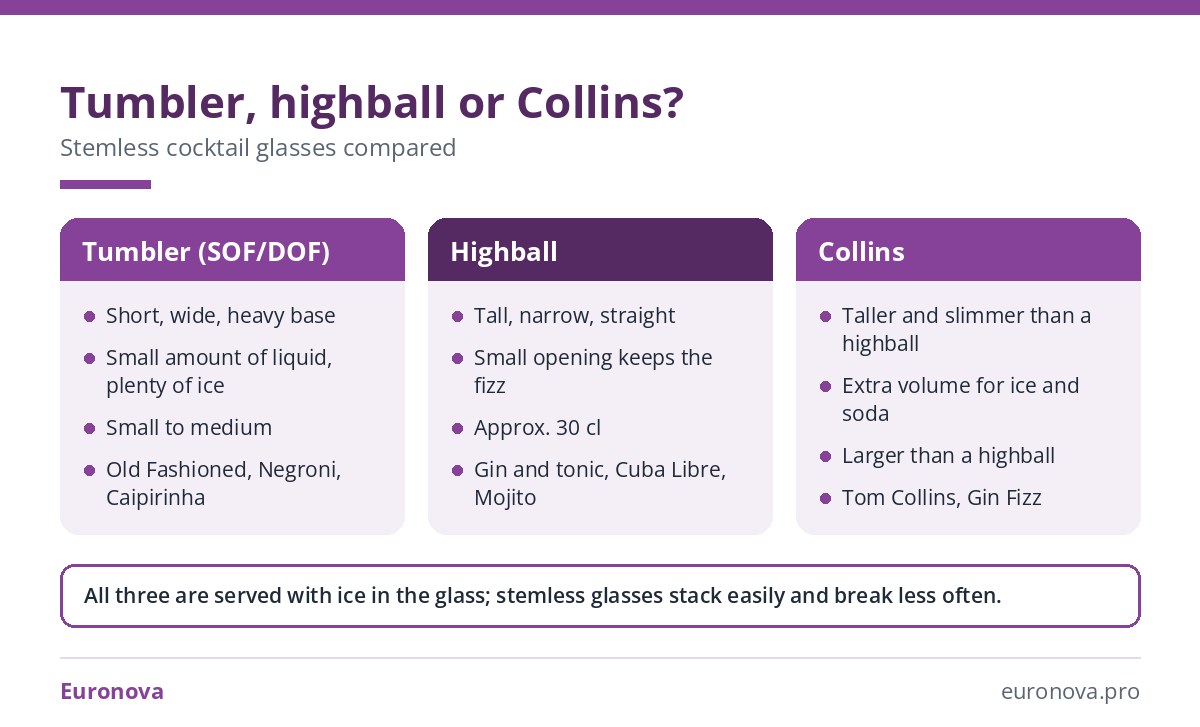
The tumbler is short, wide and has a heavy base. According to Schweppes Germany, the Single Old Fashioned (SOF) is ideal for a small amount of liquid with plenty of ice, so that classics such as the Old Fashioned, Negroni or Sazerac stay cold for a long time and dilute only slowly. The larger Double Old Fashioned (DOF) takes a large ice cube or crushed ice.
The walls do not narrow towards the top, so the drink can "breathe". That distinguishes the tumbler from a nosing glass for neat spirits.
Typical drinks: Old Fashioned, Negroni, Boulevardier, Whiskey Sour on the rocks, Caipirinha, Gin Basil Smash, White Russian.
Highball or long drink glass
The long drink glass is tall, narrow and straight. The shape is no accident: because the opening is small relative to the volume, little carbon dioxide escapes. That makes it the right choice for anything topped up with tonic, soda, ginger beer or cola. In practice, highball glasses usually hold around 30 cl, like our Dia 30 cl highball made of polycarbonate.
Typical drinks: gin and tonic, Cuba Libre, Mojito, Screwdriver, Dark ’n’ Stormy, Paloma, Long Island Iced Tea.
Collins glass
The Collins glass is the slightly taller, slimmer sibling of the highball, named after the Collins drinks. If your menu only has long drinks, a highball is often enough; if you serve fizzes and Collinses with plenty of ice and soda, the extra volume helps.
Typical drinks: Tom Collins, John Collins, Gin Fizz, Ramos Gin Fizz.
Speciality glasses: margarita, hurricane, balloon and more
Speciality glasses are not essential, but they sell. A drink in a distinctive glass gets shared in photos and ordered by guests at the next tables too.
- Margarita glass: the wide, two-tiered bowl resembles an upturned sombrero. It is meant mainly for frozen margaritas and offers plenty of rim for salt.
- Hurricane or fancy glass: bulbous, tall, with a short stem, named after the shape of old hurricane lamps. Ideal for large-volume fruity drinks with lots of garnish: Pina Colada, Hurricane, Singapore Sling, Sex on the Beach.
- Balloon glass: a large, round wine bowl with plenty of room for ice and aromas. The standard for Aperol Spritz, Hugo, Lillet Wild Berry and the Spanish-style gin and tonic.
- Copper mug: keeps the drink noticeably cold and goes with the Moscow Mule and Mint Julep.
- Tiki mug: colourful ceramic mugs for a Mai Tai, Zombie or Bahama Mama.
- Shot glass: for shots and layered drinks. The small 10 cl grappa glass with a fill line at 0.05 l also covers digestifs.
Overview: which glass for which cocktail
The classification in the table follows established bar practice, as summarised for example in the Miomente glassware guide. The capacities for the martini glass and coupe come from Wikipedia; the others are common guide values from bar practice.
| Glass | Shape | Ice in the glass | Usual size | Typical cocktails |
|---|---|---|---|---|
| Martini glass | V-shaped bowl, long stem | no | 150–200 ml | Dry Martini, Manhattan, Cosmopolitan |
| Cocktail coupe (coupette) | round, shallow bowl, stem | no | approx. 100 ml pour | Daiquiri, Sidecar, White Lady |
| Nick & Nora | small tulip, stem | no | small | stirred classics |
| Sparkling wine glass | slim bowl | no | approx. 18 cl | French 75, Kir Royal, Bellini |
| Tumbler (SOF/DOF) | short, wide, heavy base | yes | small to medium | Old Fashioned, Negroni, Caipirinha |
| Highball / long drink | tall, straight | yes | approx. 30 cl | gin and tonic, Cuba Libre, Mojito |
| Collins glass | taller and slimmer | yes | larger than a highball | Tom Collins, Gin Fizz |
| Margarita glass | two-tiered, wide bowl | mostly no | medium | Margarita, Frozen Margarita |
| Hurricane / fancy | bulbous, short stem | yes | large | Pina Colada, Hurricane, Singapore Sling |
| Balloon glass | large, round bowl | yes | large | Aperol Spritz, Hugo, gin and tonic |
| Copper mug | copper mug | yes | medium | Moscow Mule, Mint Julep |
| Tiki mug | ceramic mug | yes | medium to large | Mai Tai, Zombie |
Cocktail glasses in hospitality: what to look for
At home you can have a different glass for every drink. In a venue, other things count: number of pieces, breakage, the glasswasher, storage space and legal compliance.
Basic bar glassware
For most cocktail menus, five shapes are enough:
- Tumbler for short drinks on the rocks and neat spirits
- Highball for all long drinks
- Coupe or martini glass for everything "straight up"
- Balloon glass for spritzes and gin and tonic
- Sparkling wine glass for sparkling wine cocktails and receptions
Add one or two signature glasses, such as the hurricane or copper mug, if the menu includes the matching drinks. A simple calculation helps with quantities: how many drinks in this type of glass go out on a busy evening, and how long does the washing cycle take? Depending on your workflow, keep a multiple of the number of seats in circulation so that the bar never runs out of clean glasses.
Glass or shatterproof plastic?
For indoor areas with table service, classic glass remains the standard. On terraces, by the pool, on the beach, at festivals and events, many venues rely on polycarbonate or Tritan. These glasses look like glass but do not shatter. Options in our range include the Disco 28 cl martini-style cocktail glass and the larger Disco 40 cl cocktail glass for long drinks and fruity cocktails with lots of ice.
Fill lines and legal metrology rules
If you sell drinks by volume, national legal metrology rules in many countries require serving glassware that meets metrological requirements. Such rules typically cover vessels for carrying and pouring drinks (bottles, jugs) and for drinking (glasses), but not cups for tea, coffee and cocoa. The glass usually needs a clear, indelible fill line with the nominal capacity stated. This applies above all to long drinks, beer, wine and spirits listed on the menu with a stated volume. When buying, choose glasses with a suitable fill line, such as the Pasabahçe Draft beer glass marked 0.3 l. If you are unsure whether a glass is suitable for your menu, contact your national metrology authority.
Glasswasher, storage and chilling
- Check dishwasher resistance: in a venue, glasses go through the glasswasher several times a day.
- Stackability saves space under the bar. Stemless glasses have a clear advantage here.
- Pre-chill stemmed glasses: if you serve many short drinks without ice, plan space in a glass chiller.
- Repeat availability: a range you can reorder prevents mismatched glasses after the first months of breakage.
Around the glasses, a bar also needs shakers, bar strainers, jiggers and bar spoons. You will find them all among our cocktail bar tools.
Our view from practice
Every day we see how bars, hotels and catering companies buy glassware, and the pattern repeats itself: the menu is carefully planned, and the glasses come last. Yet the glass helps decide how the drink reaches the guest, how fast the bar works and how many glasses are still on the shelf after the season.
Our advice: start with a few basic shapes in large numbers rather than ten shapes in small quantities. A good highball, a sturdy tumbler and a coupe carry most of any cocktail menu. For the terrace, pool and events, a second set in polycarbonate or Tritan pays off, so you can serve outside just as you do inside.
For events where you need hundreds of glasses for one evening, we offer hire of glasses, plates and cutlery as well as sales. That way a catering company does not have to increase its stock for every large order.
Rok
Order cocktail glasses from Euronova
In our online shop you will find glasses and glassware for bars, restaurants, hotels and catering, from long drink and cocktail glasses to sparkling wine glasses and shatterproof polycarbonate and Tritan versions, as well as many brands such as Arcoroc.

Put together your basic glassware directly in the Euronova online shop, and for your next event take a look at our catering equipment hire.
FAQ
What types of cocktail glasses are there?
There are three families: stemmed glasses such as the martini glass, the coupe and the Nick & Nora; stemless glasses such as the tumbler, highball and Collins; and speciality glasses such as the margarita, hurricane and balloon glass, plus the copper mug and tiki mug. The shape depends on whether the drink is served with ice, how large it is and whether it is carbonated.
What glasses does a bar need at a minimum?
For most menus a tumbler, a highball, a coupe or martini glass, a balloon glass and a sparkling wine glass are enough. Add signature glasses such as the hurricane or copper mug only if the menu includes the matching drinks. Having enough pieces of each shape matters more than having many shapes.
What is the difference between a martini glass and a coupe?
A martini glass has a pointed, V-shaped bowl, while a coupe has a round, shallow bowl. Both are designed for chilled drinks served without ice. The coupe spills less when carried and suits sours and drinks with juice.
Can I serve a gin and tonic in a long drink glass?
Yes. A highball or long drink glass is in fact the classic choice, because the narrow opening keeps the carbon dioxide in the drink for longer. A balloon glass is the alternative for the Spanish-style serve with lots of ice and herbs.
Do cocktail glasses in hospitality need a fill line?
If you sell drinks by a stated volume, national legal metrology rules in many countries require serving glassware that meets metrological requirements, which usually means glasses with a fill line. This applies above all to long drinks, beer, wine and spirits. If in doubt, contact your national metrology authority.
Sources
- Wikipedia (DE): Cocktailglas
- Schweppes Germany: Folge 05 "Glasklar"
- Miomente: Welches Glas passt zu welchem Cocktail?