Making Cocktails Behind the Bar: Techniques, Bar Tools and Service
Making Cocktails Behind the Bar: Techniques, Bar Tools and Service

A good cocktail in a bar is above all a repeatable process. Every cocktail is measured, chilled with the right technique, served in the right glass and finished with a garnish that adds something to the flavour. Four things determine quality: a well-organised station, a handful of mastered techniques (shake, stir, build, muddle), accurate measures and clean ice. In this guide we go through everything step by step, from opening the bar to last orders. We have also added a list of bar tools, split into essential and optional depending on the size of your venue.
In brief
- The technique follows the ingredients. Juices, syrups and egg white are shaken in a shaker, spirit-only drinks are stirred with a spoon in a mixing glass, and simple long drinks are built directly in the glass.
- A jigger instead of guesswork. A jigger with internal markings gives the same taste and the same portion cost with every order.
- A garnish has to earn its place. Citrus peel, herbs or a salt rim should enhance the aroma of the cocktail, not just decorate it.
- Ice is an ingredient. It must be clean, stored in a clean container and replaced regularly during service.
- Choose equipment to match your volume. A small bar in a restaurant needs a different kit from a cocktail bar or drinks service at a 200-guest wedding.
Contents
- The bartender's station: order before the first ticket
- Bartending techniques behind every drinks menu
- Bar tools: what is essential and what is optional
- Glassware: a cocktail starts with the right glass
- Cocktail garnishes that add something
- Ice and station hygiene
- Our view on bar equipment
- Equip your bar with a single order
- Frequently asked questions about making cocktails in a bar
- Sources
The bartender's station: order before the first ticket
The fastest bartenders do not have faster hands. They have a better-organised station. Every tool is always in the same place, within arm's reach, and there is nothing unnecessary on the counter. Clutter and too much equipment slow service down, so a good station has a clearly defined place for everything.
Before opening, it makes sense to run through a standard checklist:
- Ice. A full ice bin, with a clean scoop kept outside the ice (never leave it buried in the cubes).
- Tools. Shaker, mixing glass, bar spoon, strainers and jiggers, washed and laid out in a fixed order.
- Mise en place. Sliced citrus, herbs, syrups and juices in closed containers, labelled and kept chilled.
- Glassware. The right types of glasses polished, some of them chilled in the fridge or freezer.
- Stock. Speed rail bottles topped up, straws, napkins and stirrers restocked.
Restocking at opening and keeping things tidy during service are the foundation of bar organisation, as the bar cleaning checklists used by venue maintenance companies also stress. Shallow GN containers work well for garnishes and mise en place: you can fit several kinds of fruit and herbs into one rail and move the whole lot into the fridge easily. A suitable option is the GN 1/4 gastronorm container, 20 mm deep.
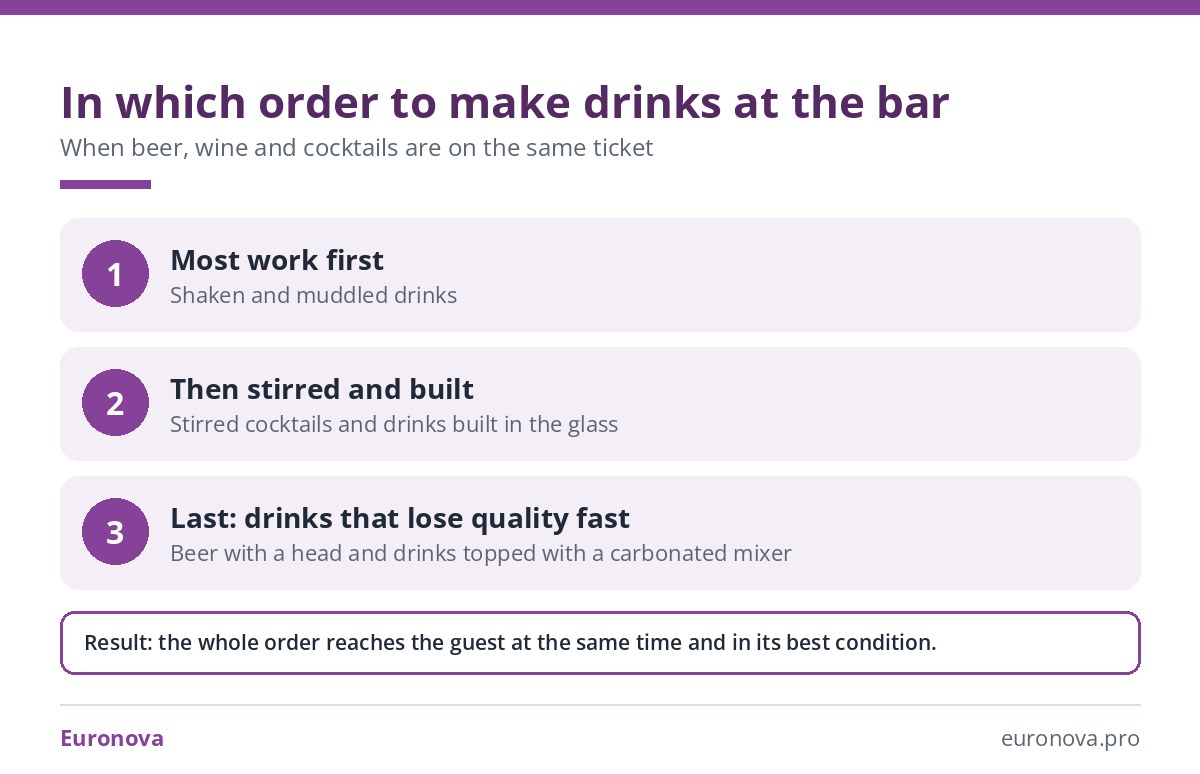
Order of preparation for multiple orders
When beer, wine and cocktails are all on the same ticket, set a fixed order. Start with the drinks that take the most work (shaken, muddled), then the stirred and built ones, and finish with the drinks that lose quality with every second: beer with a head and drinks topped with a carbonated mixer. That way the whole order reaches the guest at the same time and in its best condition.
Bartending techniques behind every drinks menu
Most classic and signature cocktails are made with just a few techniques. The choice depends on the ingredients and the texture you want to achieve.
| Technique | When to use it | Tools needed | Effect |
|---|---|---|---|
| Shaking | citrus juices, syrups, cream, egg white | shaker, Hawthorne strainer, fine strainer | chilling, aeration, slight dilution |
| Stirring | spirit-only drinks, vermouths, bitters | mixing glass, bar spoon, julep strainer | clear, smooth drink without aeration |
| Building | long drinks, highballs | jigger, bar spoon, serving glass | speed, ideal at busy times |
| Muddling | mint, fruit, sugar | muddler, sturdy glass or shaker | releases aroma and juice |
| Layering | shots and layered drinks | bar spoon, jigger | distinct coloured layers |
| Throwing | drinks to be aerated without shaking | two vessels, strainer | gentle aeration and chilling |
| Blending | frozen and fruit drinks | bar blender | thick, creamy consistency |
Shaking: in a cocktail shaker
A shaker combines ingredients that do not want to mix on their own: sour juice, thick syrup, spirits. The order matters. According to the Fine Wine cocktail catalogue, add the ice first, then the ingredients that need chilling, and the spirit last to avoid unnecessary dilution. Shake hard and briefly until the metal visibly frosts. Shaking for too long gives a watery drink. Then strain through a Hawthorne strainer, and if there were herbs or pips in the shaker, also through a fine strainer (double strain).
Stirring: in a mixing glass
Spirit-only cocktails such as a Martini, Manhattan or Negroni are stirred with a bar spoon in a mixing glass filled with ice. The movement is fluid, the spoon glides along the wall of the glass and the ice turns as one block. Stirring takes longer than shaking, does not aerate the drink and leaves it clear and silky. Serve in a chilled stemmed glass or over a large ice cube.

Building, muddling and layering
Building is the fastest technique: ice into the glass, a measured spirit, a top-up of mixer and a short stir. Most drinks at a busy bar are made this way, from a gin and tonic to a Cuba Libre.
Muddling takes a light touch. Herbs such as mint should be pressed gently and twisted slightly rather than crushed. Crushed leaves release bitter, astringent notes that ruin a Mojito. Citrus can be muddled harder, because you are after the juice and the oils in the peel.
Layering relies on the density of liquids. The heaviest ingredients, such as syrups and high-sugar liqueurs, go to the bottom, and lighter spirits on top. Pour slowly over the back of a bar spoon held against the inside of the glass.
Throwing means pouring the mixture from one vessel into another, as also described in the Fine Wine catalogue. The drink is aerated but stays clearer than after shaking. The technique also impresses guests sitting at the bar.
Bar tools: what is essential and what is optional
The set of tools you need depends on what you serve and how much. A hotel bar with a short list of classics needs less than a cocktail bar with a signature menu, while wedding catering needs above all consistency and spare stock.
| Tool | Restaurant / café bar | Cocktail bar | Catering and events |
|---|---|---|---|
| Shaker (Boston or three-piece cobbler) | essential, 1–2 pieces | essential, 2 per station | essential, with spares |
| Bar jigger | essential | essential, several sizes | essential at every station |
| Bar spoon | essential | essential | essential |
| Mixing glass | optional | essential | optional |
| Hawthorne strainer and fine strainer | essential | essential | essential |
| Muddler | essential if you serve Mojitos | essential | essential |
| Board and knife for citrus | essential | essential | essential |
| Citrus squeezer | optional | essential | essential |
| Ice bin and scoop | essential | essential | essential, larger capacities |
| Pourers | optional | essential | essential |
| Bar blender | optional | optional | depends on the menu |
| Citrus zester, peeler, garnish tweezers | optional | essential | optional |
| Straws, stirrers, cocktail picks | essential | essential | essential in large quantities |
When buying, think about what happens at peak times: each station should have its own set of tools so nobody has to borrow from a colleague. Two shakers per bartender mean one drink can be made while the other shaker waits to be washed. For events where you need the equipment for just one evening, catering equipment hire is the answer.
Bar jiggers: how to choose and use them
The jigger is the tool that pays for itself fastest. Free-pouring means the same drink is too strong one time and too sweet the next, and the portion cost gets out of control. When choosing a jigger, look at three things:
- Internal markings. A good jigger has internal markings every 5 ml, so you can measure smaller amounts of syrup or juice with the same jigger.
- Two volumes. A double-sided jigger covers the standard serve and half of it, which speeds up work on recipes with several ingredients.
- Volumes that match your menu. Choose jiggers according to the serves on your menu so every bartender pours exactly what the guest pays for.
Always hold the jigger over the shaker or glass, fill it to the brim and empty it in one decisive movement. Pour thick ingredients such as syrup or liqueur out completely, as they cling to the sides. When training new bar staff, it makes sense to start by checking pouring accuracy: it is the simplest way to keep portion costs under control.
Glassware: a cocktail starts with the right glass
The glass affects the temperature, the aroma and the guest's impression. A few basic types cover most menus:
- Stemmed glasses for cocktails served without ice. The stem protects the drink from the warmth of the hand. For stirred classics, the Hudson Nick & Nora 17 cl glass works well: slim and practical for service.
- Low glasses for drinks on ice. An Old Fashioned, a Negroni over a large cube or a whisky sour. A versatile choice is the Hill 30 cl tumbler.
- Tall glasses for long drinks. Highballs, Mojitos, drinks with tonic.
- Polycarbonate glasses for terraces, beaches and events. Where ordinary glass is a risk, good options include the Disco 28 cl martini-style cocktail glass or the 25 cl polycarbonate disco tumbler.
Keep glasses for drinks served without ice in the fridge, or chill them with ice and water while you make the drink. A warm glass will warm up even a perfectly stirred cocktail within a few minutes.
Cocktail garnishes that add something
A garnish is part of the recipe, not an ornament. A good garnish enhances the flavour or aroma of the cocktail, while a poorly chosen or excessive one can spoil the impression. The authors of the Epicurious guide to cocktail garnishes take a similar view: a garnish should be chosen deliberately, to match the profile of the drink.
The most common garnishes in a bar:
- Citrus peel twist. A strip of peel expressed over the drink releases essential oils that the guest notices with the first sip. Cut without the white pith, as it is bitter.
- Fruit slices and wedges. Lime for rum and tequila drinks, orange for drinks with bitters, lemon for sour-style classics.
- Herb sprigs. A sprig of mint or rosemary right next to the straw works on the nose. Give it a light slap between your palms before serving.
- Salt or sugar rim. Moisten only the outer rim of the glass so the salt does not fall into the drink. Ideally coat half the rim so guests can choose for themselves.
- Straws, cocktail picks and stirrers. The practical part of the garnish, which should suit the character of the venue.
Prepare garnishes before service in quantities for a few hours, keep them chilled in closed containers and top them up as you go.
Ice and station hygiene
Ice is sometimes called the fifth ingredient of a cocktail, and it should be treated as such. Good bar practice calls for clean ice, storage in sanitised containers and replacement roughly every 4 hours during service. A few rules worth writing into your venue's procedures:
- Only scoop ice with a scoop, never with a glass: a shard of glass in the ice means discarding the entire bin.
- Keep the scoop in a separate holder; do not leave it in the ice.
- Use fresh ice for the shaker and for the glass. Ice from the shaker never goes back into a drink served on ice.
- Wash and sanitise glasses after every use, and clean counters, sinks and tools continuously during the shift. You will find rules like these in daily bar cleaning checklists.
- Clean back bar fridges and garnish containers on a fixed schedule, ideally at closing.
The detailed hygiene rules in your venue follow from its HACCP system. Agree washing frequencies, storage temperatures and ice-handling procedures with the person responsible for HACCP, and record them in the documentation that your local food safety authority checks during inspections.
Our view on bar equipment
Every day we equip restaurants, hotels, bars, cafés and catering companies, so we see how bars come together: from the first order to every top-up that follows. The most common mistake is buying equipment piece by piece, at the last minute and from different sources. Then it turns out the glasses do not match the jigger volumes, and at peak time a second shaker is missing.
That is why we advise starting with the menu. First the list of drinks, then the techniques you need for them, and finally the tools and glassware chosen for those techniques and serves. A kit like this, bought in one place, is consistent, easier to top up and easier to train your team on.
We put our range together for exactly these needs: stemware and tumblers for the classics, polycarbonate glasses for terraces and events, bar and barista tools, straws and garnishes, and GN containers for mise en place and back-of-house equipment. The same applies to new venues and to bars that have been running for years: ordering should be simple, and wholesale prices should keep the portion cost where the menu expects it to be.
Rok
Equip your bar with a single order
Whether you are fitting out a bar from scratch or restocking before the season, at Euronova you will find cocktail glasses, bar tools, straws and garnishes, as well as GN containers, kitchenware and HoReCa equipment for the back of house, all in one place. We offer competitive wholesale prices for hospitality venues, hotels, catering companies and distributors.

Start with the food service range in the Euronova online shop, and for a one-night event check out our catering equipment hire.
Frequently asked questions about making cocktails in a bar
When should a cocktail be shaken and when stirred?
Shake drinks containing juices, syrups, cream or egg white, as these ingredients need to be vigorously combined and aerated. Stir spirit-only cocktails such as a Martini or Negroni with a bar spoon in a mixing glass so they stay clear and smooth.
Which bar tools should I buy to start with?
To start with, a shaker, a jigger with markings, a bar spoon, a Hawthorne strainer and a fine strainer, a muddler, a board and knife for citrus, and an ice bin with a scoop are enough. Add a mixing glass, pourers, a peeler and a blender as your menu grows.
Why use a jigger if an experienced bartender free-pours?
A jigger delivers the same taste with every order, no matter who is behind the bar. It also allows an accurate calculation of portion cost and faster training of new staff.
How should cocktail garnishes be prepared before service?
Slice citrus, prepare twists and herbs for a few hours of service, keep them chilled in closed containers and top them up during the shift. Shallow GN containers make it easy to keep everything in one place at the station.
Which glasses work best on terraces and at events?
Where ordinary glass breaks easily, for example on terraces, by pools and at outdoor events, venues choose polycarbonate or Tritan glasses. Our range includes both cocktail shapes and long drink glasses.
Sources
- Fine Wine: Katalog koktajle (PDF)
- European Bartender School: Cocktail Muddler
- European Bartender School: 7 Cocktail Garnish Ideas
- Decanter: Cocktails at home, your home bar basics
- Epicurious: A Pro’s Guide to Cocktail Garnishes
- Cocktail Recipe & Techniques Guide (PDF)
- Bar Cleaning Checklist: Daily Bar & Pub Cleaning Guide