Catering Portion Calculator: Food Quantities per Person for a Buffet
Catering portion calculation: food quantities per person for a buffet

You calculate catering portions with a simple formula: grams per person × number of calculation guests (children pro rata) + a small reserve. If you add up the professional guideline values for the main course, sides and dessert, a buffet served as a main meal comes to roughly 500 to 800 g per adult. For a finger food-only buffet, you count pieces instead of grams. Below you will find values per course, a worked example for 80 guests and how to convert the quantities into the number of plates, cups and GN containers you need to prepare.
At a glance
- Formula: quantity per person × (adults + children × 0.5) × (1 + reserve). If you plan tightly, allow a 0 to 10% reserve.
- Guideline values per course: main course meat 100 to 150 g, starchy side 100 to 250 g, vegetables 200 to 250 g, dessert 100 to 150 g per person.
- Finger food: 5 to 7 pieces for a reception of about two hours, around 12 pieces if finger food carries the whole evening.
- Less waste: offer more variety in small quantities rather than large bowls of a few dishes, and plan bread as an inexpensive filler.
- Factor in the equipment: your quantity plan tells you directly how many plates, glasses, cups and containers you need.
Contents
- The basic formula in three steps
- Guideline values per person and course
- Cold, hot and hot-and-cold buffets
- Finger food: pieces instead of grams
- Factoring in children, time of day and duration
- Worked example: company party with 80 guests
- Reserve or tight calculation?
- From grams to tableware: factor in the equipment
- Our view from practice
- Frequently asked questions
- Sources
The basic formula in three steps
Whether it is a wedding with 150 guests, a company anniversary in a hotel or lunch at a nursery: quantity planning always follows the same process.
- Determine the number of calculation guests. Adults count in full. Children count as roughly half, small children as less, teenagers almost as adults. So 60 adults and 20 children make 70 calculation guests.
- Set the quantity per person for each component. Not a flat "600 g of food", but separately for soup, meat or fish, sides, vegetables, salad, bread and dessert. Only then does the plan become a shopping and production list.
- Multiply and decide on the reserve. Number of guests × quantity per component gives the total in kilograms or litres. Then decide deliberately whether to add a reserve, and how much.
The second step matters most. A single total per person is handy for a first estimate, but the kitchen needs quantities per component; otherwise you end up with five kilograms too much potato gratin and too few vegetables.
Guideline values per person and course
The table below summarises a professional calculation that the magazine top agrar published based on advice from culinary experts. The values apply per adult for a set menu or a buffet served as a main meal.
| Component | Quantity per person |
|---|---|
| Starter: salad | 100–150 g |
| Starter: soup | 200–250 ml |
| Main course: stew or soup | 300–500 ml |
| Main course: meat | 100–150 g |
| Main course: fish fillet | 125–200 g |
| Starchy side (potatoes, rice, pasta) | 100–250 g |
| Vegetable side | 200–250 g |
| Dessert | 100–150 g |
How to read the ranges: use the lower value when there are many components, at lunchtime or when the programme takes centre stage. Use the upper value with few dishes, in the evening, for long events and for guests who have done physical work, for example at a volunteers' celebration or a party for a trades business.
For vegetables, the values refer to the ready-to-eat quantity. The German consumer association's portion planner points out that, depending on the vegetable, you need to buy more, because trimming and preparation create waste. With broccoli, leeks or asparagus, the difference between purchase weight and plate weight is considerable.
Cold, hot and hot-and-cold buffets
At a buffet, the grams are distributed differently than with plated service, because guests take a little of everything. The Küchengötter portal lists for a cold buffet, per person, among other things:
- approx. 200 g meat or fish
- approx. 100 g dips and sauces
- 200–250 g assorted salads
- 50 g cheese
- 150 g bread
- 150 g dessert
For a hot-and-cold buffet, the quantities shift: the list per person there is 150–200 ml soup, 100 g salads, 80 g terrine or pâté, 150–250 g meat, 250 g vegetable sides, plus 100 g creamy and 100 g fruit dessert.
The difference in bread and salad stands out. At a cold buffet they are the main players; at a hot-and-cold buffet, hot sides and vegetables take over that role. If you are planning a cold buffet, be more generous with bread, cold cuts and salads. If you serve hot food, plan the sides around the capacity of your hot-holding containers: one full GN container that stays hot to the end is worth more than three that look tired after an hour.
Lunchtime or evening?
A lunchtime buffet is usually smaller than an evening one, especially if work continues afterwards or a seminar follows. At lunchtime, work with the lower end of the ranges and reduce the number of components rather than the portions per dish. In the evening, with drinks and an open end, demand is closer to the upper end.
Finger food: pieces instead of grams
Nobody thinks in grams with finger food, but in pieces. The quantities depend almost entirely on whether the finger food replaces a meal or accompanies one. Küchengötter calculates 5 to 7 pieces per person for a small finger food reception of about two hours, and about 12 pieces per person for a finger food buffet that lasts the whole evening.
| Occasion | Pieces per person |
|---|---|
| Sparkling wine reception before a set menu | closer to the lower end, approx. 4–5 |
| Reception, approx. 2 hours | 5–7 |
| Finger food buffet as a full meal | approx. 12 |
The reception row is our own derivation: if a set menu follows, the canapés should whet the appetite, not fill guests up.
In practice: a "piece" is a portion eaten in one or two bites or spooned from a small dish. It helps to allocate the pieces to containers when planning. Savoury salads, bowls or creams go into finger food cups; skewers and canapés onto platters. With cups, the volume determines how many grams you count per piece. A 180 ml finger food cup suits small portions of salad or dessert, while a 250 ml cup is for portions that are almost a small meal. If you prepare in advance and transport, finger food cups with lids are practical because they stack and can be kept chilled.

Factoring in children, time of day and duration
Flat values rarely fit every group of guests. Three factors shift the quantities most:
Age of guests. Children eat less, teenagers often more than expected. The quantity calculation by the Catholic rural youth organisation KLJB Freiburg gives average values for groups of children and notes that quantities for teenagers and adults can be increased slightly. As examples, it gives per person 100–150 g bread, 200 g pudding, 125 g quark dessert or 200 g fruit salad. For schools, nurseries and care homes, a separate look is worthwhile anyway: the menu and portion sizes in educational and care settings are usually framed by national dietary guidelines for institutional catering, so check the rules that apply in your country.
Time of day and programme. People eat less at lunchtime and at events with a packed programme. In the evening, when the food is the focus, they eat more.
Duration and drinks. The longer the buffet is open and the more alcohol flows, the more often guests go back for a second or third helping. For open-ended celebrations, a midnight snack such as soup or open sandwiches pays off more than enlarging the main buffet.
Dietary preferences. Ask about vegetarian, vegan and allergy-related requests in advance, and plan these dishes with full portions rather than as an afterthought. The German consumer association's portion planner lets you weight children and older guests and choose between menus with and without meat. It works well as a check on your own calculation.
Worked example: company party with 80 guests
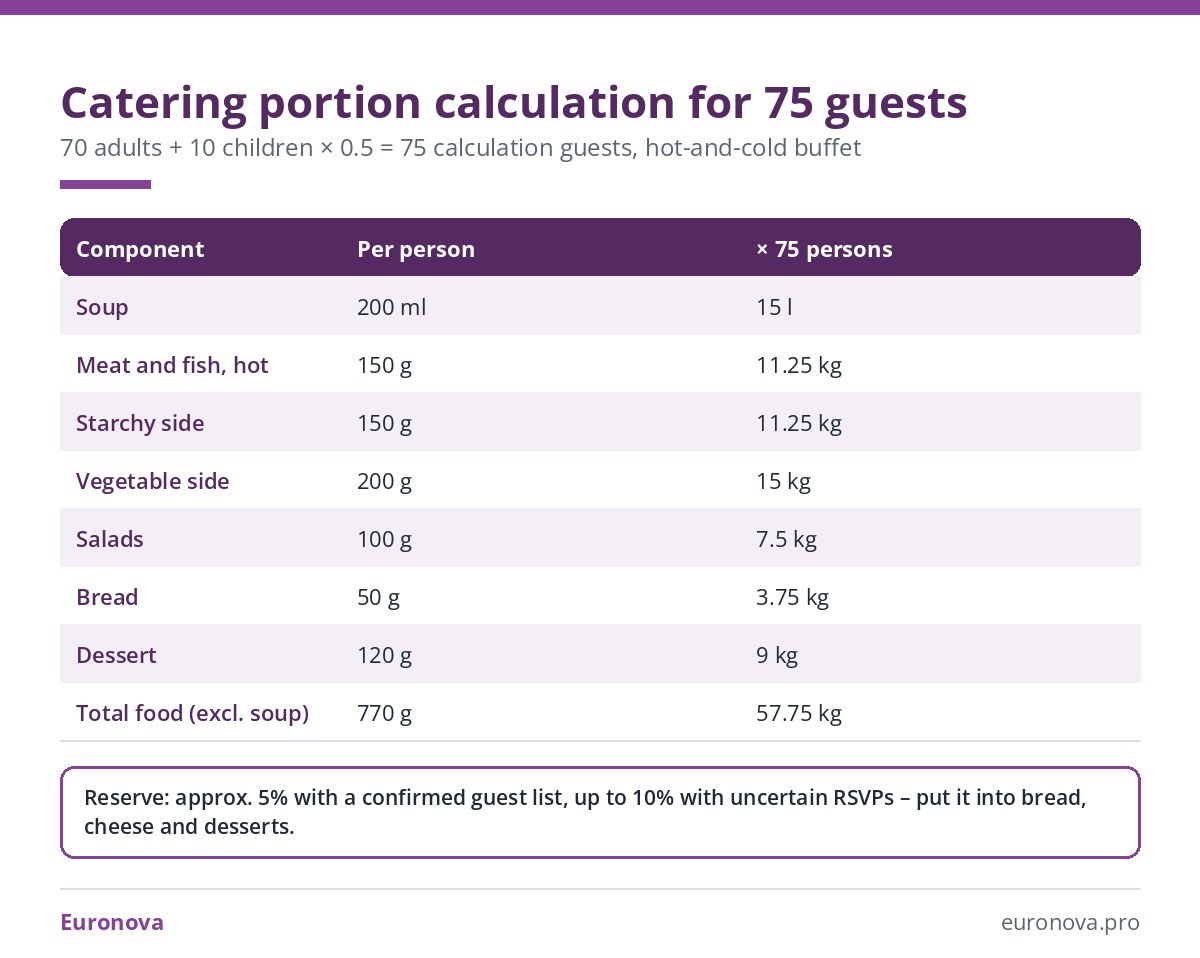
Suppose a hotel is hosting an evening party with a hot-and-cold buffet: 70 adults and 10 children, starting at 7 pm, open end.
Step 1: calculation guests. 70 + (10 × 0.5) = 75 persons.
Steps 2 and 3: quantities per component. We use values from the middle of the professional ranges.
| Component | per person | × 75 persons |
|---|---|---|
| Soup | 200 ml | 15 l |
| Meat and fish, hot | 150 g | 11.25 kg |
| Starchy side | 150 g | 11.25 kg |
| Vegetable side | 200 g | 15 kg |
| Salads | 100 g | 7.5 kg |
| Bread | 50 g | 3.75 kg |
| Dessert | 120 g | 9 kg |
| Total food (excluding soup) | 770 g | 57.75 kg |
Reserve. With a confirmed guest list, a small top-up of about 5% on the main components is enough, i.e. roughly 0.6 kg more meat and 0.6 kg more sides. With uncertain RSVPs go up to 10%, but put the safety margin into components that keep, such as bread, cheese and desserts, which can still be used the next day.
Purchasing. For vegetables, add trimming loss on top of the 15 kg of ready-to-eat produce. For meat, plan for cooking loss, which depends on the cut and cooking method.
At around 770 g per person, this example sits at the upper end of the range from the introduction, because a full evening with soup, bread and dessert is planned. This is exactly why calculating by component pays off: you immediately see where you can cut back, for example reducing vegetables to 150 g if salads are also served.
Reserve or tight calculation?
In catering, too much food is a more common mistake than too little. According to the German Federal Ministry of Agriculture, almost 10.8 million tonnes of food waste were generated in Germany in 2022, of which 18 percent, or about 2 million tonnes, came from out-of-home catering.
The German consumer association cites overproduction and oversized portions as recurring causes. With buffets, there is the added problem that hot dishes and salads quickly look unappetising and get replaced.
A catering guide for cultural venues goes even further: it recommends calculating quantities tightly instead of adding a flat safety margin and, depending on whether it is a main meal or an interval snack, calculating for 15 to 20% fewer guests. Its example: for 50 guests, cater for 40.
In practice, this means:
- Top up little and often, don't overfill. Smaller containers that are swapped more frequently keep the buffet fresh and leftovers small.
- Variety before quantity. Verbraucherzentrale advises increasing the choice rather than the quantities when in doubt. Bread is a good filler.
- Smaller plates at the buffet. Guests who approach the buffet with a smaller plate take smaller portions and would rather come back.
- Use leftovers safely. Unserved dishes can be stored chilled or offered to guests to take away, provided hygiene and the cold chain allow it. Have suitable takeaway food packaging ready for this.
From grams to tableware: factor in the equipment
Once the quantities are set, a second calculation follows that is often forgotten: what will the food be cooked, transported, presented and eaten in? Our example gives roughly 11 kg of meat and 11 kg of sides, which are cooked in GN containers and kept hot on the buffet. A porcelain GN 1/1 container, 68 mm deep, fits standard chafing dishes and looks good on the buffet at the same time.

Add plates in two sizes, for example a 27 cm flat plate for the main course and a 21 cm flat plate for starters, salad and dessert. Plan bowls for soup and dessert, and cups or glasses for a dessert buffet, depending on the concept. Because guests visit the buffet several times, we allow more plates than guests, so that used tableware never goes back to the table.
At Euronova we offer everything between the quantity plan and the buffet: porcelain and tableware, glassware, cutlery, GN containers, disposables and finger food items, as well as food storage and transport solutions. For one-off events, you can also hire plates, glasses and cutlery from us instead of buying them.

Put together your equipment directly in the Euronova online shop; for finger food occasions, the quickest route is the disposable finger food category.
Our view from practice
We talk every day with restaurants, hotels, caterers and kitchens in schools and care homes. One thing strikes us again and again: the quantity planning is often carefully calculated, but the equipment is guessed. Then, in the evening, the dessert cups run out or a hot-holding container is missing, and even the best calculation spreadsheet no longer helps.
Our advice: treat tableware, glassware and containers as part of the same calculation. If you are planning for 75 calculation guests, write down next to each food component the container it is prepared, stored, presented and eaten in. Small portions in suitable finger food cups, GN containers of the right depth and enough plates in two sizes are not a side issue. They are the tools that let you calculate tightly without the buffet looking empty.
That is why we have built our range so that you can order or hire everything for an occasion in one place.
Rok
Frequently asked questions
How many grams of food per person should you allow for a buffet?
If you add up the professional guideline values for meat, sides, vegetables and dessert, a buffet served as a main meal comes to roughly 500 to 800 g per adult, depending on the number of components. At lunchtime or alongside a busy programme, less is enough. It is best to calculate each component separately: around 100 to 150 g of meat and 200 to 250 g of vegetables per person.
How many canapés do you need per guest?
For a reception of about two hours, allow 5 to 7 pieces per person. If finger food replaces dinner, allow around 12. Before a set menu, fewer are needed, as the canapés should only stimulate the appetite.
How should children be counted when planning food quantities?
We recommend counting each child as roughly half an adult portion. Small children eat less, teenagers almost as much as adults. So 40 adults and 10 children make 45 calculation guests.
How much reserve food should you plan?
With a fixed guest list, 0 to 5% is enough; with uncertain RSVPs, around 10%. Put the reserve into components that keep well, such as bread, cheese or desserts. If you want to consistently avoid food waste, calculate tightly and, when in doubt, increase the variety rather than the quantity.
Sources
- top agrar: Passend portioniert
- Küchengötter: Buffet richtig planen
- Verbraucherzentrale: Portionsplaner
- Verbraucherzentrale: Essen außer Haus – was in Töpfen und auf den Tellern bleibt
- KLJB Freiburg: Mengenkalkulation
- BMLEH: Lebensmittelabfälle in Deutschland
- Catering-Leitfaden für Kulturbetriebe und -veranstaltungen