How to Lay Cutlery Correctly: Table Setting Rules, Measurements and Order
How to lay cutlery correctly: rules, measurements and order

The basic rule of table setting is: forks go to the left of the plate, knives and spoons to the right, and the knife blade always faces the plate. Guests work from the outside in, course by course. Dessert cutlery lies horizontally above the plate. All handles end about 1 cm from the edge of the table, and the pieces lie parallel with equal spacing. Below you will find the measurements, the order for three- to five-course menus, where the glasses go and a workflow that lets service staff set an entire banquet table quickly and consistently.
At a glance
- Side rule: what the guest holds in the left hand lies on the left (forks). What they hold in the right hand lies on the right (knives, soup spoon). The blade faces inwards.
- Order: guests use cutlery from the outside in. So you lay it the other way round, from the main course outwards.
- Maximum number: no more than four pieces on the right, three on the left and two at the top. If the menu needs more, cutlery is added during the meal.
- Measurements: handles end about 1 cm from the table edge, the gap between knife and fork is about 28 to 32 cm, and each guest needs a cover width of 60 to 80 cm.
- Glasses: stand at the top right. The lead glass for the main course stands above the knife tip; the other glasses are aligned with it.
Contents
- The basic rule: forks left, knife and spoon right
- Spacing and measurements at a glance
- Cutlery order for multi-course menus
- Dessert cutlery, soup spoon and butter knife
- Correct placement of glasses and napkin
- How service staff set a banquet table
- Table setting by occasion and type of venue
- One-sided or two-sided setting?
- Our view from food service purchasing
- Cutlery, plates and glasses for your table setting
- Table setting FAQ
- Sources
The basic rule: forks left, knife and spoon right
The logic is simple. A right-handed person cuts with the right hand and holds the fork in the left. So all forks lie to the left of the plate, and all knives and soup spoons to the right. The knife blade faces the plate so that nobody touches the blade when reaching for it, and so the cover looks neat and complete.
When eating, the guest works from the outside in. The cutlery for the first course therefore lies furthest out, and the cutlery for the main course right next to the plate. Planet Wissen sums up the hospitality rule like this: a maximum of four pieces of cutlery on the right, three on the left, two at the top and only exceptionally three. Anything more is added course by course. This is not penny-pinching. A cover with eight pieces side by side is cluttered, takes up more space than the cover width allows and makes it harder for the guest to choose.
Special cutlery such as sorbet spoons or gourmet spoons is not on the table from the start. It arrives with the dish it is intended for.
Spacing and measurements at a glance
In service, a table with uneven spacing stands out immediately, especially on long tables with many covers side by side. These values have become established in training and practice:
| Element | Guideline value | Practical tip |
|---|---|---|
| Distance of handle from table edge | approx. 1 cm | rule of thumb: one thumb's width |
| Spacing between pieces of cutlery | even, very narrow | rule of thumb: about the thickness of a postcard |
| Inner gap knife–fork | approx. 28 to 32 cm | space for the charger or main plate |
| Cover width per guest | 60 to 80 cm | measured from plate centre to plate centre |
| Charger plate to table edge | approx. 1 cm | diameter at least 30 cm |
| Charger plate relative to main plate | approx. 2 cm larger | so the rim remains visible |
The exam guidelines of the IHK Trier chamber of commerce for setting a banquet table specify a base line 1 cm from the table edge. All pieces of cutlery lie parallel, straight, at right angles to the table edge and with equal spacing. The thumb-width and postcard rules of thumb are described by hotelfach.de. For the inner gap, the German Gastronomic Academy gives approximately 28 to 32 cm.
The cover width of 60 to 80 cm and the charger plate measurements come from the table setting tips in Gastgewerbe-Magazin. The cover width also determines how many guests fit at a table. At 70 cm, four guests sit on each long side of a 2.80 m table; at 60 cm, almost five. For banquets in particular, it pays to do this calculation before you set up the tables.
Cutlery order for multi-course menus
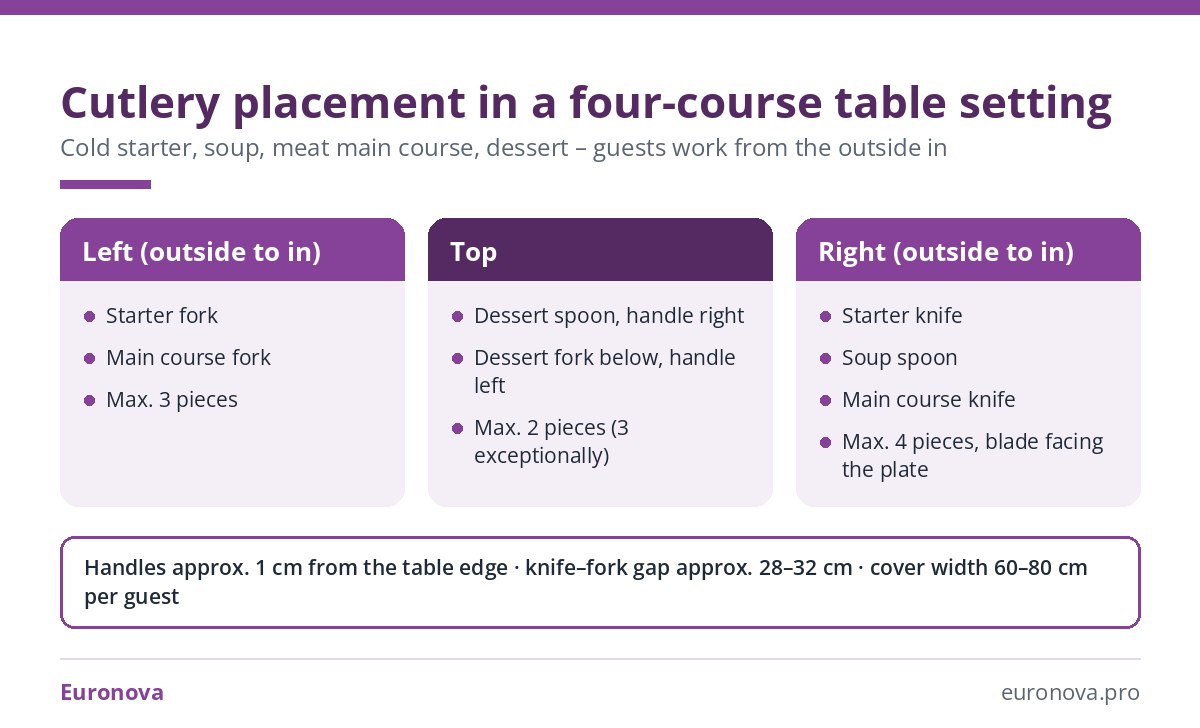
The quickest way to learn the order is with an example. Take a classic four-course menu: cold starter, soup, meat main course and dessert.
| Position | From the outside in |
|---|---|
| Right | starter knife, soup spoon, main course knife |
| Left | starter fork, main course fork |
| Top | dessert spoon, with the dessert fork below it |
That makes three pieces on the right, two on the left and two at the top, so the cover stays under the maximum. If a fish course comes between the soup and the main course, the right side holds the starter knife, soup spoon, fish knife and main course knife, and the left the starter fork, fish fork and main course fork. That is four pieces on the right and three on the left, and the cover is full. A sixth course, such as an intermediate dish or sorbet, is added during the meal.
Cutlery is added from the side on which it will later lie: knives and spoons from the right, forks from the left. For multi-course menus, cutlery can also be presented on a service plate. This is handy when the table is already full or a course is prepared at the table.
Common mistakes in cutlery order
- Soup spoon too far in: if soup is the first course, the spoon lies on the far right. If it follows a cold starter, it lies between the starter knife and the main course knife.
- Forgotten fish cutlery: if you serve a fish dish, lay a fish knife and fish fork, not simply another set of table cutlery.
- Too much at once: more than four pieces on the right looks overcrowded and confuses the guest.
Dessert cutlery, soup spoon and butter knife
Dessert cutlery lies above the plate, parallel to the table edge. The rule: the handle points towards the hand that will later hold the piece. The dessert spoon lies at the top with its handle to the right, the dessert fork below it with its handle to the left. Before dessert, service staff draw both pieces down, the fork to the left and the spoon to the right. If only one piece is needed, for example a spoon for mousse or ice cream, only that one lies at the top.
The soup spoon belongs on the right, in the position that matches its course on the menu. If soup is served in a cup with a saucer, the matching spoon is often brought with it rather than laid in advance.
The bread plate and butter knife go on the left. According to Gastgewerbe-Magazin, the bread or side salad plate stands on the left side of the cover. The butter knife lies vertically on the right edge of the bread plate with the blade facing left. At the top, the bread plate is aligned with the main course plate. A small flat plate makes a good bread plate, for example the Banquet plate, 17 cm diameter, or the 19 cm version.
Correct placement of glasses and napkin
Glasses stand at the top right of the cover, on the side of the drinking hand. The starting point is the lead glass: the wine glass for the main course. It stands above the tip of the main course knife. The water glass stands to the left above the lead glass. Other wine glasses are arranged in the order of the courses, so guest and server always know which glass is next.
In practice, three glasses per cover have proven themselves: water, white wine and red wine. Add a sparkling wine glass for the aperitif or a dessert wine glass if the menu calls for it. More glasses get in each other's way, and the server changes the glass anyway when the drink changes.
In a formal setting, the napkin lies on the charger plate, centred between knife and fork. If the plate is already set with the starter, place it to the left of the forks. IHK Trier even uses a 50 cm napkin folded into quarters as a measuring aid for the centre of the cover. More on this below.
How service staff set a banquet table
At a table with 40 covers, it is not just the result that counts but also the process. Anyone who completes one cover and then the next needs more time and works less precisely than a team that goes round the table piece by piece. This workflow has proven itself:
- Check the room: light, smell and room temperature, then align tables and chairs. hotelfach.de describes this as the first step.
- Lay the table linen: the tablecloth lies flat, the centre crease faces up and the overhang is equal on all sides.
- Mark the centre of the cover: according to IHK Trier, a 50 cm napkin folded into quarters serves as the measure. Add 2 cm at the top and bottom and 1 cm on each side. Alternatively, place the charger plate as the centre, about 1 cm from the table edge.
- Lay the knives: go round the table clockwise and lay all the main course knives first. The German Gastronomic Academy recommends laying the knife first and then the fork. The old method of measuring the inner gap with a knife is no longer common, because knives in modern cutlery ranges are shorter than they used to be.
- Lay the forks: then all the main course forks, with an inner gap of 28 to 32 cm from the knife.
- Other courses from the inside out: IHK Trier gives the order hot starter, soup spoon, cold starter and finally the dessert cutlery at the top.
- Bread plate and butter knife: top left, aligned with the main course plate.
- Glasses: first the lead glass above the knife tip, then the other glasses aligned with it.
- Napkins, menu cards, decoration: last, so that nothing gets knocked over while setting.
- Check: stand at the head of the table and check the lines. Handles, plate rims and glasses should form a straight line along the whole length.
A tip from practice: carry cutlery on a tray with a napkin or in a cutlery basket. Hold it only by the handle and polish it beforehand. Fingerprints on a blade are very visible by candlelight.
Table setting by occasion and type of venue
Not every venue needs a full menu cover. What matters is what the guest orders and when they receive it.
A la carte restaurant: the basic cover usually consists of a knife, fork, bread plate and one glass. Whatever the guest then orders, the server adds or swaps according to the order, for example a soup spoon, fish cutlery or a steak knife. That way there is never unused cutlery on the table.
Banquet and wedding: the menu is set in advance, so everything is laid up to the maximum. This is where a charger plate pays off, for example the Banquet plate 30 cm, together with a slightly smaller main plate such as the Banquet plate 27 cm. The starter plate, soup cup and main plate then follow one another on the charger.
Café and breakfast: in a coffee setting, the cup stands on its saucer to the right of the cake plate, with the teaspoon on the saucer, handle pointing right. The cake fork lies to the right of the plate or on the plate itself.
Pizzeria and bistro: simple table cutlery is enough, often with a sharp knife for pizza. More important than the details is that every cover looks the same and can be reset quickly.
Catering, contract catering and takeaway: at standing receptions, in schools or nurseries and at outdoor events, durability and speed count. Unbreakable glasses such as the Disco polycarbonate water glass, or disposable cutlery for serving counters and takeaway, follow the same side rule. Even a napkin pouch with knife and fork is offered so that the guest takes the fork with the left hand and the knife with the right.

One-sided or two-sided setting?
Two-sided is usual when a dish is eaten with knife and fork: fork on the left, knife on the right. You set one-sided when only one piece of cutlery is needed. A single soup spoon lies on the right, a single dessert spoon at the top. In a coffee setting, everything lies on one side.
For left-handed guests, the cover can be mirrored. Planet Wissen describes setting a mirrored cover for left-handers as a nice gesture. In a restaurant, this is possible if the guest mentions it when booking or the server notices it. At a banquet table, the overall picture stays uniform and the guest can rearrange the cutlery if needed.
Our view from food service purchasing
If you want to lay cutlery correctly, you first need the right equipment. Many problems that count as service mistakes actually start with purchasing. A cover only looks calm if all the pieces come from one range and match in length, weight and shape. If the knife is shorter than the fork, the base line along the table edge is never quite right.
In restaurants and hotels we often see cutlery bought as needed, with tableware and glassware following later. We advise planning the table setting as a whole: which courses do you offer, how many guests are seated at peak times and how many covers are in the dishwashing area at the same time? From this you can work out how many pieces of each item of cutlery, plate and glass you need. Plates in graduated sizes from one range let you coordinate charger, main and bread plates neatly.
For catering and events, buying is not the only option. You can also hire plates, glasses and cutlery from us. That way you can set a large wedding or corporate banquet with matching equipment without permanently filling your storeroom.
Rok
Cutlery, plates and glasses for your table setting
In the Euronova online shop you will find everything a professional table setting needs: cutlery and serving cutlery, plates and porcelain, for example from Gural Porselen, glasses and glassware, for example from Arcoroc, as well as table decoration, bar equipment and disposables for takeaway and catering. You can buy plates, glasses and cutlery from us or hire them for events.

Put together your table setting in the online shop and order directly online.
Table setting FAQ
Where does the soup spoon go?
The soup spoon goes on the right, among the knives, in the position that matches the soup course on the menu. If soup is the first course, it lies on the far right. If it follows a cold starter, it lies between the starter knife and the main course knife.
Where does the water glass go in a table setting?
The water glass stands at the top right of the cover, to the left of and slightly above the lead glass. The lead glass is the wine glass for the main course and stands above the tip of the main course knife. Other wine glasses are arranged next to it in the order of the courses.
What is the maximum number of cutlery pieces you should lay?
A maximum of four on the right, three on the left and two at the top, three in exceptional cases. That is enough for a five-course menu including fish and dessert. For any further course, cutlery is added during the meal or presented on a service plate.
In what order do service staff lay the cutlery?
From the inside out, i.e. in reverse menu order. At a banquet table, the team works clockwise round the table, first laying all the main course knives, then all the main course forks and then the pieces for the other courses. The dessert cutlery goes at the top of the cover last.
Where does the napkin go in a coffee setting?
In a coffee setting, the napkin usually lies to the left of the cake plate or folded on the plate. The cup stands on its saucer on the right, with the teaspoon on the saucer, handle pointing right.
Sources
- Gastronomische Akademie Deutschlands: Eindecken von Messer und Gabel
- IHK Trier: Eindecken einer festlichen Tafel (exam guidelines)
- Planet Wissen: Tischetikette
- Gastgewerbe-Magazin: Ultimative Tipps rund um das Eindecken
- hotelfach.de: Tisch eindecken, Gläser und Besteck von A bis Z