Non-Stick Frying Pans for Commercial Kitchens: Selection, Use and Care
Non-stick frying pans for commercial kitchens: selection, use and care

In a commercial kitchen, the non-stick frying pan is the tool for everything that would otherwise stick: scrambled eggs and omelettes at breakfast, skin-on fish fillets, pancakes, vegetables and low-fat pan dishes. For it to keep pace in a restaurant, hotel or catering business, three things count: a stable, sufficiently thick base, the right size for each station and a team that has temperature and cleaning under control. Read on to find out which coatings exist, what temperatures they withstand, how to extend their lifespan under constant use and how to tell when a pan needs replacing.
At a glance
- In a commercial kitchen, non-stick pans are for delicate protein dishes: eggs, fish, pancakes, vegetables and pasta tossed in sauce, all with little fat.
- Professional PTFE coatings withstand up to about 230 °C in continuous use and briefly up to about 250 °C. Heating an empty pan on high is off-limits, especially on gas and induction.
- Washing by hand with a soft sponge, wooden or plastic spatulas and protection between stacked pans significantly extend service life.
- At the latest when the coating starts to flake, the pan must be replaced. Many deep scratches mainly cost you the non-stick effect.
- PTFE is a PFAS. The German Federal Institute for Risk Assessment (BfR) does not expect harmful health effects with correct use; an EU-level restriction procedure is under way.
Contents
- What a non-stick pan is for in a commercial kitchen
- PTFE or ceramic: coatings compared
- What temperatures the coating can withstand
- Choosing the size and type for your kitchen
- Cleaning and care in everyday kitchen use
- When to replace a non-stick frying pan
- PFAS, PTFE and "PFOA-free": what food businesses need to know
- From our experience
- Non-stick pans for your kitchen at Euronova
- Frequently asked questions
- Sources
What a non-stick pan is for in a commercial kitchen
Every pan on the line has its job, and the job of a coated pan is clearly defined. According to TÜV SÜD, PTFE pans are particularly suitable for delicate protein dishes such as fish or scrambled eggs cooked with little fat. These are exactly the dishes that cause the most trouble during service if they stick: torn fillets, omelettes that won't slide off the base, residues that cost time at the sink.
Typical uses in a food service business:
- Hotel breakfast and brunch: fried eggs, scrambled eggs and omelettes a la minute, often in large numbers one after another.
- A la carte kitchen: fish fillets, scallops, vegetables and sides that are gently pan-fried.
- Café and bistro: crepes, American pancakes, French toast and rösti.
- Pizzeria and trattoria: pasta tossed in sauce.
- Catering and contract catering: pan dishes in larger quantities, where quick cleaning between batches counts.
For hard searing of steaks at very high temperatures, the team uses uncoated pans. Stiftung Warentest recommends stainless steel and cast iron pans for this, because coated pans cannot withstand high temperatures. Dividing tasks this way gets the longest service life out of every non-stick pan. With pasta in sauce, vegetables with some liquid or eggs, the temperature stays in a range the coating can handle anyway.
PTFE or ceramic: coatings compared
The German consumer association (Verbraucherzentrale) names PTFE and ceramic as the most important non-stick coatings. PTFE is a plastic that many know by the brand name Teflon. It allows frying with little fat and is acid-resistant, but sensitive to scratches. Added titanium, diamond or ceramic particles can make the layer more durable. Ceramic coatings also have a non-stick effect, can be heated to about 400 °C depending on the manufacturer and are often light in colour.
| Criterion | PTFE coating | Ceramic coating |
|---|---|---|
| Non-stick effect | very pronounced, ideal for eggs and fish | present, according to TÜV SÜD weaker and wears off over time |
| Temperature in professional use | continuous up to approx. 230 °C, briefly up to approx. 250 °C | depending on the manufacturer up to approx. 400 °C |
| Heating up | faster and more even in the lab test | some models took longer |
| Mechanical stress | sensitive to scratches, particle reinforcement helps | some models more sensitive in the test |
| Acids | resistant | depends on the manufacturer |
| Typical durability of the non-stick effect | strongly dependent on care and heat | often approx. 1.5 to 2.5 years |
The temperature values for PTFE in professional use come from the coating manufacturer ILAG, which states for professional PTFE pans about 230 °C in continuous use and briefly about 250 °C. TÜV SÜD reports that ceramic and enamelled pans withstand up to 400 °C, but have a weaker non-stick effect. In a lab test by the ARD Marktcheck programme, the PTFE pans tested heated up faster and more evenly; some ceramic pans took longer and were more sensitive to mechanical stress.
The base matters too
The body of the pan is at least as important as the coating. The test showed that base thickness and any bulging affect heat distribution and therefore the cooking result. For food service this means: a thick, dimensionally stable base distributes heat evenly over the whole surface, warps less under constant load and delivers the same result batch after batch. Aluminium conducts heat very well and keeps the weight in the hand low, which every chef notices during a long breakfast service.

What temperatures the coating can withstand
Temperature is the most important factor in the lifespan of a coated pan, and in a commercial kitchen with powerful burners it is the one most often underestimated. The key values:
- Water-based dishes: according to the German Federal Institute for Risk Assessment (BfR), cookware containing water-based food stays close to boiling point, i.e. at about 100 °C. Sauces, vegetables and eggs are therefore ideal for a non-stick pan.
- Oil as a warning sign: depending on its composition, oil starts to smoke at about 110 to 270 °C. Smoke or a smell indicates that the pan is too hot.
- Professional limit: professional PTFE pans are rated for about 230 °C in continuous use and briefly about 250 °C. Overheating can cause discolouration, blistering, flaking and loss of the non-stick effect.
- Critical range: if empty PTFE cookware is heated strongly, the coating can start to decompose from about 360 °C and release fumes that are harmful to health.
The BfR advises never heating PTFE-coated cookware strongly when empty and urges particular caution with gas and induction hobs, because they generate high temperatures very quickly. According to a report on advice from the Bavarian consumer association, consumer advocates recommend heating an empty pan for no more than three minutes, and on induction for not even one minute.
Three rules for the team
- Put fat or food in the pan first, then turn up the heat; never leave an empty pan on a burner at full power.
- Use medium settings on induction: they are enough for eggs, fish and vegetables and are kind to the coating.
- If the oil smokes, turn down the heat immediately or take the pan off the heat.
These rules belong in the induction of new staff and on the workstation sheet. Breakfast or catering helpers often do not know the limits of coated pans.
Choosing the size and type for your kitchen
The right size depends on what is cooked at the station and how many portions go out at once. At Euronova we stock aluminium frying pans with a non-stick coating and a material thickness of 3.5 mm in diameters from 22 to 40 cm. This is how they are typically used:
| Diameter | Typical use in food service |
|---|---|
| 22 cm | single-portion omelette, fried eggs, sides |
| 26 cm | pancakes, fish fillet, pasta for one to two portions |
| 28 cm | all-round pan for the a la carte station |
| 30 cm | vegetables, rösti, several fish portions |
| 32 cm | scrambled eggs for the breakfast buffet, larger pan dishes |
| 36 cm | catering batches, sautéed potatoes, vegetable pans |
| 40 cm | large quantities in canteens, care homes or at events |
When choosing, also consider:
- Type of hob: for induction, the pan needs a suitable base. Before ordering for an induction kitchen, check the information in the product description.
- Rotation: plan at least one more pan per station than are on the hob at the same time during service. That way one can cool down and be washed by hand while the next one is in use.
- Standard sizes: few diameters, but several of each, simplifies storage, reordering and staff training.
- Weight: large diameters above 32 cm are usually moved with both hands. This argues for aluminium, with its good weight-to-heat ratio.
Cleaning and care in everyday kitchen use
Whether a non-stick pan lasts a few months or considerably longer is decided mainly at the dishwashing station. The recommendations from TÜV SÜD, Stiftung Warentest and Verbraucherzentrale translate into a clear routine:
- Let it cool. Do not hold a hot pan under cold water. Verbraucherzentrale advises avoiding thermal shocks.
- Wash by hand. Stiftung Warentest recommends warm water, a little detergent and a soft sponge. Hand washing is also better because coated pans can knock against other items in the dishwasher.
- No aggressive cleaning agents. According to TÜV SÜD, harsh products shorten the lifespan. Abrasive pads, steel wool and rough sponges have no place on the coating.
- The right utensils. Wooden or plastic spatulas instead of metal, no sharp objects in the pan, no cutting in the pan.
- Stack with protection. Verbraucherzentrale recommends a cloth or cardboard between stacked pans. On a commercial kitchen shelf, a piece of corrugated cardboard or a felt protector is often enough.
If a pan suddenly starts to stick, the cause is often a baked-on layer of fat and protein. Soaking in warm water with detergent and cleaning with a soft sponge usually removes it. Mark non-stick pans clearly in your kitchen, for example with coloured tape on the handle, so that nobody at the dishwashing station reaches for a steel scourer.
When to replace a non-stick frying pan
There is no fixed deadline. In an article on replacing coated pans, Daniela Krehl of the Bavarian consumer association says it depends mainly on care, and that a pan should be thrown away "at the latest when the coating starts to flake". Scratches in themselves are not a health concern, but they reduce the non-stick effect.
Check your pan stock regularly, for example during the monthly stocktake, for these signs:
- The coating is flaking or coming off, and metal shows through on the base or rim: the pan must be replaced.
- Blistering or discolouration of the coating are typical consequences of overheating, which ILAG cites as a cause of flaking and loss of the non-stick effect.
- Food sticks despite thorough cleaning and enough fat. For a station that sends out eggs or fish every minute, the pan is then no longer economical.
- The base is warped and the pan no longer sits flat. Heat is then distributed unevenly and the cooking result suffers.
Worn-out pans do not belong in mixed general waste but at a recycling centre. If you plan regular replacement cycles and keep spare pans of the same size in stock, you avoid a worn piece continuing to work through service.
PFAS, PTFE and "PFOA-free": what food businesses need to know
PTFE belongs to the PFAS group of substances. The BfR does not expect harmful health effects with correct use. According to current knowledge, small swallowed PTFE particles are not digested but excreted unchanged. The decisive safety rule remains: never overheat an empty pan.
The BfR describes PFAS as an environmental problem because of their persistence and accumulation. In its short explainer on PFAS in frying pans dated 13 January 2026, the institute reports that a restriction procedure is under way at EU level. Conventional PTFE pans could disappear from the market or be replaced after a possible transition period; at that time there was no ban on frying pans in force. For purchasing this means: follow the status of the procedure before buying large quantities for stock.
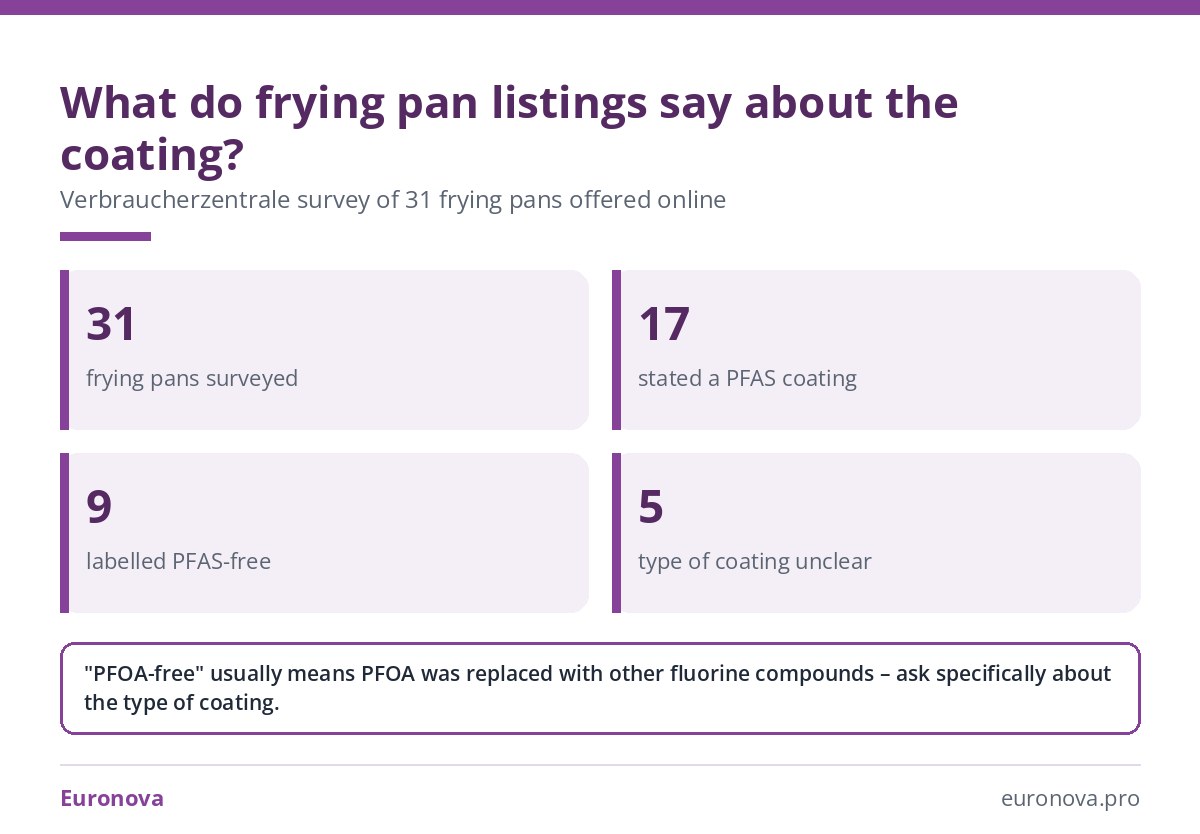
One detail helps when reading product information: according to Verbraucherzentrale, "PFOA-free" usually means that PFOA has been replaced with other fluorine compounds. In a survey of 31 pans offered online, 17 stated a PFAS coating, nine were labelled PFAS-free and for five the type of coating remained unclear. So ask specifically about the type of coating if your business has this topic in its purchasing guidelines.
From our experience
We equip restaurants, hotels, cafés, pizzerias, caterers, schools and care homes, and in almost every one of these kitchens the non-stick pan is one of the most frequently used tools. The question buyers ask us most often is not whether they need a coated pan, but which sizes and how many.
Our recommendation: think in stations, not individual pieces. A hotel breakfast station needs several small pans for eggs and omelettes, while a catering kitchen prefers a few large diameters for batches. With our aluminium pans from 22 to 40 cm and 3.5 mm material thickness, you can build both from one range, which simplifies reordering and storage.
A pan is only as good as the way it is handled. If you give your team the rules on temperature and a washing routine, you get considerably more services for your money. That is why, alongside our range, we also publish expert articles like this one.
Rok
Non-stick pans for your kitchen at Euronova
In our B2B shop you will find aluminium non-stick frying pans in seven diameters, plus cookware, kitchen utensils, tableware and everything a commercial kitchen needs every day.

Build your pan stock around your stations, for example with the versatile 28 cm aluminium frying pan for the a la carte range, and add plates, glasses and cutlery in the same order in the Euronova online shop.
Frequently asked questions
How long does a non-stick frying pan last in a commercial kitchen?
There is no fixed lifespan; it depends mainly on heat, cleaning and utensils. For ceramic coatings, Verbraucherzentrale often cites around 1.5 to 2.5 years of non-stick performance. Avoiding overheating, washing by hand and using wooden or plastic spatulas significantly extends the service life of any pan.
Can a coated frying pan go in the dishwasher?
Stiftung Warentest recommends washing by hand, because pans knock against other items in the dishwasher and the coating can suffer. According to TÜV SÜD, aggressive cleaning agents shorten the lifespan further. Warm water, a little detergent and a soft sponge after cooling are enough.
Are scratches in a non-stick pan dangerous?
According to the Bavarian consumer association, scratches are not a health concern, but they reduce the non-stick effect. The BfR explains that small swallowed PTFE particles are excreted unchanged. However, if the coating is flaking, the pan must be replaced.
Are PTFE frying pans banned in the EU?
No. According to the BfR's information from January 2026, there was no ban on frying pans in force. An EU-level PFAS restriction procedure is under way that could affect conventional PTFE coatings after a possible transition period. The current status is published by the BfR and the European Chemicals Agency (ECHA).
Sources
- TÜV SÜD: Tips for buying a frying pan (press release 2023)
- Stiftung Warentest: Pfannenkunde, der richtige Umgang
- Verbraucherzentrale: Gusseisen, Edelstahl, Teflon – welche Pfanne ist wann die richtige?
- Verbraucherzentrale: Pfannen und PFAS
- BfR: Questions and answers on PTFE-coated cookware
- BfR: Kompakt erklärt – PFAS in der Bratpfanne
- ARD Marktcheck (SWR): Beschichtete Pfannen im Test
- ILAG: Antihaftbeschichtungen für professionelles Kochgeschirr
- myhomebook: Wann man beschichtete Pfannen austauschen sollte