Ordering Catering Equipment Online: Plan, Compare, Restock
Ordering catering equipment online: planning, comparing, restocking

Ordering catering equipment online saves you trips, phone calls and time, provided you clarify three things first: what your business actually needs for service, which products you want to be able to reorder for years, and which material and labelling requirements apply. This guide shows restaurants, hotels, cafés, bars, caterers and contract catering kitchens how to plan requirements, compare offers on more than just the unit price and bundle reorders so that storage, costs and availability stay in balance.
At a glance
- Plan from the guest: number of seats, menu and dishwashing cycle determine the quantities of plates, glasses and cutlery.
- Choose ranges you can reorder and standardise on gastronorm so that containers fit the fridge, oven and buffet.
- For everything that comes into contact with food, check for the "for food contact" label or the glass-and-fork symbol; for appliances, check for the CE marking.
- Bundle reorders using fixed minimum stock levels and a regular ordering rhythm, so each delivery is worthwhile.
- If you sell food or drinks to take away, plan single-use and reusable packaging together.
Contents
- What counts as catering equipment
- Systematic requirements planning: five steps
- Hygiene and labelling: what the products must meet
- Comparing offers: more than the unit price
- Takeaway packaging: know your obligations
- Central purchasing for multiple sites or departments
- Restocking without shortages or a full storeroom
- Our view from everyday purchasing
- Order catering equipment from Euronova
- Frequently asked questions
- Sources
What counts as catering equipment
The term is broad. The industry's leading trade fair, Internorga in Hamburg, groups its exhibits into seven main areas: restaurant and hotel equipment with glassware, porcelain, cutlery and buffet accessories; kitchen technology and equipment; food; beverages and dispensing technology; digital solutions such as POS and inventory management; information and vehicles; and packaging and delivery with single-use, reusable and takeaway packaging.
For your online shop order, it is mainly the non-food part that counts. This overview helps you separate the areas before you write your shopping list:
| Area | Typical products | What to look out for when buying |
|---|---|---|
| Table and service | Plates, bowls, glasses, cups, cutlery, table decoration | Range you can reorder, stackability, dishwasher suitability according to the manufacturer |
| Kitchen | Cookware, knives, chopping boards, kitchen utensils | Material, cleaning, suitability for your type of hob |
| Storage and transport | Gastronorm containers, cling film, food paper, boxes | Standard dimensions, lids, food contact label |
| Buffet and bar | Buffet equipment, bar tools, cocktail accessories | Durability in constant use, consistent look |
| Takeaway and disposables | Meal boxes, aluminium containers, disposable cutlery, finger food cups | Size to match the portion, reusable option, leak-tightness |
| Hygiene and staff | Kitchen cleaning products, chef's clothing | Alignment with the cleaning plan, enough items for changes |
| Appliances | HoReCa appliances | CE marking, connection ratings, installation space |
Systematic requirements planning: five steps
A good order does not start in the basket, but with the menu. This sequence has proven itself for new openings, refurbishments and menu changes.
1. Translate your concept and menu into products
Go through every dish and every drink and write down what it is served on. Pasta plate, flat plate for main courses, small plate for bread or dessert, soup bowl or bowl for a poke bowl: this gives you a list of items instead of a vague "buy tableware". The same applies behind the bar for every glass: long drink, white wine, red wine, draught beer, water, espresso, cappuccino.
2. Calculate quantities from seats and circulation
The quantity per item depends not only on the number of seats but on how many pieces are in circulation at once: on the table, in the dishwashing area and in the cupboard as a reserve for breakages. A worked example with assumed values: a restaurant with 60 seats and a fast dishwashing cycle plans one set on the tables, one set in the dishwashing cycle and a reserve of half a set for its main course flat plates. That gives 60 + 60 + 30 = 150 plates. For buffets, banquets or long evenings without washing in between, demand is significantly higher, because guests take a fresh plate several times.
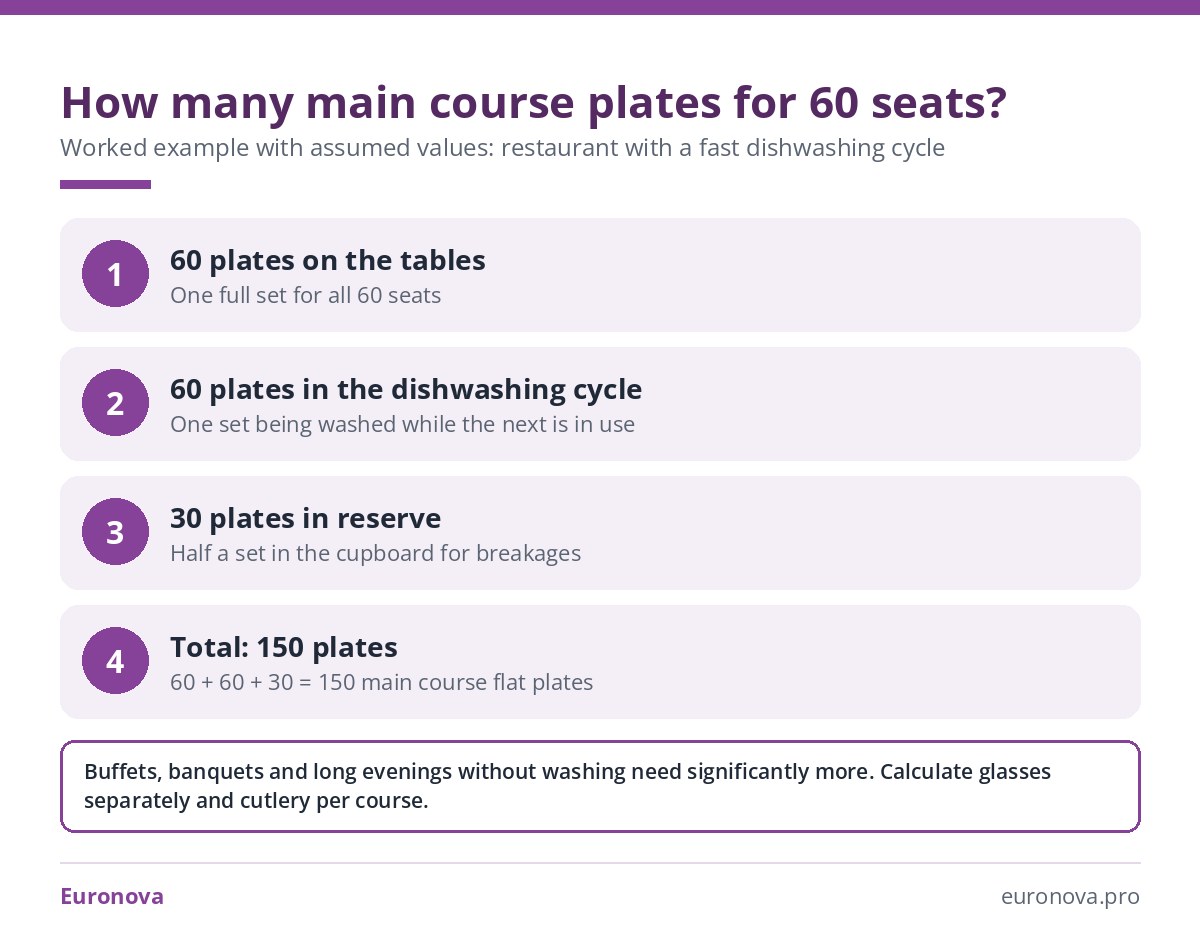
Calculate glasses separately, as they break more often than porcelain and circulate faster behind the bar. Calculate cutlery per course, not per guest.
3. Standardise
Fewer different formats mean simpler washing, stacking and reordering. Two rules help:
- One main porcelain range. Choose a range with several sizes, for example the Gourmet Sepia range from 21 to 34 cm, and complete it with bowls from the same line.
- Gastronorm as the common measure. GN containers fit the fridge, oven, pass and buffet. Once you plan around GN, you need to decant food less often.
4. Separate initial equipment from consumables
Plates, glasses, knives and pots are bought once and replaced when broken or worn. Films, packaging, napkins, disposable cutlery and cleaning products are used up continuously. Keep two lists: initial equipment with a one-off budget, and a consumables list with weekly or monthly quantities. Only the second needs a regular ordering rhythm.
5. Factor in space and workflows
New appliances and shelving need space. In its planning guidance for food service premises, the Berlin occupational safety authority specifies, among other things, a movement area of 1.0 m × 1.5 m per workstation and anti-slip flooring of class R12 V4 for kitchens and dishwashing areas. Workplace requirements are set by the occupational health and safety rules in your country, so before ordering worktables, shelving or appliances, check that these areas will be maintained.
Hygiene and labelling: what the products must meet
Everything in your kitchen that comes into contact with food is subject to special rules. Under Regulation (EC) No 1935/2004, food contact materials and articles must not, under normal or foreseeable conditions, transfer constituents to food that could endanger health or bring about an unacceptable change in the composition, smell or taste of the food.
How to recognise this when buying: under the same regulation, such products carry the words "for food contact", the glass-and-fork symbol or an unambiguous intended use, any special conditions of use such as temperature limits or cleaning instructions, and the name and address of a manufacturer or seller established in the EU. Read this information on containers, films and packaging, especially if you fill them hot or store acidic foods.
For appliances, the CE marking is what counts. In its leaflet Technical appliances in food service, the Berlin authority explains that CE-marked products meet the essential safety requirements. Gas appliances must be connected by an authorised company.
Under Annex II to Regulation (EC) No 852/2004, premises must also be clean, kept in good repair and easy to clean. Your equipment should support your HACCP plan. So plan kitchen cleaning products, chopping boards and storage in line with your cleaning and monitoring plan.

Comparing offers: more than the unit price
Two offers with the same unit price can cost very different amounts in practice. So compare using these criteria:
| Criterion | Why it matters | How to check it |
|---|---|---|
| Price per piece instead of per carton | Pack sizes of 6, 12 or 50 pieces distort the comparison | Divide the carton price by the number of pieces |
| Delivery costs per order | Delivery makes small individual orders more expensive | Bundle orders so that each delivery is worthwhile |
| Reorder availability | A range that is no longer available after a year forces a complete replacement | Look for brand ranges and permanent product codes |
| Durability in constant use | Breakage and wear are running costs | Read the manufacturer's information on material and dishwasher suitability |
| Labelling | Missing food contact information is a risk during inspections | Check the product information and packaging |
| Breadth of range | One supplier for porcelain, glass, disposables and cleaning saves ordering work | Check that all areas of your list are covered |
Reorder availability in particular is often underestimated. If you choose porcelain from well-known manufacturers such as Gural Porselen, or glassware from Arcoroc, you can replace broken pieces individually instead of buying a whole new set.
Takeaway packaging: know your obligations
Since 3 July 2021, certain single-use plastic products, such as plastic cutlery, plates, straws and expanded polystyrene food containers, may no longer be placed on the market in the EU. Under the Single-Use Plastics Directive (EU) 2019/904, member states must also take measures to reduce the consumption of single-use plastic cups and food containers; depending on the country, food and drink businesses may be required, for example, to offer alternative products, accept customers' own containers and inform consumers. In addition, the new EU Packaging and Packaging Waste Regulation (PPWR) is being phased in. If you are unsure how the rules apply to your business, check with your local environmental authority or your trade association.
For your order, this means: plan takeaway food packaging, aluminium packaging and disposable cutlery around your portion sizes, and include the reusable option in your quantity planning from the start. For finger food catering, it is worth looking at suitable containers, for example finger food cups with lids.
Central purchasing for multiple sites or departments
A hotel with a kitchen, restaurant, bar and room service, or a group with several outlets, often orders from many suppliers at once. Central purchasing means one function pools requirements, defines standard products and orders in larger quantities.
The advantages are clear:
- Consistent equipment: the same plate range and the same glasses in every property make swapping and reordering easier.
- Fewer orders: larger, combined deliveries make each delivery more economical.
- Better overview: prices and quantities are in one place, not in five inboxes.
The challenge is cost allocation. In an article on cost centre controlling in hotels, the software provider Scopevisio describes how, without an integrated system, it often remains unclear at the end of the month how much each unit has used, and recommends allocating costs when goods are issued from the store. In practice: buy centrally, store centrally, and charge to the kitchen, bar or floor when items are issued.
Many businesses also work with an approval process: departments report their needs via a list with permanent product codes, and purchasing pools them and orders weekly. Purchasing groups and inventory management systems support this process with price comparisons and order suggestions.
Restocking without shortages or a full storeroom
Consumables such as films, packaging and cleaning products should never run out, but nor should they take up storage space for months. Inventory management systems use requirement types for this, such as minimum stock, planned quantities and latest order date, as well as parameters such as minimum order quantity and minimum order value, as described for example by SOG's ERP purchasing module. The principle also works with a simple spreadsheet:
- Record consumption: for four weeks, count how much of each consumable you use per week.
- Set the minimum stock: weekly consumption times delivery time in weeks, plus a safety buffer for peaks, holidays and events.
- Choose an ordering rhythm: a fixed day once a week or once a fortnight is enough for most businesses.
- Bundle: top up every order with items that will be due soon, so that each delivery is worthwhile.
- Check the season: temporarily raise minimum stock levels before the terrace season, Christmas parties or banquet weeks.
An example with assumed values: a snack bar uses 400 meal boxes a week, and the delivery time is about one week. With a buffer of 200 pieces, the minimum stock is 600 boxes. When stock falls below this level, order, together with the films, napkins and cleaning products that will be due soon anyway.
Our view from everyday purchasing
We see every day that good orders start with a clear list. Businesses that have translated their menu into products once and defined a main range of porcelain and glassware order faster, replace breakages in a targeted way and keep costs under control.
That is why we have built our range so that a business gets as much as possible in one place: porcelain, glassware and cutlery, cookware and knives, storage and transport, disposable and takeaway packaging, buffet and bar equipment, appliances, cleaning products and chef's clothing. Bundling your orders with us makes each delivery more economical and saves you coordinating several suppliers.
For caterers and event organisers, we also offer plates, glasses and cutlery for hire as well as for sale. That way you can cover peaks without filling your storeroom with tableware you only need a few times a year.
Rok
Order catering equipment from Euronova
Euronova is a B2B online shop for restaurants, hotels, bars, cafés, pizzerias, caterers, commercial kitchens, schools, nurseries and care homes. You will find numerous brands across all areas, from bar tools and cling film and food paper to pizza tools.

Product catalogues, new arrivals and expert articles help you choose. Start your list directly in our HoReCa equipment categories.
Frequently asked questions
Can I also hire tableware for an event?
Yes. For plates, glasses and cutlery, we offer catering equipment hire as well as sales. This suits caterers and venues that need more equipment for banquets or celebrations at short notice than they want to store permanently.
How can I keep delivery costs down when ordering online?
Combine consumables and replacements for breakages into one order instead of placing many small individual orders. Fewer, larger orders reduce delivery costs per item and the time spent on ordering.
How can I tell whether a product is suitable for food contact?
Look for the words "for food contact", the glass-and-fork symbol or an unambiguous intended use, as well as any special conditions of use such as temperature limits. This labelling of food contact materials and articles is required by Regulation (EC) No 1935/2004.
Is gastronorm worthwhile for small kitchens too?
Yes, especially there. Standard gastronorm containers fit the fridge, the oven and the pass, save decanting and space, and can be combined in different sizes and depths, for example as porcelain GN containers for the oven and the buffet.
Sources
- Internorga: list of exhibits 2025
- LAGetSi Berlin: Planungshinweise für Gaststätten
- LAGetSi Berlin: Technische Geräte in der Gastronomie
- EUR-Lex: Regulation (EC) No 1935/2004 on materials and articles intended to come into contact with food
- EUR-Lex: Regulation (EC) No 852/2004 on the hygiene of foodstuffs
- Scopevisio: Kostenstellen-Controlling im Hotel
- SOG: ERP-System für den Einkauf