How to Store Spices: Rules for Restaurants and Home Kitchens
How to Store Spices in the Kitchen: Rules for Home and Food Service

Store spices in airtight containers in a dry, dark and cool cupboard, away from the cooker, oven, window and steam from pans. Label every container with the name and date, and use stock in the order it arrived in the kitchen. That is the whole rule. In a professional kitchen, food hygiene rules add a few more requirements: a dedicated storage area, closed containers made of food-contact materials and control of use-by dates. Below we explain how to organise this step by step, at home and in a restaurant, hotel or catering business.
Key points
- Four factors destroy the aroma of spices: light, heat, moisture and air. Good storage limits all four at once.
- The best place is a closed cupboard or drawer at a steady room temperature. The worst are a shelf above the cooker, the space next to the oven and a windowsill.
- The container must be airtight. Glass, ceramic, porcelain and metal all work well; in food service, lidded GN containers.
- Label every container with the product name and the date it was opened. In a restaurant, add the best-before date and rotate stock on a FIFO or FEFO basis.
- Throw away any spice that is mouldy, damp or contains pests without hesitation.
Contents
- What robs spices of flavour and aroma
- Where to store spices in the kitchen
- Which containers to choose for spices
- Spices in a commercial kitchen: dry store and workstation
- Labels and stock rotation
- How to tell a spice has lost its freshness
- Storing food in containers: rules for the whole kitchen
- Our view
- Storage equipment from one supplier
- Frequently asked questions
- Sources
What robs spices of flavour and aroma
The aroma of spices comes mainly from essential oils and volatile compounds. These are delicate: heat and light make them evaporate, while moisture makes the spice clump and lose its free-flowing texture. According to advice from Akademia Smaku, moisture causes spices to clump and increases the risk of mould, while heat and light quickly strip them of their essential oils.
It makes sense to break this down into four factors, as each needs a different kind of protection:
- Light. Sunlight and strong artificial lighting speed up the breakdown of colourings and aromatic compounds. Paprika, turmeric and dried herbs suffer most and visibly fade.
- Heat. Every extra dose of heat speeds up the evaporation of oils. A shelf above the hob is the worst place in the kitchen for spices.
- Moisture. Steam collects inside the jar, the spice clumps and, in extreme cases, mould appears.
- Air. Every time a container is opened, oxygen gets in and aromas are exchanged. The more empty space in the jar and the more often you open it, the faster the spice loses its aroma.
Herb shop NaturSZOP sums this up in one recommendation: dried herbs and spices are best kept tightly closed in a dry, cool and shaded place, because moisture, high temperature, light and frequent contact with air reduce their quality.
The most common mistake: shaking spices over the pan
Most of us do it on autopilot: hold the jar over a steaming pan and shake. Steam gets inside, condenses, and a few days later the spice has clumped. It is better to shake the portion onto a spoon or into a small bowl away from the pan and only then add it to the dish. In a professional kitchen, mise en place solves the problem: spices for the shift are measured out in advance into small containers at the workstation, while the main stock stays in a cupboard or the dry store.

Where to store spices in the kitchen
The ideal place is dark, dry, away from sources of heat and steam, and at a steady temperature. In practice, that means a closed cupboard or drawer. Kurkumania.pl recommends exactly that: a dry, closed cupboard with no light, away from heat sources and at a steady room temperature.
| Location | Rating | Why |
|---|---|---|
| Closed cupboard away from the hob | Very good | Dark, dry, steady temperature |
| Drawer with a container insert | Very good | Dark, easy to reach, organised at a glance |
| Pantry or dry store | Very good for stock | Cool and stable, room for larger packs |
| Open shelf at the back of the kitchen | Acceptable | Only with opaque containers, away from windows |
| Shelf above the cooker or extractor hood | Poor | Heat and steam every time you cook |
| Next to the oven or dishwasher | Poor | Fluctuating temperature and humidity |
| Windowsill | Poor | Direct sunlight and heating up |
At home, one cupboard or drawer just for spices is usually enough. In a food service business, storage works on two levels: stock is kept in the dry store, and only the portion for the current shift sits at the workstation.
What about the fridge and freezer?
Dried spices do not need refrigeration, and taking a cold container into a warm kitchen encourages condensation inside. Fresh herbs, spice pastes, marinades and spice-based sauces are different: they are perishable foods that belong in the cold room or fridge, in closed, labelled containers.
Which containers to choose for spices
A container has three jobs: keep out air and moisture, protect from light and not react with its contents. Akademia Smaku recommends glass or ceramic with tight-fitting lids, as they do not absorb odours and make it easy to check the condition of the spice.
| Material | Advantages | What to watch out for |
|---|---|---|
| Clear glass | Does not absorb odours, contents visible, easy to wash | Keep in a cupboard, not in the sun |
| Dark glass | Extra protection from light | Label it, as contents are hard to see |
| Porcelain and ceramic | Block light, do not absorb odours | Needs a tight-fitting lid |
| Metal (tins, steel containers) | Complete protection from light, durable | Tight seal, spice must be dry |
| Food-contact plastics | Light, unbreakable, practical in a large kitchen | Tight lid, food-contact marking |
NaturSZOP points out that a clear container also works well if it stands in a cupboard rather than on a sunny shelf. Kurkumania.pl recommends dark glass and metal tins, which protect against light and air when tightly closed.
Container size matters
The more air above the spice, the faster it loses its aroma. So keep spices you rarely use in small containers and split large packs into portions. In food service, this looks like this: a sack of pepper or a kilogram pack of paprika goes into a larger, airtight container in the dry store, and only as much as is used in a shift or a few days goes to the workstation.
Paper bags and retail packs
Spices are often sold in paper or foil bags that do not reseal tightly once opened. It is best to decant the contents straight into your own container and stick on a label with the name and the date opened. If you leave the spice in its original packaging, wrap it tightly and place it in a closed container.
Spices in a commercial kitchen: dry store and workstation
In a restaurant, canteen or catering operation, spice storage is not just about flavour but also about hygiene and order, which the inspector will check. Under Annex II of Regulation (EC) No 852/2004, premises where food is handled must be kept clean and in good condition, and food must be protected against any contamination at all stages, including dust and dirt during storage.
In practice, a three-level split works well:
- Dry store. This is where stocks of spices, flour, sugar, grains and other dry goods go. The room or a separate cupboard should be dry, clean, ventilated and protected from the sun. Food stands on racks, not on the floor, in closed containers.
- Workstation. On the line, keep only the portion for the shift, in small closed containers placed away from hobs, fryers and the combi oven.
- Cold room or fridge. Only for fresh herbs, pastes, marinades and mixes containing fat or water.
GN containers: one standard for everything
In large kitchens, it is most practical to base all storage on Gastronorm containers. Their standardised dimensions mean they fit racks, trolleys, refrigerated counters and bain-maries. At the spice station, shallow 1/4 containers work well, for example a GN 1/4 container, 20 mm deep, while deeper models such as a GN 1/2 container, 100 mm deep suit stock in the dry store. Where looks matter, for instance in an open kitchen or at a buffet station, a porcelain GN 1/3 container is a good choice, and it also blocks light.
Small dishes are also handy for measuring out portions for the shift, for example a round finger food cup, 180 ml. The cook has exactly as much spice to hand as needed and does not open the main stock for every dish.
Labels and stock rotation
Even the best container is no help if nobody knows what is in it and since when. Traceability requires that every food can be identified and withdrawn if necessary, so it must be labelled, for example with the production date and the best-before date.
On the label of a spice container in a restaurant, it makes sense to note:
- the product name (and, for blends, the ingredients),
- the date received into the store,
- the date opened or decanted,
- the best-before date from the original packaging,
- where needed, the initials of the person who decanted it.
A consistent system of labels, colours and label positions makes the team's work much easier, especially with shift work.
FIFO and FEFO in practice
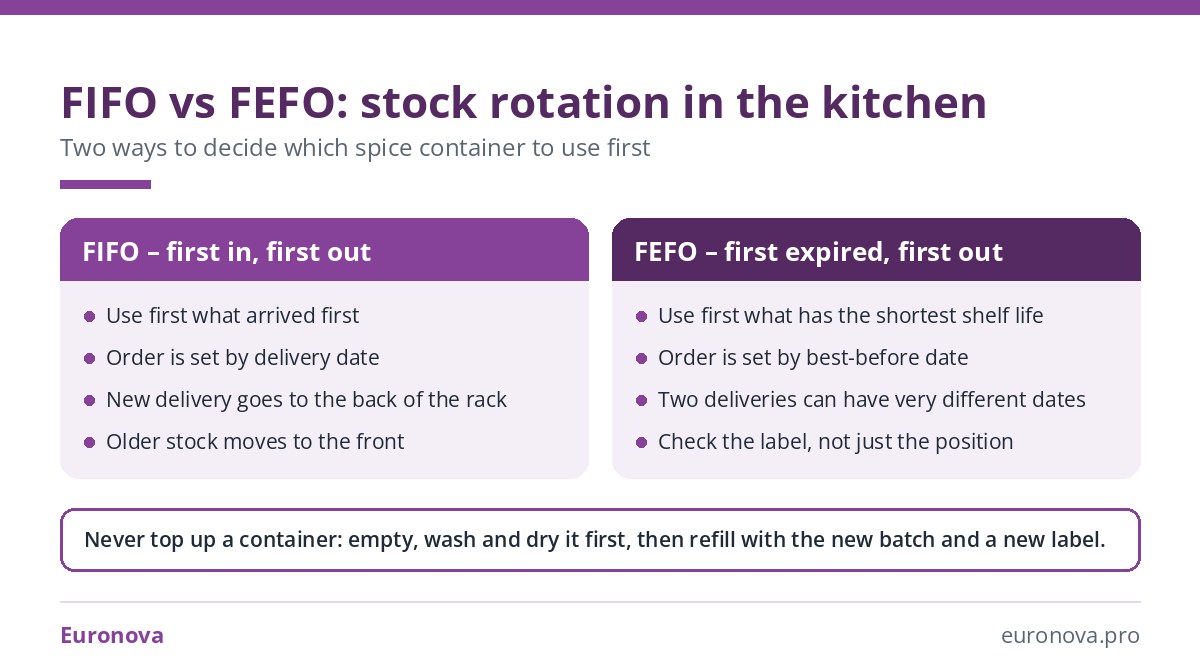
Stock is rotated according to one of two principles. FIFO (first in, first out) means you use first what arrived first. FEFO (first expired, first out) means the item with the shortest shelf life goes first. With spices, the difference can be significant, because two deliveries of the same product can have completely different dates. The simplest habit: put the new delivery at the back of the rack, move the older one to the front, and never top up a container with a new batch, but empty, wash and dry it first.
Spice blends and allergens
Ready-made spice blends can contain allergens, so the label on a blend in a restaurant should list its ingredients, not just its name. The same information is useful for front-of-house staff and on the menu, because under Regulation (EU) No 1169/2011 you must provide guests with allergen information for non-prepacked food as well.
How to tell a spice has lost its freshness
Spices rarely go off in a dangerous way, but they quickly lose what you buy them for: flavour and aroma. NaturSZOP lists the typical signs: a weaker characteristic smell, a change of colour, clumping or dampness, an unusual smell, and the presence of mould or pests. Spices that are mouldy, damp or contain pests must be thrown away.
A quick check before use takes a few seconds:
- Colour. Paprika, turmeric or dried parsley should have a vivid colour. A faded spice has also lost some of its aroma.
- Smell. Rub a pinch between your fingers. If the smell is barely noticeable, the dish will need more spice, which raises the cost per portion.
- Texture. Lumps, moisture, a coating or stuck-together particles mean steam or water has got into the container.
- Pests. Tiny insects, fine webbing or small holes in bags rule out the entire stock, and the container must be thoroughly washed and dried.
In a restaurant, it makes sense to build this check into a fixed schedule, for example once a week when a delivery is received.
Storing food in containers: rules for the whole kitchen
The same rules that protect spices apply to the whole back of house. The hygiene requirements of Regulation (EC) No 852/2004 and good hygiene practice require food to be protected against contamination, drying out and spoilage: cover it, keep it in clean containers or wrap it in food-contact paper or film. Do not store prepared dishes below raw food, and keep cleaning agents and disinfectants in a safe place, away from food preparation areas.
What this means day to day:
- Nothing loose. Raw ingredients and semi-finished products go into closed, labelled containers, in the cold room too.
- Prepared above raw, never the other way round. On the refrigerated rack, prepared dishes stand higher than raw meat or fish.
- Chemicals kept separate. Dishwashing and disinfecting products do not belong in the dry store next to spices or on a shelf above the counter.
- A clean fridge is part of the system. A fridge alone does not guarantee safety: the cleanliness of refrigeration equipment and the correct arrangement of food also count.
- Temperature and humidity under control. Controlling the factors that promote spoilage, such as temperature and humidity, is the basis of food safety.
If you are unsure about the requirements for your business, for example with a new storeroom or a menu change, the most reliable option is to talk to a HACCP consultant or your local food safety authority.
Our view
Our conversations with restaurateurs, hotels and catering companies point to one thing: order with spices starts with a single container system, not with random jars. When the whole kitchen works with the same sizes, everything has its place on the rack, in the drawer of the refrigerated counter and on the transport trolley.
That is why we recommend building your storage around GN containers: shallow ones for the workstation, deeper ones for stock, porcelain where guests can see into the kitchen. Add a dated label, stock rotation and a fixed place in the dry store. You put such a set together once and then simply top it up.
Our aim is that a new venue can order all of its back-of-house equipment from us in one place, and an established venue can just as easily add the containers it is missing.
Rok
Storage equipment from one supplier
At Euronova you will find GN containers in a wide range of sizes and depths, including porcelain ones, as well as insulated food boxes, trays and other solutions for storing and transporting food. We equip restaurants, hotels, bars, pizzerias, cafés, catering companies and canteens in schools, nurseries and care homes, at competitive wholesale prices.

Start with the GN gastronorm containers category, and put together the rest of your kitchen and serving equipment in the Euronova online shop.
Frequently asked questions
Can I store spices on an open shelf?
Yes, as long as the shelf is away from the cooker, oven and window, and the spices are kept in airtight, opaque containers. Light and heat quickly weaken the aroma, so clear jars are better kept in a cupboard. In a restaurant, keep only one shift's portion on an open shelf at the workstation.
How often should spices be replaced?
Follow the best-before date on the packaging and your own check of colour, smell and texture. A faded spice with little aroma is still safe to eat, but it seasons food less well. Throw away any spice that is damp, mouldy or contains pests straight away.
Can I top up an old spice with a new batch in the same container?
In a commercial kitchen, it is better not to. Mixing batches blurs the dates and makes FIFO or FEFO stock rotation harder. Use up the remainder first, wash and dry the container, and only then refill it with the new batch and a new label.
Which containers work best for spices in a restaurant?
Lidded GN containers are the most practical, because they fit racks, refrigerated counters and trolleys. Shallow 1/4 or 1/3 sizes work well at the workstation, deeper 1/2 sizes for stock in the dry store. Every container must be made of food-contact material and labelled.
Sources
- Akademia Smaku: Jak przechowywać i stosować przyprawy?
- NaturSZOP: Jak przechowywać zioła i przyprawy? 7 porad
- Kurkumania.pl: Jak przechowywać przyprawy, by nie traciły aromatu?
- EUR-Lex: Regulation (EC) No 852/2004 on the hygiene of foodstuffs
- EUR-Lex: Regulation (EU) No 1169/2011 on the provision of food information to consumers