GN Container Sizes: Dimensions, Depths and Capacity
GN Container Sizes: Dimensions, Depths and How to Choose

Every GN container is based on one standard format: GN 1/1, which measures 530 × 325 mm. All other sizes are fractions of it. GN 1/2 measures 325 × 265 mm, GN 1/3 325 × 176 mm, GN 1/4 265 × 162 mm, and GN 2/1 is a double module of 650 × 530 mm. The fraction in the name gives the length and width. Depth is stated separately in millimetres, most often from 20 to 200 mm. Below you will find a full gastronorm size chart, ways of combining sizes in one module, and a checklist to go through before ordering containers for an oven, bain-marie or refrigerated counter.
Key points
- GN 1/1 = 530 × 325 mm. This is the base module to which all other sizes refer.
- The fraction defines the footprint, not the capacity. A GN 1/3 takes up a third of the area of a GN 1/1; its capacity depends on the depth.
- Standard depths are 20, 40, 65, 100, 150 and 200 mm. Shallow ones are for baking and display, deep ones for cooking, marinating and storage.
- Smaller sizes combine into a full module: 2 × 1/2, 3 × 1/3, 4 × 1/4, 6 × 1/6 or 9 × 1/9 fill one GN 1/1 space.
- Check the appliance before you buy: the runner format, shelf spacing, well depth, and whether the lid needs a ladle notch or a seal.
Contents
- Where GN dimensions come from
- GN container size chart
- How sizes combine into one module
- GN container depths
- Capacity in litres: why listings differ
- How to choose the size for your dishes and volumes
- How to check a container fits the appliance and lid
- Material and dimensions
- Our view
- GN containers from Euronova
- Frequently asked questions
- Sources
Where GN dimensions come from
GN stands for Gastronorm, the European system of modular containers for food service. The dimensions are defined in standard EN 631-1:1993 for catering containers. Its purpose is practical: one module should fit the oven, refrigerated counter, bain-marie, trolley and rack, whoever the manufacturer. That is why a container can go straight from the kitchen to the buffet and then into the cold room without transferring the food.
The system is based on a 530 × 325 mm module. The designation GN 1/1 means the container takes up the whole module. GN 1/2 is a half, GN 1/3 a third and so on. Designations with a numerator greater than 1, such as GN 2/3, 2/4 or 2/8, describe shapes that do not come from a simple division into equal sections, but still fit the same module.
In practice this means one thing: when you buy a GN 1/2 container, you do not need to measure your counter or oven. It is enough to know that the appliance takes the GN 1/1 format, because two 1/2 containers take up exactly one such space.
GN container size chart
The dimensions in the table are external dimensions, measured at the rim. It is the rim that rests on the oven runners and on the edges of the counter openings, so it has to match the standard. The inside of the container is always slightly smaller, because the walls are slightly tapered.
| Size | Dimensions (mm) | How many fit in a GN 1/1 | Typical use |
|---|---|---|---|
| GN 2/1 | 650 × 530 | 0.5 (equal to two 1/1 modules) | large refrigerated cabinets, ovens with wide chambers, transporting large quantities |
| GN 1/1 | 530 × 325 | 1 | baking, steaming, main dishes on the buffet |
| GN 2/3 | 354 × 325 | 1 together with a GN 1/3 | main dishes in the counter alongside sides |
| GN 1/2 | 325 × 265 | 2 | salads, side dishes, sauces, buffet portions |
| GN 2/4 | 530 × 162 | 2 | long, narrow portions, e.g. cold cuts, fish, pastries |
| GN 1/3 | 325 × 176 | 3 | ingredients at the workstation, salads, desserts |
| GN 1/4 | 265 × 162 | 4 | side dishes, dressings, sauces |
| GN 2/8 | 325 × 132 | 4 | narrow rows of ingredients in a salad bar |
| GN 1/6 | 176 × 162 | 6 | ingredients on the service line, pizza, sandwiches |
| GN 1/9 | 176 × 108 | 9 | spices, herbs, toppings in small quantities |
The full set of sizes and their standard dimensions is listed in the description of the Gastronorm system. When comparing offers, bear in mind that suppliers list dimensions in different orders: "325 × 265 mm" and "265 × 325 mm" are the same GN 1/2.
How sizes combine into one module
The modular system works because the rims of smaller containers divide the 530 mm side and the 325 mm side into equal sections. A few combinations worth knowing by heart:
- GN 1/2: two 325 × 265 mm containers sit side by side along the longer side (2 × 265 = 530 mm).
- GN 1/3: three containers 176 mm wide add up to roughly 530 mm.
- GN 1/4: four containers arranged in a 2 × 2 grid.
- GN 1/6: six containers in a 3 × 2 layout, handy at a pizza or sandwich station.
- GN 1/9: nine containers in a 3 × 3 layout, ideal for spices and toppings.
- GN 2/3 + GN 1/3: one large section for the main dish and a smaller one for a side, together a full GN 1/1.
- GN 1/2 + 2 × GN 1/4: half the module for a salad, the other half for two sauces.
Mixed layouts sometimes require divider bars, i.e. cross bars that split a GN 1/1 opening into smaller sections. Without them, containers of different sizes can shift or sink into the counter opening. If your counter has openings for full GN 1/1 containers and you are planning a set with 1/3 and 1/6, plan the divider bars together with the containers.
GN container depths
Depth is the second dimension you have to choose, and it is completely independent of the footprint. The same GN 1/2 can be 20 mm deep and used to display slices of cheese, or 200 mm deep and hold several litres of soup. In product listings, depth is marked with the letter H or the word "height", e.g. "GN 1/1, H 65 mm".
The most common are depths of 20, 40, 65, 100, 150 and 200 mm. Their typical uses are as follows:
| Depth | Best suited for |
|---|---|
| 20 mm | display on a cold buffet, cold cuts, cheeses, portioned desserts, baking flat products |
| 40 mm | roasting meat and fish in the oven, roasted vegetables, tray bakes |
| 65 mm | the most versatile: main dishes in the bain-marie, gratins, porridges, rice |
| 100 mm | goulash, dishes in sauce, high-turnover buffet dishes |
| 150 mm | soups, sauces, steaming in larger quantities, marinating |
| 200 mm | cold-room storage, stocks, reserves of sauces and ingredients |
On a buffet, a shallower container usually looks better, because the food is closer to the guest and easier to serve. In the kitchen, a deeper one lets you prepare more at once and top up the counter less often. A good compromise for many restaurants is a set of 65 mm containers for service and 150 or 200 mm for the back of house.
In cafés and bars, small formats such as GN 1/6 and 1/9 of medium depth work well at a dessert topping or fruit station.
Capacity in litres: why listings differ
The standard defines the rim dimensions, not the capacity. The litres depend on how tapered the walls are, how rounded the corners are and how wide the rim itself is. That is why two GN 1/1 containers 150 mm deep may show slightly different capacities in their descriptions, even though both fit the same oven.
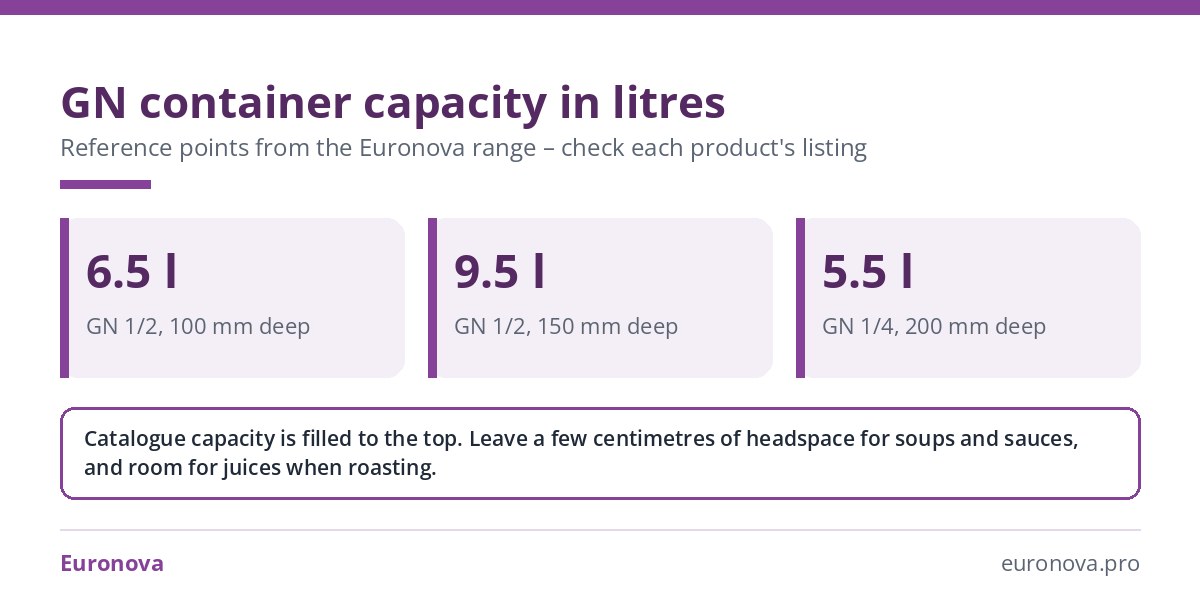
A few reference points from our range:
- a GN 1/2 container, 100 mm deep holds 6.5 l,
- a GN 1/2 container, 150 mm deep holds 9.5 l,
- a GN 1/4 container, 200 mm deep holds 5.5 l.
When planning quantities, allow some margin. The capacity given in catalogues is usually filled to the top, but in practice you do not fill a container to the brim. With soups and sauces in a bain-marie, leave a few centimetres of space so nothing spills when carrying and serving. When roasting, leave room for the juices and fat released from the meat.
A simple way to estimate: weigh one standard portion, check how many portions you serve at peak time between two top-ups, and only then choose the depth. Two GN 1/2 containers 100 mm deep that you can swap are better than one heavy GN 1/1 200 mm deep that is hard to carry and cools quickly every time it is opened.
How to choose the size for your dishes and volumes
Choose the footprint according to the number of dishes that should go into one counter opening or onto one shelf. Choose the depth according to the quantity and consistency. A few proven layouts:
Restaurant with daily specials
Main dishes in GN 1/1 or 2/3, 65 mm deep; side dishes in GN 1/3 or 1/4, 100 mm deep. Sauces in GN 1/6, 150 mm deep, so the ladle reaches the bottom without tilting the container.
Hotel breakfast buffet
For the cold section, shallow GN 1/1 and 1/2, 20 or 40 mm deep: cold cuts, cheeses, fruit. For the hot section, GN 1/2, 65 or 100 mm deep, so fried eggs, sausages and vegetables can be topped up from the kitchen without changing the whole counter. On upmarket buffets, porcelain containers in GN formats work well, as they go on the table without an extra serving dish.

Pizzeria and sandwich station
Ingredients in GN 1/6 and 1/9 in the refrigerated counter, in a 3 × 2 or 3 × 3 layout. Back-up stock of the same ingredients in deeper 1/4 or 1/3 containers in the cold room, ready for a quick swap.
Catering and canteens
In schools, nurseries and care homes, volume and transport are what count. Here, GN 1/1 containers 100 or 150 mm deep with lids work best, going straight into GN-compatible insulated food boxes. One dish is cooked, transported and served in the same container.
How to check a container fits the appliance and lid
The GN format guarantees that the footprint fits, but a few details are worth checking before you order.
- Read the appliance format. Combi ovens, refrigerated cabinets and counters are usually described as "6 × GN 1/1", "10 × GN 1/1" or "GN 2/1". This information is on the rating plate and in the manual.
- Check the runner spacing. In an oven, the spacing between shelves limits the container depth. A deep container can take up two runners, which reduces the number of trays.
- Measure the depth of the well or opening. In a bain-marie and refrigerated counter, the bottom of the container must not rest on the heating element or the bottom of the well. If the opening is shallow, choose a lower container.
- Find out whether the opening needs divider bars. When mixing sizes in a GN 1/1 opening, divider bars are needed, otherwise smaller containers will not be stable.
- Choose the lid by size, not by depth. A GN 1/2 lid fits any 1/2 container, from 20 to 200 mm. For a bain-marie, choose a version with a notch for a spoon or ladle; for the cold room and transport, a sealed version, e.g. a GN 1/6 lid with seal.
- Pay attention to the material where temperature is concerned. For the oven and bain-marie, choose containers designed for high temperatures, e.g. stainless steel. Use porcelain GN containers in line with the manufacturer's recommendations given with the product.
One practical test in the kitchen: place the empty container in the appliance and check that the rim sits evenly along its whole length. A container that hangs down on one side is a sign that the format or divider bars are wrong.
Material and dimensions
The same GN format is available in different materials, and each behaves differently in the kitchen and front of house. The rim dimensions stay the same, so you can combine them into one system.
- Stainless steel is the kitchen staple: oven, bain-marie, cold room and dishwasher. It is easy to clean, conducts heat well and stands up to daily use.
- Porcelain in GN format is the choice for buffets and table service. It keeps food at temperature and looks like tableware, while fitting standard counter openings. Our range includes porcelain containers approximately 68 mm deep in GN 1/1, GN 1/2, GN 1/3 and GN 2/4 formats.
With porcelain, bear in mind that the walls are thicker than steel, so the capacity at the same depth may be smaller. When planning portions, work from the litres stated for the specific product.
Our view
Most of the problems with GN containers we see at our customers do not come from a poor product, but from buying piece by piece. A few formats from different suppliers, lids that fit only some of the containers, missing divider bars for the counter. The result is chaos in the back of house and time lost at peak.
That is why we advise starting with your appliances. Write down how many GN 1/1 spaces you have in the oven, bain-marie, counter and cold room, then plan how you will divide them. Only then choose the depths: shallow for display, medium for service, deep for the back of house. Choose lids for each size straight away.
If you put together the containers, lids, buffet porcelain and insulated food boxes in one place, you can be sure the whole system fits, and every top-up is simply a repeat of the same order. That is how we build our range for venues of every kind, from newly opened bistros to hotels and catering companies with many years of experience.
Rok
GN containers from Euronova
At Euronova you can put together a complete GN system in a single order: stainless steel containers in formats from GN 1/1 down to the small fractions, in depths from a shallow 20 mm to a deep 200 mm, lids, porcelain buffet containers, plus insulated food boxes and food transport solutions. We offer competitive wholesale prices for restaurants, hotels, catering companies, canteens and HoReCa distributors.

See the full range in the GN gastronorm containers category, and if you need shallow formats for display, take a look at, for example, the GN 1/1 container, 40 mm deep and the GN 1/4 container, 20 mm deep. You will find the rest of your kitchen and serving equipment in the Euronova online shop.
Frequently asked questions
What are the dimensions of a GN 1/1 container?
A GN 1/1 container measures 530 × 325 mm at the rim. It is the base module to which all other GN sizes refer. The depth is chosen separately, most often between 20 and 200 mm.
What is the difference between GN 1/2 and GN 2/4?
Both take up half of a GN 1/1 module, but they have different shapes. GN 1/2 measures 325 × 265 mm and is almost square, while GN 2/4 measures 530 × 162 mm and is long and narrow. GN 2/4 works well for food laid out in rows, such as fish or cold cuts.
Does a GN lid fit a container of any depth?
Yes, as long as the size matches. A GN 1/3 lid fits any 1/3 container regardless of its depth, because the rim has the same dimensions. You only choose the type of lid: with a spoon notch for a bain-marie, or with a seal for storage and transport.
How many litres does a GN container hold?
It depends on the size, depth and shape of the walls, so check the capacity of the specific product. For example, our GN 1/2 container 100 mm deep holds 6.5 l, and the 150 mm deep version holds 9.5 l. In practice, containers are not filled to the brim.
Which GN size should I choose for a pizza prep counter?
Most often GN 1/6 or 1/9, because one GN 1/1 opening then holds 6 or 9 different ingredients. Match the depth to the depth of the counter opening, and use divider bars when mixing sizes.
Sources
- EN 631-1:1993 – Catering containers. Dimensions of containers
- Wikipedia (EN): Gastronorm – description of the system and sizes