How to Choose a Commercial Dishwasher: Finding the Right Model for Your Business
How to Choose a Commercial Dishwasher for Your Restaurant, Café or Hotel

Choose a commercial dishwasher based on your busiest hour, not on the number of programmes on the control panel. First, count how many racks of dishes need washing in the worst hour of service. Next, measure your largest plates, trays and containers. Finally, check what electrical supply, water and drainage you have in the dishwashing area. These three figures almost always point to the right type of machine: undercounter, glasswasher, hood-type, pot and utensil washer or conveyor dishwasher. Below we go through the whole selection step by step, with worked examples and a list of questions to ask the supplier.
Key points
- Peak counts, not the average. Capacity is given in racks per hour, and you choose the machine for the busiest hour of service.
- The type follows from the volume. An undercounter model is enough for a café or small restaurant, a hood-type handles higher volumes, and a conveyor is for operations serving hundreds or thousands of covers a day.
- Thermal rinse and temperature are hygiene. A final rinse at 82–90 °C reduces the amount of chemicals and speeds up drying.
- Water decides the service life. With hard water, a softener or filter is a must, as limescale damages heating elements and nozzles.
- Installation before purchase. Larger machines usually need a 400 V connection, high-capacity drainage and good ventilation.
Contents
- Step one: count the racks at peak time
- Which type of dishwasher suits which business
- Technical specifications to check
- Space, electrics, water and drainage
- Hard water: softener, filter or reverse osmosis
- Chemicals, programmes and temperature for different ware
- What a dishwasher costs to run every day
- Test the machine with your own tableware
- Our view: choose the dishwasher together with the tableware
- Tableware and equipment for working with a dishwasher
- Checklist before ordering
- Frequently asked questions
- Sources
Step one: count the racks at peak time
A dishwasher's catalogue capacity is a good starting point, but on its own it does not tell you whether the machine will cope with the workload in your venue. Before choosing, it makes sense to collect a few concrete figures, as listed in Dziennik Wschodni's guide to dishwashing under intensive use:
- how many racks need washing in the busiest hour,
- what your largest plates, trays, containers and utensils are,
- which kinds of soiling need a second cycle,
- whether the dishwashing area has separate places for dirty and clean ware,
- what power supply, water inlet and drainage are available,
- whether the water hardness has been measured, not just estimated.
How to calculate it in practice
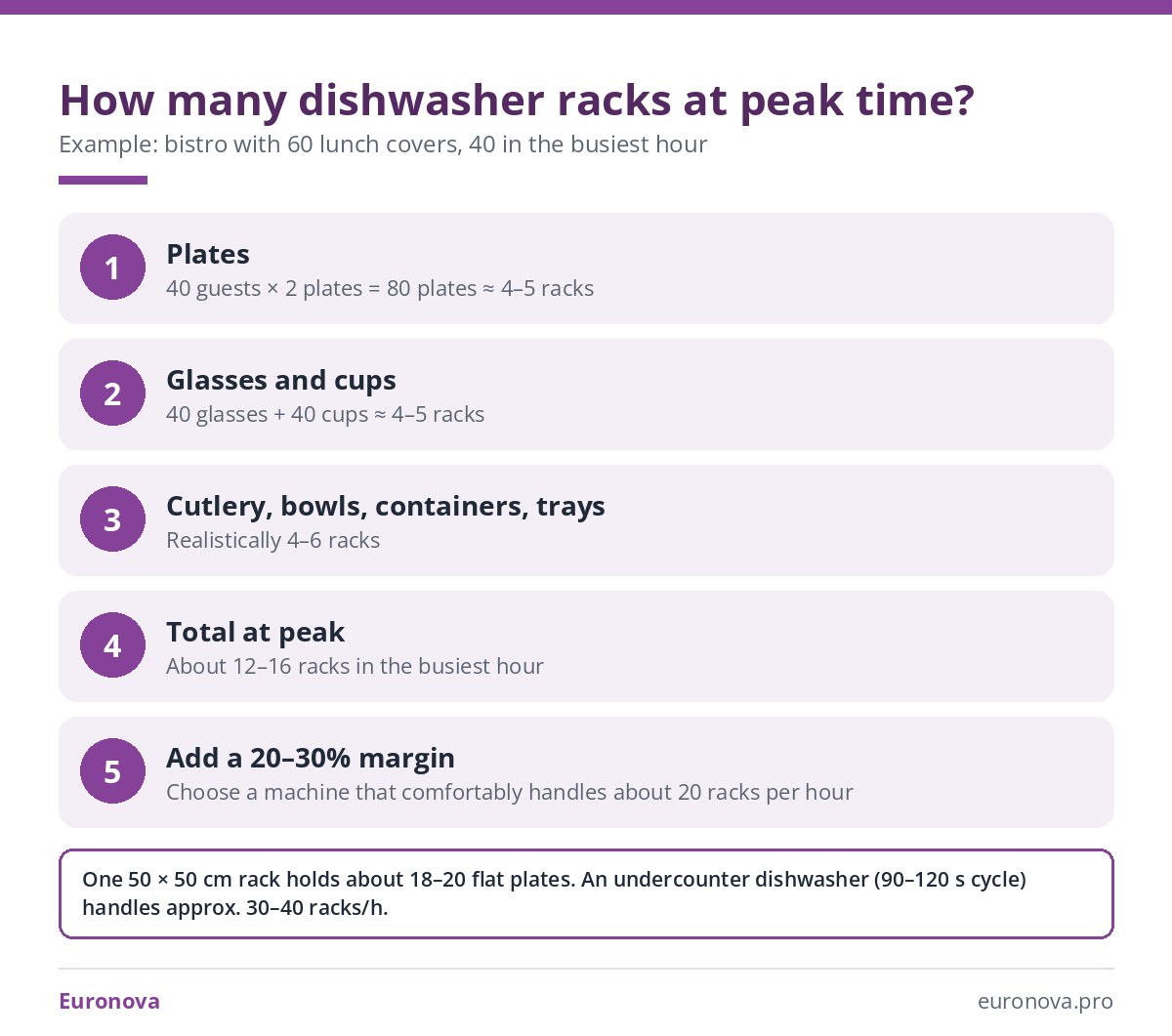
Bear in mind that one 50 × 50 cm rack holds around 18–20 flat plates or anywhere from fifteen to just over twenty glasses, depending on their diameter. Then break one cover down into the items that actually end up in the dishwasher.
Example: a bistro with 60 covers at lunch, 40 of them in the busiest hour.
- On average, each guest leaves a main plate, a starter or dessert plate, a glass, a cup and a set of cutlery.
- 40 guests × 2 plates = 80 plates, i.e. about 4–5 racks.
- 40 glasses and 40 cups make another 4–5 racks.
- Cutlery, bowls, kitchen containers and trays: realistically 4–6 racks.
- Total: about 12–16 racks at peak time.
Add a 20–30% margin to the result, because racks are rarely loaded perfectly and some ware goes through a second cycle. In this example, you need a machine that comfortably handles about 20 racks per hour.
According to Infrastruktura Gastronomiczna's guide to dishwashers for professional kitchens, an undercounter machine with a 90–120 second cycle handles around 30–40 racks per hour, which is enough for a café, bar or small restaurant with up to 60 covers per service. Our bistro falls within this range with room to spare.
Remember that catalogue capacity assumes non-stop operation. Staff still have to remove the clean rack, put the ware away and load the next one. The more cramped the dishwashing area, the more the real capacity differs from the figure on the product sheet.
Which type of dishwasher suits which business
Once you know the number of racks, choosing the machine type is straightforward. The overview below is based on the typical operating ranges described in the guide to industrial dishwashers and the guide for professional kitchens.
| Machine type | Typical capacity | Who it is for | Power supply |
|---|---|---|---|
| Glasswasher | smaller racks, short cycle | bars, pubs, cafés with a lot of glassware | usually 230 V |
| Undercounter (front-loading) | approx. 30–40 racks/h | cafés, bars, small restaurants up to approx. 60 covers per service | 230 V for smaller models |
| Hood-type (pass-through) | from 40 up to 120 racks/h | restaurants, hotels, canteens, catering | usually 400 V |
| Pot and utensil washer | depends on the chamber | kitchens with many pots, roasting tins and GN containers | usually 400 V |
| Conveyor (rack or flight type) | hundreds to thousands of covers a day | large hotels, hospitals, contract catering operations | 400 V, technical design |
Glasswasher
A glasswasher has a smaller chamber and a lower rack, often with a glass programme at a lower temperature. In a bar or café, glassware makes up most of the ware, so a separate glasswasher takes the load off the main machine and protects glasses from being washed in the same cycle as heavily soiled plates.
Undercounter dishwasher
The most common choice to start with. It fits under the counter, loads from the front, and smaller versions run on a standard 230 V socket. Check the chamber height if you wash large flat plates or trays.
Hood-type dishwasher
You slide the rack in along the runners and lower the hood from above. Capacity rises significantly, but along with the machine you need an inlet table and an outlet table. Before buying a hood-type machine, plan space for the whole line, not just the appliance.
Pot and utensil washer
Useful wherever the kitchen works with large pots, pans, roasting tins and GN containers. It has a taller chamber and a more powerful pump. In venues with lots of burnt-on residue, it cuts down on scrubbing by hand.

Conveyor dishwasher
Ware travels through washing, rinsing and drying zones on a belt or in racks. According to the guide to industrial dishwashers, the complete installation requires a technical design, suitable space and powerful ventilation.
Technical specifications to check
A product sheet lists dozens of items. Only a few of them matter when choosing.
- Thermal rinse. A final rinse with water at 85–90 °C is the standard for hygienic dishwashing in food service. Agree the requirements for your type of business with a food hygiene consultant before you sign the order.
- Wash and rinse temperature. The guide to industrial dishwashers states that low-temperature machines wash at 49–60 °C and need sanitising chemicals, while high-temperature machines rinse at 82–85 °C, which reduces the amount of chemicals and speeds up drying.
- Wash pump pressure. This directly affects cleanliness. According to the same source, the difference between a 0.8 bar and a 1.5 bar pump is noticeable with heavily soiled ware.
- Cycle time. For undercounter models it is usually 90–180 seconds. A shorter cycle means more racks per hour, but only if the boiler keeps up with heating the rinse water.
- Water consumption per rack. Good undercounter machines use 2.5–3.5 litres, poorer designs as much as 6–8 litres.
- Chamber and rack dimensions. Measure the largest plate, tray and container you have in your venue.
- Chemical dosing. Built-in detergent and rinse aid pumps give repeatable results without topping up by eye.
- Drain pump. Needed when the drain in the room is higher than the dishwasher's outlet.
Space, electrics, water and drainage
The most expensive mistakes when buying a dishwasher are installation mistakes. A machine that does not fit into the workflow or keeps tripping the fuse will never reach its capacity.
Power supply
Smaller undercounter machines usually manage on 230 V. Hood-type and conveyor machines usually require a three-phase 400 V connection. For a hood-type machine, the guide to industrial dishwashers mentions a fuse in the order of 16–32 A. Always confirm the connected load, protection and cable cross-section with a qualified electrician, based on the rating plate of the specific model.
Drainage
A hood-type machine discharges tens of litres of water per cycle, so the drain must have sufficient flow capacity. The minimum is a trap that can be cleaned. If the floor or wall drain is higher than the machine's outlet, you need a drain pump.
Ventilation
A thermal rinse means a lot of steam. With a hood-type or conveyor machine, plan mechanical ventilation for the dishwashing area. The guide mentions an air change rate of around 20–30 times per hour. The ventilation design should be prepared by a mechanical services engineer.
Space and ware flow
A dishwashing area with a hood-type machine and tables usually takes up 6 to 12 m². Dirty ware should come in from one side and clean ware leave on the other, without the routes crossing. Leave space for waste sorting, a rack shelf and for setting down clean ware.
Hard water: softener, filter or reverse osmosis
Effective dishwashing is a combination of time, temperature, chemicals and spray force. Dziennik Wschodni points out that limescale on heating elements limits heat transfer, and deposits in nozzles change the spray pattern. The result: poorer washing, longer heating times and higher bills.
The rule is simple: first measure the water hardness at your premises, then choose the water treatment. In many areas the water is moderately hard to hard, so a filter or softener is a necessity there, not an option.
- An ion-exchange softener removes calcium and magnesium ions and protects heating elements and nozzles. Many dishwashers have one built in.
- A filter works well with moderately hard water and as protection against particles.
- Reverse osmosis produces water almost free of minerals. Choose it where glasses and cutlery must come out of the machine spotless and without polishing: in cocktail bars, specialty coffee shops and fine dining restaurants.
The choice of water treatment should be based on an analysis of the local water and the recommendations of the specific machine's manufacturer. You can get the hardness figure from your local water supplier or with test strips; for a larger investment it makes sense to order a full analysis.
Chemicals, programmes and temperature for different ware
Detergent and rinse aid are dosed according to the requirements of the washing process, as the handbook of the German commercial dishwashing association (AK GGS) also stresses. In practice, this means automatic dosing units set up by a service technician, and chemicals chosen according to water hardness.
- Porcelain and plates with food residue: standard or intensive programme, high rinse temperature. Scrape leftovers into the waste before loading.
- Glassware: glass programme, lower temperature and a well-chosen rinse aid. A separate rack for stemmed glasses reduces breakage.
- Cutlery: cutlery basket, washed with handles down, so that hands do not touch the clean part when unloading.
- Pots and GN containers: intensive programme, higher pressure, ideally in a pot washer.
- Plastic ware, e.g. polycarbonate and Tritan: temperature and chemicals in line with the ware manufacturer's recommendations.
What a dishwasher costs to run every day
The purchase price is only the beginning. According to the guide for professional kitchens, a 40-rack-per-hour machine that uses a lot of chemicals or needs frequent descaling can cost more to run than a 30-rack model with good filtration.
Calculate water consumption for your own case. A venue washes 35 racks per hour for 5 hours a day, i.e. 175 racks.
- A machine using 3 litres per rack: 525 litres a day.
- A machine using 7 litres per rack: 1,225 litres a day.
The difference is 700 litres a day, and every one of those litres has to be heated to rinse temperature and dosed with chemicals. Over a month of operation, that means noticeably higher bills for water, waste water and electricity. Energy consumption depends mainly on the heating element output and the number of cycles, so when comparing models, look at litres per rack and boiler output.
Test the machine with your own tableware
The editors of Dziennik Wschodni recommend a test with typical ware from your venue. Not a demonstration with perfectly stacked plates, but several racks in a row, just like at peak time. Watch the washing results, the handling time, how easy it is to change racks and the space on the clean side. Take your largest plates, mugs and containers to the test.
Our view: choose the dishwasher together with the tableware
From the perspective of a supplier of equipment to restaurants, hotels, bars and catering companies, the most common mistake when choosing a dishwasher is treating it separately from what will be washed in it. The machine works with your plates, glasses, cutlery and GN containers. These determine the chamber height, the type of racks and the turnaround rate.
That is why, when opening a venue or changing the menu, we advise planning three things together: the dishwasher, the tableware and the number of sets in circulation. When there is too little tableware, even a fast machine becomes a bottleneck, because front-of-house staff are waiting for a clean plate. When the tableware is matched to the racks and programme, the same machine runs more calmly and evenly.
In practice, this means measuring your largest plates before choosing the chamber, for example 30 cm flat plates or 27 cm deep plates, allowing a reserve of covers for peak time, and considering lightweight polycarbonate or Tritan glasses where speed and breakage resistance count. If you source your equipment in one place, it is easier to keep dimensions consistent and restock without hold-ups.
Rok
Tableware and equipment for working with a dishwasher
In the Euronova online shop you can put together everything that goes through the dishwashing area every day: porcelain, glassware, cutlery, GN containers, trays and HoReCa appliances, at wholesale prices and in a single order. If you are planning a machine for large plates, take a look at, for example, the Gourmet Aqua flat plate, 30 cm or the Gourmet Aqua Bonna deep plate, 27 cm.

For bars and outdoor terraces, polycarbonate glasses and Tritan glasses are a practical choice. For one-off catering events, also check out catering equipment hire and cutlery hire.
Checklist before ordering
- Count the racks at peak time and add a 20–30% margin.
- Measure your largest plates, trays, GN containers and pots.
- Choose the machine type: glasswasher, undercounter, hood-type, pot washer or conveyor.
- Check the available power supply with an electrician: 230 V or 400 V, load and protection.
- Establish where the drain is and decide whether you need a drain pump.
- Measure the water hardness and choose a softener, filter or reverse osmosis.
- Plan the ventilation and the ware flow: dirty side, clean side.
- Compare water consumption per rack and the availability of chemicals.
- Ask about servicing, spare parts and response time in the event of a breakdown.
- Run a test with your own tableware.
Frequently asked questions
Can I use an ordinary domestic dishwasher in a restaurant?
It is not worth it. A domestic dishwasher has a long cycle lasting tens of minutes and does not provide a thermal rinse at 82–90 °C. In a food service business, that means running out of clean dishes at peak time and problems at hygiene inspections.
How many racks per hour does a small café need?
An undercounter dishwasher or glasswasher handling around 30–40 racks per hour is usually enough. Still, calculate your own peak: divide the number of cups, glasses and saucers in your busiest hour by the rack capacity and add a margin.
Does a commercial dishwasher need a 400 V connection?
Smaller undercounter models usually run on 230 V. Hood-type, pot and utensil, and conveyor dishwashers usually require a three-phase 400 V connection. The final requirements are on the model's rating plate, and the connection should be made by a qualified electrician.
When do I need a water softener?
Whenever the water at your premises is hard, which is the case in many areas. Limescale damages heating elements and nozzles, impairs washing results and increases energy consumption. Measure the water hardness and match the water treatment to the dishwasher manufacturer's recommendations.
Is one dishwasher enough for plates, glasses and pots?
In a small venue, yes, if the machine has separate programmes and enough chamber height. With higher volumes, splitting the work is better: a glasswasher for the bar, an undercounter or hood-type dishwasher for tableware and a separate pot washer.
Sources
- Dziennik Wschodni: Jak dobrać urządzenie do higienicznego mycia naczyń w intensywnej eksploatacji
- Infrastruktura Gastronomiczna: Jak wybrać zmywarkę gastronomiczną do profesjonalnej kuchni
- Infrastruktura Gastronomiczna: Jak wybrać zmywarkę przemysłową do profesjonalnej kuchni
- AK GGS: Compendium of practice for Commercial Dishwashing