Molecular Cuisine: Techniques, Example Dishes and Equipment for Restaurants
Molecular Cuisine: Techniques, Example Dishes and Equipment for Restaurants

Molecular cuisine is a way of cooking that uses chemistry and physics to change the texture, shape and temperature of food. Instead of entirely new flavours, you get familiar flavours in a surprising form: caviar made from juice, warm jelly, vegetable foam or ice cream frozen at the table. Below we explain where this movement comes from, how its key techniques work, what you really need in the kitchen to put them on the menu, and how to work safely with liquid nitrogen.
Key points
- Molecular cuisine combines cooking with the natural sciences, mainly physics and chemistry; its formal beginning is linked to the work of Nicholas Kurti and Hervé This in 1988.
- The core techniques are spherification, gelling, emulsification (foams and light sauces), sous vide, liquid nitrogen and dry ice.
- Most effects require precision, not an expensive laboratory: precise scales, temperature control, a well-organised workstation and the right containers.
- Molecular dishes are usually small portions, so the tableware largely determines the guest's impression: flat plates, platters, glassware.
- Liquid nitrogen requires protective equipment, ventilation and storage in containers designed for an evaporating gas.
Contents
- Where molecular cuisine comes from
- Key molecular cuisine techniques
- Examples of molecular cuisine dishes
- Spherification step by step
- Equipment: what comes from the lab and what from a well-equipped kitchen
- Presentation: tableware is half the effect
- Safety with liquid nitrogen and additives
- Our view: molecular cuisine starts with a good back of house
- Frequently asked questions
- Sources
Where molecular cuisine comes from
The starting point is considered to be the work of Nicholas Kurti and Hervé This in 1988. A physicist and a chemist began investigating what cooks had been doing for centuries without anyone asking why: why a sauce curdles, how the proteins in an egg change as it sets, what happens to meat at a given temperature. The new approach reached restaurants thanks to chefs such as Ferran Adrià of El Bulli, who turned foams and spheres into a recognisable style.
It makes sense to distinguish two terms that are often confused. Hervé This describes molecular gastronomy as a science that uses the scientific method to investigate the mechanisms of phenomena during cooking. Molecular cuisine, on the other hand, is a culinary trend: cooking with new tools, methods and ingredients, where "new" means new compared with classic French cuisine of Paul Bocuse's era. Put simply, the scientist asks why something works, and the chef puts the answer on the plate.
The Polish educational resource Zintegrowana Platforma Edukacyjna sums it up as "the kitchen as a laboratory": combining culinary skills with knowledge of physics and chemistry. The aim is a single one: to surprise the guest with shape and texture while highlighting the flavour of the ingredient.
Is it "chemicals in food"?
Guests often ask this. Many techniques, gelling for example, are based on natural gelling and thickening agents such as agar or pectins. Molecular cuisine does not add "chemicals"; it uses, in a controlled and repeatable way, phenomena that happen in every pot. When a waiter can explain this in two sentences, a guest's mistrust turns into curiosity.
Key molecular cuisine techniques
The table below lists the techniques that most often make it onto restaurant menus and what they require in practice.
| Technique | Effect on the plate | Key ingredients or equipment |
|---|---|---|
| Spherification | "caviar" and spheres with a liquid centre | sodium alginate, calcium chloride, pipette or syringe, strainer |
| Gelling | jellies, including warm ones, juice "pasta", glazes | agar, carrageenan, pectins, precise scales |
| Emulsification | foams, espumas, light sauces | lecithin, stick blender, siphon |
| Sous vide and slow cooking | evenly cooked meat and fish | vacuum packer, immersion circulator or water bath |
| Liquid nitrogen | instantly frozen ice cream, sorbets, foams | cryogenic containers, gloves, face protection |
| Dry ice | lightly carbonated, fizzy fruit and drinks, smoke effect | gloves, ventilation |
| Deconstruction | a classic dish taken apart into its individual elements | a standard kitchen, mise en place containers |
Spherification
This is the technique molecular cuisine is best known for. A liquid base with added sodium alginate is dropped into a calcium chloride solution. Where the two liquids meet, a thin, flexible membrane forms, while the centre of the sphere stays liquid. The guest bites into the sphere and feels it burst, releasing juice, liqueur, coffee or soup. This is how "caviar" is made from fruit, vegetables or alcoholic drinks.
Gelling
Gelling gives a liquid a new texture. Instead of gelatine, molecular cuisine often uses agar, carrageenan or pectins. Their advantage in restaurant practice is simple: agar jellies hold their shape at temperatures at which gelatine would already have melted. According to Medonet, just 1–2 g of gelling agent turns a liquid dish into a jelly, and the jelly can be served warm, at around 40 °C. With quantities like these, scales accurate to a tenth, ideally a hundredth, of a gram are essential, not optional.
Emulsification, foams and espumas
An emulsion binds ingredients that would otherwise separate, such as fat and water. With lecithin, you can whip juice, soup or a vegetable base into a light, stable foam that is spooned onto the dish just before service. A siphon with a charger, meanwhile, produces denser espumas, hot or cold. Foams are the favourite technique of kitchens just starting out: they deliver an effect for little investment.

Sous vide and slow cooking
Sous vide is the slow cooking of vacuum-sealed food in a water bath. Meat or fish reaches a precisely set temperature throughout, keeping a tender texture and aroma with little seasoning. Slow cooking goes a step further: Medonet describes cooking for more than 24 hours at around 60 °C. For a restaurant, this is also an organisational tool. Portions prepared in advance, packed and labelled, wait in the cold room and only go into the pan to be seared.
Liquid nitrogen and dry ice
Liquid nitrogen is extremely cold, so it freezes instantly. This is how ice creams and sorbets are made in front of the guest, along with crunchy foams and meringues that "smoke" in the mouth. Dry ice, i.e. solid carbon dioxide, creates a mist effect in cocktails, and gives fruit enclosed with it in a container that is not airtight a slightly fizzy, tangy taste. Both substances require strict safety rules, which we cover below.
Deconstruction and "note by note"
Deconstruction means taking a familiar dish apart into its components and serving each in a new form. ZPE notes that molecular kitchens even use a laboratory centrifuge to separate suspensions and emulsions and prepare elements of a dish separately. "Note by note" cuisine goes furthest, building dishes from compounds found in food: water, proteins, acids and fats. In restaurants it is still a niche, but it shows clearly where the movement is heading.
Examples of molecular cuisine dishes
The ZPE material gives grape-flavoured caviar, green peas in foam with edible film, and haute cuisine-style mini portions as typical examples. Foodfakty lists egg ice cream, strawberry "pasta", lemon caviar and carrot foam. Medonet describes spinach ice cream and parsley foam as an example of how molecular cuisine changes the form and heightens the taste experience.
How can you bring this to your menu? A few ideas that work well in restaurants and bars:
- Starter: beef tartare with beetroot or pumpkin seed oil caviar instead of the classic garnishes.
- Soup: beef consommé or cream of mushroom soup served as a warm jelly with a frothy horseradish espuma.
- Main course: sous vide pork tenderloin with wild mushroom foam.
- Dessert: sea buckthorn sorbet or a deconstructed nut roll, with ice cream frozen at the table.
- Bar: a cocktail with liqueur spheres or dry ice smoke.
The best effect comes from one molecular note in a well-known dish. The guest recognises the flavour, and the form surprises them. This is easier to introduce than a full tasting menu and safer for your costs.
Spherification step by step
Basic spherification is a good first test for the team. The process described in the ZPE material is as follows:
- Prepare the base. Mix juice, stock or liqueur with sodium alginate. The pH of the base should be higher than 3.6; very acidic juices, such as lemon, need adjusting or a different version of the technique.
- Let the base rest. Mixing creates air bubbles. Leave the base in a closed container in the cold room until it clears, otherwise the spheres will float and lose their shape.
- Prepare the bath. In a second container, dissolve calcium chloride in water. A wide, shallow container is best for the bath.
- Drop. Using a pipette, syringe or dispenser, drop the base into the bath from a low height.
- Remove and rinse. After a short time, transfer the spheres with a strainer into clean water to stop the reaction and remove the aftertaste of calcium chloride.
- Serve immediately. With basic spherification, the membrane thickens over time, so it is best to serve the spheres straight away.
Each stage means its own container, so it makes sense to plan the workstation in advance. GN gastronorm containers work well here: they fit refrigerated counters and racks, are easy to label and can be lined up in working order. Keep the base after mixing in a smaller container covered with a GN 1/6 lid with seal, and the bath and rinsing water in shallower, larger-format containers.
Equipment: what comes from the lab and what from a well-equipped kitchen
The biggest myth about molecular cuisine is that you need to set up a laboratory. In practice, the equipment falls into two groups.
Specialist equipment. Scales accurate to a hundredth of a gram, pipettes or dispensers, a siphon for espumas, a vacuum packer and immersion circulator for sous vide, and for liquid nitrogen, cryogenic containers and protective equipment.
Equipment every professional kitchen already has. Heavy-based pots and saucepans for heating agar, fine strainers, a stick blender, ladles, measuring spoons and spatulas, chopping boards, knives, and lidded containers for storing bases and semi-finished products. Whether a technique works consistently during service depends largely on the quality of this second group. Agar scorched in a thin saucepan changes flavour, and a base in a container that does not seal absorbs odours from the cold room.
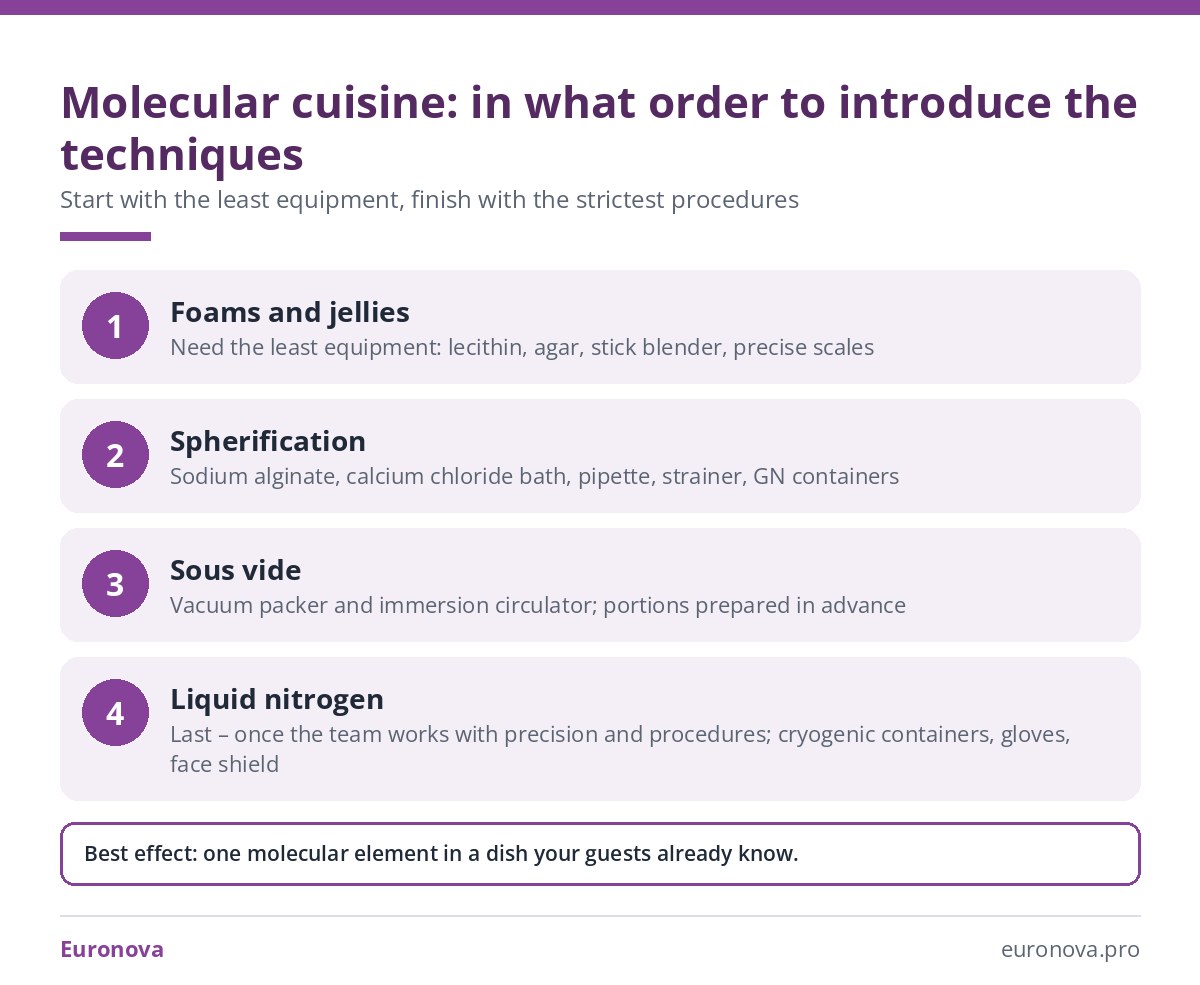
A proven order for introducing the techniques is: foams and jellies first, because they need the least equipment, then spherification, then sous vide, and liquid nitrogen last, once the team is used to working with precision and procedures.
Presentation: tableware is half the effect
A molecular dish is often a few grams of caviar, a spoonful of foam, a thin sheet of jelly. On a plate that is too small or too decorated, it gets lost. That is why chefs choose large, flat surfaces that give the composition space and bring out the colour.
For mini portions and tasting sets, the Notte flat plate 34 × 16 cm is a good fit: its elongated shape lets you line up several elements of one deconstruction. Wider compositions suit the Notte plate 27 × 25 cm, and sharing starters the oval platter 29 × 17 cm. Serve a warm soup jelly or a consommé with spheres in the Banquet soup cup 350 ml, and cocktails with liqueur caviar or foam in Refine 53 cl glasses, where the wide bowl shows the layers off nicely.
At Euronova you can equip your whole venue in one place: porcelain, glassware, cutlery, cookware, kitchen utensils, GN containers and catering appliances, at wholesale prices for restaurants, hotels, bars and catering companies. If you are planning a new menu with elements of molecular cuisine, start by browsing our kitchen utensils and presentation tableware.

You will find the full range and current promotions in the Euronova online shop.
Safety with liquid nitrogen and additives
The mist effect at the table looks effortless, but liquid nitrogen is a substance you work with according to procedures. The rules are clear: do not touch liquid nitrogen or objects cooled with it with bare skin; wear cryogenic gloves, protective clothing and a face shield. The room where nitrogen is stored or used must be well ventilated, with gas detection or a portable oxygen monitor, because evaporating nitrogen displaces oxygen from the air. Never seal nitrogen in a tight container without a pressure relief valve: a small amount of liquid turns into a very large volume of gas, and the pressure builds up.
In restaurant practice, this means a few rules:
- Before first use, train the team according to the gas supplier's safety data sheet and decide who is allowed to work with nitrogen.
- Store nitrogen only in containers designed for it, never in a screw-top bottle or a closed food container.
- Serve the dessert to guests only once the nitrogen has completely evaporated; liquid nitrogen on the plate or in the glass must never get into the mouth.
- Do not touch dry ice without gloves, and do not seal it airtight together with a drink.
For additives such as sodium alginate or calcium chloride, buy food-grade products with dosing instructions, and follow them. Declare allergens on the menu, including soy lecithin if you use it. If you are unsure about additives or procedures, consult a food technologist or your venue's HACCP consultant.
Our view: molecular cuisine starts with a good back of house
Every day we talk to chefs, restaurant owners and hoteliers who want to refresh their menus. These conversations point to one thing: the success of molecular techniques rarely depends on the recipe alone. It depends on whether the kitchen can repeat the effect in a full restaurant, on a Saturday night, for the twentieth time in a row.
That is why we advise starting with the back of house. A well-organised workstation with GN containers, quality saucepans, precise tools and well-chosen tableware ensure that the foam, spheres or warm jelly turn out the same every time. Then comes presentation: a few grams of caviar on a well-chosen plate make a bigger impression than a complicated dish on random crockery.
This is exactly why we build Euronova's range so that a venue can put everything together in one place: from cookware and GN containers to porcelain and glassware, at wholesale prices. A new venue and a restaurant with a long history need the same thing: equipment they can rely on when something new appears on the menu.
Rok
Frequently asked questions
What is molecular cuisine in simple terms?
It is cooking that uses physics and chemistry to change the texture, shape and temperature of food. The flavour stays familiar, but the dish looks and behaves differently, for example as caviar made from juice or a warm jelly. The movement has developed since the late 1980s.
What are some examples of molecular cuisine?
The best known are fruit or liqueur caviar, vegetable foams and espumas, warm jellies, juice "pasta" and ice cream frozen with liquid nitrogen. Deconstructed dishes, in which a classic dish is taken apart into its individual elements, also belong here.
What is the Cook & Chill method?
It is a system in which dishes are cooked in advance, rapidly cooled in a blast chiller, stored in the cold room and reheated just before service. It makes planning work easier and is often combined with sous vide. Set the required temperatures and cooling times in your HACCP plan.
Can I introduce molecular cuisine in an ordinary restaurant?
Yes. Foams, jellies and spherification mainly require precise scales, a few additives and a well-equipped workstation with containers, saucepans and utensils. It is best to start with one element in a dish your guests already know.
Is food prepared with molecular techniques safe?
Yes, if you use food-grade additives at the recommended doses and follow the rules for working with liquid nitrogen and dry ice. Most importantly, the nitrogen must evaporate completely before serving. It makes sense to describe the procedures in your venue's HACCP system.
Sources
- Wikipedia (EN): Molecular gastronomy
- Zintegrowana Platforma Edukacyjna: Kuchnia molekularna
- Academia Europaea: lecture by Hervé This
- Spaeden: Kuchnia molekularna, czyli obiad rozbity na atomy
- Medonet: Kuchnia molekularna – opis, techniki gotowania
- Medonet: Kuchnia molekularna w kontrze do kuchni tradycyjnej
- Foodfakty: Kuchnia molekularna, czyli perły technologii na talerzu
- Nauka w Polsce: Przyszłość na półmisku
- Linde: Working safely with liquid nitrogen (PDF, Dutch)