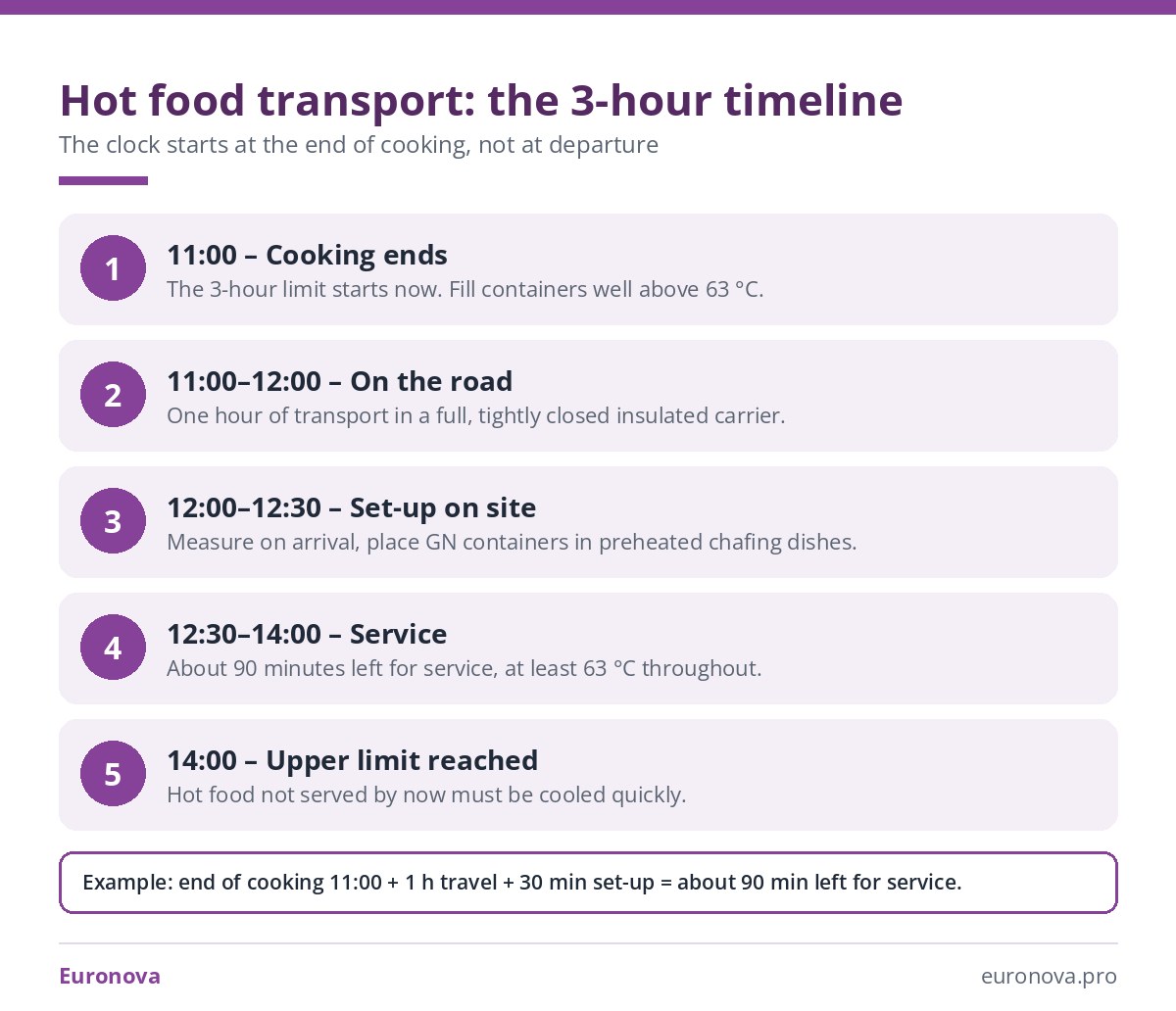
Anyone transporting hot food has to control two values: core temperature and time. Widely used national hygiene guidance in Europe requires hot food to stay at a minimum of 63 °C until it is served. As little time as possible should pass between the end of cooking and the last plate; many European guidelines for institutional catering set three hours as the upper limit. To achieve this you need a high starting temperature, well-filled and tightly closed containers, a clean load space and a thermometer to record the values at loading and on arrival. This guide covers the applicable values, the right containers and a process your team can use to make every delivery equally safe.
Euronova
euronova.pro
Safe hot food transport
Discover containers and packaging for food transport, plus more equipment for commercial kitchens.
The legal basis across the EU is Regulation (EC) No 852/2004 on the hygiene of foodstuffs. It requires vehicles and containers to be clean and in good condition, and foods for which temperature is critical to safety to be transported at an appropriate temperature that can be monitored. You set the specific values in your HACCP plan.
National hygiene guidance commonly specifies at least 63 °C for hot holding and serving; Slovenia's National Institute of Public Health (NIJZ) basic hygiene guidelines are one example. For cooling cooked food, these guidelines state that it should cool from 63 °C to 20 °C within a maximum of two hours, then from 20 °C to 5 °C within a further four hours at most. They set no time limit for hot holding or transport, but advise against preparing food in advance. Check which values your local food safety authority applies.
In other countries you will come across different figures. Since 2020, the German Federal Institute for Risk Assessment (BfR) has recommended that heated food be kept at a minimum of 60 °C throughout, because heat-resistant microbes such as Bacillus cereus and Clostridium perfringens barely grow above this temperature. Older guidelines and the German standard DIN 10508 required 65 °C for many years.
Source
Minimum temperature
Time limit
National hygiene guidance, e.g. NIJZ (SI)
63 °C
not specified, preparing in advance not advised
BfR, 2020 recommendation (DE)
60 °C throughout
until consumption
Institutional catering guidelines (DE)
60–65 °C
max. 3 hours
Our practical recommendation: plan for at least 63 °C at the point of service and pack the food considerably hotter. That gives you a margin for the minutes when the doors are open. The value that is binding for your business is set out in your HACCP plan. If in doubt, contact your local food safety authority.
How long can food be in transit
Time matters as much as temperature. Many European guidelines for institutional catering, including the German standard DIN 10508, set 180 minutes as the upper limit for hot holding. Hot food that has not been served must then be cooled quickly. This is a sensible practical limit for any food service business.
The three hours start at the end of cooking. Departure and arrival times are irrelevant. If you finish cooking at 11:00, spend one hour on the road and set-up takes half an hour, you have around 90 minutes left for service. Work out this timeline for every trip before you plan the route.
How slowly good containers cool is shown by an older BfR opinion No 008/2008: rice stayed hot in a transport container for about three hours before cooling to around 60 °C. The critical count of B. cereus was reached after about seven hours. The three-hour limit therefore has a clear safety margin. This applies especially to rice, pasta, stews and sauces, because spore-forming bacteria multiply readily in them. Slovenia's NIJZ has published dedicated material on Bacillus cereus in food (in Slovenian).
The right containers and packaging
Food only stays hot for as long as its container and packaging allow. The basic rule: vehicles, transport containers and boxes must be food-safe, clean and must not adversely affect the food. The right solution depends on quantity, route and how the food is served.
GN containers as the basis
For caterers and large kitchens, the Gastronorm system is the standard. Containers of the same size are used for preparation, transport and the buffet. The food is not transferred, so it loses less heat and no extra hygiene risk arises. In the GN containers category you will find containers in all standard sizes. If you want to transport food directly in the serving dish, choose porcelain such as the GN 1/1 porcelain dish, 68 mm deep. Porcelain retains heat and goes straight onto the buffet without transferring.
Insulated food carriers
GN containers go into double-walled insulated food carriers, often known in the trade as thermoports. These carriers do not heat; they only maintain the existing temperature. So everything must go in very hot and the carrier should be as full as possible. The less empty air inside, the more slowly it cools.
Disposable packaging for delivery and takeaway
For deliveries to individual customers, offices or wards, you need disposable packaging that can handle hot food. Aluminium containers are heat-resistant, can be sealed tightly and reheated in the oven if needed. Other pots, boxes and cups can be found in takeaway food packaging. Use film and food wrap from the cling film, food paper and rolls category to wrap everything securely.
Use
Suitable solution
What to watch
Catering, banquets, buffets
GN container in an insulated food carrier
carrier full, lid tight
Canteens, schools, care homes
GN container, serve from the same container
timeline from kitchen to last portion
Delivery, takeaway
aluminium containers or takeaway packaging
tightly closed, short journeys
Soups and stews
tightly closed containers filled to the brim
bring to the boil when reheating
Step by step: safe food transport
Safe transport does not depend on an individual driver but on a fixed process. These steps have proven themselves in food service:
Plan the timeline backwards. Start from the end of service and count back to the end of cooking. If there are more than three hours in between, cook later or in stages.
Preheat the containers. Fill food carriers and containers with hot water beforehand or put them in a warm oven. A cold container draws more degrees from the food in the first few minutes.
Fill hot. Transfer the food straight from the hob or oven into the container, at a temperature well above 63 °C.
Load fully and close tightly. Use several smaller, well-filled containers rather than one large half-empty one. Cover and wrap every dish.
Measure the temperature at loading. Insert the thermometer into the centre of the food, record the time and value, and sign.
Load cleanly and separately. Never place food on the floor. Keep hot and cold food apart and do not carry cleaning agents or tools alongside. The load space must be arranged so that food is not exposed to contamination.
Drive directly. No intermediate stops and no open doors for other deliveries. With several drops, load the first drop last.
Measure the temperature on arrival. Measure again, record the value and decide: serve, reheat or discard.
Clean and dry. Clean containers and carriers after every trip and leave them open to dry so they are hygienically clean for the next use.
Measuring and recording temperature
The thermostat on a hot-holding unit is not sufficient proof. Control thermostats do not show the exact temperature, so regular checks with a thermometer are needed. For transport, this means a probe thermometer belongs in every carrier and every vehicle.
Records can be simple. One form per trip is enough, listing the dish, time cooking ended, temperature at loading, temperature on arrival, action taken and initials. For larger fleets, wireless digital thermometers that store readings automatically are worthwhile. Check the thermometer itself regularly, for example monthly in iced and boiling water. If it deviates, replace or calibrate it. That way you have complete evidence when the food safety inspector calls.
When food arrives too cold
Even with a good process, a container sometimes arrives below the target value. The German guidelines for good hygiene practice at events give a clear rule: if the temperature dropped only briefly and slightly, to no lower than 60 °C and for no more than 15 minutes, the food may be reheated. Any greater deviation means it is discarded.
When reheating, the food must reach at least 70 °C, including in the core, and hold that temperature for at least two minutes. Bring soups to the boil. The same rule applies if you deliberately deliver food chilled and regenerate it only on site, as is usual in the cook-chill process. Plan a heat source and time for this on site, then measure again. Record the specific values for your business in your HACCP plan.
Important: reheating only saves food if the deviation was brief. If food has sat in the lukewarm zone for longer, microbes may have multiplied and formed heat-stable toxins. Reheating does not remove them. In that case, discard the food, however hard that is.
On site: service and buffet
The chain does not end on arrival. The same values apply on the buffet as in the vehicle, and the clock keeps running. Place GN containers directly into preheated chafing dishes or bain-maries. Serve smaller quantities and top up from the carrier rather than putting everything out at once.
The surroundings matter too. Decorations, flowers and table ornaments near open food must meet hygiene requirements. For soups at banquets, preheated cups such as the Banquet consommé cup 350 ml work well. Portion finger food into 250 ml finger food bowls so it can be handed to guests quickly.
Our view: safety starts with purchasing
Every day we see how restaurants, hotels, caterers, schools and care homes put together their equipment. Our experience: hot transport rarely fails because of the team's commitment, but mostly because of equipment that does not match.
When the preparation container, the food carrier and the buffet unit share the same Gastronorm size, there is no transferring, which removes one of the biggest sources of heat loss in the whole process. That is why we advise customers to buy equipment as a system: containers, lids, serving porcelain and disposable packaging that work together.
Sufficient stock is just as important. If you have enough containers, you can transport in smaller, fully loaded units, and that is exactly what keeps the temperature up. That is why our range for food service and institutional catering offers everything in one place, from GN containers and aluminium trays to film and serving porcelain.
Rok
Hot transport equipment from Euronova
From Euronova you can order everything you need for safe hot food transport: GN containers, aluminium and takeaway packaging, film and products for storage and transport, buffet equipment and serving porcelain.
In food service, bain-maries and chafing dishes are standard. Both keep food hot in a water bath into which the GN container is placed directly. Heat lamps are often added for chips and roasts. Always check the temperature of the food itself, not just the setting on the unit.
How do I keep food hot for as long as possible during transport?
Fill the food very hot and preheat the containers. Use several well-filled, tightly closed containers and place them in an insulated food carrier. Less air and fewer door openings on the way mean a more stable temperature. Regardless, stick to the three-hour upper limit.
What temperature must hot food be on arrival?
At least 63 °C, the value set by widely used national hygiene guidance. If the food is below this, the length of the deviation decides whether you reheat it or discard it. Record the target value in your HACCP plan.
Can I deliver food cold and reheat it on site?
Yes, this is standard practice in the cook-chill process. The food must then be transported chilled and reheated on site to at least 70 °C in the core, held at that temperature for at least two minutes. Soups should be brought to the boil.
Do the rules also apply to schools and care homes?
Yes. In settings for children, older people or patients, the values must be followed particularly strictly. Check whether your local food safety authority publishes specific guidance for these groups.
Euronova
Questions about transport equipment?
Write to us if you have questions about food storage and transport products or equipment for your commercial kitchen.