How to Remove Stains from Chopping Boards: Wood, Plastic, Commercial Kitchen
How to Remove Stains from Chopping Boards: Wood, Plastic, Commercial Kitchen
Most stains on a chopping board can be removed with simple means. Rub wood with coarse salt and half a lemon, rinse with clean water, leave to dry upright and then oil it. Clean plastic boards hot in the dishwasher and, for stubborn stains, give them a deep clean. If the colour has penetrated deep cuts, the only fix for wood is sanding, and for plastic a new board. Here you will learn how to go about it, which cleaning agent suits which material and how to use boards in a food service business so that stains never become a hygiene problem.
Euronova
euronova.pro
The right chopping boards for commercial kitchens
Discover chopping boards and cleaning products for professional food service in the Euronova online shop.
Wood: salt and lemon against stains and odours, then rinse with clean water, dry completely and treat with neutral cooking oil. Never in the dishwasher.
Plastic: dishwasher at a minimum of 60 °C; for visible stains, a deep clean with a suitable cleaner, without long exposure to aggressive agents.
Deep cuts are the real cause of stubborn stains: sand wood, replace heavily scored plastic boards.
In food service, colour-coded boards prevent cross-contamination and ensure strongly coloured foods always end up on the same board.
No material is more hygienic across the board: undamaged surfaces, separate boards, thorough cleaning and complete drying are what count.
Stains form where pigments from food penetrate the surface. Every kitchen knows the usual culprits: beetroot, turmeric, tomato, peppers, berries, red cabbage and herbs such as parsley. Then there are the odours of onion, garlic and fish, which often linger longer than the visible colour.
How badly a board stains depends on the material and the condition of the surface. Wood is open-pored and absorbs pigments more easily. That is why, according to the NDR consumer guide, plastic is considered particularly suitable for strongly coloured or strong-smelling foods such as beetroot and onion. With plastic, wear is the key factor: scratches roughen the surface, so food residues and liquids penetrate more easily and leave stains. This is how a handbook on commercial warewashing describes it for plastic ware.
This leads to a simple rule: a smooth, new board can almost always be brightened again. A board full of deep cuts holds colour where neither sponge nor brush can reach. The sooner you act, the easier the stain comes out. Do not let coloured juices dry at all: rinse the board straight after chopping, not after service.
Wooden boards: gentle stain removal
Wood tolerates water, heat and mild household remedies, but not the dishwasher. The consumer portal of the German state of Hesse points out that heat and dishwasher detergents damage the material. For a stained wooden board, proceed as follows:
Clean thoroughly: clean the board with hot water, washing-up liquid and a clean brush along the grain. A brush is a better choice than a sponge. Microbiologist Markus Egert explains on the ARD-Marktcheck programme that kitchen sponges harbour very high numbers of microbes and can transfer them to the board.
Salt and lemon: sprinkle coarse salt generously over the damp surface, rub it with a halved lemon and scrub hard along the grain. The salt acts as a fine abrasive, while the lemon's acid lightens pigments and neutralises odours. Leave to work for a few minutes.
For stubborn spots: apply a paste of bicarbonate of soda and a little water, leave briefly and scrub it off with a brush. Alternatively, wipe the board with diluted vinegar. Do not use acid and bicarbonate together, but one after the other, rinsing in between.
Rinse with clean water: remove all residues thoroughly with clean water.
Dry completely: stand the board upright so air reaches both sides. Never leave it lying on the worktop and never soak it in water, or it will warp.
Oil: once the board is completely dry, rub in neutral cooking oil, let it soak in and wipe off the excess. The Hesse portal also recommends regular oiling. The oil layer keeps the wood supple and makes it harder for new pigments to penetrate.
For extra hygiene, the Bavarian Ministry of Food and Agriculture mentions a 0.5 per cent salt solution for stains as a supplement to cleaning with hot water and washing-up liquid. Here too: rinse with clean water and let it dry quickly.
When the colour is deep in the wood
If stains remain visible after several attempts, they are mostly in cuts and grooves. Solid wood boards can then be sanded, first with medium and then with fine grit, always along the grain. Afterwards clean the board, let it dry and oil it again. According to the Bavarian ministry, lots of cuts or grooves are a reason to sand or replace a board anyway. Replace boards with deep cracks or grooves.
Plastic boards: removing stains without damaging the material
In a commercial kitchen, plastic has one clear advantage: it can go in the dishwasher. According to the German Federal Centre for Nutrition, many plastic boards can be machine-washed at 60 °C. According to ARD-Marktcheck, polypropylene (PP) is heat-resistant up to 100 °C and resistant to cleaning agents. The manufacturer's marking, however, is always decisive.
For light stains, a dishwasher cycle with targeted pre-treatment is often enough:
Lemon juice or vinegar: apply to the stained area, leave for a while, scrub with a brush and wash. Particularly effective on fresh tomato or pepper stains.
Bicarbonate of soda paste: mildly abrasive and suitable for dull, superficial films.
Oil against orange stains: residues of tomato, peppers or carrot are fat-soluble. Rub a little cooking oil into the area, leave it to work and then degrease the board thoroughly with washing-up liquid.
Deep cleaning for stubborn stains
If deposits or stains are visible, the commercial warewashing handbook says a deep clean is needed. For melamine, the handbook recommends active-oxygen cleaners for brightening. Avoid long exposure to strongly acidic or alkaline cleaners, however, as they can alter the plastic surface.
In practice this means:
Choose a cleaner approved by the manufacturer for plastics and for food-contact surfaces.
Follow the dosage and contact time in the instructions for use. Do not soak boards "overnight" unless the manufacturer specifies it.
Never mix cleaning agents and follow the safety data sheet, especially for chlorine or acid-based products. Wear gloves.
After deep cleaning, rinse the board thoroughly with clean water or run it through a normal cycle so no cleaner residue remains.
If the stain is still visible on a rough, scored area after that, the board has had its day. According to the handbook, heavily scratched plastic items or those with an altered surface must be replaced.
How to remove onion, garlic and fish odours
Odours often cling to a board longer than colour. Three steps help with any material:
Rinse with cold water first. Hot water can bind the proteins in fish and meat to the surface. So rinse off coarse residues cold first, then clean the board hot with washing-up liquid.
Salt and lemon work against odour and stains at the same time and are the first choice for wood.
Bicarbonate of soda absorbs odours. Apply it as a paste, leave for a few minutes, brush off and rinse well.
In the long run, separation helps most: if you always cut onion, garlic and fish on the same board, your other boards will have no odour problems. In commercial kitchens, colour coding takes care of this automatically.
Which cleaning agent for which board?
Agent
Wood
Plastic
Used for
Hot water, washing-up liquid, brush
yes, daily
yes, daily
cleaning after every use
Dishwasher from 60 °C
no
yes, if the manufacturer allows
hygiene routine in a commercial kitchen
Coarse salt and lemon
yes
yes
fresh stains, odours
Bicarbonate of soda paste
yes, briefly
yes
stubborn films, odours
Diluted vinegar
yes
yes
odours, thorough interim cleaning
Cooking oil
yes, for care
yes, against orange stains
wood care, fat-soluble pigments on plastic
Active-oxygen cleaner
no
yes, as per manufacturer's instructions
visible stains, deposits
Sandpaper
yes, for solid wood
no
deep stains and grooves
When cleaning is no longer enough
A chopping board is a consumable. At the latest when one of these signs appears, it should leave the kitchen:
Deep or numerous grooves: juice, colour and microbes collect here. According to Berliner Morgenpost, the German Federal Institute for Risk Assessment recommends replacement in this case. Depending on the board, wood can also be sanded.
Cracks in the wood or a warped board that no longer lies flat.
A rough, frayed plastic surface that does not brighten even after deep cleaning.
A persistent odour that returns even after salt, lemon and bicarbonate.
In food service businesses, a fixed inspection slot pays off, for example during the weekly deep clean. If you keep spare boards in stock, you can swap them without hesitation instead of using a borderline board for another week.
Hygienic practice in food service
Stains are primarily a cosmetic issue. They become a hygiene issue when they indicate damaged surfaces or when one board is used for everything. No material is more hygienic across the board: the Hesse consumer portal stresses that how a board is handled matters more than the material itself.
Colour coding: one board per food group
Colour-coded chopping boards prevent microbes from raw meat passing to salad or bread. The German cleaning products industry association IKW gives this common allocation:
Colour
Food
Red
raw red meat
Yellow
poultry
Blue
fish
Green
washed fruit and vegetables
White
bakery products, pasteurised dairy, cooked food
Many businesses add a brown board for unwashed root vegetables, and some kitchens use yellow for cooked meat. Which allocation you choose matters less than consistency: according to IKW, once an allocation is set it should be kept. Display the colour chart prominently at the workstation, include it in your HACCP plan and introduce new staff and kitchen helpers to it on their very first day.
A side effect fits the topic nicely: if beetroot, berries and turmeric always end up on the green board, the other boards never stain. A slight tint on the vegetable board bothers no one as long as the surface is smooth and undamaged.
Cleaning in daily practice
Clean after every use, not only after service. Never use meat and fish boards for salad and vegetables without thorough cleaning, as the Hesse portal stresses.
Machine-wash at a minimum of 60 °C if the boards are dishwasher-safe, as NDR recommends. Hand washing with hot water and washing-up liquid can be just as hygienic if cleaning is thorough and drying complete.
Dry completely in a board rack, not stacked damp on top of each other.
No extra promises: according to the German Federal Institute for Risk Assessment, as reported by Stiftung Warentest, antibacterial silver coatings offer no additional protection against microbes. Normal kitchen hygiene and separate boards matter more.
The legal basis across the EU is Regulation (EC) No 852/2004 on the hygiene of foodstuffs, which requires food-contact surfaces to be in good condition and easy to clean. For caterers and event organisers, hygiene does not stop at the kitchen door: include a cleaning plan for boards and work surfaces in your bar operations at events too.
Which material for which kitchen?
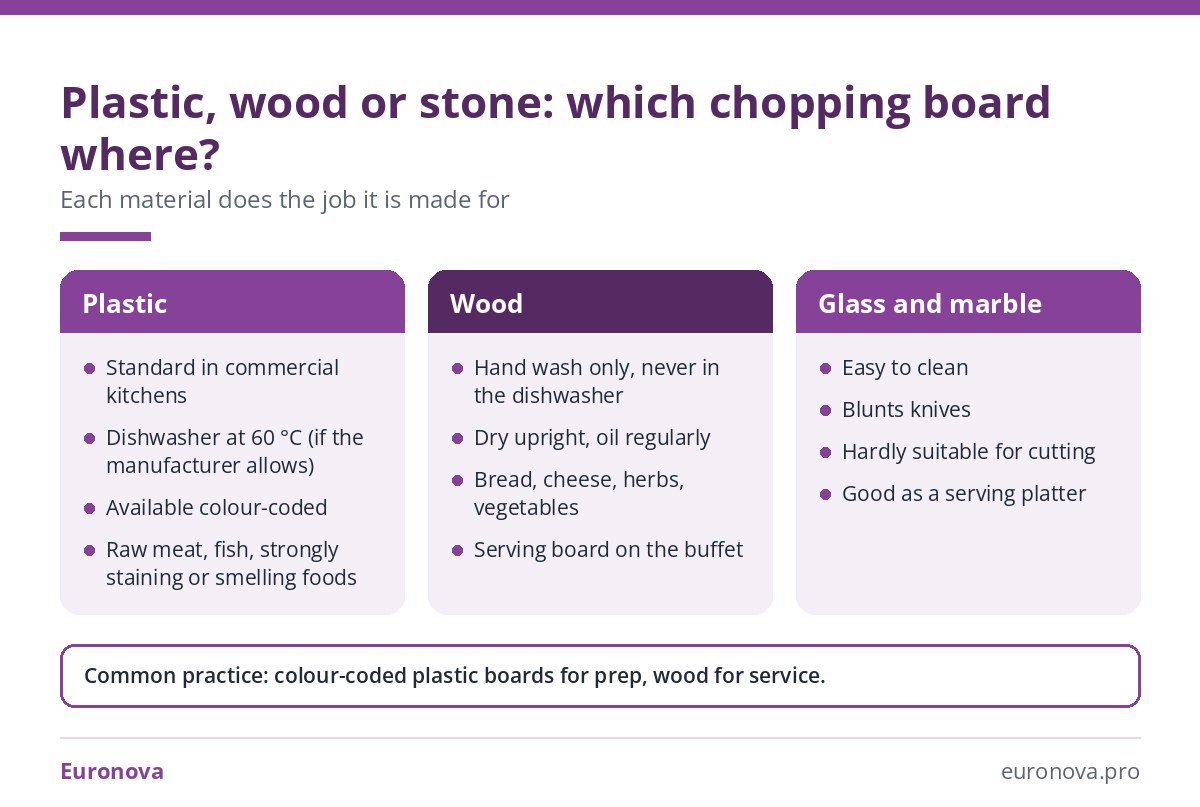
Plastic is the standard in commercial kitchens because, according to Berliner Morgenpost, it withstands washing at 60 °C with standard detergent. It is available colour-coded, is lightweight and suits raw meat, fish and anything that stains or smells strongly.
Wood has its place where boards are cared for by hand and presentation matters: as a bread and cheese board, a serving board on the buffet or for herbs and vegetables. According to NDR, wood is in principle no less hygienic, and some types of wood even have antimicrobial properties. Proper hand care is the condition.
Glass and marble are easy to clean but blunt knives, as NDR describes. They are therefore hardly suitable for cutting in a commercial kitchen, though they work well as serving platters.
Many businesses combine them: colour-coded plastic boards for prep, wood for service. That way each material does the job it is made for.
Our view from food service purchasing
For us, chopping boards are not a side issue but a working tool that affects speed and hygiene in the kitchen every day. A stained board is rarely a care mistake. Most often it shows that the board has too many jobs or has simply been in use for too long.
That is why we advise restaurants, hotels, canteens and caterers to plan boards as a set: one colour per food group and spares in the store room, so nobody grabs the red board for salad in a rush. Buying cleaning products, boards and knives from one supplier keeps the workflow simple and replacement planned.
For purchasing departments, fast reordering also counts. That is exactly what our range of kitchen utensils, knives, chopping boards and cleaning products offers, complemented by expert articles like this one.
Rok
Chopping boards and cleaning products from Euronova
At Euronova, restaurants, hotels, caterers and kitchens in schools, nurseries and care homes will find chopping boards, knives and kitchen utensils alongside professional cleaning products. For daily and deep cleaning, see the kitchen cleaning products for commercial kitchens category.
Can I clean a wooden chopping board with baking powder?
Yes, but pure bicarbonate of soda, the main ingredient of baking powder, works better. Mix it with a little water into a paste, rub it in with a brush along the grain and rinse thoroughly. Then dry the board upright and oil it.
How do I get the onion smell out of a chopping board?
First rinse the board with cold water, then clean it with hot water and washing-up liquid. Next, rub it with salt and lemon or a bicarbonate of soda paste, leave it to work and rinse with clean water. A dedicated board for onions and garlic is the lasting solution.
Which chopping board is the most hygienic?
No material is better across the board. What matters is a smooth, undamaged surface, separate boards for raw meat, vegetables and bread, thorough cleaning after every use and complete drying. In food service, colour-coded plastic boards are standard because they can go in the dishwasher at 60 °C.
Can a wooden chopping board go in the dishwasher?
No. Heat, moisture and dishwasher detergents make wood swell, warp and crack. Clean wooden boards by hand with hot water, washing-up liquid and a brush.
Are stained plastic chopping boards still hygienic?
A slight tint on a smooth surface is mainly a cosmetic issue. But if the surface is rough and heavily scored and the staining does not go even after deep cleaning, replace the board.
Euronova
Questions about chopping boards?
Write to us about chopping boards or cleaning products for your food service business and tell us what you need.