How Much Tableware Does a Restaurant Need? Plates, Glasses and Cutlery per Seat
Restaurant Tableware Calculation: Plates, Glasses and Cutlery per Seat
When equipping a new restaurant, operators plan roughly three sets of tableware, cutlery and glassware per seat: one on the table, one in the dishwasher and one in reserve. That rule is your starting point. The figure only becomes reliable once you factor in the menu, table turnover, dishwashing time and a buffer for breakage, and then order from a single range in full packs. This is exactly where a specialist supplier such as Euronova pays off: plates, glasses and cutlery come from one source and can also be hired for peak periods. Below you will find calculations for restaurants, cafés, bars and catering, each with a worked example.
Euronova
euronova.pro
Tableware tailored to your needs
Discover plates, glasses and cutlery for professional food service and plan an order that fits your venue.
Basic rule: seats × 3 for everything that goes on the table for every guest, i.e. main plates, knives, forks, spoons and water glasses.
Detailed planning: plan less frequently used soup plates, dessert plates or sparkling wine glasses in smaller quantities, and fast-circulating bar glasses by drinks per hour and washing cycle.
Catering: guests × pieces per cover × 1.1 gives the requirement including a 10 % buffer; for glasses, better allow 12 %.
Ordering: round up to full packs (usually 6 or 12 pieces) and stick to one range so that reorders match your existing stock.
Before you calculate a single figure, gather five values. Without them, every calculation remains a guess.
Seats: count indoor seating and the terrace separately, as the terrace is often full only in season, but then needs fully laid tables.
Menu and courses: how many pieces does an average guest need? A bistro serving a dish of the day manages with a main plate and cutlery, while a set-menu restaurant lays covers for starter, main, dessert and bread.
Table turnover: how often is a seat re-occupied at peak time? A lunch service with two sittings in 90 minutes puts different pressure on tableware than an evening service with one sitting.
Washing cycle: the time until a used piece is back, clean and dry, at the pass or the bar. According to a bar station planning guide, this cycle is between 45 minutes and one hour in most venues.
Buffer: breakage, wear, loss and busy days. More on this below.
An overview of the items a restaurant and café typically need is provided by the Gastro Academy equipment list: flat and deep plates in various sizes, knives, forks and spoons, glasses for water, red wine, white wine, sparkling wine and beer, charger plates in upmarket venues and serving utensils for buffets. A café adds coffee and espresso cups, tea and latte macchiato glasses, cake plates and forks, and coffee and espresso spoons.
Basic formula: three sets per seat
The usual calculation for an initial fit-out is: seats × 3. According to Gastro Academy, this applies to frequently used inventory, i.e. plates, forks, knives, spoons and glasses. Buy less frequently needed tableware in smaller quantities.
The logic behind it is explained in a first fit-out checklist: one set on the table, one in the dishwasher, one in reserve. For glasses, allow a little more generously, because breakage is higher in the first months while routines at the dishwashing station and the bar settle in.
The rule works well as long as two conditions are met: the dishwashing area can turn items around within one service, and each guest uses one piece per course. As soon as you run several sittings an evening, serve set menus or your dishwashing area reaches its limit at peak times, calculate in more detail.
Calculating how many plates you need
Calculate plates separately by type, because a main plate is needed by almost every guest, but a soup plate only for some orders.
Calculation for each plate type:
Requirement = seats × share of guests using this plate × 3, rounded up to full packs.
Example: 60-seat restaurant, evening service, à la carte
Plate type
Assumption
Calculation
Requirement
In packs of 12
Flat main plate, approx. 27 cm
every guest
60 × 1.0 × 3
180
15 packs
Small plate, approx. 21 cm (starter, dessert)
about two thirds
60 × 0.67 × 3
120
10 packs
Deep plate or bowl (soup, pasta)
about half
60 × 0.5 × 3
90
8 packs (96 pieces)
Bread plate
every guest
60 × 1.0 × 2
120
10 packs
For bread plates, two sets are often enough, because they usually stay on the table throughout the visit and are not changed during service. The shares in the table are assumptions for this example. You will find your own values in your till sales data: how many soups, pasta dishes and desserts go over the pass per 100 main courses?
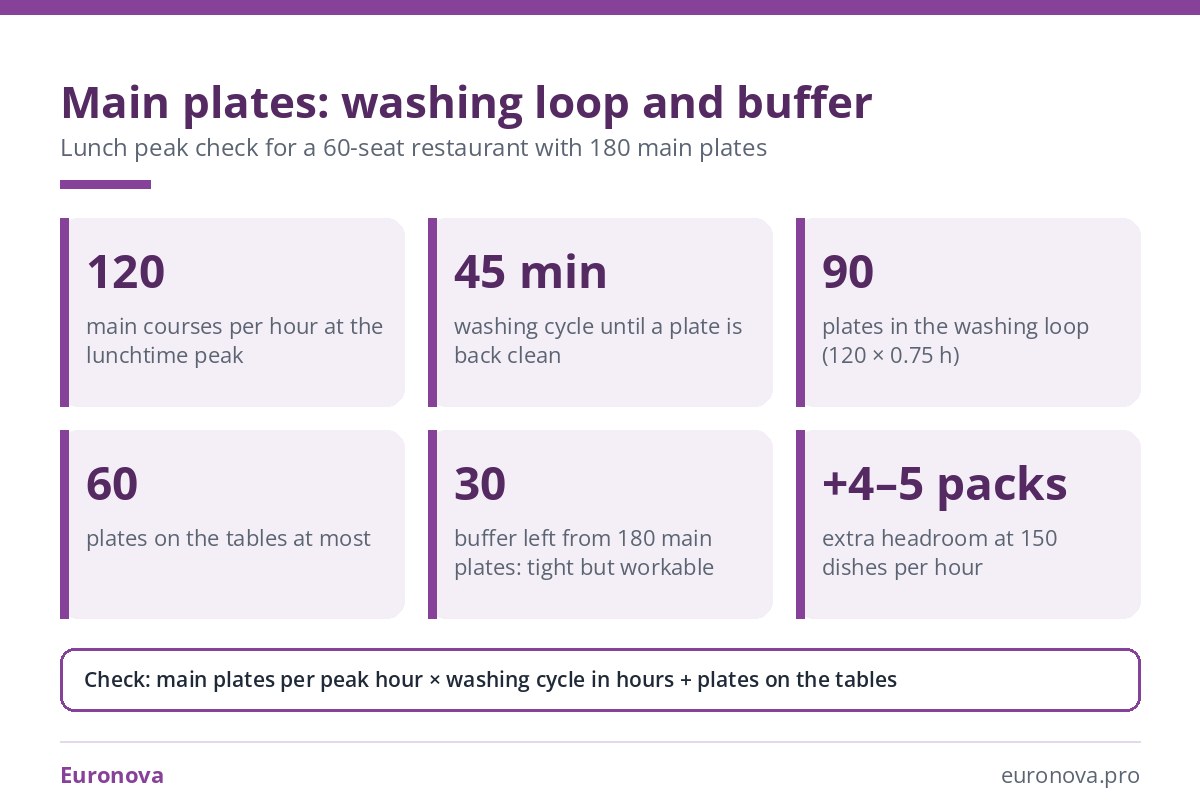
When you run several sittings: for a fast lunch with high turnover, the rule is only enough if the dishwashing area keeps up. Check it like this: main plates per peak hour × washing cycle in hours + plates on the tables. If 120 main courses go out per hour at the lunchtime peak and a plate comes back clean after 45 minutes, 90 plates are in the washing loop and up to 60 on the tables. With 180 main plates, 30 remain as a buffer, which is tight but workable. At 150 dishes per hour, 4 to 5 extra packs would give you headroom.
For main plates, a food-service-grade range is ideal, such as the Sepia 27 cm flat plate, available in packs of 12; a matching smaller plate is, for example, the Aqua 21 cm plate.
Calculating how many glasses you need
Glasses are where calculations most often go wrong, for two reasons: they break more often than plates, and at the bar they circulate much faster.
Glasses on the table: treat water glasses like main plates, i.e. seats × 3. For wine, sparkling wine and beer glasses, calculate with the share of guests who order the drink, then add a generous buffer.
Glasses at the bar: here, speed is what counts. The bar station glassware formula is: drinks per hour × share of this glass type × washing cycle in hours, plus a buffer. An example shows how big the difference is: a bar serving 60 drinks per hour with a 45-minute washing cycle needs about 45 wine glasses in circulation, not the 24 sitting in the cupboard.
Example: bar with 80 drinks per hour at peak, 1-hour washing cycle
Glass type
Share of drinks
Glasses in circulation
Plus 12 % buffer
Order quantity
Wine glass
30 %
24
27
30 (5 × 6)
Beer glass
35 %
28
32
36 (6 × 6)
Long drink glass
20 %
16
18
18 (3 × 6)
Water glass
15 %
12
14
18 (3 × 6)
Add the glasses standing on the shelf at the start of the evening. Stackable water glasses save space in the back bar, for example the Timeless 34 cl water glass. For wine and sparkling wine, you will find the right shapes among our glasses and glassware.
Calculating how much cutlery you need
Calculate cutlery by cover, not by guest. A guest having the dish of the day needs a knife and fork; a guest on a three-course menu needs considerably more.
Service planning material for chef training allows six pieces of cutlery per cover for a three-course menu: knife and fork for the starter and main course, a dessert spoon and a butter knife. Add three glasses (water, white wine, red wine), two plates (charger plate and bread plate) and a napkin.
For an à la carte restaurant, the rule again applies: seats × 3 for knives, forks and spoons. With 60 seats, that is 180 pieces of each. Adjust steak knives, fish cutlery or dessert forks to the share of dishes that need them, just as with plates.
For a set-menu restaurant, multiply the pieces per cover by the number of seats and multiply the result by two to three, depending on whether each seat is taken once or twice an evening.
Don't forget serving utensils: for buffets, hotel breakfasts and sharing plates you need serving forks, ladles and tongs. Plan one piece per bowl or platter on the buffet, plus a spare for swapping. You will find a selection among our serving utensils.
Café: cups, saucers and cake plates
In a café, the focus shifts from the plate to the cup. Turnover is high, drinks are finished quickly and cups go through the dishwasher more often than plates in a restaurant.
Proceed as follows:
Determine your drinks mix: what share of orders is espresso, cappuccino, white coffee, tea or latte macchiato?
Take your busiest hour: drinks per hour on Saturday morning or at lunchtime, not the average.
Calculate as for a bar: drinks per hour × share × washing cycle in hours, plus cups on the tables, plus a buffer.
Count the saucers too: every cup needs its saucer, and experience shows saucers break just as often as cups. Order them in the same quantity.
Cake plates and forks: by the share of guests who order cake, times three.
A 40-seat café selling 70 drinks per hour at peak, 40 % of them cappuccinos, has 21 cappuccino cups in circulation with a 45-minute washing cycle, plus up to 16 on the tables. With a 12 % buffer, you arrive at about 42 cappuccino cups; order saucers in packs of 12, i.e. 48 pieces. Suitable saucers such as the Gourmet 17 cm saucer or the 19 cm version are available in packs of 12.
Tableware for catering and events
In catering there is no washing loop during service, at least not a reliable one. Every guest gets their own cover, and anything that breaks has to be replaced from the reserve. That is why you calculate by guests and courses here instead of by seats.
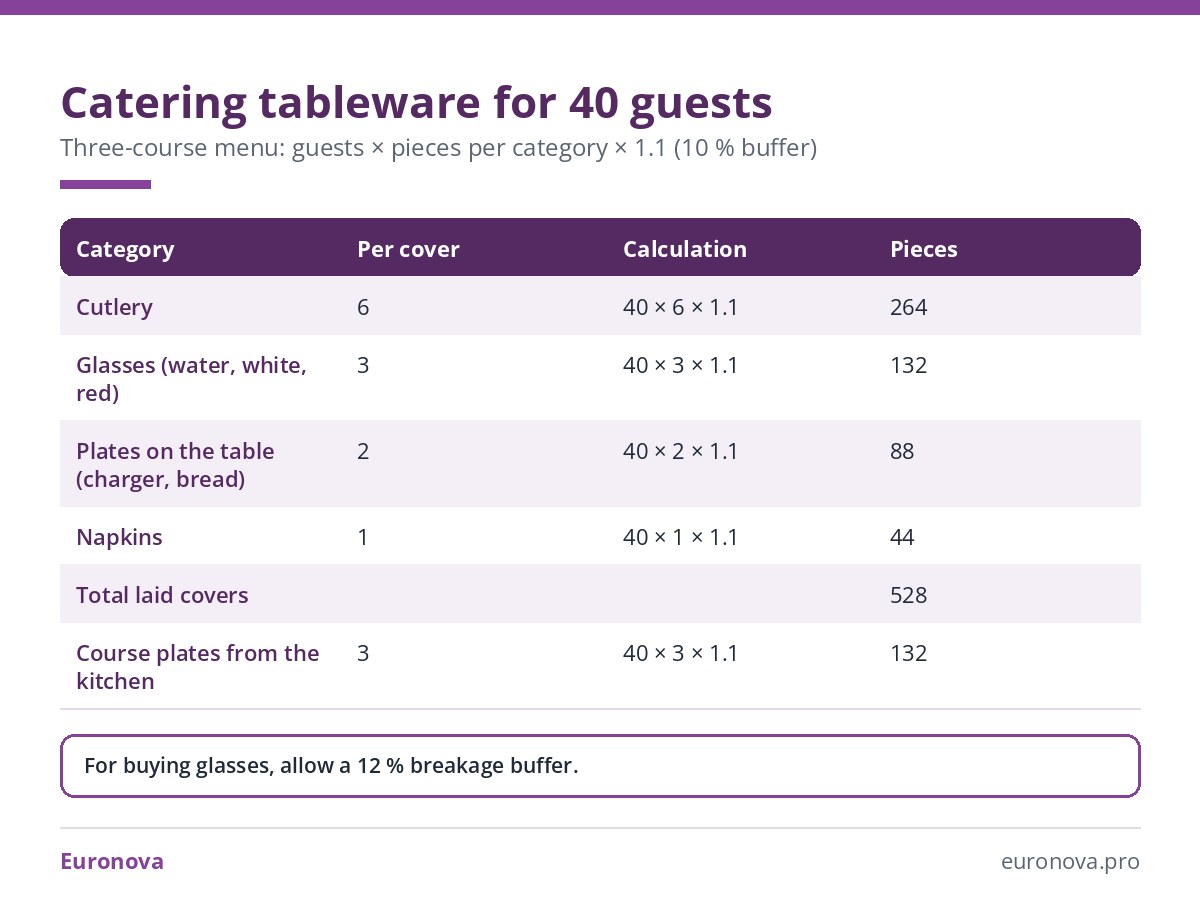
The formula from asyoube service planning is: number of guests × pieces per category × 1.1 for a 10 % buffer. For 40 guests and a three-course menu, that gives 264 pieces of cutlery, 132 glasses, 88 plates and 44 napkins, 528 pieces in total. When buying glasses, the same source also recommends a 12 % breakage allowance.
Important: in this example, only the charger plate and bread plate are laid on the table. The plates for each course come from the kitchen and must be added to your list. With three plated courses for 40 guests, that is another 40 × 3 × 1.1 = 132 plates.
For multi-day events, finger food receptions or crew and staff catering, calculate separately for each meal and each serving point. For standing receptions, 180 ml finger food bowls in packs of 30 are practical, and for takeaway service, plan disposable cutlery by number of guests plus a buffer.
Buy or hire? If you regularly lay tables for groups of a similar size, buy a basic stock. For occasional large events that exceed this stock, hire the difference. At Euronova, both options are available for plates, glasses and cutlery: purchase and catering equipment hire.
How much buffer for breakage, loss and peaks?
The buffer is the part of the calculation many people set too tight. Three values help you judge it:
In an established restaurant, the buffer is already included in the third set of the basic rule. A small stock of plates and glasses in the storeroom is also worthwhile, so a full evening doesn't fail because of an empty shelf.
For events, 10 % on all items is the usual figure, 12 % for glasses.
In the first months after opening, glasses in particular break more often until the team and routines settle in. So calculate more generously for glasses.
Signs that your buffer is too small: staff wait for plates at the pass, glasses go out still damp, or pieces from a different range end up on the table. At that point at the latest, it is time to reorder.
A calculated figure is not yet an order. Three steps turn it into a shopping list that works in day-to-day operation.
Round up to packs. Commercial porcelain and glassware are sold in fixed units, often of 6 or 12 pieces. Always round up, never down.
Stick to one range. Mixed inventory quickly looks unprofessional, as Gastro Academy also points out. Choose a range from an established brand so that reorders after breakage or a new menu match your existing stock.
Combine everything in one order. Plates, glasses, cutlery, serving utensils and consumables in a single order save procurement time and shipping costs.
Once your list is ready, you can order porcelain, glassware and cutlery for restaurants, hotels, cafés, bars and catering from a single shop at Euronova.
Many first fit-out calculations are not wrong, just incomplete. The three-sets-per-seat rule is a good start, but it tells you nothing about how fast your dishwashing area works, how many glasses go over the bar on a Friday night, or what is still in the cupboard after six months of breakage.
That's why we recommend thinking about your requirement twice: once for day one and once for the first year. For day one, quantity counts. For the first year, what counts is being able to reorder the same plates and glasses without your tables looking like a flea market.
So it pays to buy porcelain, glassware and cutlery from a specialist supplier with a wide choice of brands, rather than picking up individual items wherever they happen to be cheap. With us you will find plates, glasses, cutlery, serving utensils and disposables in one shop, and for events that exceed your stock you can also hire plates, glasses and cutlery. Our expert articles help you choose before you order.
Rok
FAQ
How many plates does a 50-seat restaurant need?
As a basic stock, plan 50 × 3 = 150 flat main-course plates. Plan side plates and soup plates by the share of guests who use them, for example 100 small plates and 75 deep plates if two thirds and half of guests use them. Then round up to full packs.
How many glasses per guest should a caterer plan?
For a menu served with water, white wine and red wine, that is three glasses per guest, plus one more for a sparkling wine reception. Multiply by the number of guests and add at least 10 %, or better 12 % for glasses, as a buffer.
Does the seats-times-three rule also work for a bar?
Only to a limited extent. At a bar, glasses circulate much faster than tableware in a restaurant. Calculate with drinks per hour at peak time, the share of each glass type and the washing cycle, then add the shelf stock and a buffer.
Should I buy or hire tableware for events?
Buy the stock you need regularly. For occasional large events that exceed it, hiring is the right solution. At Euronova, both options are available for plates, glasses and cutlery.
Euronova
Questions about planning your tableware?
Tell us what plates, glasses and cutlery your venue needs.