Commercial Deep Fryer for Professional Kitchens: How to Choose, Standards and Use
A commercial deep fryer is the right choice when its tank size and power match your busiest hour, the unit meets European standards and your team can use it safely and cleanly every day. The appliance itself is only part of the equation: oil, cleaning, the fire extinguisher, baskets and packaging for fried food all decide whether the fries at 7 pm are as good as at noon. If you plan the fryer together with everything around the frying station and buy it from a specialist catering equipment supplier, you avoid gaps, repeat orders and problems at your next inspection. Commercial fryers differ mainly in their installation, energy source and tank design. The right choice depends on what you fry, how much goes out at peak time, and how much space and connected load your kitchen has. In most commercial fryers, the heating elements sit above the bottom of the tank. Below them is a cooler area where batter and crumbs sink without carbonising. This keeps the oil fresh for longer and the food free of bitter off-flavours. The cold zone is so important that it is covered by standards for large-kitchen fryers: the German DIN 18856:2023-10, for example, contains requirements for heating and control equipment, heat-up time, cold zone, foam zone, materials, surface temperatures and hygiene. Automatic basket-lift systems raise the basket out of the oil once the programmed time is up. This takes pressure off the team at peak times and ensures consistent results. Occupational safety guidance requires mechanical basket lifts to lower slowly and continuously, with the drive switching off automatically at the end positions. Pressure fryers fry under slight overpressure at a lower temperature. The most common planning mistake is a tank that copes with the average but fails at peak time. So proceed in four steps. Example: a restaurant sells mainly fries at the lunchtime peak, plus fried fish in the evening. Rather than one large tank, it is better to work with a twin-tank fryer: fries on the left, fish on the right, each tank at its own temperature. At lunchtime both tanks fry chips; in the evening the fish oil stays completely separate. Think about fire safety when choosing the size, too. German rules for commercial kitchens, for example, generally require a fixed extinguishing system for fills above 50 litres. A larger total capacity split across several smaller units can therefore be the simpler solution. Agree with an occupational health and fire safety specialist on what applies to your business. You can recognise a good commercial fryer by the details that save time and oil during service. Where the fryer stands determines ergonomics and fire safety. Expert occupational safety guidance on fryers gives clear dimensions: Water and hot fat don't mix. Experience shows that a distance of 90 cm between the fryer and appliances containing liquids, such as boiling kettles or sinks, is sufficient. If that is not possible, a non-combustible partition at least 35 cm high is required. A tested fire extinguisher to EN 3 with the class F pictogram, specifically suited to cooking oil and fat fires, must be within reach. Staff must be trained in safe working and fire prevention, as required by occupational health and safety legislation. And the most important rule: a fryer must never be left running unattended. Oil is the most expensive consumable at the fryer and your biggest lever for quality and safety. The right fat. Neutral vegetable fats offered specifically for frying are suitable. According to expert frying guidance, oils with more than 2 % linolenic acid, such as ordinary soybean and rapeseed oil, and animal fats such as lard and tallow are not suitable. The right temperature. Commission Regulation (EU) 2017/2158 also applies to food service businesses and requires measures to reduce acrylamide formation (a substance formed when starchy foods are heated strongly). In practice, this means: don't fry above 175 °C, cook fries golden yellow rather than brown, and record temperature checks as part of your food safety management. Daily care. Drain and filter the fat every day, removing sediment. Never salt over the tank, and let food drain well before it goes into the oil: water and salt speed up fat breakdown. The right time to change. In several European countries, frying fat with more than 24 to 27 % polar compounds is considered unfit for consumption. A polar compound tester makes the time to change objective; also watch for dark colour, strong smell, smoke and foaming. Record the limit for your business in your HACCP system. Once the fat starts to deteriorate, the entire fill must be drained, the fryer cleaned and refilled. Topping up with fresh oil does not rejuvenate old oil. Changing the oil is also fire safety: the auto-ignition temperature of frying fat drops the longer it is used. If you use oil for too long, you shrink the safety margin between working temperature and fire. Rooms, appliances and extraction systems must be cleaned thoroughly and regularly for hygiene and fire safety, using cleaning products with the lowest possible risk. Grease that builds up in the hood and filters is flammable and therefore belongs in your regular cleaning schedule. This oil change routine has proven itself: For cleaning the tank, work surfaces and hood, you will find professional kitchen cleaning products for food service in our shop. Used fat must be disposed of properly as waste: it belongs neither down the drain nor in mixed waste. Waste cooking oil is usually collected by a licensed collector who takes away the containers. With a commercial fryer, running costs over the years often exceed the purchase price. Three things count: A fryer alone is not yet a frying station. At Euronova, restaurants, hotels, cafés, pizzerias, caterers and contract kitchens get catering equipment and the supplies around it in one place: takeaway food packaging for fries and fried fish, food paper and films, food storage products, cleaning products and chef's clothing for your team. Browse our HoReCa catering equipment and order everything for your frying station in a single order. When buying a fryer, the conversation mostly revolves around litres and kilowatts. Both matter. But whether the station works day to day is decided by what stands around the appliance. A second basket, the right cleaner for the daily oil change, enough delivery packaging and clean chef's whites for the team: if one of these is missing on a Friday night, even the best fryer grinds to a halt. That's why we advise planning the frying station as a whole and buying it together. That is exactly what our range is designed for: catering equipment, kitchen utensils, packaging, cleaning products and chef's clothing in one shop, with expert articles to help you choose, in several European language versions. So you order once and have everything the station needs. Rok The power of commercial fryers is stated in kilowatts, but what really matters is power relative to oil capacity. More power per litre means the oil gets back to temperature faster after frozen product goes in. Larger electric units run on three-phase power, so have an electrician check your connection before you buy. There is no fixed number of days. In several European countries, frying fat with more than 24 to 27 % polar compounds is considered unfit for consumption. Filter the oil every day, measure it regularly and replace the entire fill once the limit is reached or when colour, smell and foaming indicate spoilage. Fill the oil to the mark, heat it to no more than 175 °C, let food drain well before frying and don't overfill the basket. After frying, let the food drain and salt it away from the tank. Never leave the fryer unattended and keep a class F fire extinguisher within reach. A tested fire extinguisher to EN 3 with the class F pictogram, designed for cooking oil and fat fires. For larger oil volumes, consult a fire safety specialist about an additional fixed extinguishing system. Never use water. The word comes from the verb to fry. In commercial kitchens the appliance is also called a deep fryer or deep-fat fryer, and in many European kitchens you will also hear the French word friteuse.Commercial Deep Fryer: How to Choose, Standards and Safe Use

In brief
Contents
Which type suits which kitchen
Type
Typical use
What to look out for
Countertop fryer, single tank
café, bar, pizzeria with a small snack menu
worktop space, fat drain, electrical connection
Countertop fryer, twin tank
restaurant serving fries plus fish or meat
separate temperature control for each tank
Free-standing fryer (electric)
restaurant, hotel, canteen with high throughput
three-phase connection, cold zone, drain tap
Free-standing fryer (gas)
large kitchen with an existing gas supply
flame supervision, professional installation
Fryer with basket lift
restaurant chain, large kitchen
programmed times, slow lowering
Pressure fryer
chicken and large pieces in batches
cooking at a lower temperature
Pastry fryer
pastry shop, hotel breakfast, doughnuts
shallow, wide tank for fried pastries
Cold zone: the food service standard
Basket-lift fryers and pressure fryers
Sizing the tank and power correctly
Features and materials that prove themselves daily
Installation and workplace safety
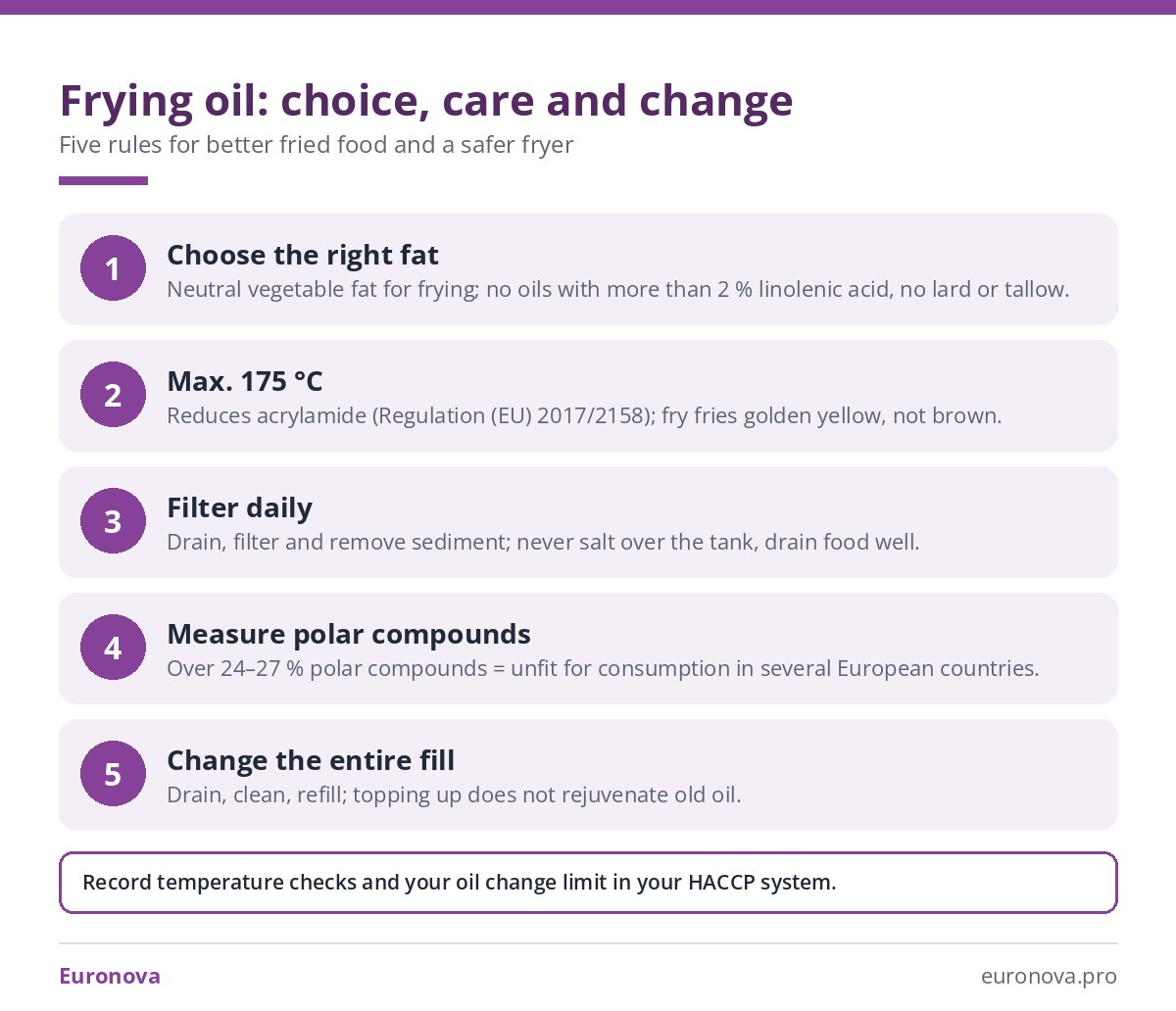
Frying oil: choice, care and changing
Cleaning and disposal
What it costs to run
Everything around the fryer at Euronova

Our view: plan the fryer as a system
FAQ about commercial deep fryers
How many watts does a commercial fryer need?
How long can oil stay in a deep fryer?
How do you use a commercial deep fryer correctly?
Which fire extinguisher do you need for a deep fryer?
Where does the word fryer come from?
Sources