Menu Holders for Restaurants and Hospitality: Materials, Sizes and How to Choose
Menu Holders for Restaurants and Hospitality: Materials, Sizes and How to Choose
The right table menu holder for a restaurant or hospitality venue depends on three things: the size of your menu card, a material that suits your tables and can be wiped clean every day, and a base that stands firm even on a terrace or buffet. It is best chosen not on its own, but as part of the whole table setting, together with porcelain, glassware, cutlery and table decor. That way everything matches and you order in one go. This is exactly what Euronova is built for: an online shop for catering equipment covering the entire table.
Euronova
Create a coordinated table setting
Discover catering equipment such as porcelain, glassware, cutlery and table decor for coordinated table settings.
An obligation, not decoration: guests must know the prices of food and drinks before they order. A menu holder handles this most neatly at the table.
Size first: measure your menu card before choosing a holder. The sleeve or clip slot must fit the size and thickness of the card, including lamination.
Material to match your concept: acrylic is neutral and light, stainless steel and aluminium are hard-wearing, while wood, slate and concrete add warmth or weight to the table.
Think hygiene: smooth, wipeable surfaces and laminated inserts save time when laying tables.
Order together: menu holders, glassware, porcelain and table decor in one order give a consistent table setting and simplify procurement.
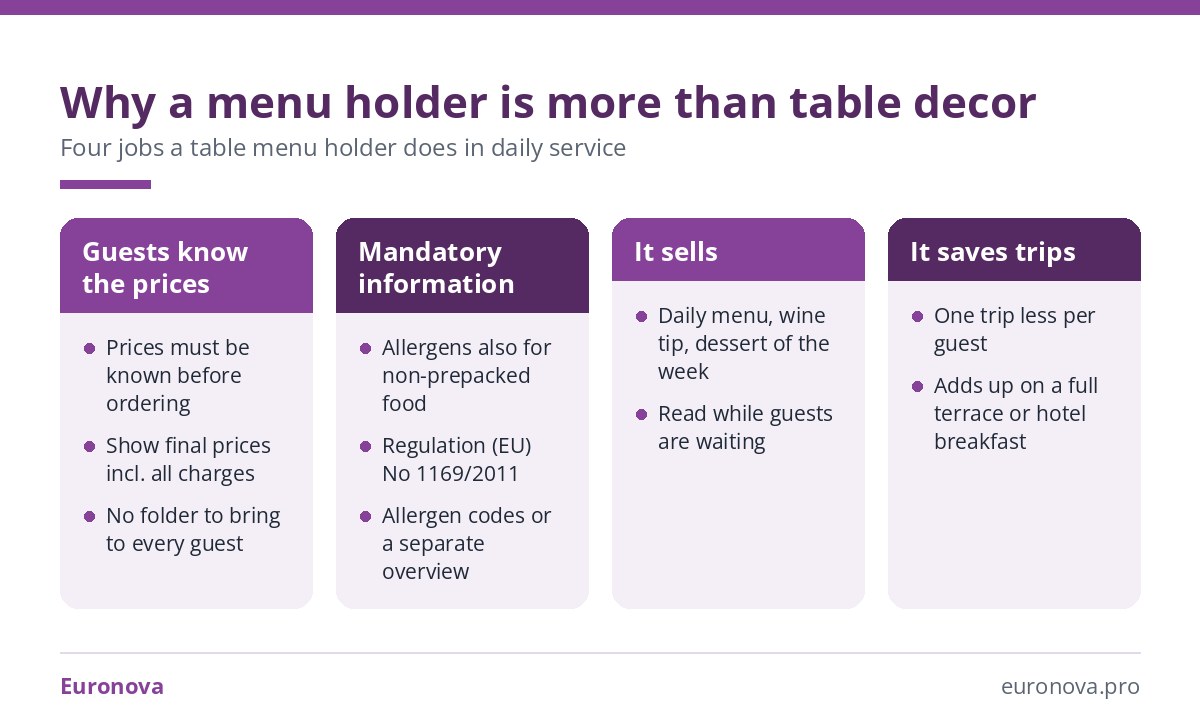
A menu holder looks like a small detail. For your business, though, it does several jobs at once.
Guests know the prices. Before ordering, guests must know what they will pay for a dish or drink. Food service businesses therefore need a price list for food and drinks on which prices are clearly shown, as required by hospitality and consumer protection rules. If your menu stands permanently on every table, this is covered without staff having to bring a folder for every new guest. Make sure the menu shows final prices including all charges.
It displays mandatory information. Even for non-prepacked food, i.e. everything you prepare fresh and serve, you must inform guests about the main allergens. This is laid down in Regulation (EU) No 1169/2011 on the provision of food information to consumers, and the European Commission has published guidance on allergen labelling to help. Many venues print allergen codes directly on the menu or place a separate allergen overview in a second holder. A holder on the buffet or counter is ideal for this, because guests see the information where they choose.
It sells. A daily menu, a wine recommendation or the dessert of the week in a holder gets read while the guest is waiting. A menu in a folder, by contrast, goes back to the pass after the order.
It saves trips. When the menu is already on the table, staff save one trip per guest. On a full terrace or at a hotel breakfast, that quickly adds up.
Common styles at a glance
Before material even comes into it, the style decides which cards you can use at all.
Clip holders and slot holders
This is a small, heavy base with a slot or clip into which the card is inserted. Clip holders suit single sheets, laminated cards or card stock. The width of the slot is crucial: if the card is too thick, it won't hold or will get damaged. If it is too thin, it falls over. So measure the thickness of the finished laminated card, not the paper.
Sleeve holders
Here the card sits in a clear sleeve, usually acrylic, mounted on a base. The big advantage: nobody touches the card itself, so it stays clean and can be swapped in seconds. For daily or weekly menus that change often, this is the most practical solution.
L-shaped, T-shaped and triangular holders
L-shaped holders show one side, T-shaped and triangular holders two or three. On tables where guests sit on both sides, a double-sided holder is well worth it: menu on the front, drinks or allergen overview on the back.
Holders for counters, buffets and table numbers
Small holders for price tags, buffet labels or table numbers follow the same principle in a small format. For hotels with a breakfast buffet and for caterers, they are often the most important use, as every dish should be labelled and come with allergen information.
Materials: what suits which venue
The material determines how a holder looks, how much it can take and how much work it is to clean.
Material
Look on the table
Advantages in service
Especially suited to
Acrylic
neutral, modern, almost invisible
light, clear, insert swapped quickly
restaurant, café, hotel, events
Stainless steel
clean, professional
robust, keeps its shape, easy to wipe
bistro, canteen, contract catering
Aluminium
light and elegant
stable base at low weight
hotel, banqueting, lounge
Wood
warm, natural
pleasant to the touch, matches wooden tables
café, pizzeria, country inn
Slate and stone
rustic, high-quality
heavy and stable, also outdoors
wine bar, terrace, steakhouse
Concrete
urban, minimalist
very stable in the wind
bar, street food, outdoor catering
A few rules from practice:
Outdoors, weight matters. On a terrace, light holders blow over at the first gust of wind. A heavy base of stone, concrete or solid metal is the right choice here.
Changing cards need sleeves. If you print a new menu every day, a sleeve saves time. Rigid clip holders are better suited to cards that stay the same for months.
Choose the material to match the table setting. A stainless steel holder next to light banqueting porcelain looks different from a wooden holder next to a dark gourmet range. When you choose new porcelain, plan the holder at the same time.
The right size
The most common menu sizes in hospitality follow the A series of paper sizes (ISO 216, originally the German DIN standard). The sizes build on each other: an A5 sheet is an A4 sheet halved, A6 is A5 halved.
A4 is the classic size for a full menu. In a holder, it suits the counter, entrance or buffet rather than small tables for two.
A5 is the all-rounder for table holders: large enough for a daily menu with prices and allergen codes, small enough for tables for two and four.
A6 suits drinks specials, desserts, cocktail recommendations or an allergen overview.
DL is narrow and tall, which makes it popular for wine and cocktail lists at the bar.
Small sizes suit table numbers, reservation signs and buffet labels.
Before ordering, check two measurements: the inside dimensions of the sleeve or slot and the thickness of the card after lamination. Sleeves are often a few millimetres larger than the paper size so that the card slides in easily. That much play is fine.
At the bar, size also shapes the impression: a short, curated list in a narrow format looks more upmarket than a crammed page.
Menu holders by type of venue
Restaurant
In a restaurant, the holder should show the card while making way for the plate and glass. A proven choice is an A5 sleeve holder for the daily menu and recommendations, complemented by a bound main menu brought by staff. Choose the material and colour to match your porcelain and glassware so the table looks calm.
Hotel and breakfast buffet
Hotels need two levels: holders on the restaurant tables and lots of small labels on the buffet. For the purchasing department, it pays to choose one consistent range in several sizes. That way table holders, buffet labels and counter holders match visually, and reorders stay simple.
Bar and lounge
Bars are darker, tables are smaller and glasses are moved around a lot. A narrow, stable holder in DL or A6 works best. If you are launching a new cocktail list, plan the equipment that goes with it straight away, from cocktail tools to the right glasses and glassware.
Café and patisserie
In a café, cakes and seasonal offers change often. Sleeve holders are the first choice here, as are double-sided holders for tables where guests sit on both sides. Wood or white acrylic suit light interiors.
Pizzeria
In a pizzeria, the table is often full of pizza plates, oil, seasonings and drinks. A compact, heavy holder in A6 or A5 with pizza specials and drinks stands here without getting in the way. A surface that tolerates oil and grease marks and can be wiped quickly is important.
Catering and events
At events, the menu, table layout and venue change every time. You need lots of identical holders for menus, table numbers and buffet labels that are easy to transport and stack. Acrylic and aluminium are popular. If you need extra cutlery for an event, you can hire it instead of buying from us and plan the table setting in one step.
Schools, nurseries and care homes
In contract catering, appearance matters less than clarity and safety. The weekly menu and allergen overview belong in a visible spot by the serving counter. Holders with a heavy, flat base and no sharp edges make sense, because children or residents with limited motor skills can easily knock a holder over. Large print and a generous size such as A4 help with reading.
Hygiene and daily care
Many hands touch a menu holder. So it belongs in the daily cleaning routine when laying tables, just like cutlery and tables.
Laminate or use a sleeve. Laminated cards and sleeves can be wiped; open paper cards cannot.
Choose the right cleaners. Acrylic, wood and metal don't tolerate the same products. Follow the manufacturer's care instructions and use mild, material-friendly products for plastics. For tables, counters and metal surfaces, you will find professional kitchen cleaning products in our range.
Plan replacements. Scratched sleeves and worn cards quickly look neglected. Keep a few spare holders and freshly printed inserts in reserve.
Clear responsibility. Decide who changes the cards and cleans the holders, for example during mise en place before service. Then the daily menu is never yesterday's.
How many menu holders you need
The basic calculation is simple: one holder per table, plus holders for the entrance, counter and buffet. Also allow spares for breakage, loss and extra tables on busy days. Example for a restaurant with 22 indoor tables and 12 terrace tables:
Where used
Quantity
Recommended type
Indoor tables
22
A5 sleeve holder
Terrace tables
12
A5 or A6 with a heavy base
Entrance (price list)
1
A4, placed where it is easy to read
Counter and bar
2
DL for drinks and cocktails
Allergen overview
2
A5 or A4 by the counter and the pass
Spares
4
same as the table holders
Total
43
With this list, you can order once and in full instead of buying individual pieces again and again.
Your whole table in one place
A menu holder never stands alone: it sits next to the plate, glass, cutlery and decor. At Euronova, you will find equipment for the whole table in one shop, from porcelain and glassware through cutlery and serving utensils to table decor and venue decoration.
Our view: the menu holder belongs to the table concept
We work every day with restaurants, hotels, bars, cafés, pizzerias, caterers and contract kitchens, and when it comes to equipment we notice one thing again and again: small items such as menu holders are often bought last and one at a time. The result is tables where porcelain, glasses and holders don't match.
That's why we recommend planning the table as a whole. If you choose tableware, glassware, cutlery, table decor and accessories together, you get a coordinated look and save time on procurement. That is exactly why our range is so broad.
Our expert articles, product catalogues and language versions are meant to make choosing easier for buyers in hotels and food service businesses, including when they equip several locations.
Rok
FAQ about menu holders
Does every table need a menu on it?
Not necessarily. Guests must know the prices before they order, which you can also ensure by having staff bring the menu or by displaying the price list clearly in the venue. A menu holder on every table is the most convenient way to make sure of this at all times.
Which menu holder material is easiest to care for?
Smooth surfaces such as stainless steel, aluminium and acrylic are the quickest to wipe clean. For acrylic, use mild cleaners suitable for plastics, following the manufacturer's instructions. Wood and slate look warmer but need a little more care.
Which size is best for a daily menu?
For most venues, A5 is the best size: it has room for dishes, prices and allergen codes and still suits small tables. Drinks specials and cocktails work well in A6 or DL.
How many menu holders should I order?
Plan one holder per table, plus holders for the entrance, counter, buffet and allergen overview. Also allow spares for breakage and extra tables. Combining everything in one order saves time on procurement.
Euronova
Questions about table settings and menu holders?
Write to us with any questions about catering equipment or the right equipment for your venue.