Cutting Takeaway Packaging Costs for Delivery: 7 Levers for Restaurants
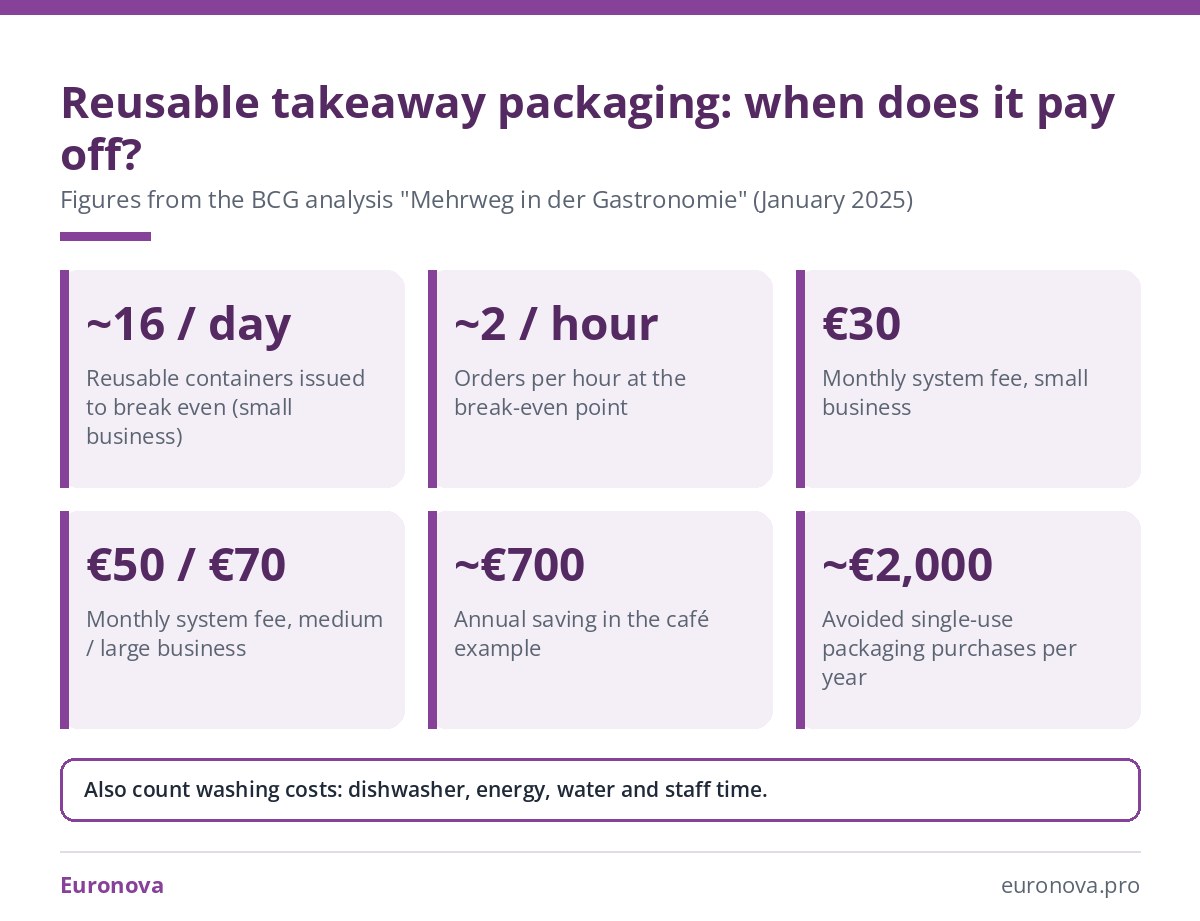
If you want to cut takeaway packaging costs for delivery, the biggest savings come not from the cheapest container but from a system: a few standard formats instead of many special sizes, packaging that suits the dish and does not leak, consolidated orders in planned quantities from a single supplier, and reusable packaging wherever your volume justifies it. That is exactly what a B2B catering supply shop such as Euronova is built for: takeaway packaging, disposable cutlery, food transport containers and reusable cups all come from one range. Below we show what packaging really costs per order and where you can win the money back. Packaging costs are more than the unit price of a box. A typical delivery order includes a container or box, a lid, a sauce pot, cutlery, napkins, a carrier bag and often a label or tamper seal. On top of that come costs that never appear on a packaging supplier's invoice: storage space, your staff's packing time, packaging waste obligations and refunds when a dish leaks or arrives cold. According to the German Federal Environment Agency's guide to reusable packaging in food service, unit prices alone range from roughly 12 cents for a coated single-use cup to 50 cents for a single-use PET container, depending on the material (as of the guide's publication in 2021). A sample calculation shows why this matters: an Asian dish in three plastic containers at 50 cents each costs €1.50 in containers alone, before lids, cutlery and bag are added. A pizza in a box is considerably cheaper. How hard this hits your margin is shown by a sample calculation for delivery platform orders: on a €28 order, 25 per cent commission, i.e. €7, goes to the platform, and packaging is costed at roughly €1.50 to €2.50. With 30 per cent cost of goods and €2 for packaging, only around €3.60 gross profit is left before labour and energy costs. Commissions on platforms such as Wolt and Glovo differ, but the logic stays the same: in this calculation, almost every euro saved on packaging goes straight to profit. In many kitchens the packaging shelf grows with every new menu. Every bowl, every side and every dessert has its own size, often from different suppliers. That costs you twice: you buy small quantities on worse terms, and opened cartons sit in the stockroom tying up space and capital. The opposite approach is a system of three to five standard formats that cover the whole menu: a large meal container for mains, a small one for sides, a leak-proof pot for soups and sauces, plus your pizza or burger box. Dishes that do not fit get an adjusted portion rather than a new container. According to Kloepfel Magazin, businesses that standardise and bundle their packaging volumes often achieve savings of 5 to 25 per cent in practice, especially where packaging has not been reviewed systematically for a long time. How to do it: The most common trap: containers that are too small and get squashed when closed, or too large, so the food slides around and cools down. Test every standard format with your main dishes on a real delivery route before you commit to it. The cheapest packaging is the one in which the dish arrives intact. A leaking curry sauce costs you a refund, a bad review and, at worst, a regular customer. That is why it pays to use materials in a targeted way: When choosing materials, it is worth looking at paper, board and fibre. Among other options, German chambers of commerce point food businesses to compostable single-use packaging made from bagasse, i.e. from the fibres of pressed sugar cane stalks, as used by food trucks. For single-use plastic, on the other hand, EU rules are getting stricter: under the Single-Use Plastics Directive (EU) 2019/904, member states must achieve a measurable reduction in the consumption of single-use plastic cups and food containers by 2026. If you switch to paper and board packaging wherever the dish allows, you depend less on these rules. Our range includes dedicated categories for paper and board packaging and eco-friendly takeaway packaging, so you can put together your standard formats in one step. Lots of small top-up orders from different suppliers are expensive: each one brings its own shipping costs, its own minimum quantities and its own admin. If you bundle packaging, disposable cutlery, napkins and cleaning products with one supplier, you order less often but in larger quantities. A simple routine: The effect is reinforced by Lever 1: once only five formats instead of fifteen sit on the shelf, the consolidated order is quickly calculated. Anyone who hands over packaging filled with goods to end customers has obligations under extended producer responsibility for packaging. For food service there is a relief for so-called service packaging, i.e. packaging that is only filled when it is handed to the customer, such as pizza boxes, meal containers or takeaway cups: the obligations for it can already be taken over by the supplier who sells you the packaging. When placing your consolidated order, clarify which service packaging is already covered, and keep the invoices as proof. The detailed rules are currently being adapted to the Packaging and Packaging Waste Regulation (EU) 2025/40, which applies from 12 August 2026. If in doubt, your national packaging authority or chamber of commerce can clarify what applies to your business. In many kitchens, cutlery, napkins, sauces and extra bags are packed automatically, even when the customer is eating at home. This is the simplest lever: ask in the ordering process whether the customer wants cutlery, and add napkins in a fixed number per order rather than by the handful. For dishes that are shared anyway, one set per order is enough. If you include cutlery, choose a standard set from our disposable cutlery range and buy it in larger quantities, instead of stocking forks, knives and spoons individually in different versions. EU rules are gradually bringing reusable packaging into takeaway food as well. From 12 February 2028, Regulation (EU) 2025/40 requires businesses selling takeaway food and drinks to also offer customers reusable packaging, with an exemption for micro-enterprises. From 12 February 2027, they must also allow customers to have their own container filled. Under the EU Single-Use Plastics Directive, food and drink businesses also play a part in reducing single-use plastic consumption. If you are unsure whether and when these obligations apply to your business, your local authority or a trade association for the hospitality sector can help. Whether reusable packaging pays off beyond the legal obligations depends on volume. The German analysis "Mehrweg in der Gastronomie" by BCG (January 2025) calculates that small businesses paying a €30 monthly system fee break even at around 16 reusable containers issued per day, i.e. roughly two orders an hour. In the calculation, medium-sized businesses pay €50 and large ones €70 a month. In the analysis's café example, reusable packaging saves around €700 a year, against avoided single-use packaging purchases of around €2,000. Three factors decide whether the numbers work for you: For drinks in-house, at events and at the bar, robust reusable polycarbonate cups are a one-off purchase instead of ongoing single-use packaging costs. For transporting larger quantities, for example for corporate deliveries, food transport containers are ideal: once returned, you wash and reuse them. For caterers, hotels and event organisers, the biggest packaging item is often not the takeaway box at all, but disposable tableware at events. Here it pays to compare with hired tableware: plates, glasses and cutlery arrive for the occasion and then go back, and you do not buy single-use quantities that end up in the bin after the event. At Euronova you can buy or hire plates, glasses and cutlery, for example in our catering equipment hire section. Packaging is just one of many cost areas. If you want to improve your margin across the board, cut your energy costs in parallel too, especially for dishwashers, hot-holding equipment and refrigeration, which run for long hours in delivery and catering. We do not see packaging as a side issue you top up in passing, but as part of the product. With a delivery, the customer first sees your container and only then the food. Saving in the wrong place here means paying twice, through complaints and reviews. At the same time, packaging is one of the few cost areas in delivery that you control entirely yourself. The platform sets the commission, the market sets food prices. Which containers you use, how many formats sit in your stockroom and how often you order are your decisions. That is why we recommend a fixed packaging system from one range: takeaway packaging made from paper, board and eco-friendly materials, disposable cutlery, transport containers and reusable cups in one consolidated order. It makes purchasing predictable and saves you the cost and hassle of many small deliveries. Rok Euronova is a B2B online shop for catering equipment, serving restaurants, pizzerias, cafés, hotels, caterers and commercial kitchens. For your delivery service you will find takeaway food packaging, paper and board packaging, eco-friendly packaging, disposable cutlery and food storage and transport products from many brands. Put your standard formats together in one order and use it to start a new ordering cycle. It depends heavily on the dish. A pizza in a box needs just one piece of packaging, while a meal with several containers, sauces and cutlery needs considerably more. A sample calculation for platform orders assumes roughly €1.50 to €2.50 per order. Work out your own figures for each dish and check where standard formats and extras on request bring the amount down. Yes, a surcharge for single-use packaging or a discount for reusable packaging is a common way to offset the extra cost. The key is to show the surcharge clearly on the menu or in the ordering app. Packaging that you hand over filled to end customers is subject to extended producer responsibility obligations. For service packaging such as pizza boxes, meal containers or cups, your supplier can take these obligations over. Keep your invoices as proof; if in doubt, your national packaging authority or chamber of commerce can clarify what applies in your case. Paper, board and fibres such as bagasse suit many dishes, while robust reusable cups work well for drinks and events. The most sustainable and cheapest packaging is usually the one that fits exactly: no excess material, no extra bag and no cutlery that nobody needs.Cutting Takeaway Packaging Costs for Delivery: 7 Levers for Restaurants

In brief
Contents
What packaging really costs per order
Cost area
Where it arises
Lever
Material
containers, boxes, cups, lids
standard sizes, consolidated buying
Extras
cutlery, napkins, sauce pots, bags
only on request
Delivery and purchasing
many small orders from several suppliers
fixed ordering cycle, fewer and larger deliveries
Storage
opened cartons of many formats
fewer formats, clear minimum stock levels
Packaging waste
packaging waste obligations
clarify with your supplier what is already covered
Complaints
leaking or soggy dishes
suitable, leak-proof material
Lever 1: slim down your packaging range
Lever 2: choose material and size to suit the dish
Lever 3: buy together and plan your ordering cycle
Lever 4: clarify your packaging waste obligations
Lever 5: add extras only on request
Lever 6: use reusable packaging where it pays off
Lever 7: for catering and events, hire instead of throwing away
Our view
Packaging, cutlery and reusable containers in one place

FAQ
How much should packaging cost per delivery order?
Can I charge a surcharge for single-use packaging?
Do I have to register my takeaway packaging with a packaging compliance scheme myself?
Which delivery packaging is both sustainable and affordable?
Sources
We recommend