Buffet Serving Utensils for Hospitality: Types, Material, Hygiene
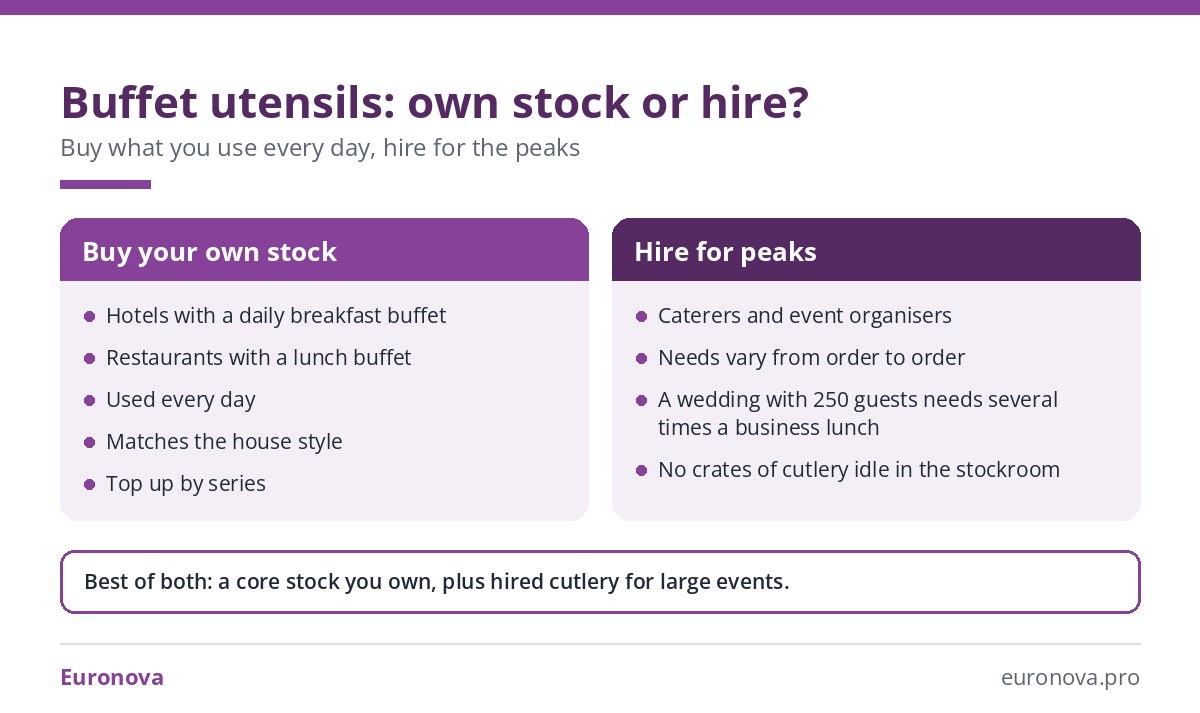
Good buffet serving utensils for hospitality have three things in common: there is the right tool for every dish, they are made of dishwasher-safe 18/10 stainless steel, and there are enough of them for the team to swap them at any time during service. If you sort out all three with one supplier, with serving utensils, gastronorm (GN) containers, disposable cutlery for self-service and, where needed, hired cutlery for large events, you avoid empty spots on the buffet and last-minute orders. This guide shows which pieces you need, how to set them out and how to keep utensils clean and rust-free even after countless wash cycles. Buffet cutlery is another name for serving utensils: the tools used to portion, scoop and place food on the plate. They are distinct from the cutlery guests eat with. Serving utensils include serving spoons, serving forks and meat forks, salad servers, ladles, sauce spoons, skimmers, tongs, spaghetti servers and cake servers, among others. For a typical buffet in a hotel, restaurant or at a catered event, the basic pieces are: Depending on your concept, add special pieces, such as a cheese knife for the cheese board or a bread knife at the carving station. The basic rule: the utensil follows the consistency of the dish and the shape of the container. A deep GN container of goulash needs a long-handled ladle, a shallow tray of pastries needs a server. Cut corners here with one spoon for everything and you get spills, breakage and guests helping themselves with their fingers. Small items need a tool too. Serve nuts, seeds or bar snacks at the bar or on an evening buffet in portion packs, or dispense them with small scoops and spoons. As for the containers themselves: uniform formats make the buffet look calmer and refilling faster. Gastronorm (GN) containers can go straight from the kitchen into the chafing dish or buffet display, and you match the utensils to the depth of these containers. Buffet utensils take more punishment than any table cutlery. They sit for hours in hot, acidic or salty food, then go through a commercial dishwasher. That is why the material determines their service life. The designation 18/10 stainless steel refers to an alloy with 18% chromium and 10% nickel. The handbook of the German professional association for commercial dishwashing (AK GGS) distinguishes two groups: chromium-nickel steel is considered fully dishwasher resistant, whereas this does not generally apply to magnetic chromium steel with around 13 to 17% chromium. The same handbook warns that prolonged contact with acidic or salty food residues can cause pitting corrosion, i.e. small pinpoint rust spots. What this means when buying: Utensils from one series have another advantage: when spoons, tongs and servers come from the same line, the buffet looks tidy, and replacement pieces match visually later on. A serving utensil must stay in the bowl without sliding in. Handles that are too short disappear into the goulash, and then the next guest reaches into the food to fish the spoon out. So choose the length according to the deepest container you use on the buffet, not the plate. The handle matters just as much. Guests often serve themselves with a plate in one hand and the utensil in the other. Tongs with a good spring, spoons with a sufficiently wide handle end and ladles with a hook on the handle that catches on the rim make self-service easier. At staffed stations, for example a carving station, the tools can be heavier and more specialised. Where the utensils sit decides how guests flow along the buffet. Three rules have proven themselves: Guest cutlery is best rolled in napkins or set out in cutlery boxes. At seated banquets you can lay it on the tables, and guests take only plates at the buffet, for example a large 30 cm Banquet flat plate for the main course and a small one for bread or dessert. On a buffet, many hands reach for the same handle. That is why a fundamental principle of good hygiene practice applies: ready-to-eat food should not be touched directly with bare hands, but served with suitable tools. In the EU, this follows from Regulation (EC) No 852/2004 on the hygiene of foodstuffs and your HACCP system. For service, this means: The same principles apply to schools, nurseries and care homes in contract and institutional catering. There, food is often portioned out rather than self-served, so portion scoops and tongs are especially important. The hygiene basis for commercial kitchens in the EU is Regulation (EC) No 852/2004, supplemented by national guides to good hygiene practice and the guidance of your local food safety authority. From these and the AK GGS handbook, clear procedures follow for buffet utensils: For the dishwasher, work surfaces and buffet equipment you need the right products. Our range of kitchen cleaning products includes detergents for professional use. For a hotel with a daily breakfast buffet or a restaurant with a lunch buffet, owning your utensils pays off: they are used every day, match the house style and can be topped up by series. It is different for caterers and event organisers, whose needs vary from order to order. A wedding with 250 guests needs several times the stock that is enough for a business lunch. Here, hiring supplements your own core stock: buy the pieces you need all the time and hire for the peaks, instead of having crates of cutlery sitting in the stockroom for half the year. The quantity follows from the number of dishes, not just the number of guests. Count every bowl, tray and platter as one item with its own serving utensil. Add a reserve for swapping during service, because utensils fall on the floor, end up in the food or disappear into the dish room with the containers. For long buffets, such as a breakfast that runs for four hours, plan for more rounds of swaps than at a short reception. For guest cutlery, add a reserve for second helpings and dessert. How much food you plan per person, and therefore how many containers and serving utensils you need, follows the same logic as catering portion planning: quantity per person times number of guests, divided by dish. At Euronova you will find serving utensils for buffets and service together with everything else a buffet needs: gastronorm (GN) containers, porcelain, glassware, disposable cutlery and cleaning products. That way you order serving utensils, containers and plates in a single purchase. For events, you can hire cutlery instead of buying stock for peak demand. Buffets are often planned from the food outwards, and the utensils come last. We see it the other way round: the utensils are the tools through which guests experience the food. Tongs that do not grip or a spoon that sinks into the soup get noticed, no matter how well the food was cooked. That is why we advise buying buffet utensils as a system: a stainless steel series matched to your containers, with a reserve for swapping during service and disposable cutlery for busy self-service. If you hire extra cutlery for large functions rather than inflating your own stock, you keep costs and storage space under control. Our range is built for exactly this kind of purchase: serving utensils, GN containers, plates, glassware, disposables and cleaning products in one place, with the option to buy or hire cutlery. Our expert articles help you make the right choice before you order. Rok Serving utensils include serving spoons and forks, serving tongs, ladles, sauce spoons, salad servers, spaghetti servers and cake servers. Then there are special pieces such as cold meat forks, carving forks or cheese knives. Which pieces you need depends on the dishes on your buffet. Guest cutlery goes with the plates and napkins at the start and end of the buffet line, or is laid on the tables in advance. Serving utensils belong right next to each dish, ideally on a small rest in front of it. That way every utensil stays with its own dish. Utensils made of chromium-nickel steel, i.e. 18/10 stainless steel, are considered fully resistant in commercial dishwashing. Check the information in the product description and wash the utensils as soon as possible after service so that acidic and salty residues do not dry on. At the latest, whenever a utensil is dirty or has fallen into the food or onto the floor. On long buffets, the team should check utensils and containers at short intervals and keep enough clean spare pieces to hand.Buffet Serving Utensils for Hospitality: Types, Material, Hygiene

In brief
Contents
What buffet serving utensils include
Which utensil goes with which dish
Dish
Suitable buffet utensil
What to look out for
Bread, rolls, croissants
serving tongs, bread tongs
one-handed use, no hand contact with baked goods
Cold cuts, cheese slices
cold meat fork, small tongs
thin tines that do not tear thin slices
Scrambled eggs, rice, mash
portion scoop, serving spoon
even portions, wide bowl
Vegetables, sides in liquid
slotted serving spoon
liquid drains off, plate stays clean
Soups, stews, curries
ladle
handle long enough for deep containers
Sauces, dressings
sauce spoon, dressing ladle
deep bowl, little dripping
Salads
salad servers, salad tongs
picks up leaves and toppings together
Pasta, especially long pasta
spaghetti server
teeth hold the pasta
Roasts, whole fish
carving fork, serving set, carving knife
ideally a staffed station
Cakes, tarts, lasagne
cake server, cake knife
flat, wide surface, clean edge
Fruit salad, desserts in glasses
dessert spoon, small tongs
small size for small portions
Material: why 18/10 stainless steel is the safe choice

Length, handle and handling
How to set out utensils on the buffet
Hygiene during service
Cleaning and care after service
Buy or hire?
How many buffet utensils you need
Buffet utensils from Euronova

Our view: a buffet is only as good as its utensils
FAQ
What counts as serving utensils?
Where should guest cutlery go on a buffet?
Are buffet serving utensils dishwasher safe?
How often should serving utensils be replaced during service?
Sources