Compostable Takeaway Boxes: Choosing and Buying for Food Service
Compostable Takeaway Boxes: Choosing and Buying for Food Service
Compostable takeaway food boxes are the right choice for restaurants, pizzerias, cafés and caterers when three things match: the material matches the dish, the proof matches the marketing claim, and the quantity matches your storage. If you choose boxes on these three points and order them together with other consumables from a catering equipment wholesaler, you avoid wrong purchases, complaints and extra shipping costs. At Euronova you will find a dedicated eco-friendly packaging category for exactly this. Read on to find out what "compostable" really means, which box suits which dish, which labelling is mandatory and what packaging rules require of you.
Euronova
Choose the right takeaway boxes
Discover packaging and consumables for your food service business in the Euronova range.
Compostable is not the same as biodegradable: compostable means the box breaks down under defined conditions; the relevant standard is EN 13432.
Material follows the dish: sugar cane fibre or board boxes for mains, fries and salads; leak-proof pots with lids for soups and sauces.
Food contact must be marked: the glass and fork symbol or the words "for food contact" belong on the product, packaging or label.
Single-use plastics rules: consumption of single-use plastic food containers must be reduced, and from February 2028 the EU Packaging Regulation introduces an obligation to offer reusable packaging.
Bundling your purchases pays off: boxes, cutlery, cups and transport containers in one order.
Packaging carries many green terms that easily get mixed up in everyday use. For your purchasing, and for what you tell customers, a clear distinction pays off. In its guide to bio-based and biodegradable single-use packaging, the German Federal Environment Agency explains: biodegradable plastics can be made from renewable raw materials such as starch, cellulose or PLA, but also from petroleum. Compostable is a subset for which breakdown has been proven under defined conditions. So the two words are not synonyms.
Term
What it describes
What it means for your purchase
Bio-based
the raw material: wholly or partly from plants
says something about origin, not end of life
Biodegradable
end-of-life behaviour: microorganisms break down the material
says little without stated conditions
Compostable
breakdown under defined conditions, tested to EN 13432
the most reliable term, if the standard or certificate is stated
Recyclable
technical possibility of processing in a recycling stream
for board-plastic composites, often only on paper
Reusable
packaging is cleaned and refilled
a dedicated deposit or return system
On the term recyclable, the same agency gives a telling example: a paper cup with a plastic coating can be more than 90% board and still not be recycled, because the layers cannot be separated. For you as a buyer this means: a fibre box labelled compostable to the standard is a clearer claim than a vague "recyclable" on a coated container.
Materials at a glance: which box for which dish
Compostable takeaway boxes come in a few material families, each with its favourite dish. What matters is what goes in the box: hot or cold, dry or saucy, greasy or crispy, a short takeaway or 30 minutes in a delivery backpack.
grease resistance per data sheet, folding or tuck closure
Palm leaf and wood
bowls, plates, trays
catering, finger food, buffet
size and stackability
PLA (bioplastic from plant starch)
windows, lids, salad containers, cold drink cups
cold food, salads, desserts
for cold contents only, check the temperature rating
Three questions help you match box to dish:
How hot does the food go out? For food straight from the pan or fryer, sugar cane fibre or board boxes are the usual choice. PLA parts such as windows or lids are designed for cold food; check the temperature rating in the data sheet.
How much liquid is involved? Soups, ramen and thin sauces need a pot or container with a tight lid. For dips and dressings, small sauce pots are a cleaner solution than a compartment in the meal box.
How long is the food on the road? For delivery, the lid must hold even when the box is tilted, and boxes must stack. Multi-compartment boxes stop sides from going soggy.
An example from a pizzeria's lunch service: pasta with tomato sauce goes into a kraft paper noodle box or a bagasse container with lid, the side salad into a cold salad container with a clear lid, and the dressing into a separate sauce pot. Three products, one order, no soggy salad.
Labels and proof: what to check in the data sheet
"Compostable" is a claim that should be backed by proof. The most important basis is the European standard EN 13432. It describes the conditions under which packaging counts as industrially compostable. If a product cites this standard or a certificate based on it, you have a verifiable claim instead of a marketing word.
How strictly this proof is treated is shown by the example of food waste bags in Germany: according to the INAK information sheet on compostable food waste bags, certified bags must meet EN 13432 and additionally DINplus, be made predominantly from renewable raw materials and carry a large printed seedling logo. They must break down within six weeks, which matches the usual processing times in industrial composting plants. These rules do not apply directly to takeaway boxes, but they show which marks carry weight.
Food contact suitability is just as important as the compostability label. The legal basis is Regulation (EC) No 1935/2004 for all food contact materials and Regulation (EU) No 10/2011 for plastics, which includes PLA lids and windows. The labelling must include the words "for food contact", the glass and fork symbol, which applies across the EU, or a statement of the specific intended use, clearly visible, legible and indelible on the product, packaging or label.
Your data sheet checklist:
EN 13432 standard or compostability certificate stated
glass and fork symbol or the words "for food contact"
the material of every part, including lid and window
capacity in ml and external dimensions in cm
temperature, grease and liquid ratings
pack unit and quantity per carton
Because the marking is often only on the outer carton, it is worth keeping the label or delivery note for food safety inspections.
Legal framework: single-use plastics and the EU Packaging Regulation
Compostable single-use boxes and offering reusable packaging are not mutually exclusive; they complement each other. Under the EU Single-Use Plastics Directive (EU) 2019/904, member states must achieve a measurable reduction in the consumption of single-use plastic beverage cups and food containers by 2026 compared with 2022, and national measures can also involve food and drink businesses.
Important: under EU rules, packaging with bioplastic parts, for example a container with a PLA lid, also counts as a plastic product. So when buying, check what material each part of the box is made of.
The next stage comes from Brussels. The Packaging and Packaging Waste Regulation (EU) 2025/40 (PPWR) entered into force on 11 February 2025 and has applied since 12 August 2026. From 12 February 2028, certain types of packaging must be compostable (Article 9), and from the same date an EU-wide obligation to offer reusable packaging for takeaway food and drinks applies (Article 33), with an exemption for micro-enterprises. Implementation details are still evolving, so follow the current position via your national authorities or hospitality trade association.
What does this mean for your purchasing? Plan on two tracks: compostable single-use boxes for everyday business and a reusable solution for customers who want one. For events and bars, robust reusable polycarbonate cups are a proven complement, and for catering and deliveries to regular customers there are gastronorm (GN) containers and food and tableware transport solutions.
Disposal: what to tell customers
Customers often ask where the box goes after the meal. A clear answer is part of the service. On bio-based and biodegradable plastics, the German Federal Environment Agency explains that single-use items made from degradable plastic, such as cups, cutlery and plates, do not belong in food waste. What goes into the food waste bin is decided by the local waste management service: many do not accept compostable plastics in food waste because their facilities cannot process them.
In practice this means:
At the counter or on the delivery slip: a short note on how to dispose of the box according to local rules.
For your business: ask your waste management service how to separate used single-use packaging and kitchen food waste.
Communicate honestly: "made from sugar cane fibre, compostable to EN 13432" is a precise claim. "100% home compostable" without proof is not.
Telling customers exactly what the box can do convinces them more than any green leaf on the lid.
Buying in practice: six steps to the right box
Well-planned purchasing saves storage space and stops you running out of the right size in the middle of lunch service.
Review the menu. Put every takeaway dish into a category: hot and dry, hot with sauce, cold, liquid, side, dip. The most common mistake is one box for everything, in which soups leak and fries go soft.
Set the capacity. Measure a typical portion with a measuring jug and choose a box one size up so the lid does not rest on the food. Smaller containers are usually enough for sides and desserts.
Clarify lid and seal. Hinged lids are fast at service; separate lids seal better for liquid dishes. For delivery, stackability in a backpack or thermo box also counts.
Check the proof. EN 13432, the glass and fork symbol and the material of each part, as described above. This is work that a specialist supplier with clear product data makes easier: you compare data sheets instead of decoding marketing promises.
Plan quantity and storage. Work out your weekly consumption and plan a reserve for holidays, events and delivery peaks. Store fibre boxes dry and protected so they keep their shape.
Bundle your order. Boxes, disposable cutlery, cups, bags and cleaning products in one order save time in accounts.
The same logic applies to schools, nurseries and care homes that portion food or deliver it to external sites: categorise the dishes, set the capacity, check for the food contact marking. For transporting larger quantities, gastronorm (GN) containers have also proven themselves.
Why the effort pays off
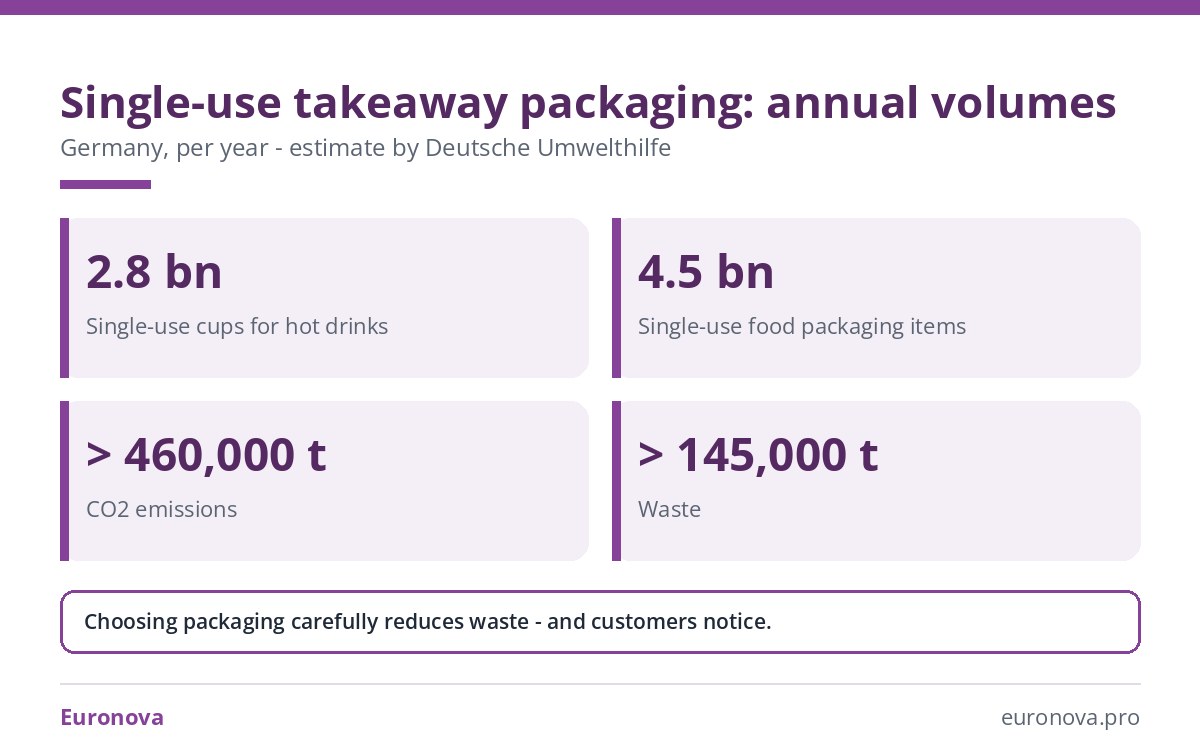
The volumes are considerable. In its takeaway buying guide, the German organisation Deutsche Umwelthilfe estimates that Germany produces 2.8 billion single-use cups for hot drinks and 4.5 billion single-use food packaging items every year, associated with more than 460,000 tonnes of CO₂ emissions and more than 145,000 tonnes of waste. Every business that chooses its packaging carefully plays its part, and customers increasingly notice that choice.
There is also a practical benefit: a box that suits the dish gets to the customer hot, leak-free and looking good. That is the best advertising for your business, whether the food goes over the counter or through a delivery service.
As a business customer, you order online and receive your consumables in one delivery.
Our view: the right box is a purchasing decision
When food businesses look for compostable takeaway boxes, they are rarely looking for just a box. They are looking for a solution that suits the dish, is legally sound and gives customers a good feeling.
That is why we see packaging as part of the overall equipment. The curry box, the sauce pot, the disposable cutlery, the reusable cup for the summer party and the GN container for catering belong in the same purchase. Planning them together means fewer suppliers, fewer invoices and fewer gaps in the stockroom.
Our range covers single-use and takeaway packaging just as it covers porcelain, glassware, cutlery and storage and transport products. With expert articles and versions in several languages, we want to make choosing and ordering as easy as possible for business customers.
Our advice: start with the menu, not the catalogue. Once it is clear what goes in the box, the right box is quickly found.
Rok
FAQ
Which compostable box is suitable for hot food?
For hot main courses, curries, burgers and fries, boxes made from sugar cane fibre (bagasse) or board are the usual choice. Check the temperature and grease resistance details in the technical data sheet. PLA parts, such as windows, are designed for cold food.
What proves that a box is compostable?
The relevant standard is EN 13432 for industrially compostable packaging. If a product cites this standard or a certificate based on it, the claim can be verified. In addition, food contact suitability must be marked with the glass and fork symbol or the words "for food contact".
Do I still have to offer a reusable option if I use compostable boxes?
Under the EU Single-Use Plastics Directive, single-use plastic cups and food containers are subject to consumption reduction measures, and this also covers boxes with plastic parts such as PLA lids. From 12 February 2028, the EU Packaging Regulation introduces an obligation to offer reusable packaging for takeaway food and drinks, with an exemption for micro-enterprises.
Can customers put compostable boxes in the food waste bin?
That is decided by the local waste management service. Many do not accept compostable plastics in food and garden waste because their facilities cannot process them. A short disposal note on the delivery slip answers the question before it is asked.
How many boxes should I keep in stock?
Work out your weekly consumption for each box size and plan a reserve for peaks such as holidays and events. Store fibre boxes dry. Ordering boxes together with your other consumables keeps purchasing simple and reduces the number of deliveries.
Euronova
Questions about takeaway packaging?
Write to us if you would like advice on compostable boxes or other catering equipment.