Choosing Restaurant Plates: Types, Sizes and Materials
Choosing Restaurant Plates: Types, Sizes and Materials
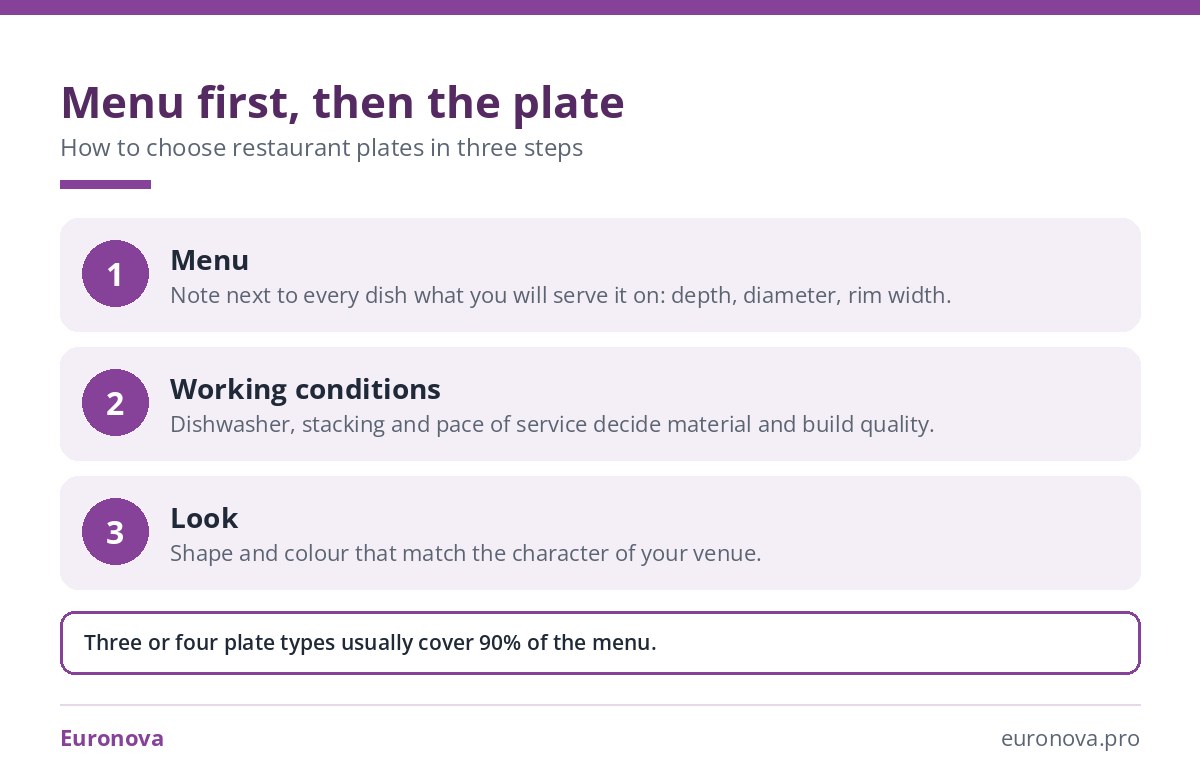
You choose restaurant plates in three steps. First the menu, because it tells you which types and sizes you need. Then the working conditions, i.e. the dishwasher, stacking and pace of service, which decide the material and build quality. Finally the look: shape and colour that match the character of your venue. A plate that only looks good in a photo but has a chipped rim after three months does not work in food service. Below you will find how to go through these steps, how many pieces to order and how to care for your tableware so it lasts as long as possible.
Euronova
euronova.pro
Choose tableware that fits your venue
At Euronova you will find porcelain plates and other tableware for restaurants and food service businesses.
The most common mistake when equipping a new venue is choosing a "nice set" and then adapting the dishes to it. The order should be the other way round. Take your current menu and note next to each item what you will serve it on. Cream soup, beef broth, steak tartare, duck breast, risotto, tagliatelle, cheesecake: each of these has different requirements for depth, diameter and rim width.
Such a list immediately shows how many different plate types you really need. It usually turns out that three or four types cover 90% of the menu, and individual signature dishes can be served on something special. Complete table settings in a restaurant are of course more than plates: a list of basic tableware also includes platters, cutlery, glasses, cups, jugs, condiment dishes and service trays, so it pays to plan everything at once so that styles do not clash.
The second question is: how does service work? A bistro with fast table turnover needs plates that are easy to carry three to an arm and quick to stack. A fine dining restaurant with a six-course tasting menu needs more variety and large flat plates with a wide rim that give plating room. A hotel with a breakfast buffet needs, above all, quantity and resistance to intensive washing.
Which types of plates a restaurant needs
The core set for most venues is similar. What differs are the proportions: a pizzeria will order more large flat plates, an Italian trattoria more pasta plates, and an Asian restaurant more bowls. The table lists typical uses and the diameters we stock.
Plate type
Used for
Example from our range
Large flat
main courses, steaks, fish, plating with plenty of space
A deep plate or bowl is a must if the menu includes soups, stews or bowls. A pasta plate with a wide rim and deeper well is a good compromise: it holds sauce and temperature while still looking elegant. For main courses in venues with culinary ambitions, 27–30 cm works better than 25 cm, because the portion does not touch the rim and the chef has room for sauce and sides.
Shape, size and food presentation
Plate shape is a kitchen tool, not just decoration. Unilever Food Solutions chefs describe plate choice as the foundation of plating: a round plate is an elegant classic, a square one allows you to play with the geometry of the arrangement, a rectangular one suits elongated dishes, and a deep plate is not just for soups and pasta, as it works well for any dish with sauce. The same source notes that serving in bowls has been on trend for several years (cream soups, bowl food, sides), while slate allows simple, refined presentation, for example for finger food.
In practice, remember a few rules:
The portion occupies the centre, not the whole plate. If the food touches the rim, the plate is too small. A plate that is too large for a small portion also looks poor, so serve starters on 23 cm, not 30 cm.
The rim is the frame. A wide rim "frames" the dish and makes it easier for the server to hold the plate without touching the food. A narrow rim gives more working surface.
Match the depth to the sauce. A dish with plenty of sauce will spill on a flat plate on its way to the table.
Use unusual shapes selectively. Square and rectangular plates are excellent for signature dishes, but they stack less well and take up more space in the dishwasher.
Check back-of-house dimensions. Before ordering 30 cm, measure the dishwasher racks, shelves and plate warmers. A plate that does not fit the rack slows down every service.
Material: why porcelain rules in restaurants
At home you can afford delicate handmade ceramics. In a restaurant, a plate is washed several times a day, carried in stacks, put into a warmer and set down on the pass with a swing at the peak of service. That is why the standard is hotel-grade porcelain designed for these conditions.
Stoneware is sometimes chosen for venues with a rustic character because it has a warmer, rawer look, but it is generally thicker and heavier, which matters for servers and shelving when you have many covers. Earthenware is better left for decoration: it is more porous and copes less well with intensive use. Tempered glass and melamine have their place by pools, in gardens and in canteens, where resistance to drops counts.
With porcelain, build quality matters. According to the trade magazine Biznes Hotel, good commercial tableware is distinguished by precise firing, a smooth glaze and resistance to chipping and thermal shock, which translates into durability through repeated commercial dishwasher cycles.
Features that decide durability in daily use
Once you have your list of types and sizes, compare specific ranges by their practical features. These will decide whether in a year's time you are replacing 10% of your tableware or 40%.
Reinforced rim
Commercial plates have reinforced rims because the rim takes the most knocks: when stacking, in the dishwasher rack and when set down on a tray. Look at the plate's profile from the side: a thickened rim is a good sign.
Glaze
The glaze should be even, smooth to the touch, free of bubbles and discolouration. Run your finger over the underside of the plate where it touches the counter. A rough, unglazed foot is normal, but it must not have sharp edges that would scratch the plate below it in the stack.
Stacking
Plates from one range should stack into a stable, vertical pile. Good stacking saves space back of house, speeds up work in the dish room and reduces the risk of a stack toppling.
Heat resistance
A plate taken from the warmer and topped with a cold sauce, or moved straight from a hot dishwasher to a cold counter, undergoes thermal shock. Hotel-grade porcelain is built for this; ordinary household tableware often is not.
Range continuity
When buying, ask whether the range is permanently available. A restaurant loses a few pieces every month and needs to replace them with the same model. Professional manufacturers, as Biznes Hotel notes, often offer a multi-year chip guarantee and a guaranteed production period for each line. That is exactly why we build our range around series available in several diameters, such as Gourmet Patera from 19 to 30 cm.
Plate colour and finish
A white plate is the base for good reason: it highlights the contrast with the food, suits any cuisine and is easy to replace. Round white plates are a classic many restaurants will not give up, but colour has its place too: black plates work in any type of cuisine because a carefully presented dish stands out well on a dark background, while pastels such as blue, mint or powder pink build the atmosphere of a venue.
A practical rule: core tableware in white or ecru, colour or a pearl finish for selected dishes. The Gourmet Nacrous 25 cm range and its Nacrous 30 cm version are a good choice when you want to showcase main courses or desserts without replacing all your tableware. With dark plates, test specific dishes with the kitchen: dark sauces and grilled meat can blend into the background, while light ingredients gain.
For a restaurateur, this means a simple rule: buy tableware intended for food service from a supplier that sells it as a food contact product. Use decorative plates from craft fairs or souvenir tableware at most as part of the decor. For food safety inspections or when introducing HACCP, keep the purchase documents for your tableware together with the rest of your venue's records.
How many plates to order: a sample calculation
The number of seats in the dining room is only the starting point. During service, some plates are on tables, some are in the dishwasher or drying, and some must wait in reserve for breakage and sudden rushes. That is why we plan several sets per seat when planning, and more for the most-used plates.
Example: a 50-seat bistro serving lunch and dinner, with a soup of the day, four pasta dishes, six main courses and three desserts on the menu.
Plate
Calculation
Quantity
Flat main course 27 cm
50 seats × 3 (table, dish room, reserve)
150 pieces
Pasta plate 28 cm
about half the guests choose pasta, × 3
75–80 pieces
Bowl or deep plate for soup
50 × 2, soup is served mainly at lunch
100 pieces
Flat 23 cm (starters)
50 × 2
100 pieces
Flat 19 cm (desserts, bread)
50 × 3, as it also serves as an underplate
150 pieces
Oval platter 36 cm
sharing dishes, boards
15–20 pieces
These ratios vary by venue. If the dish room works fast and you have a second dishwasher, less reserve is enough. If you serve banquets, plan for the largest event, not an average evening. For one-off large events, instead of storing hundreds of plates back of house all year, you can use our catering equipment hire.
Important: order with a 5–10% reserve above your calculation. A missing piece in the middle of the season causes more trouble than a few spare plates on the shelf.
Washing and storage that extend tableware life
Even the best porcelain wears out faster if the team handles it carelessly. Most damage does not happen at the guest's table but in the dish room and on the way to the shelf. A few rules worth writing into your dish room instructions:
Remove leftovers with a soft scraper or rinse them off; do not bang the plate against the edge of the bin. Knocking the rim is the quickest way to a chip.
Load plates into the rack so they do not touch. Use racks designed for plates and do not squeeze in extra pieces.
Use programmes and chemicals as instructed by the dishwasher manufacturer. Overdosing detergents can dull the glaze and decorations over time.
Avoid sudden temperature changes, such as soaking hot plates in cold water.
Stack by size and range. Smaller plates on larger ones get scratched and fall more easily.
Do not slide plates off one another. Lift them from the stack, because the unglazed foot acts like sandpaper.
Do not build stacks too high and store them on stable, level shelves away from the edge of the counter.
Inspect tableware regularly. Take plates with chips or cracks out of the dining room: they look poor, and dirt builds up more easily in damaged areas.
When transporting plates to catering events, use transport crates and dividers, and carry hot food in porcelain in thermo boxes. Plates transported without protection are the most common source of losses for caterers.
Our view on choosing tableware
We equip restaurants, hotels, pizzerias, cafés and caterers, and we see that the best decisions are made when the owner treats plates as a working tool, not an accessory. A venue that chose one good range in several diameters can replace broken pieces in minutes a year later and does not have to worry that a new plate differs in shade from the old one.
That is why we encourage you to start with the basics: a flat main course plate, a pasta plate or deep plate, a smaller plate for starters and desserts, a platter. This should be hotel-grade porcelain that the dish room can wash ten times a week. Only then do you add accents on top of this base: a pearl finish for main courses, oval platters for sharing, bowls for bowl food.
The other thing we keep repeating is planning the whole picture. Plates, cutlery, glasses and GN containers for the back of house bought in one place are easier to match in style and easier to top up. That is exactly why we build our food service range so that both a new venue and a long-established restaurant can be equipped without compromise.
Rok
Restaurant tableware in one order
At Euronova you can choose plates for your entire menu: Gourmet Patera flat plates in 19, 23, 25, 27 and 30 cm diameters, the Madera 28 cm pasta plate, the pearl-finish Nacrous range, Banquet plates and oval platters. In the same basket you will find cutlery, glasses, GN containers such as the GN 1/1 porcelain container for the buffet, and kitchen utensils.
Browse the full range in the Euronova online shop and equip your dining room and back of house in one go.
FAQ
Which plates should I buy when opening a new restaurant?
Four types are usually enough to start: a 27–30 cm flat main course plate, a pasta plate or deep plate, a 23 cm flat plate for starters and a 19 cm plate for desserts and bread. Add a few platters for sharing dishes. Choose one range in several diameters so that replacing missing pieces is easy.
What size plate for a main course?
In restaurants, 27 or 30 cm work best. The larger diameter gives the chef room for plating and sauce, and the portion does not touch the rim. A 25 cm plate suits lunches and smaller portions.
White or coloured plates for a restaurant?
White is the safest base because it suits any cuisine and brings out the colours of the food. Colour, black or a pearl finish is worth adding as an accent for selected dishes. Before buying in quantity, check with the kitchen how the key dishes on the menu look on each background.
How many plates do we need per cover?
For the most-used plates, allow about three per seat: one on the table, one in the dishwasher, one in reserve. For less frequently used plates, two are enough. Add 5–10% to the total as a breakage reserve.
Euronova
Questions about restaurant plates?
Write to us about tableware and HoReCa equipment and discover Euronova's range for food service businesses.