Choosing a Catering Thermo Box: Capacity, GN Size and Insulation
Choosing a Catering Thermo Box: Capacity, GN Size and Insulation
Choosing a thermo box for catering starts with the containers, not the box itself. First count your portions and allocate them to gastronorm (GN) containers. Then choose an insulated box that takes this set without gaps, has walls thick enough for your journey and is made of a material that withstands daily washing. When you buy thermo boxes, GN containers and transport accessories together, in one place, everything fits from the very first trip. Below we show you how to do it step by step.
Euronova
euronova.pro
Choose the right thermo box for your catering
At Euronova you will find thermo boxes, GN containers and food transport accessories for catering businesses.
A thermo box is an insulated container that slows down heat exchange between the food and its surroundings. It does not heat or cool by itself (unless it has a heating element or an ice pack): it holds the temperature the food had when the lid was closed. That is why the condition of the food going in and how tightly it is packed matter so much.
In catering you will come across several types:
Top-loading thermo boxes: the simplest type, with a lid that lifts off from above. Suitable for one or two GN containers, soups in deep containers, bread and desserts.
Front-loading thermo boxes: with a door and runners on several levels. You can take out one container without opening the whole interior, which saves heat when serving on site.
Versions on wheels or with a dolly: large, multi-level carriers for weddings, conferences and school lunches, when you transport dozens of kilograms of food at once.
Insulated bags and boxes: a lighter solution for delivering individual orders and smaller sets.
Active boxes: with heating or cooling, when the journey or the waiting time before service is long.
For most caterers, the core of the fleet is passive top-loading and front-loading GN thermo boxes, plus a few smaller containers for sauces, sides and desserts.
Step 1: count portions and allocate them to GN containers
A thermo box's capacity in litres tells you little about how many meals will fit. What counts is how many GN containers of a given depth go in. So you start with the menu.
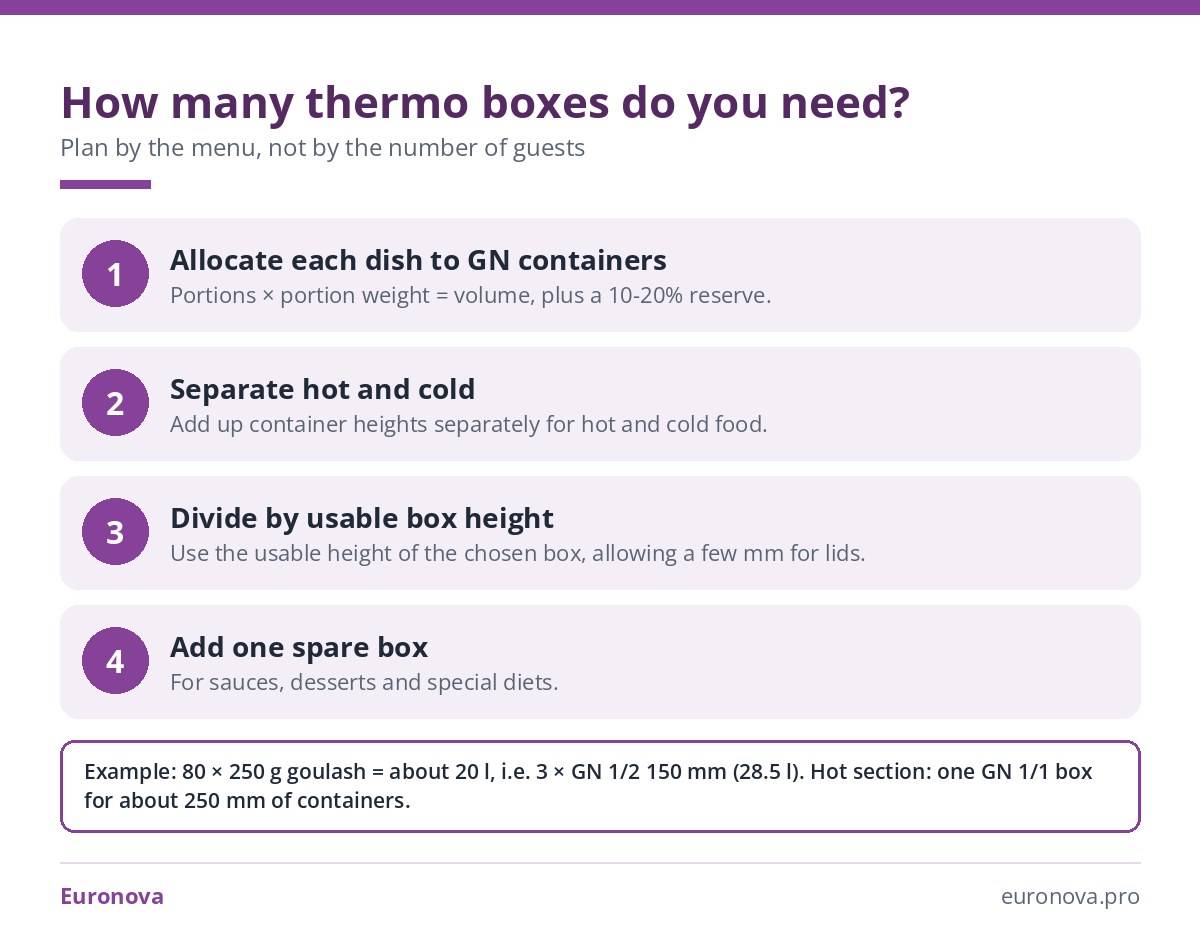
Write down the dishes and number of portions. For example: 80 portions of goulash at 250 g, 80 portions of potatoes, 80 portions of salad.
Convert portions into volume. Goulash with sauce is about 1 kg per litre, so 80 × 250 g gives about 20 litres.
Choose containers with a reserve. Do not fill containers to the brim: sauce splashes under the lid and the lid no longer seals well. Assume you use about 80–90% of the volume.
Sort dishes by temperature. Hot dishes go in one box, cold ones in another. Salad must not travel next to goulash.
Here are example capacities of popular GN containers from our range:
In our example, 20 litres of goulash go into three GN 1/2 containers 150 mm deep. Together they hold 28.5 l, so the reserve is safe. Two GN 1/2 containers together take up the area of one GN 1/1, so three such containers make two levels in the box. The potatoes take another two GN 1/2 containers 100 mm deep. For the hot section, you therefore need a GN 1/1 thermo box for about 250 mm of container height, or two smaller boxes.
Do this calculation once for a typical order and then use it as a template. A business delivering lunches for 60 nursery children every day needs a different set from one serving a banquet for 200 people. But both start with the same table: dish, portions, volume, containers.
Step 2: match the GN format and loading method
GN thermo boxes are designed to the gastronorm standard, in which the basic GN 1/1 format measures 530 × 325 mm. Smaller containers (1/2, 1/3, 1/4, 1/6, 1/9) are fractions of this area, so you can combine them freely as long as together they fill the 1/1 format.
When choosing, check three things:
Interior format. A GN 1/1 thermo box takes one 1/1 container or a combination of smaller ones. If you also use the GN 2/4 format, make sure it fits on the runners or the base of the box.
Usable height. Manufacturers state how many containers of a given depth fit, e.g. one 200 mm or three 65 mm. Add up the depths from step 1 and allow a few millimetres for lids.
Opening method. Top loading is simpler and seals better on short journeys. Front loading with runners works well when you serve dishes gradually on site and do not want to release heat from the whole box every time.
The most common mistake at this stage is buying a box by eye and then buying containers that do not fit or slide around inside. A loose container shifts on bends, spills sauce and leaves an empty space filled with air that cools the food. If there is space left in the box, fill it with an empty lidded container or a thermal insert.
Stainless steel containers cope best with transport and dishwasher cleaning. Porcelain GN containers work well where the food goes straight from the box to the buffet and needs to look good.
Step 3: assess insulation and temperature holding time
How long food holds its temperature depends mainly on the thickness and material of the walls, how well the lid seals, how full the box is and the ambient temperature. Thicker walls always extend this time, but they also increase the external dimensions, so fewer boxes fit in the vehicle.
How to approach this in practice:
Calculate the actual time from closing to service. Add packing, unloading, buffet set-up and delays to the driving time. A 40-minute drive can easily turn into two hours.
Compare manufacturers' figures under the same conditions. A reliable manufacturer states the temperature holding time at a given ambient temperature and with a full load. Choose a model whose stated time comfortably exceeds your longest scenario.
Pack boxes full. Several containers side by side hold the temperature longer than one in an empty box.
Prepare the box before loading. Before hot food, it is worth preheating the interior, e.g. with a container of hot water; before cold food, put in ice packs.
Open the box as little as possible. Every time the lid is opened, heat or cold is lost. Arrange the containers in the order in which you will serve them.
For cold food, long journeys and summer, choose a box with space for ice packs; for hot food, one that takes a heat pack. If your journeys regularly take several hours, consider an active box.
Step 4: choose an easy-to-clean material, closure and design
A catering thermo box works every day, so safety and long-term cost depend on the material.
EPP (expanded polypropylene): light, flexible and crack-resistant. This is the material for repeated, intensive use; it can be washed, and models designed for it can also go in the dishwasher. For a catering business, it is usually the best everyday choice.
EPS (polystyrene): cheaper and insulates well, but is more fragile. It is used mainly for one-way and shipping transport, e.g. for fish on ice or for deliveries to customers who do not return the packaging.
Double-walled plastic with insulation in between: a harder shell that copes well with knocks and frequent washing. It works well for bulk meal transport to schools or care homes.
Besides the material, assess:
The food contact marking. Look for the glass-and-fork symbol and a declaration of compliance for food contact plastics issued under Regulation (EU) No 10/2011. It is worth asking for this document, as it comes in handy during an inspection.
A smooth interior and rounded corners. Dirt does not collect in crevices, and the box dries quickly.
Lid and closure. The lid should seal all the way round, and clips or straps should hold it in place when braking.
Handles and stackability. A full GN 1/1 box of soup is heavy. Comfortable handles and stable stacking speed up loading.
Space for a label. Noting contents, allergens and packing time makes work on site and HACCP record-keeping easier.
Step 5: follow food safety rules during transport
A thermo box is part of your HACCP system, not just vehicle equipment. Regulation (EC) No 852/2004 on the hygiene of foodstuffs requires vehicles used to transport food to be clean, in good repair and capable of being adequately cleaned or disinfected. Foods in which microorganisms can grow quickly must be kept at temperatures that do not pose a health risk.
In practice, this means a few rules:
Minimise time at ambient temperature. Prepared food should not stand at room temperature for longer than necessary; the general recommendation is no more than two hours. National hygiene guidelines typically require hot food to be held at a minimum of 63 °C until service and chilled food at 5 °C or below; check the limits that apply with your local food safety authority. A thermo box helps you stay within these limits, but only if the food goes in hot, straight after cooking.
Measure and record the temperature.The European Commission's guidance on HACCP systems states that on receipt of goods, the temperature during transport, the cleanliness of the vehicle and the history of previous loads are checked. The aim is to avoid cross-contamination, including with allergens. A probe reading at dispatch from the kitchen and on arrival is the simplest proof that the hot or cold chain was not broken.
Separate allergens and food types. Transport gluten-free dishes and special diets in separate, labelled containers, ideally in a separate box. Raw products never travel together with ready-to-eat food.
Separate clean and dirty flows. Boxes and containers returning from an event are the dirty flow. Clean and dirty flows should not cross, so plan where boxes are washed and where clean ones wait.
Wash the box after every use. If fish travelled in it, it must be thoroughly washed and dried before transporting desserts. That is why easy cleaning from step 4 is a matter of safety, not just convenience.
If you are not sure how to include transport in your HACCP plan, consult a food hygiene specialist or your local food safety authority.
Checklist before you order
Question
What to check
How many portions do you transport for a typical order?
number and depth of GN containers with a 10–20% reserve
Which GN format do you use in the kitchen?
box interior matched to GN 1/1 or a combination of smaller sizes
How long is your longest journey including service?
stated temperature holding time with a reserve
Do you transport hot food, cold food or both?
separate boxes, heat packs or ice packs
How often will the box be used?
EPP or reusable plastic, resistance to washing
Does the box come with documents?
food contact marking, declaration of compliance
How do you load and serve?
top or front loading, handles, stacking
Thermo boxes and GN containers in one order
At Euronova, in the storage and transport section you will find thermo boxes for storing and transporting food. Alongside them are gastronorm GN containers in various formats and depths, trays and serving accessories. So you can put together a complete transport set in one place, without hunting for matching parts from several suppliers.
We supply restaurants, hotels, caterers and the kitchens of schools, nurseries and care homes. From this perspective, one thing is clear: a thermo box is part of a system, not a separate purchase.
When the box, GN containers, lids and trays come from a single range, the whole kitchen works to one standard. The container goes from the oven into the box, from the box onto the buffet, then into the dishwasher, without transferring food and without hunting for the right lid.
That is why we advise starting with the menu and the containers, and choosing thermo boxes to match. Such a set is easy to top up with later orders as the business grows and orders increase. That is exactly why we build a range where everything is in one place, and keep adapting it to the needs of food service.
Rok
FAQ
Which thermo box should I choose when starting a catering business?
The most versatile is a GN 1/1 thermo box with height for several containers, made from a reusable material. It takes one large container or a combination of smaller ones. Buy at least two straight away: one for hot food, the other for cold.
Can hot and cold food be transported in the same thermo box?
No. Hot food warms cold food and vice versa, so both leave the safe temperature range faster. Each group should travel in a separate box with its own heat packs or ice packs.
How many thermo boxes do we need for a wedding for 100 people?
It depends on the menu, not the number of guests. Allocate each dish to GN containers, usually with a 10–20% reserve, and add up their heights separately for hot and cold food. Divide the result by the usable height of the chosen box and add one spare box for sauces, desserts and special diets.
How do you clean an EPP thermo box?
After every trip, empty the box and wash the inside and lid with warm water and a food-safe detergent. Models designed for it can go in the dishwasher. The box must dry completely before closing, and dirty boxes should be stored separately from clean ones.
Euronova
Talk to us about catering transport
Write to us if you are looking for food transport equipment or restocking your catering business.