Sharpening kitchen knives in food service: methods, angle and routine
Sharpening kitchen knives in food service: methods, angle and routine
In a commercial kitchen, sharpening knives is not a one-off job but a constant routine: a quick pass on the honing steel before every shift, and a full sharpening on a whetstone when the steel no longer helps. That routine only works with knives that take an edge well: made of quality steel, with a comfortable, hygienic handle, and chosen for the tasks at each station. So in a restaurant that cuts kilos of vegetables and meat every day, sharpness starts with the choice of knives and chopping boards, and only then with the stone. Below you will find the complete sharpening process, a table of tools, a shift routine and rules for choosing knives for heavy-duty work.
Euronova
euronova.pro
Choose knives for heavy-duty work
Euronova supplies professional knives, chopping boards and kitchen utensils for restaurants, hotels and catering businesses.
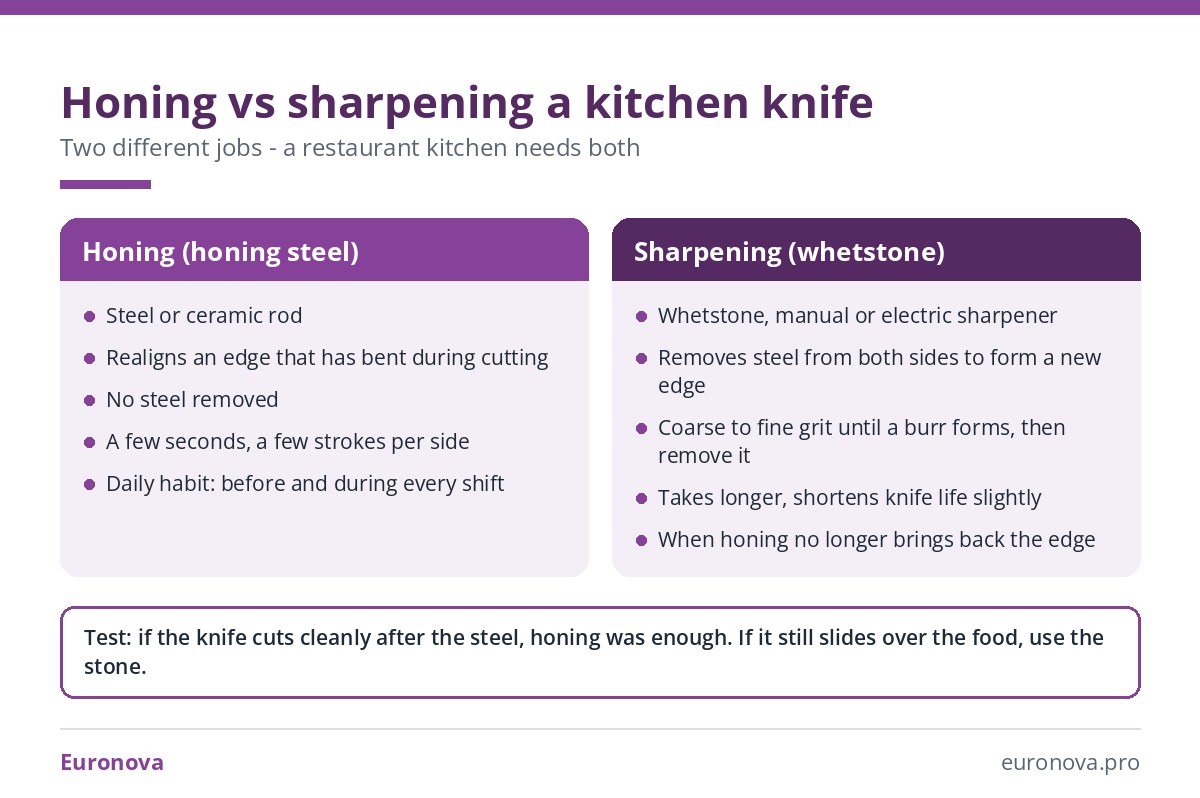
Sharpening removes a layer of steel and creates a new edge; a honing steel only realigns an edge that has rolled during work. A restaurant needs both.
What matters most is a consistent sharpening angle, not pressure. Use the angle stated by the knife manufacturer; for typical kitchen knives it is from just over ten to about twenty degrees per side.
On the stone, work from coarse to fine grit until a burr forms along the whole length of the blade, then remove it.
A sharp knife is a workplace safety measure: a dull one needs more pressure and slips more easily.
Knives made of good steel, hand washing, the right chopping board and safe storage extend the time between sharpenings more than any sharpener.
Most misunderstandings about sharpness come from mixing up two processes.
Honing (realigning the edge) is done with a honing steel, i.e. a steel or ceramic rod. During cutting, the very thin edge of the blade bends to one side, microscopically and invisibly. The knife feels dull even though no steel has been lost. A few strokes on the steel bring the edge back into line. It is a quick job, a matter of seconds, and in a commercial kitchen it should be a daily habit.
Proper sharpening means removing material from both sides of the blade until they meet in a new, straight edge. It is done on a whetstone or a manual or electric sharpener. It takes longer and shortens the knife's life a little every time, so it is done less often, when honing no longer has any effect.
In practice: if the knife cuts cleanly again after the steel, honing was enough. If it still slides over the food after honing, the edge is worn and it is time for the stone.
How to tell a knife needs sharpening
A chef at the station feels it in the hand, but with dozens of knives in circulation, simple shared tests are worth having:
Tomato test. A sharp knife goes through the skin without pressure. A dull one slides over it or squashes the fruit.
Paper test. A sheet of paper held in the air should slice cleanly. Tearing or catching at one spot points to a chipped or worn section of the edge.
Onion and herb test. A dull blade crushes instead of cutting: herbs go dark on the board and onions release more juice.
Light test. Looking at the edge under a light from the side of the blade, you will see reflections where the edge is rounded. A sharp edge reflects practically no light.
Do not wait until the knife is completely dull. Restoring an edge that has gone fully round takes much more work on a coarse stone and removes more steel than regular, more frequent sharpening.
What to sharpen knives with in a commercial kitchen
Each tool has its place in a restaurant's work routine. The overview below helps you decide what belongs at the station and what in the back.
Tool
What it is for
What to watch out for
Honing steel (steel or ceramic)
daily edge realignment before and during a shift
needs practice and a consistent angle; will not restore a very dull blade
Water stone or whetstone
full sharpening, edge restoration, work on Japanese knives
a water stone must be soaked before use and kept wet; sharpening takes longer
Manual sharpener with guide
quick sharpening for inexperienced staff, a fixed angle set by the guide
the sharpener's angle must match the knife's angle
Electric sharpener
institutional catering kitchens, many knives, fast results
generally not suitable for single-bevel, serrated or very thick-bladed knives
Workshop bench grinder
not for kitchen knives
overheats the steel, removes too much material, leaves metal filings
For kitchen knives in a restaurant, a set usually suffices: a honing steel at every station plus a combination stone (coarse and fine grit) or a guided sharpener in the back. Kitchens in hospitals, schools or care home canteens, where many people with different levels of experience use the knives, often choose guided solutions because the angle then does not depend on the worker's hand.
How to sharpen a knife on a whetstone, step by step
A stone gives the best control over the edge. The process that the sharpeners from the De Meesterslijpers workshop describe in their guide to sharpening a chef's knife goes from 400 grit through 1000 to 1200, finishing on a leather strop. In a version for the everyday kitchen it looks like this:
Prepare the stone. Submerge the water stone until it stops releasing air bubbles. Place it on a damp cloth or rubber base so it does not slide on the worktop. Mistake: working on a dry stone, which clogs with filings and stops cutting.
Set the angle. Place the blade on the stone at the angle recommended by the knife manufacturer. Less experienced staff can use a clip-on angle guide. Mistake: lifting the spine during the stroke, which rounds the edge instead of sharpening it.
Sharpen on the coarse grit. Guide the knife in steady strokes from heel to tip, with light finger pressure on the flat near the edge. Work on one side until you can feel a fine burr, a thin "wire" of steel, along the whole length of the other side with your fingertip. Mistake: switching sides before the burr appears at the tip and the heel.
Turn the knife over. Repeat on the other side until the burr moves over to the first side. This is the sign that both faces have met in a new edge.
Refine on the fine grit. Switch to the 1000 side or higher and make increasingly lighter, alternating strokes on both sides. The burr shrinks and the edge becomes smooth.
Remove the remaining burr. A few light strokes on a leather strop or the honing steel, or drawing the edge through soft wood, removes the last particles of steel.
Test and wash. Do the paper or tomato test. Then wash the knife so no filings get into the food, dry it and put it back in its place. Rinse the stone and let it dry.
Single-bevel knives, such as the Japanese yanagiba or deba, are sharpened differently: the edge is worked at an angle on the bevelled side only, while the flat side is just smoothed by laying it flat on the stone.
How to use a honing steel
Hold the steel vertically, with its tip resting on a board or cloth. Draw the blade from heel to tip, top to bottom, alternating sides, at the same angle as when sharpening. A few strokes per side with light pressure are enough. The downward stroke towards the worktop is safer than impressively waving the steel in the air, especially in a cramped kitchen at peak time.
How often to sharpen knives in a restaurant
How often depends on the hardness of the steel, the number of covers, the type of food and the chopping boards. Rather than a rigid calendar, a simple routine works better:
Before every shift: honing steel for all knives used at the station.
During the shift: honing steel whenever the chef feels the knife starting to tear.
Full sharpening: when the honing steel no longer brings back the edge. In a kitchen with a lot of prep this will be considerably more often than in a café that mainly cuts cakes and fruit.
Set inspection: check all knives from time to time for chips, loose handles and blade wear. A knife whose blade has become narrow and uneven after years of sharpening is better replaced than rescued.
Hard steel, typical of many Japanese knives, holds its edge longer but is more brittle and needs a stone. The softer steel of European knives dulls faster, but responds well to a honing steel and copes with heavy-duty work.
Most common sharpening mistakes
Inconsistent angle. The edge's worst enemy. Better to work more slowly but evenly.
Too much pressure. It does not speed up the work, but it easily chips the edge and removes too much steel.
A bench grinder instead of a stone. It overheats the steel, ruins its temper, removes too much material and leaves filings.
Sharpening a serrated knife like a straight one. Bread knives need a thin rod that sharpens each serration individually.
No washing after sharpening. Steel filings must not get into food.
Sharpening done by whoever is around. In a restaurant it pays to appoint one or two people responsible for sharpening and to train the rest of the team to use the honing steel properly.
Types of knives in a commercial kitchen and how to sharpen them
A good set is a few knives chosen for the tasks at each station, not a block set of random models. The most important types:
Knife
Kitchen tasks
Sharpening
Chef's knife
the basic tool: vegetables, meat, herbs, chopping
stone or sharpener, honing steel every day
Santoku
all-rounder, often used instead of a chef's knife, good for thin slices
stone, more gently, as the steel is often harder
Vegetable and paring knife
short blade for precise peeling, coring, garnishes
stone or sharpener, frequent honing
Filleting knife
fish, separating meat from skin, flexible blade
stone, take care with the thin tip
Boning knife
separating meat from the bone
stone, regular honing
Bread knife
bread, rolls, cakes with a hard crust, serrated blade
thin rod for the serrations, rarely
Cleaver
chopping bones and hard foods
wider angle, coarse-grit stone
For a small kitchen, the basics are a chef's knife, a vegetable knife, a bread knife and a boning or filleting knife. With higher prep volumes it pays to have two of the most-used knives, so that one can go for sharpening without the station standing idle.
Professional chef's knife: how to choose knives for heavy-duty work
Sharpening will not save a knife that was poorly chosen in the first place. When buying knives for food service, look at:
Steel. Knife-grade stainless steel, properly hardened, holds an edge and can be sharpened regularly without chipping.
Handle. In a commercial kitchen hygiene counts: a plastic handle without gaps where dirt collects, easy to wash and secure in a wet hand.
Balance and length. A chef's knife with a length suited to the hand and the board. A longer blade speeds up cutting large quantities; a shorter one gives more control.
Full tang. A blade that runs into the handle increases durability during daily cutting for hours at a time.
Colour coding. Many kitchens assign knives and boards with coloured handles to food groups, such as raw meat, fish, vegetables and bread. This makes it easier to follow HACCP principles, the system for controlling hazards in food production, and reduces the risk of transferring bacteria from raw meat to ready-to-eat foods.
In schools, nurseries and care homes, where kitchen teams change, simplicity works best: a few recurring models, a clear colour split and a fixed place for every knife.
Care: chopping boards, washing and storage
What happens to a knife between cutting and sharpening decides how often you need to reach for the stone.
Chopping board. Wood and soft plastic are kind to the edge. Glass, stone, ceramic and metal trays dull the blade with every stroke, so never cut directly on a plate or the worktop.
Washing. By hand, straight after use, then dry immediately, especially where the blade meets the handle. The sharpeners' guide cited above recommends washing knives by hand only, because detergents and machine washing in a dishwasher damage the blade and handle. Do not leave knives in a sink full of water: it is a danger to anyone reaching in and a risk of discolouring the steel.
Between ingredients. After raw meat, wash and disinfect the knife before cutting another food, or switch to a knife from another colour group.
Storage. A magnetic strip, knife block or blade guard. Knives loose in a drawer knock against each other, lose their edge and are dangerous for whoever reaches in.
Everything for the kitchen in one order
Regular sharpening makes sense when the knives at the stations deserve it. At Euronova you will find professional kitchen knives, chopping boards and kitchen utensils, alongside pots, pans, GN containers and the rest of your restaurant equipment, all in one place.
If you are putting together a set for a new station or topping up knives after an inspection, start in the cooking utensils section, and equip the whole kitchen and dining room in the Euronova online shop.
Our view on sharpness in the kitchen
In conversations about sharpening, the questions that come up most are about the stone, the angle and the technique. They matter, but in a kitchen that serves hundreds of covers a day, sharpness is above all a question of organisation: the right knives at the right stations, boards that do not destroy the edge, and a fixed place for every knife.
We supply restaurants, hotels, pizzerias, cafés and catering companies, as well as kitchens in schools, nurseries and care homes. That is why we see knives as part of the complete kitchen equipment. The chef's knife, the chopping board, the GN container for chopped vegetables and the thermo box for transport form one workflow. When all these elements fit together, the knife dulls less and the team works faster and more safely.
So we encourage you to think in sets when equipping a kitchen: knives in recurring models, boards in colours assigned to food groups, and utensils in numbers that allow pieces to be swapped without downtime. Such a set is easy to top up with your next order, and sharpening becomes routine rather than a rescue job.
Rok
FAQ
How much does knife sharpening cost a restaurant?
The biggest cost is not the sharpening itself but labour time and a workstation standing idle. A restaurant with its own honing steel at every station, a whetstone or sharpener in the back and one person trained to sharpen keeps its knives in shape as it goes. A spare of the most-used knife ensures sharpening never holds up service.
What oil should I use for sharpening knives?
It depends on the stone. Water stones work with water only and must never be oiled. Oil stones need a thin oil; in a kitchen, choose a food-safe mineral oil, because residue ends up on the blade, and wash the knife thoroughly after sharpening anyway.
Can serrated knives be sharpened?
Yes, but not on a flat stone or in a standard sharpener. Serrations are sharpened one by one with a thin, tapered rod, from the bevelled side only. Bread knives dull more slowly than straight-edged knives, so they rarely need it.
Can kitchen knives go in the dishwasher?
In a commercial kitchen, good knives are washed by hand and dried straight away. A dishwasher with strong detergent and contact with other items speeds up edge wear and can damage the handle.
When should a knife be replaced rather than sharpened?
When the blade has become noticeably narrower and uneven after many sharpenings, has deep chips or cracks, or the handle is loose or has gaps where dirt collects. Such a knife is hard to keep hygienic and is dangerous, and replacing it costs less than a cut finger and downtime.
Euronova
Talk to us about kitchen equipment
Write to us if you are looking for professional knives or other utensils for a commercial kitchen.