How to Improve Coffee Quality in Your Café: 8 Areas to Check
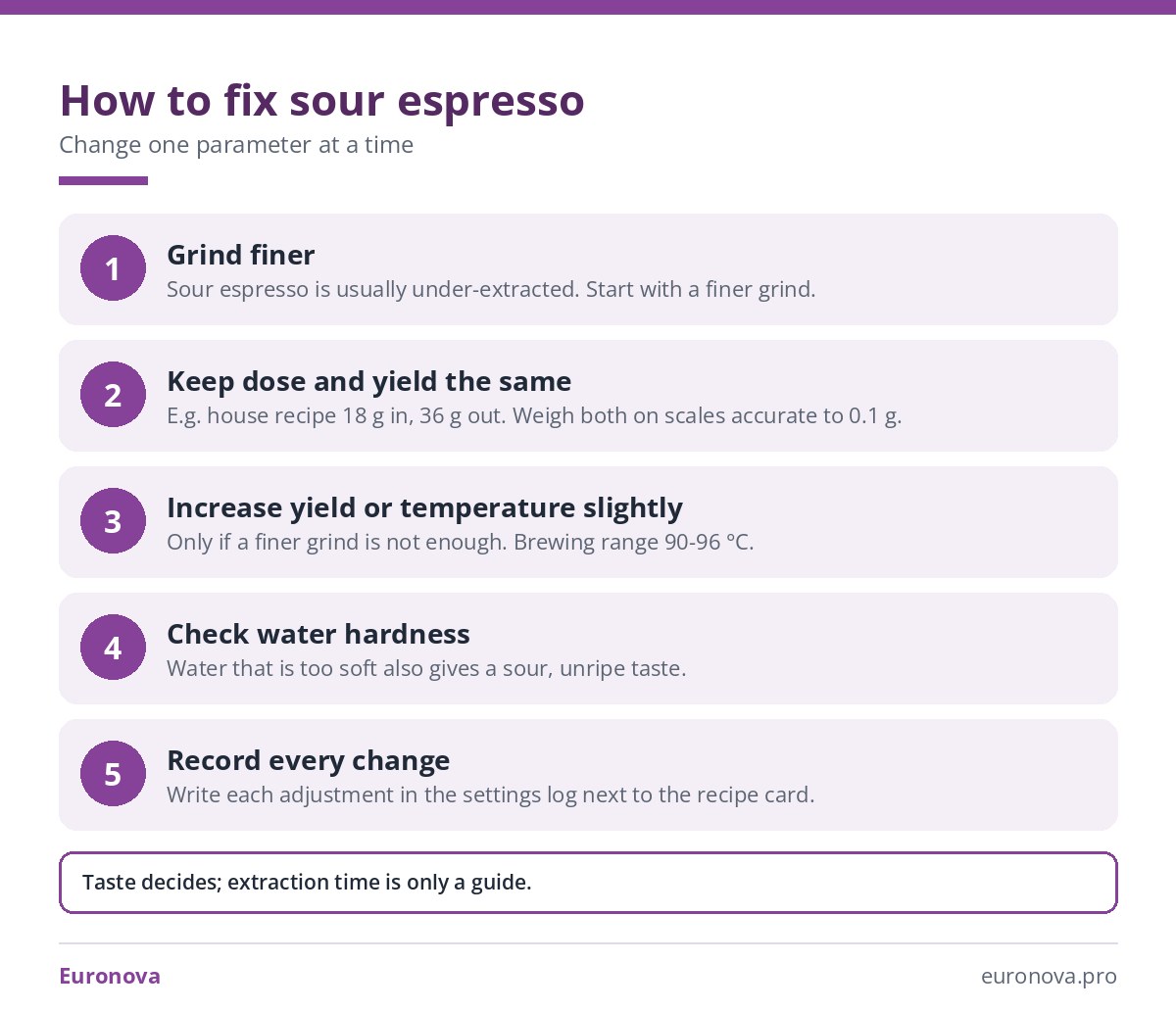
Coffee quality in a café rarely improves with a single purchase. It improves with a system in which every barista on every shift makes the same coffee to the same recipe, on the same equipment, and serves it in the same well-prepared cup. The beans and the coffee machine set the upper limit of flavour. Whether the guest tastes it depends on the water, the grind, cleaning, milk, cups and the team's habits. Below are eight areas worth reviewing in order, with typical mistakes and how to fix them. For bar and front-of-house equipment, the simplest approach is to source everything from one supplier such as Euronova, which supplies cafés, hotels and restaurants. Start with what you sell most. If most orders are cappuccino, latte and flat white, you need a coffee that cuts through milk. If filter coffee sales are growing, you need beans that show their origin. The flavour of the drink is most strongly influenced by the variety and origin of the beans and the quality of the water: climate, soil, growing altitude and processing method create a profile that no barista can change afterwards. They can, however, easily spoil it. Practical rules for choosing coffee for your business: Do not change beans more often than the team can adapt. Every new coffee means a new recipe and a few days of dialling in the grinder. Even the best beans lose their aroma if they are kept too long or in poor conditions. After roasting, coffee gradually oxidises, and after grinding it loses aroma much faster, because the surface area exposed to air increases many times over. What this means in a café: For storing stock in the back of house, airtight containers are useful, and for an orderly storeroom, GN containers that fit standard shelving and worktables. Coffee is about 98% water. Its mineral content, purity and temperature all matter. Water that is too hard gives a flat taste, while water that is too soft gives a sour, unripe taste. Hard water also deposits limescale in the boiler and group head of the coffee machine, which over time changes temperature and flow. Tap water hardness varies greatly from place to place, sometimes even between parts of the same city, so: The brewing temperature should be in the range of 90–96 °C: below this, coffee is under-extracted, sour and flat; above it, over-extracted and bitter. If your coffee machine allows temperature adjustment, set it for each coffee and do not change it without reason. This is where cafés gain quality fastest, because it mainly costs attention. Baristas call the process of setting the grinder and recipe "dialling in". Here is how to do it: Espresso needs a very fine grind, filter coffee a medium one. For filter coffee the starting point is a ratio of about 1:15, i.e. 1 g of coffee to 15 ml of water. Grind consistency is key: a burr grinder produces uniform particles, so the whole portion extracts at the same rate. A guest rarely says "under-extracted". They say "sour" or "bitter". This table helps translate their words into an adjustment at the grinder. For sour espresso, start with a finer grind and only then adjust other parameters. If acidity bothers guests in milk-based coffees, consider medium-roast beans, which give a fuller taste and softer acidity. Coffee leaves oils that turn rancid within hours. Residue in the group head, on the shower screen, in the basket and in the grinder burrs carries over into every following cup. Professional barista training treats cleaning and equipment maintenance, and the effect of equipment condition on drink quality, as a separate module, not an add-on. A simple routine worth hanging next to the coffee machine: Worn screens, cracked gaskets and scratched milk jugs should be replaced straight away. Their cost is small compared with coffee poured down the drain. In many venues milk-based coffees make up most of sales, so milk is as much part of the recipe as the espresso. This is the last stage where good coffee can lose out. An espresso in a cold cup loses temperature within seconds and the crema breaks down faster. So: A uniform set of cups also matters for organisation. When all cappuccino cups have the same volume, the same recipe gives the same drink, regardless of which barista is at the machine. Everything described above only works if every employee does it, not just the best barista. In a venue where several people make coffee on different shifts, consistency matters more than originality. How to set up a standard in a few days: A standard like this protects the venue against staff turnover. A new person learns from the card, not from verbal instructions to which every shift adds its own tweaks. Most of the improvements described require small but complete equipment: barista and bar tools, porcelain cups with saucers, glasses, takeaway cups and lids, storage containers and HoReCa appliances. At Euronova you can put all of this together in one order, at wholesale prices and with a range tailored to professional food service. Start with the bar tools section; porcelain, glassware and appliances are in the full HoReCa catalogue. We supply cafés, restaurants, hotels and catering companies, so we see that coffee quality is decided by the whole bar, not by one machine. The beans and the coffee machine are the foundation, but the guest judges the cup they are handed. That is why we advise treating equipment as part of the recipe. Scales next to the grinder, a jug of the right size, a cup whose volume matches the drink and a takeaway cup with a lid that does not leak make sure the standard written on paper becomes the standard in the cup. Sourcing all of this from several suppliers costs time, which is what café owners have least of. Ordering in one place, with easy restocking, lets you focus on what really builds a café's reputation: the coffee and the guests. Rok Sour espresso is usually under-extracted. Grind finer and keep the dose and yield the same. If that is not enough, increase the yield or temperature slightly. Change one parameter at a time and also check water hardness, because water that is too soft also gives a sour taste. At the start of every shift and after every change of bean batch. Adjustments during the day are normal, because humidity and temperature in the venue affect how the coffee behaves. It makes sense to record every change in a settings log. Yes, if more than one person makes the coffee. Training gives the team a shared language and one method, and a written recipe card lets you keep that level after the course ends. It works best combined with equipping the station with the scales and tools the team practised on. It affects the temperature and how long the drink keeps its crema and foam. Warmed, thick-walled porcelain holds heat longer than a cold cup. A volume matched to the recipe prevents watery or overfilled drinks. With scales next to the grinder, a written recipe and daily cleaning, because these are the cheapest changes with the biggest effect. Then check the water and filtration, and after that complete your cups so that every coffee on the menu has its own cup with the right volume.How to Improve Coffee Quality in Your Café: 8 Areas to Check

In brief
Contents
1. Beans chosen for your menu
2. Freshness and storage
3. Water: the most overlooked ingredient
4. Grind and espresso recipe
5. Sour or bitter? A quick diagnosis
What the guest tastes
Most common cause
First step
Second step
Sour, sharp, watery
under-extraction
finer grind
higher yield or slightly higher temperature
Bitter, astringent, dry
over-extraction
coarser grind
lower yield or slightly lower temperature
Flat, no aroma
stale beans or coffee ground in advance
fresh batch, grind per portion
check water and filter
Good one time, bad the next
no scales, different team habits
weigh dose and yield
written recipe next to the coffee machine
Burnt or rancid oil aftertaste
dirty group head, portafilter or grinder
thorough cleaning
daily closing routine
6. Cleaning the coffee machine, grinder and tools
7. Milk and serving
8. Cup, glass and takeaway cup
Standards and team training
Coffee bar equipment in one place

Our view
Frequently asked questions
How do I stop the coffee in my café tasting sour?
How often should the coffee grinder be adjusted?
Is barista training worth the investment?
Does the cup really affect the taste of coffee?

Where should I start on a limited budget?
Recommended