Cooking Methods in Food Service: Techniques, Core Temperatures and Equipment
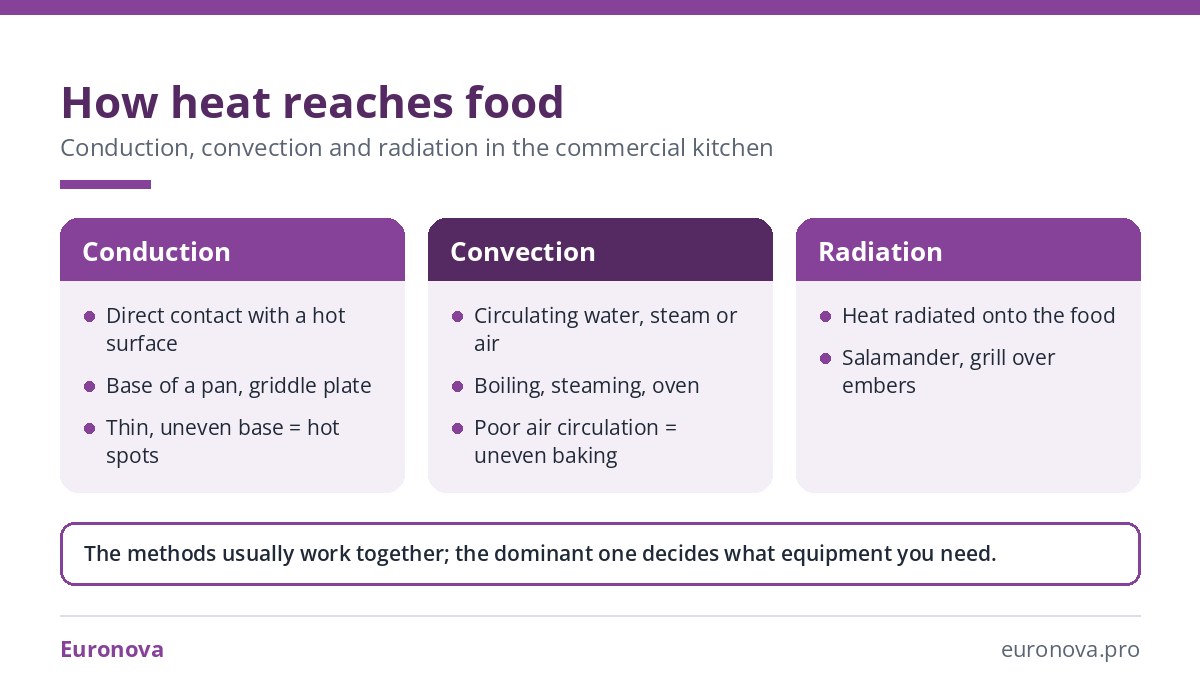
Heat treatment means exposing food to high temperatures so that it becomes safe, digestible and tasty. In a commercial kitchen three things decide the result at once: the chosen method (boiling, frying, braising, roasting and baking, steaming, sous-vide), control of time and core temperature, and equipment that lets you repeat these parameters for every portion. The first two are the chef's know-how. The third is bought by the owner, and it is most often what decides whether a HACCP system works in practice or only on paper. That is why this guide links each method to the cookware and appliances it needs, which you can put together at Euronova in one order, at wholesale prices. In technological terms, heat treatment is the processing of semi-finished products into finished dishes using heat. It changes the structure, consistency and the qualities a guest judges immediately: taste, smell and colour. For every menu it makes sense to keep three goals in mind: better digestibility and use of nutrients (starch gelatinisation, collagen breakdown, protein denaturation, softening of fibre), destruction of microorganisms and enzymes, and the formation of new flavour and aroma compounds. Heat reaches food in three ways: by conduction (the base of a pan, a griddle plate), convection (circulation of water, steam or air in an oven) and radiation (salamander, grill over embers). They usually work together, but one dominates, and that one determines what equipment you need. A pan with a thin, uneven base conducts heat in hot spots, so a steak burns on one side and stays raw on the other. An oven without good air circulation bakes unevenly. In practice, choosing the method and choosing the cookware are one decision. For the record: "heat treatment of metals", which people also search for, is an entirely different field, metallurgy (hardening, tempering, annealing). This article deals only with food. The basic methods are easiest to divide into moist (water, steam) and dry (fat, hot air, a heated surface). Boiling in water is the gentlest method, but some water-soluble vitamins pass into the liquid. Steam performs better in this respect, and in pressure appliances it is also faster: raising the pressure by 0.05 MPa gives 111 °C, and by 0.1 MPa 121 °C, which can cut cooking time by two to three times, while saturated steam does not dry the food out. In a school canteen or care home that serves several hundred portions of vegetables and fish every day, this means real savings in time and energy. Frying gives a crisp crust and the aroma of the Maillard reaction (browning of proteins and sugars), but requires control of the fat temperature. Fat that is too cold soaks into the breadcrumbs; fat that is too hot burns them before the centre heats up. Thick chicken or pork escalopes are therefore best seared and then finished in the oven. Grills and contact plates work at around 250 °C, so they suit thin portions cooked to order. Braising combines searing with slow cooking in a little liquid and fat, so it suits tougher, collagen-rich cuts: meat in sauce, goulash, shoulder. Roasting and baking work with hot, dry air. A combi oven lets you combine it with steam, which reduces drying out of large joints and terrines. In a pastry kitchen, baking is the basis of production, and consistency depends on the moulds, baking tins and small tools from our pastry equipment range. Sous-vide is cooking vacuum-packed food in a water bath at a precisely set temperature. A 2026 scientific publication states that the method usually retains more vitamin C, phenolic compounds and minerals than conventional cooking, gives repeatable results and reduces food waste. Cook-chill is a system of cooking in advance: you cook the dish, portion it, chill it rapidly and store it until regeneration. Both methods are popular in hotels and catering because they separate preparation from service. There is no single "healthiest" or "best" method. There is a method suited to the ingredient, the desired result and the scale of production. Four questions help when planning a menu: A practical example: wedding catering for 150 guests. Chicken roulade roasted in a combi oven in GN 1/1 containers, rapidly chilled, then regenerated on the day of the event and served from chafing dishes. The same roulade fried in pans in batches would need more chefs at the stove and give an uneven result. Here the method follows directly from the logistics, and the logistics from the equipment. Does cooking kill Salmonella? Yes, if the heat reaches the centre. In its Five Keys to Safer Food guidance, the World Health Organization advises that food should reach 70 °C during cooking, especially meat, poultry, eggs and seafood. The "core" is what counts: a golden-brown crust says nothing about the centre of a thick chicken thigh. Time and temperature work together. US guidelines for cooked beef state that the same Salmonella reduction is achieved at 62.8 °C after 4 minutes or instantly at 70 °C. That is why the low temperatures of sous-vide require a precisely chosen time. A Polish study on pike fillets showed that treatment at 75 °C for 20 minutes reduced the bacteria studied below the detection limit, while 65 °C for 45 minutes did not guarantee this. For safety and quality reasons, the authors recommended the 75 °C variant. How to apply this in daily work: Critical limits for individual dishes are set by the business's HACCP system (Hazard Analysis and Critical Control Points, which every food business must implement). If you are still preparing it, set the values for your menu with a food technologist or HACCP consultant. Many cases of food poisoning do not start at the stove, but an hour later, when a cooked dish cools slowly in a large pot or sits lukewarm on a buffet. Regulation (EC) No 852/2004 on the hygiene of foodstuffs requires foods that are to be stored or served chilled to be cooled as quickly as possible after heat treatment, and the cold chain must not be interrupted. A large mass of food in one pot takes hours to cool. If you spread it into shallow gastronorm containers and cool it in refrigeration equipment, that time is cut many times over. Widely used food hygiene guidance sets cooling from 63 °C to 20 °C within a maximum of two hours, and then to 5 °C within a further four hours at most; check the exact limits with your local food safety authority. GN containers have standardised dimensions, so the same containers travel from the oven to the blast chiller, into the cold room and back into the oven for regeneration, with no transferring and no extra washing up. Deeper models such as the GN 1/1 container, 200 mm deep suit soups and sauces, while shallower ones suit meat and vegetables for rapid cooling. On a hotel buffet or during a catered event, food must stay hot throughout service, typically at a minimum of 63 °C. This is what bains-marie, food warmers and chafing dishes are for: an electric chafing dish, 700 W with a 4 l capacity for smaller buffets, or a GN 1/1 food warmer, 9 l for main courses. In catering, food is transported in insulated food carriers, and takeaway dishes are packed in takeaway food packaging chosen according to the temperature and type of dish. Before using any appliance for the first time, read its technical documentation (the manufacturer's instructions with parameters and safety rules), check the connection to the utilities and level the appliance. Regular cleaning follows: burnt-on fat on a griddle and limescale in a steamer change heat transfer, and with it the actual cooking temperature. When equipping a kitchen for specific methods, follow a few rules: Stockpots, sauté pans, frying pans and lids, professional knives and chopping boards, GN containers, insulated food carriers, HoReCa heating and refrigeration appliances and buffet equipment: at Euronova this is one shop and one basket. We supply restaurants, hotels, bars, pizzerias, cafés and catering companies at competitive wholesale prices. If you are opening a business or changing equipment for a new menu, start with the full HoReCa equipment catalogue, and for one-off events, take a look at catering equipment hire. Heat treatment is usually described as the chef's know-how: methods, temperatures, times. That is true, but in a commercial kitchen this knowledge only works if the equipment makes it possible to repeat it for every portion, every day, regardless of who is at the stove. That is why we advise planning equipment from the process side. First the menu and methods, then the journey of the dish: from the oven into a GN container, from the blast chiller to the buffet, from the kitchen into an insulated carrier. When cookware, GN containers and appliances fit together, the chef works faster and the temperature at control points is no longer a lottery. That is exactly why we build our range so that a restaurant, hotel, canteen or caterer can equip the kitchen and dining room in one place and restock without searching through several suppliers. We continually adapt the range to changes in the food service market, and wholesale prices make good equipment affordable for newly opened businesses too. Rok It means exposing raw ingredients and semi-finished products to high temperatures to turn them into finished dishes. Cooking changes their structure, consistency, taste, smell and colour, improves digestibility and destroys harmful microorganisms. The basic methods are boiling, frying, braising and baking or roasting. Gentle methods without contact between the food and a lot of water retain the most nutrients: steaming and sous-vide. They reduce the leaching of water-soluble vitamins such as vitamin C. Use frying and grilling with control of fat and surface temperature so that food does not burn. Yes, if the core of the food reaches the right temperature for the right time. The World Health Organization recommends that food reaches 70 °C during cooking. Check this with a probe thermometer in the thickest part, because the appearance of meat gives no certainty. It is a metallurgical process in which metal is heated and cooled according to a set pattern to change its hardness and strength, for example by hardening or annealing. It has nothing to do with food preparation, even though the name is similar. The basics are heavy-based stockpots and saucepans, frying pans chosen for the foods you cook, an oven, GN containers, a probe thermometer and equipment for cooling and hot holding. The scope depends on the menu: a pizzeria needs a different set from a bistro serving braised dishes.Cooking Methods in Food Service: Techniques, Core Temperatures and Equipment

In brief
Contents
What heat treatment is and why we use it
Cooking methods in a commercial kitchen
Method
Medium and temperature
Typical use
Equipment and cookware
Boiling
water or steam, around 100 °C
soups, stocks, potatoes, pasta, porridges
heavy-based stockpots, boiling kettles, lids
Steaming
saturated steam, 100 °C, under pressure 111–121 °C
fish, vegetables, dumplings, diet dishes
steamers, combi ovens, perforated GN containers
Frying in fat
fat at 130–220 °C
escalopes, chips, breaded fish, pancakes
frying pans, deep fryers, turners and tongs
Fat-free searing, grilling
around 250 °C, briefly
steaks, burgers, grilled vegetables
contact grills, griddle plates, grill grates
Braising
searing at around 170 °C, then a little liquid
goulash, meat in sauce, ragu, stews
sauté pans, roasting tins, pots with a heavy lid
Roasting and baking
dry hot air, up to 300 °C in a combi oven
whole joints, soufflés, terrines, pastries, pizza
ovens, roasting tins, GN containers, pizza tools
Sous-vide
water at a constant low temperature, food vacuum-packed
fish, fillets, poultry, eggs, vegetables
immersion circulators, vacuum packers, GN containers
Boiling and steaming
Frying and grilling

Braising and roasting
Sous-vide and cook-chill
How to choose a method by food and result
Core temperature: safety and Salmonella
What happens to the dish after cooking
Rapid cooling
Hot holding and transport
Equipment and safe use of appliances
Equipment for every method in one order

Our view
Frequently asked questions
What is heat treatment of food?
Which cooking method is the healthiest?
Does cooking kill Salmonella?
What is heat treatment of metals?
What cooking equipment does a small food business need?
Sources