Food Transport in Catering: Regulations, Containers and Hygiene
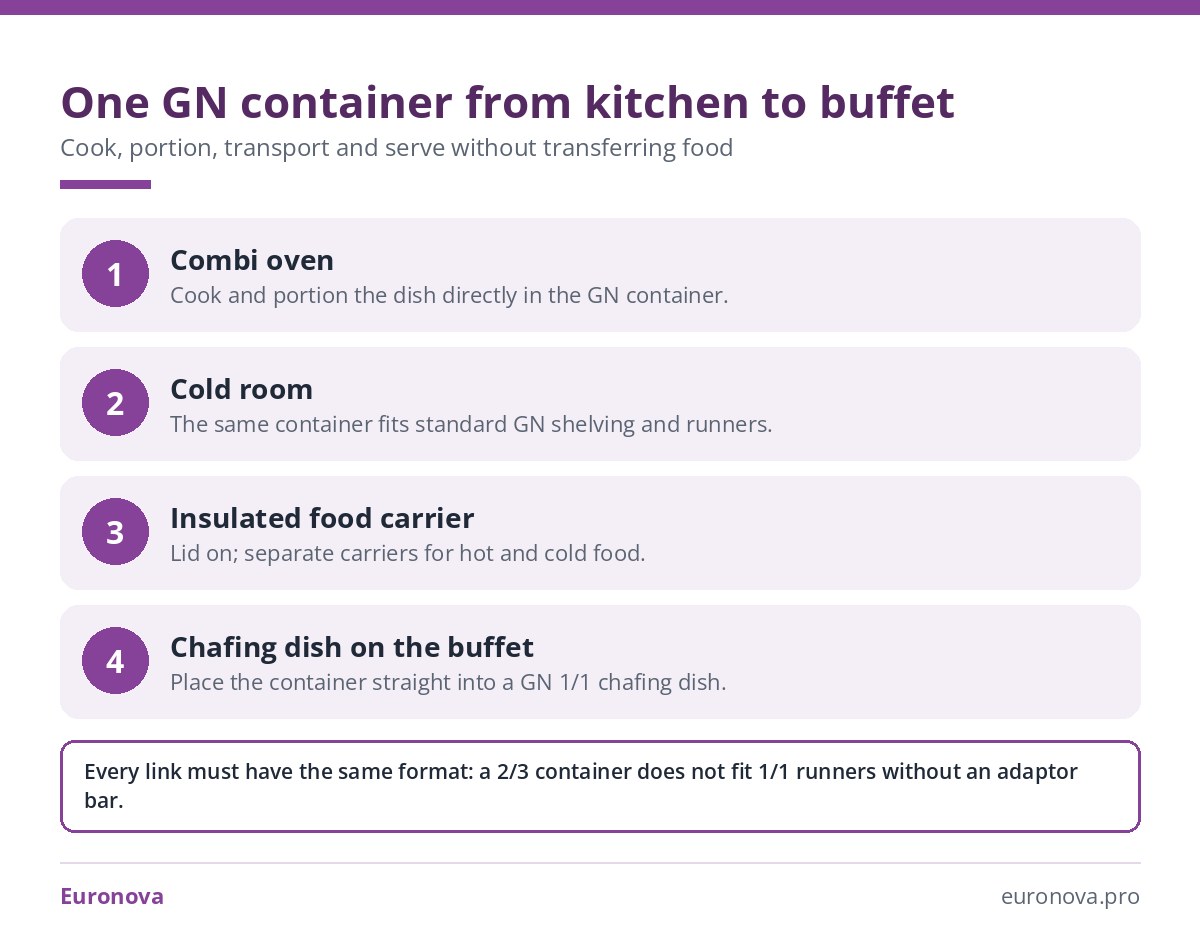
In food service, transporting food rarely means a refrigerated lorry. More often it means lunches driven from a central kitchen to a school, a wedding buffet 40 km from the restaurant, office meals, or stock you bring from the cash and carry to your venue. In all these cases the rules require the same thing. Food must arrive in clean, closed containers, at a temperature that can be maintained and checked, and without contact with anything that could contaminate it. A hygiene inspection most often passes or fails on what happens in the vehicle: what containers you have, what insulated food carriers, how you separate the load and what you record. We show how to organise transport so that it complies with the rules and is repeatable on every trip. Many food service operators think that food transport rules apply to logistics companies. That is a mistake. Obligations under food law apply to anyone who moves food as part of their business. In HoReCa practice, there are four common situations: Each of these situations needs different equipment, but the logic is the same: the product must not warm up or cool down outside the safe range, must not get dirty, and must be possible to check at its destination. Below we describe each element in turn. EU rules apply alongside national legislation. The most important is Chapter IV of Annex II to Regulation (EC) No 852/2004 on the hygiene of foodstuffs. It is an EU act that applies directly, without national implementing law. Its provisions give rise to several specific obligations: At national level, official controls of food businesses are carried out by the competent food safety authority. Commonly applied hygiene guidance sets temperatures of at least 63 °C for hot food and at most 5 °C for chilled food; check the exact requirements that apply in your country. What does this mean for a restaurant or catering company? The inspector is not interested in the make of the vehicle. They check whether the containers are clean, closed and intended for food contact, whether you know what temperature a meal travels at, and whether you have it recorded. A vehicle you regularly use to transport food for your business must have a load space that is easy to clean: smooth surfaces, no cracks and no absorbent linings. Describe food transport in your business's HACCP system, and when registering or changing your activity, check with your local food safety authority which details you need to provide. Requirements may differ depending on what you transport: ready meals in insulated carriers or raw meat. If your business transports perishable foodstuffs abroad, the ATP agreement applies, the international agreement on vehicles for carrying such products. For these vehicles, the refrigeration unit, insulation, door seals and wall thickness are among the items checked, and the certificate has limited validity and requires regular inspections. For most businesses delivering catering within a city, what stands inside the vehicle matters more than its class: insulated containers that maintain the temperature on their own. Well-chosen containers let you transport meals in an ordinary delivery van, without buying a refrigerated vehicle. The choice starts with the question of what you are transporting and for how long. Gastronorm (GN) is a standardised system of food container sizes. Its biggest advantage in transport: the same container fits the combi oven, the cold room, the insulated carrier and the chafing dish on the buffet. You cook, portion, transport and serve the dish in one container, without transferring it, which is when food loses temperature and contamination is most likely. For transport, choose depths that match your portions. A deep GN 1/1 container, 150 mm, with an 18 l capacity holds goulash for a large group. For big events, a GN 2/1 container, 100 mm, with a 31 l capacity is useful. On site, you place the container directly into a GN 1/1 chafing dish and the buffet is ready. One condition: every link in the chain must have the same format. A 2/3 container does not fit 1/1 runners without a suitable adaptor bar or another container to fill the gap, so count your sizes before you order equipment. An insulated food carrier is an insulated transport box into which you place GN containers. It maintains the temperature of hot or chilled food during transport. When choosing one, check three things: whether the carrier holds the number of GN containers you need in your format, whether the interior is easy to wash, and whether you can label carriers for hot and cold food separately. One carrier for everything is an easy way to create a temperature problem. You will find insulated carriers and other equipment in the food transport and containers category. When delivering individual portions, the container is single-use packaging. It must be intended for food contact, close well and withstand the temperature of the food. Choose it for the specific menu item: soup, chips and salad need different packaging. You will find a full overview of types in the takeaway food packaging category. Regulation 852/2004 requires not only maintaining the temperature, but also being able to monitor it. In practice this means a simple procedure for every trip: For refrigerated transport or longer journeys, use temperature data loggers that record data throughout the journey instead of manual readings. The principle stays the same: what counts is the record you show the inspector. Most contamination during transport comes from contact between raw and ready-to-eat food. Some rules follow directly from the regulations, others from good kitchen practice: It makes sense to keep spare containers. When some containers are on the road and some are being washed, the kitchen should never have to transfer food into random containers. An inspection starts with the paperwork. Prepare a folder that every employee can produce: The delivery note is the simplest of these documents, but also the one most often left out. One page with the columns "dish, time, temperature, signature" is enough, as long as you fill it in on every trip. At Euronova you can put together the entire transport chain in one place: GN containers in various sizes and depths, insulated carriers for transport and storage, trays, buffet chafing dishes and takeaway packaging. We work on a wholesale model, so you can equip a new catering business or the next central kitchen in a chain at competitive prices. Start with the gastronorm GN containers category and choose insulated carriers in the same format alongside them. For portion deliveries, see our disposable products. If you only need equipment for one large event, take a look at catering equipment hire. We supply restaurants, hotels, catering companies, schools and care homes. From our perspective, safe food transport is above all a purchasing decision that a business makes once, and makes well. When the kitchen, transport and buffet all work with the same GN format, the dish travels the whole way in one container. Less transferring means less temperature loss, fewer dirty containers and fewer opportunities for mistakes. That is why we advise planning equipment as a system: containers, lids, insulated carriers and chafing dishes that match each other, not bought separately in a rush before the first order. We select our range for the needs of food service and continually adapt it, so that you can find everything in one place, both when opening and when restocking. Rok Yes, if the load space is easy to keep clean, the food travels in closed food-contact containers, and you maintain and monitor the temperature. Before you start, describe the transport method in your HACCP system and check with your local food safety authority whether your business registration needs to be updated. The most versatile set is GN 1/1 containers in two or three depths with lids, plus insulated food carriers in the same format, kept separate for hot and cold food. Add chafing dishes for the serving location. A set like this covers both a wedding buffet and lunch deliveries. An ATP certificate applies to vehicles carrying perishable foodstuffs in international transport. A business delivering catering within its own city usually does not need one, but it must meet the hygiene requirements for transport and have them described in its HACCP system. After every trip, before the containers go back into the kitchen. Record washing and disinfection in a log, because it is one of the first documents an inspector asks for.Food Transport in Catering: Regulations, Containers and Hygiene

In brief
Contents
When does a food business actually transport food?
What the rules say about food transport
The vehicle: from van to refrigerated truck
Food transport containers: how to choose them
What you transport
First-choice container
What to watch for
Hot food for a buffet or event
GN containers with lids in an insulated food carrier
a GN size that fits the carrier and the chafing dishes on site
Lunches for a school, nursery or care home
deep GN containers, separate for soup and main course
tight-fitting lids, easy washing after every trip
Cold canapés, salads, desserts
shallow GN containers in an insulated carrier with ice packs
separating products, protecting decorations
Individual takeaway portions
single-use food-contact packaging
tight closure, separate pot for sauce
Supplies from the cash and carry
lidded storage and transport containers
separate containers for raw meat, dairy and vegetables
GN containers: one standard from kitchen to buffet
Insulated food carriers: insulation instead of refrigeration
Takeaway packaging

Temperature on the road: how to maintain and prove it
Hygiene and load separation
Documents you need in the vehicle and the office
Food transport equipment in one order

Our view: transport starts in the kitchen
Frequently asked questions
Can I transport catering food in a private car?
Which food transport containers should a new catering business start with?
Do I need an ATP certificate?
How often should containers and insulated food carriers be washed?
Sources
Recommended