How to Speed Up a Restaurant Kitchen: Workflow and Equipment
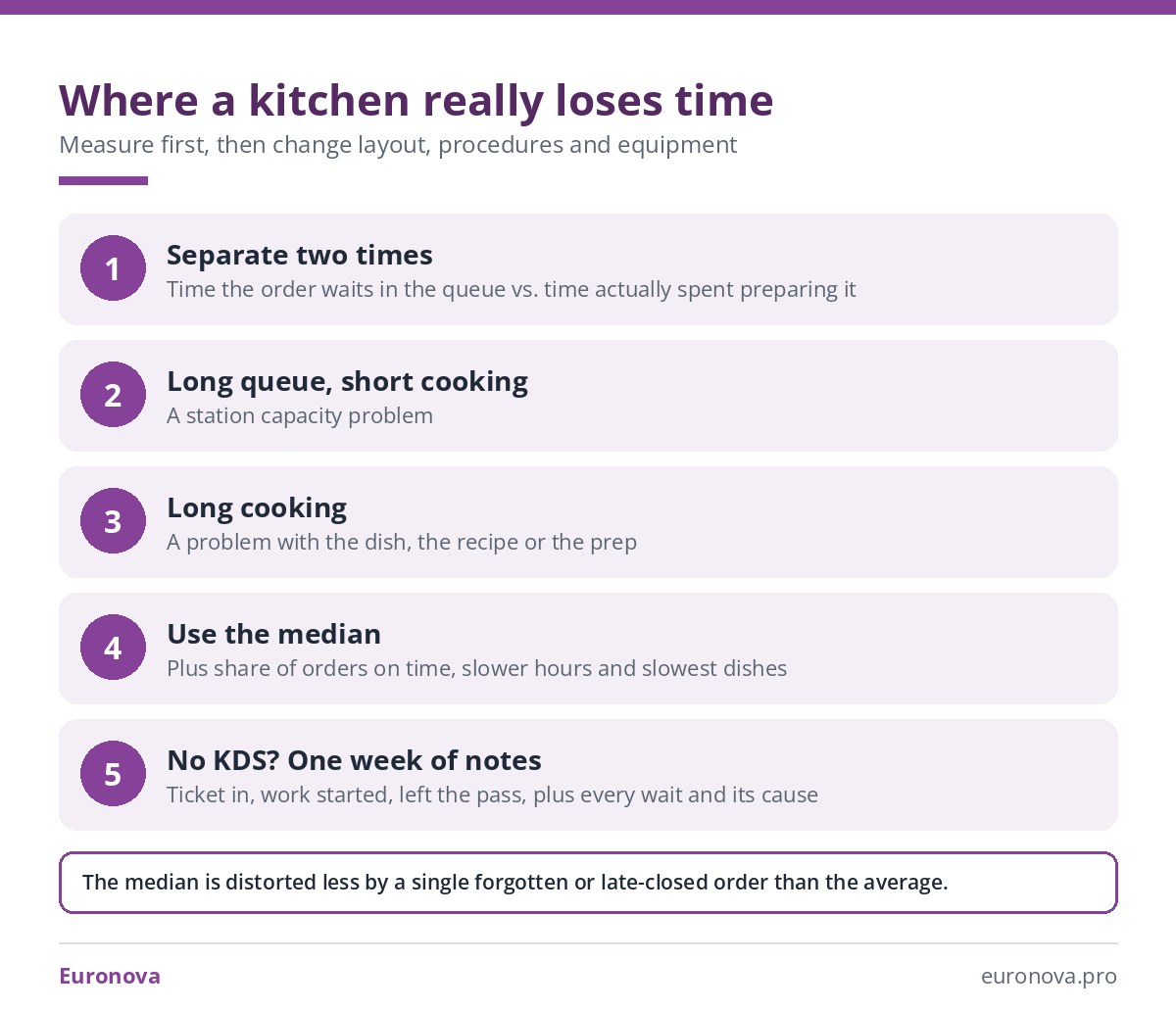
You speed up a commercial kitchen in three steps. First, measure where time is being lost. Next, sort out the workflow and the prep before service. Finally, equip every station so the cook never has to search for anything, wait for anything or decant anything. The third step is the one most often skipped, yet it is where the procedures really start to work: one standardised range of containers, a stock of plates that covers the whole rush, knives and boards assigned to stations. All of this is easier to put together with one wholesale supplier than across several random shops. Below you will find the complete process for restaurants, hotel kitchens, caterers and canteens, along with the mistakes that most often undo the effect. Most head chefs know that "things get stuck on Friday night". Few, however, can show whether the grill, the pass or a shortage of clean plates is to blame. Without that knowledge, improvements are a shot in the dark and new equipment ends up in places that were never slowing the work down. If your kitchen uses a kitchen display system (KDS, a screen on which cooks see orders instead of paper tickets), you already have the data. Such systems usually offer a report on preparation times, individual cooks' performance, station capacity, bottlenecks and the slowest menu items. The key is to separate two times: the time an order waits in the queue and the time you actually spend preparing it. A long queue with short cooking means a station capacity problem. Long cooking means a problem with the dish itself, the recipe or the prep. The second thing is choosing the right metric. It makes sense to analyse the median dish preparation time, the share of orders completed within the target time, the slower hours and the slowest dishes. The median is better than the average because a single forgotten or late-closed order distorts it less. If your kitchen has no such system, a week of manual records is enough: time the ticket came in, time work started, time it left the pass. Add a short note whenever someone was waiting for a container, an ingredient or a free burner. These notes are often the most valuable, because they reveal hold-ups no screen records: a cook running to the store room for a container, or a pass standing idle because the dish area cannot keep up with plates. After measuring, walk through the kitchen along the path of one dish, from the delivery of raw ingredients to the return of the dirty plate. The fastest kitchens work in one direction as far as possible: goods in and storage, prep, cooking, plating and the pass, with dishwashing kept separate. Every point where this line turns back or crosses another costs seconds on every order. At several hundred dishes a day, that adds up to hours. What to watch out for: In hotel and conference kitchens, where several hundred portions have to go out in a short time, layout matters even more. There, the equipment, station layout, ergonomics and the right containers decide how the team performs under time pressure. Mise en place, preparing everything you will need for service before the first guest arrives, is the cheapest speed-up there is. In practice it means: Written recipes matter more in this puzzle than you might think. In a Polish study of three HoReCa businesses published in 2020, preparing basic meals such as a sandwich took between 10 and 25 minutes before improvements, and the lack of written recipes caused unnecessary movement, waiting and mistakes. After lean methods were introduced (an approach that systematically removes everything from a process that does not add value), the total cost per meal quickly fell by 15%. So a faster kitchen is usually also cheaper to run. A good working recipe fits on one sheet next to the station. It includes the portion weight, the assembly order, the type of serving dish and a photo of the finished plate. The photo cuts the check at the pass down to a single glance. This is where plan and reality most often part ways. The procedure says "portion into containers", but the shelf holds three kinds of plastic boxes that fit neither the bain-marie nor the refrigerated cabinet. Equipment should follow from what the measurements and the path of the dish have shown. Gastronorm (GN) containers have standardised dimensions, and the smaller sizes are fractions of a full GN 1/1 container. That is why one container can travel the whole route: from batch prep, through the cold room and the oven, to the bain-marie at the pass or the buffet, without the contents being decanted. Every transfer is a lost minute, an extra container to wash and a food safety risk. Choose one range and stick with it throughout the kitchen, together with lids and trays in the same standard. You will find the selection in the GN containers category. Calculate plates, glasses and cutlery for the busiest hour, allowing for how much tableware is in the dishwasher at that moment. If stock is too low, the kitchen cooks faster than the dish area returns plates, and the pass grinds to a halt. The dish area is the station we think of last, yet during the rush it sets the pace for the whole dining room. A few rules: Storage works on the same principle. Fixed minimum stock levels that trigger a reorder, plus regular stock checks, ensure nobody discovers mid-rush that the cling film or the ticket printer roll has run out. Faster must not mean sloppier. Checks on outgoing dishes and food safety have to work even when the dining room is full. A food business works to its own food safety system based on HACCP principles, and any change to work organisation that affects storage, temperatures or the flow of raw materials must also be reflected in it. If you are unsure, consult a HACCP adviser. Habits that keep the pace up: Each of the steps described rests on concrete things: GN containers and trays, knives and boards, pots and pans, porcelain and glassware in quantities calculated for the rush, insulated food carriers for transport, takeaway packaging and HoReCa equipment for prep, cooking, display and refrigeration. In the Euronova online shop you can put all of this together in one place at wholesale prices, both when opening a new business and every time you restock. If your bottleneck is takeaway service, start with the takeaway food packaging section. If you need extra equipment as a one-off for a large banquet or event, take a look at catering equipment hire. Every day we supply restaurants, hotels, bars, pizzerias, cafés and caterers, as well as school, nursery and care home canteens. From that perspective, speeding up kitchen work is above all a question of consistency for us. The best procedure won't work if the kitchen runs on a mix of equipment bought in different places over the years. Containers don't fit the bain-marie, lids don't fit the containers, and plates from three ranges won't go into one rack. That is why we build our range so a business can source its entire back of house, from porcelain and glassware to GN containers, kitchen utensils and equipment, from one supplier. The second thing is the owner's and head chef's time. Every hour spent comparing quotes and placing orders in several shops is an hour taken from the kitchen. Ordering in one place, at wholesale prices and from a range built for professional food service, is a simple way to get that hour back. Rok With measurement. For one week, record how long orders wait and how long they take to prepare, and note every hold-up with its cause. Only once you know which station or dish slows service down should you change the layout, procedures and equipment exactly there. Yes, in a small kitchen it pays off even faster, because one cook covers several stations and every task saved during the rush is invaluable. A few GN containers in one standard, date labels and written portion weights for the most frequently ordered dishes are enough. Enough to cover the busiest hour, with a reserve for the items in the dishwasher at that time and for breakage. Count your seats, typical peak occupancy and the number of plates per cover, then add a reserve. It makes sense to buy tableware from one range so you can easily top it up. Equipment delivers the most when you buy it for a specific bottleneck and assign it to stations. Combined with a one-way workflow, mise en place and written recipes, the right equipment ensures the improvements hold in every shift, not only when your best cook is on.How to Speed Up a Commercial Kitchen: Workflow and Equipment

In brief
Contents
Where a kitchen really loses time
Zone layout and workflow
Mise en place, batch prep and written recipes
Equipment chosen for the task, not from the catalogue
GN containers as the common language of the kitchen
Utensils assigned to stations
Stock for the rush, not for an average day
Bottleneck
Typical sign
What helps
Prep
the cook weighs and cuts during service
mise en place, GN containers in one standard, portion spoons
Cooking
a queue at one station
cookware sized for the batch, an extra set of utensils
Pass
finished components cool down and wait
plating table, trays, bain-marie with GN containers
Tableware
clean plates run out during the rush
porcelain and glassware stock calculated for the peak
Transport and catering
food is decanted before departure
insulated food carriers that fit GN containers
Takeaway
packing slows down the pass
takeaway packaging in a fixed spot by the pass
Dishwashing and tableware circulation without hold-ups
Pace at peak times without losing quality or safety
Everything for a faster kitchen in one order

Our view
Frequently asked questions
Where should you start when speeding up a kitchen?
Does mise en place work in a small kitchen too?
How many plates and how much cutlery does a restaurant need?
Is new equipment enough to make a kitchen work faster?
Sources
Recommended