A la carte: What It Means and How to Prepare Your Restaurant for A la Carte Service
A la carte: What It Means and How to Prepare Your Restaurant for A la Carte Service
A la carte is a service model in which the guest chooses individual dishes from the menu, each with its own price, and the kitchen prepares them only once they are ordered. For the guest, that means freedom. For the operator, it means commitment: every item on the menu needs prepped ingredients at the station, the right plate at the pass and a complete cover in the dining room at every moment of service. That is why an a la carte menu depends to a large extent on the back of house: GN containers, kitchen utensils, porcelain, glassware and cutlery chosen so that nothing runs out during the rush. At Euronova you can order all of this equipment in one place, at wholesale prices.
Euronova
Equip your back of house for a la carte service
Choose GN containers, kitchen utensils, porcelain, glassware and cutlery for the needs of your restaurant.
Meaning: a la carte (pronounced [ah lah KART]) literally means "from the menu": the guest orders dishes individually and each has its own price.
Difference: what sets it apart from a set menu, a buffet and a tasting menu is the greatest freedom of choice, which for the kitchen means cooking to order and more extensive mise en place.
Equipment: an a la carte menu needs equipment matched to the dishes: dedicated plates for pasta, pizza and starters, glasses for different drinks and cutlery for every course.
A shorter menu: starting with around 10–15 items per category is easier to cost and needs a smaller back of house.
Allergens: allergen information for menu dishes is a legal obligation, not a courtesy to the guest.
The term "a la carte" comes from French, where it literally means "from the menu". On menus and hotel websites you will also see it written as "a la carte" or "a'la carte". On a printed menu, on the board outside the restaurant and in a hotel restaurant description, it is best to stick to the original spelling with the accent, "a la carte", because it shows attention to detail.
The model has a long history. Ordering "from the menu" developed in Paris in the 18th century as a response to rigid meals with a fixed sequence and shared tables.
In professional hospitality language, a la carte service is a specific style of service. The guest chooses dishes from the menu, the waiter takes the order, passes it to the kitchen and serves dishes prepared for that order, and the guest can order a starter, soup, main course and dessert separately. This requires the waiter to know the menu, ingredients, allergens, preparation times and order of service well.
In hotels the term has another practical meaning. An "a la carte restaurant" is usually an outlet where guests order from the menu and are served at the table, as opposed to the main buffet restaurant. For the hotel's purchasing department, that means two different sets of equipment under one roof.
A la carte, set menu, buffet or tasting menu
Some guests and newcomers to the trade confuse a la carte with any form of "eating in a restaurant". The differences are easiest to see side by side. The last column shows what each model means for equipment.
Format
How the guest pays
Freedom of choice
What it means for the back of house
A la carte
for each dish separately
very high
mise en place for the whole menu, dedicated tableware for different dishes, cover reset for every course
Buffet
one price for the self-service table
medium
chafing dishes, GN containers, platters and serving cutlery, fast plate turnover
Set menu (daily menu)
fixed price for a given menu
low
a short tableware list, predictable quantities, fast service
Tasting menu
fixed price for a sequence of dishes
none
lots of small plates and glasses for each course, precisely planned sequence
In practice, many businesses combine formats: a daily set menu at lunchtime, an a la carte menu in the evening and buffet banquets at the weekend. You can run the buffet with GN 1/1 chafing dishes, and the same GN containers then work in the kitchen for the a la carte menu. The more equipment shares a common standard, the easier it is to switch between formats.
A la carte service step by step
A la carte service is a chain in which every link needs its own equipment. This is how it works, and where it most often gets stuck.
Welcome and table. The guest sits at a table with a basic cover: a plate or charger plate, cutlery for the first course, a glass and a napkin. The trouble starts when the dishwasher cannot keep up during the rush and the waiter lays the table with an incomplete set. The answer is a reserve, not haste.
Menu and advice. The guest has time to choose, and the waiter answers questions about ingredients, allergens and waiting times. What counts here is a well-trained team and a clear menu that shows at a glance what is included in the price of a dish.
Order and hand-off to the kitchen. The order goes to the kitchen via the POS system or an order pad. A printer without a spare paper roll can stop the whole service on a Friday night, so it makes sense to order printer rolls together with other disposables.
Cooking to order. The cook assembles the dish from prepped ingredients. Without well-organised mise en place, waiting times grow with every new table.
Cover reset. Before each course, the waiter adds the cutlery the dish needs: a soup spoon, a fish knife, a dessert spoon. With a full dining room, that is dozens of extra pieces of cutlery per hour.
Service in sequence. Courses arrive in the agreed order, and after each one the waiter clears plates and cutlery. A plate cleared from the table only returns to circulation after washing, so the reserve has to cover that time.
Bill and leftovers to take away. The guest pays for what they ordered. More and more guests ask for an unfinished portion to be packed, so it makes sense to keep packaging and disposables suited to your menu dishes by the pass.
The a la carte kitchen: mise en place in GN containers
Because every dish is cooked to order, the kitchen needs all the ingredients for the entire menu within reach: chopped vegetables, portioned meat, sauces, sides and garnishes. The most practical way to store them is in GN (Gastronorm) containers, a standardised size system in which a full 1/1 container divides into smaller 1/2, 1/3 or 1/4 sizes, all of which fit the same refrigerated counters, bain-maries and ovens.
For an a la carte menu, different depths are useful:
shallow containers, for example GN 1/4, 20 mm deep, for herbs, garnishes and small sides at the pass;
The most common mistake? Buying containers by eye, in different systems and from different suppliers. Then the lids don't fit and gaps are left in the bain-marie. One GN standard across the whole kitchen saves space and time.
Tableware, glassware and cutlery: a plate for every menu item
With a daily set menu, one type of plate is enough. On an a la carte menu every dish has its own look, and a guest paying for a menu item expects it to look the way they imagined. It makes sense to draw up a simple map: menu category, tableware, number of pieces.
Calculate the number of pieces from circulation, not from the number of seats. During service, every plate is in one of three places: on the table, in the dish area or on the shelf by the pass. If the shelf runs empty, the kitchen waits for the dish area and the guest waits for the kitchen.
The same goes for glasses: a wine list, cocktails and soft drinks call for several types of wine and drinking glasses. The full range is in the glasses and glassware category. For cutlery, don't forget the cover reset from step 5, along with serving utensils and bread baskets.
How to build and cost an a la carte menu
A big menu looks impressive, but every item means separate ingredients, a separate container in the mise en place and often a separate plate. At the start it makes sense to limit yourself to 10–15 items in each category: starters, mains and desserts. Each dish has to be costed separately, taking into account the cost of ingredients, operating costs and margin.
A menu is never fixed for good. Menu engineering is the regular analysis of sales and margins that sorts dishes into four groups:
stars: popular with a high margin, worth putting in the spotlight;
plowhorses: popular but with a low margin, reconsider the portion or price;
puzzles: high margin but poor sales, they need a better description or a recommendation from the waiting staff;
dogs: low sales and low margin, candidates for removal.
An a la carte guest pays for each item separately, so they need to know what they are paying for. A restaurant might, for example, include potatoes and salad in the price of a main course but charge separately for an extra sauce or a change of side. What matters is that the menu says so clearly.
Allergens are a topic of their own. EU Regulation (EU) No 1169/2011 requires information on substances causing allergies to be provided for non-prepacked foods too, and therefore also for dishes served in a restaurant. The information must be easily accessible, clearly visible and legible. The simplest approach is to mark allergens next to every menu item and train the front-of-house team to answer questions without hesitation. Your local food safety authority can also advise on how to present allergen information.
Equipment for your menu in one order
An a la carte menu rarely calls for one big investment. More often it calls for many well-considered purchases at once: GN containers for the kitchen, utensils for the stations, plates for every category of dish, glassware, cutlery and disposables for takeaway. At Euronova you will find all of this in one shop, at competitive wholesale prices and with a range built around the needs of professional food service. We supply businesses that are just introducing an a la carte menu as well as those restocking after another season.
Start with the menu map from the previous section and browse the HoReCa equipment categories: porcelain, glassware, cutlery, cookware, and storage and transport. If you order everything in one place, it is easier to keep one tableware style and one GN standard, and every future restock becomes simpler.
Our view on the a la carte menu
An a la carte menu is usually discussed in terms of the kitchen: which dishes, which prices, which chef. We look at it from the back of house, because that is where it most often becomes clear whether the menu will survive its first full season.
Every item on the menu is a promise to the guest: that the dish will arrive fresh, on the right plate, with the cutlery served on time. That promise cannot be kept without well-thought-out equipment. That is why we encourage you to design your menu together with a shopping list: next to each dish, write down the plate, the mise en place container and the utensils it needs.
We also believe in consistency. One GN container standard in the kitchen, one porcelain line in the dining room and glasses chosen for the drinks list help the team work faster and make the business look like a whole. That is exactly why we build our range so that a restaurant, hotel or catering company can put all of this together in one place and come back for top-ups without searching all over again.
Rok
Frequently asked questions
Do you have to leave a tip in an a la carte restaurant?
No. The way you order has no bearing on tipping. Where tipping is voluntary, guests leave a tip at their own discretion, depending on how satisfied they are with the service and the food.
Can a restaurant add a service charge to a la carte dishes?
Everything the guest pays must be clearly shown before ordering, ideally on the menu or price list. A charge the guest was not told about in advance leads to disputes and complaints. If you are unsure how to state it correctly, consult your accountant or a legal adviser.
What is the difference between a la carte and a la minute?
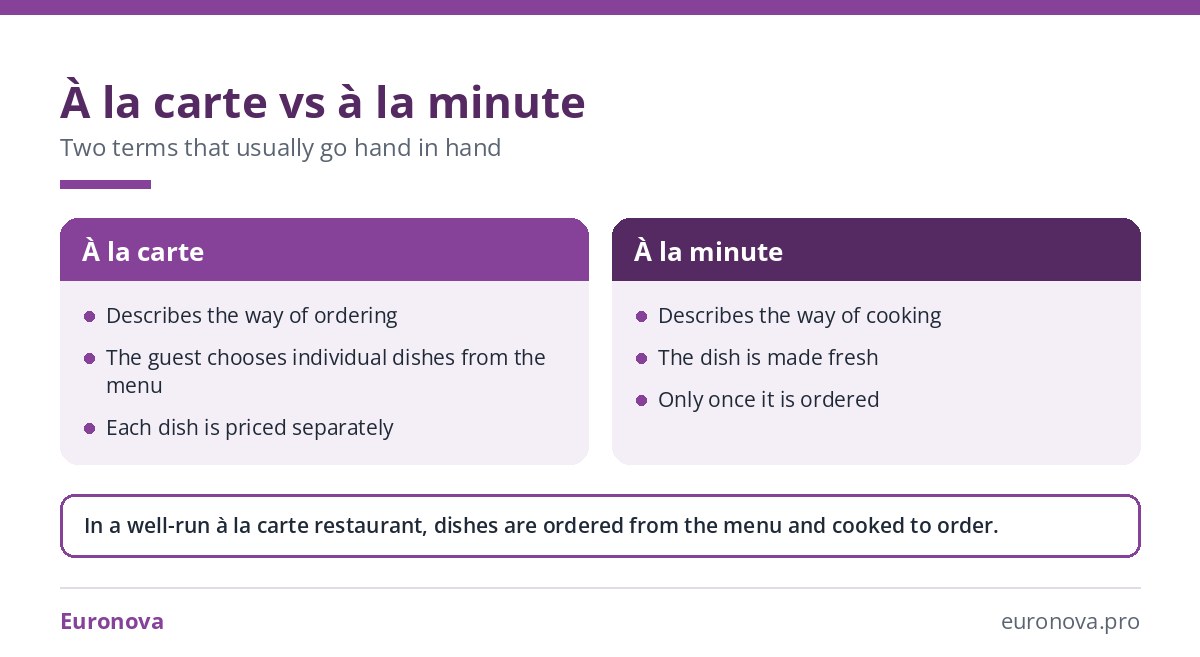
A la carte describes the way of ordering: the guest chooses individual dishes from the menu, each priced separately. A la minute describes the way of cooking: the dish is made fresh, only once it is ordered. In a well-run a la carte restaurant, the two usually go hand in hand.
How long should an a la carte menu be in a new restaurant?
A short menu works better at the start, around 10–15 items per category. It is easier to cost, to train the team on and to organise the mise en place for, and the kitchen and dining room equipment does not grow beyond what you need. Expand the menu later, based on sales and margin data.
Euronova
Let's talk about equipping your business
Write to us if you are looking for equipment for the kitchen, buffet or dining room of your restaurant or hotel.