Commercial Kitchen Equipment Hygiene: Cleaning, Disinfection and Inspection
Equipment hygiene in a commercial kitchen comes down to three things: equipment that can be cleaned thoroughly, a fixed cleaning and disinfection procedure, and a record that the procedure was carried out. EU regulations and official control guidance require food contact surfaces to be in good condition and easy to clean. That is why kitchen hygiene starts when you buy GN containers, chopping boards, knives, pots and a dishwasher, not when you pick up the bucket of detergent. Below you will find the legal requirements in plain language, a step-by-step procedure, a cleaning schedule, tips for individual appliances and a list of what the inspector looks at. At Euronova we equip the kitchens and dining rooms of restaurants, hotels, caterers, schools, nurseries and care homes, so we write from the perspective of a supplier who sees how much the choice of equipment matters. The basis is Regulation (EC) No 852/2004 on the hygiene of foodstuffs. This is an EU act that applies directly in member states without having to be transposed into national law. Its Annex II, in the chapter on equipment, states that all articles, fittings and equipment that come into contact with food must be effectively cleaned and, where necessary, disinfected. They must also be made of such materials and kept in such good order and repair as to minimise any risk of contamination. The same act requires the kitchen, where necessary, to have adequate facilities for cleaning and disinfecting work tools and equipment. The second pillar is HACCP, the Hazard Analysis and Critical Control Points system. Every food business operator must put in place and implement a procedure based on HACCP principles. It covers every stage, from receiving raw materials to serving the meal. This applies to a restaurant, but equally to a school canteen, a hotel kitchen or a caterer. Official controls are carried out by the competent food safety authority in each country. The third element is good hygiene practice: a set of everyday rules on which HACCP rests. These include machinery and equipment, cleaning and disinfection, water supply, waste control, pest control, staff training and hygiene, and documentation. National good hygiene practice guides and your local food safety authority set out the practical rules in more detail. Food contact surfaces must be in good condition, easy to clean and, where necessary, easy to disinfect. In practice this means one thing: equipment hygiene is not just tidying up. The material and condition of the equipment you choose at purchase count too. The procedure below summarises the general principles of good hygiene practice and equipment maintenance instructions. It works for a slicer, a planetary mixer, a work counter and a GN container alike. The last step is the one most often skipped, yet it decides whether all subsequent cleaning makes sense. A groove in a chopping board or a crack in a container holds residue that no detergent can remove. Promptly replacing worn small equipment is part of hygiene, not an extra cost. A cleaning and disinfection schedule describes what is cleaned, when, with what and by whom. Some frequencies follow from the general rules of good hygiene practice. You set the rest based on your own risk analysis and the appliance manufacturer's instructions. The most important moment of the day is switching from handling raw meat, fish or eggs to ready-to-eat products. If the same station does both, it needs a full clean and disinfection in between. The Codex guidelines call this separation by time. Clean the inside of a fridge or cold room once you have emptied it and moved the stock to another unit. Door seals, shelves and the condensate drain need special attention. Order is easier to keep if food is stored in closed containers with lids rather than in open packaging. For cold rooms you will usually also keep a temperature log, which the inspector checks along with the cleaning plan. Clean combi steamers, fryers, tilting pans and griddle plates once they have cooled down. Burnt-on grease is best softened with a warm cleaning solution, because detergent works better at higher temperatures. Pots, casseroles and pans with damaged coatings or warped bases are no longer fit for use. They are hard to clean, and chips can end up in the food. Dismantle slicers, mincers, mixers and planetary mixers as instructed at the end of every job. Wash and dry the working parts, meaning blades, discs and mixing tools, separately. When reassembling, check sharpness and technical condition. Have worn parts sharpened or replace them. A commercial dishwasher with a hot-water rinse cleans and thermally disinfects in one cycle, consistently, no matter who is in the dish area at the time. Take the wash and rinse parameters from the manufacturer's instructions and monitor them on the display. Clean the filters, wash arms and chamber once a day. In the dish area, dirty and clean tableware must never meet on the same counter. For smaller businesses, bars and cafés, the compact Aqua 35 dishwasher is a good fit. Clean knives, boards, ladles, spatulas and pizza tools after every use. Store them dry, in a closed cupboard or on a clean rack, away from the dirty area. Cross-contamination is the transfer of bacteria or allergens from one food to another, most often via equipment, hands or cloths. The Codex Alimentarius General Principles of Food Hygiene recommend separating raw and ready-to-eat areas. This can be a wall, distance, a one-way flow or separation by time with cleaning and disinfection in between. The same document calls for separate, labelled cleaning equipment for food contact areas and other areas. In everyday work, this means a few simple rules: Separating equipment only works if every station has enough of it. A kitchen with one board per shift will sooner or later cut salad where the chicken has just been. Cleaning agents and disinfectants must be correctly labelled, stored in a separate room or cupboard and used only at the concentration and for the contact time stated in the instructions. A solution that is too weak does not work; one that is too strong does not work better, but it can damage surfaces, seals and coatings. You will find the range in the kitchen cleaning products and disinfectants categories. Codex adds three practical tips. First, it makes sense to monitor parameters: water temperature, solution concentration and, in larger businesses, pH. Second, microorganisms can become less sensitive to a particular product over time, so consider rotating products. Third, you can check cleaning effectiveness from time to time with surface swabs, for example for the presence of proteins or allergens. Never mix products. Some agents release toxic gases when mixed. If anyone on the team feels eye or respiratory irritation while working with chemicals, stop work, ventilate the room and check the product's safety data sheet. Official controls of food businesses are carried out by inspectors from the competent food safety authority. Inspections are either scheduled or unannounced, for example following a consumer complaint. So you cannot plan to get the business ready only for an announced visit. For equipment, the inspector usually looks at: A signature in the log alone does not prove the equipment is clean. That is why it makes sense for the shift manager to check the result with their own eyes from time to time: is there residue left in the mincer, are the containers dry and free of film? A simple, realistic schedule that the team actually follows is worth more than an extensive plan that only exists on paper. Most of the rules described start with equipment: separate boards and knives for every area, GN containers with lids, pots and pans in good condition, a dishwasher that rinses with hot water instead of the team. In the Euronova online shop you will find all of this in one place, from porcelain, glassware and cutlery, through cookware, knives and boards, to GN containers, insulated food carriers and HoReCa appliances, at competitive wholesale prices. If your next kitchen check shows that the boards are scratched and there are too few containers to keep raw and ready-to-eat food apart, top up what is missing with a single order, without searching across several suppliers. We supply businesses of very different sizes: a newly opened bistro, a hotel kitchen, a catering company, a nursery canteen and a care home. They all have one thing in common: the best cleaning procedure does not help if the kitchen works with equipment that cannot be cleaned properly, or has too little of it to keep stations separate. That is why, when equipping a kitchen, we advise thinking about hygiene from the very first order. GN containers in one standard go from the cold room to the oven and the pass without decanting. A set of boards and knives for each area solves cross-contamination before anyone has to monitor it. A dishwasher with a hot-water rinse delivers a consistent result regardless of the shift. Regular restocking matters just as much. Worn small equipment is the cheapest cause of inspection problems you can fix. That is exactly why we work to make kitchen and dining room equipment easy to buy in one place, from the first order to every restock after it. Rok Cleaning removes dirt: grease, proteins and food residue. Disinfection reduces the number of microorganisms on a surface that is already clean. A disinfectant does not work effectively on a dirty counter, so the order is always the same: first clean and rinse, then disinfect. A dishwasher with a hot-water rinse cleans and thermally disinfects tableware in one cycle, provided it reaches the parameters stated by the manufacturer. The conditions are regular cleaning of the filters and wash arms and correctly chosen chemicals. Record each wash in the log just like any other task on the schedule. Clean reusable containers after every use. After each food transport, clean the inside of insulated food carriers, disinfect them and let them dry before closing them. Replace containers with scratches or cracks, because they trap residue. The technical condition of the equipment, separation of raw and ready-to-eat areas, the cleaning schedule and cleaning log, the cold room temperature log, and how cleaning chemicals are stored and used. The inspector also looks at hard-to-reach places such as the extractor hood and the space under appliances. Yes. Every food business operator, including a small café or a canteen, must put in place a procedure based on HACCP principles. The scope of the documentation should match the size and nature of the business.Commercial Kitchen Equipment Hygiene: Cleaning, Disinfection and Inspection

In brief
Contents
What the regulations say about equipment hygiene
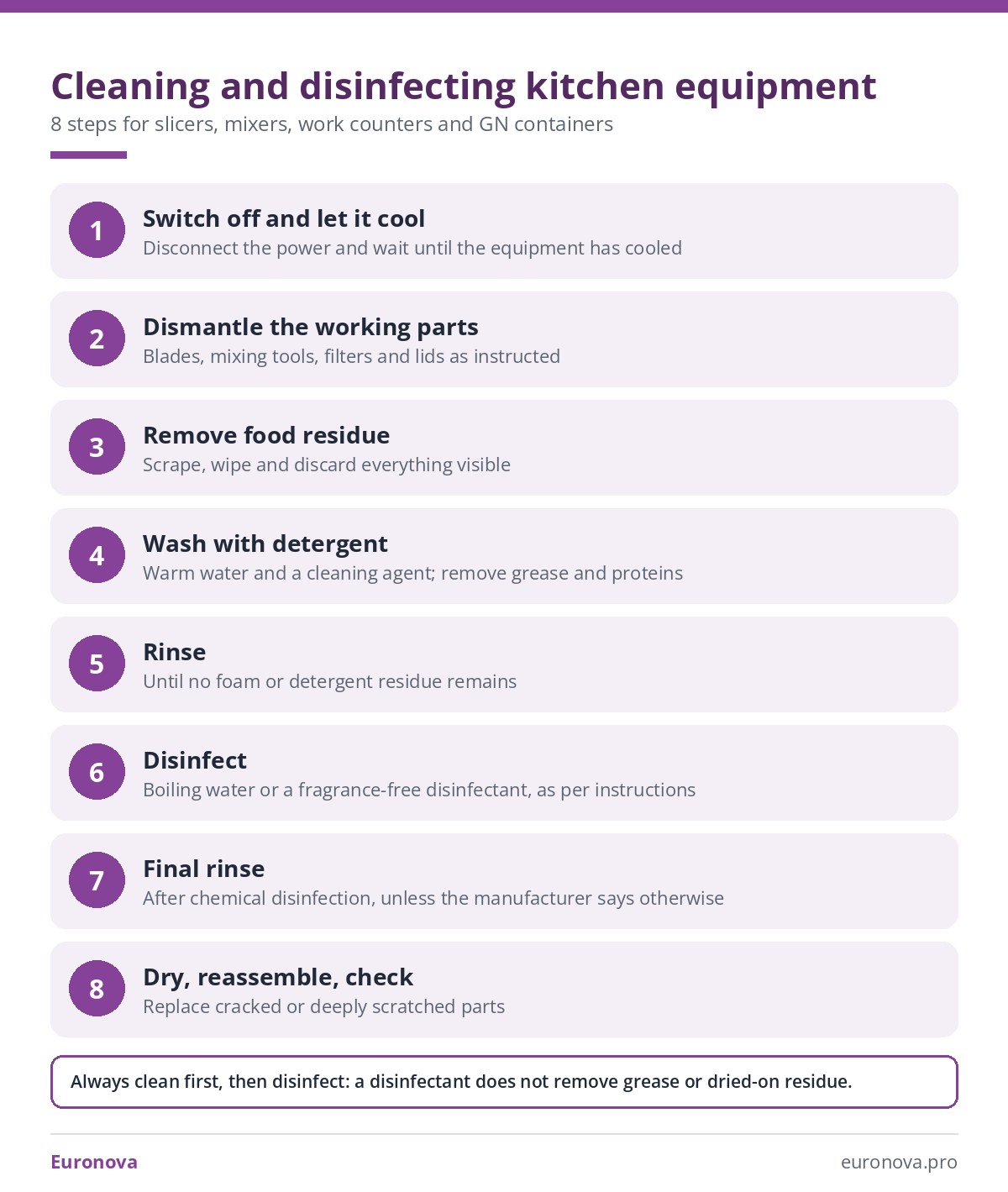
Cleaning and disinfection step by step
How often to clean: a kitchen cleaning schedule
Item
Minimum frequency
Notes
Food preparation equipment and surfaces
after every use and before reuse
also when switching from raw to ready-to-eat products
Reusable containers
after every use
applies to GN containers and insulated food carriers, among others
Cloths
cleaning and disinfection at least once a day
separate cloths for food and non-food areas
Containers for flour, sugar and dry goods
emptying and cleaning at least once a month
before topping up with a new batch
Extractor hood canopy
regularly, according to your schedule
filters as per the manufacturer's instructions
Refrigeration, heating appliances, machines
according to your schedule and the manufacturer's instructions
entry in the cleaning log
Appliance by appliance: what to watch out for
Refrigeration equipment
Cooking equipment
Food processing machines

Dishwasher and dish area
Small equipment
How to prevent cross-contamination between stations
Cleaning agents and disinfectants
Documentation and food safety inspections
Equipment that is easy to keep clean

Our view: hygiene starts at purchase
Frequently asked questions
What is the difference between cleaning and disinfection?
Is a commercial dishwasher enough to disinfect tableware?
How often do GN containers and insulated food carriers need to be cleaned?
What does a food safety inspector check on equipment?
Does every food business need HACCP?
Sources
Recommended