Commercial kitchen equipment: what to buy and how to choose it
Commercial kitchen equipment: what to buy and how to choose it
Equipping a commercial kitchen starts with the menu, not with an appliance catalogue. First decide what you will prepare and in what quantities, then divide the kitchen into zones (storage, preparation, cooking, service, dishwashing), and only then choose equipment, cookware and utensils for each zone. Below you will find a list of what a professional kitchen really needs, how to split purchases into opening and later buys, the hygiene requirements inspectors check, and the mistakes that cost restaurant owners the most.
Euronova
Equip your kitchen to suit your menu
Find equipment for your professional kitchen, from catering appliances and GN containers to pots, knives and utensils.
The same floor space can be equipped in a hundred ways, so the first question is: what will you cook and for how many people? As a guide to choosing catering equipment points out, fast food requires fast, high-output appliances, while fine dining requires precise ovens. A burger bar will rely on a contact grill, griddle and fryer. A bistro serving daily lunches will depend on a range and large stockpots. A restaurant with a tasting menu will invest in a combi steamer and precision cooking equipment.
Before you order anything, write down three figures:
Number of seats and table turns at peak time. This tells you how many portions you need to serve in an hour.
Number of dishes on the menu and cooking techniques. Each technique (frying, baking, sous-vide, steaming) means a separate appliance or a separate programme on a multifunction unit.
Sales channels. Dining room, takeaway, delivery, catering and banqueting each require different back-up: packaging, insulated food carriers, transport containers.
These three figures let you choose appliance output, cold room capacity and the number of tableware sets. Without them, it is easy to buy too much for one zone and too little for another.
Kitchen zones and their equipment
A professional kitchen works like a line: goods come in on one side, finished dishes leave on the other, and dirty tableware returns by a separate route. The table below lists the basic equipment for each zone.
Zone
Appliances
Cookware and utensils
Goods-in and storage
refrigerated cabinets and counters, freezer cabinets, shelving
GN containers with lids, storage containers, date labels
Preparation
stainless steel work tables, food processors, slicers, mixers
professional knives, colour-coded chopping boards, bowls, scales
Cooking
gas or electric range, combi steamer, contact grill, fryer, salamander
hood-type or conveyor dishwasher, washing-up sink, tabling
dishwasher racks, dosing units, detergents
Goods-in and storage
This is where food safety begins. You need refrigeration matched to your volume: in a smaller outlet, refrigerated cabinets and counters are enough, while a larger kitchen needs a walk-in cold room. Add shelving, lidded containers and a labelling system. A label with the opening date and stock rotation on a “first in, first out” basis reduce waste and make ordering easier to plan.
Preparation
Stainless steel tables, chopping boards in different colours for raw meat, fish, vegetables and ready-to-eat foods, a set of knives, bowls and scales. A food processor and slicer shorten prep time, but choose them according to your actual quantities: if you cut a few kilograms of vegetables a day, a powerful industrial machine will mostly stand idle.
Cooking
According to an overview of catering cooking equipment, the core consists of gas and electric ranges, combi steamers, contact grills, fryers, salamanders and bain-maries. The combi steamer is the most versatile: it bakes, braises, steams and regenerates food, so in many outlets it replaces several separate appliances. Alongside these is the cookware that works every day: heavy-based stockpots, casseroles, frying pans, lids and baking trays. In a professional kitchen they must withstand intensive washing, which is why stainless steel is the standard.
Service
The service zone links the kitchen to the dining room. A bain-marie keeps sauces and sides at temperature, and heat lamps stop plates from cooling. Standard-size GN containers are useful here, going from the fridge to the oven and into the bain-marie without transferring food. In the dining room, tableware counts: flat and deep plates, bowls, cups, glasses and cutlery in quantities that cover the peak plus the dishwashing cycle.
Dishwashing
This is the zone most often underestimated, yet the pace of the whole dining room depends on it. A high-capacity hood-type or conveyor dishwasher can handle hundreds of items an hour. A smaller outlet will manage with an undercounter dishwasher, but you need to work out how many plates, glasses and cutlery are in circulation at peak time. If the dishwasher cannot keep up, you need more tableware in circulation or a more powerful machine.
Kitchens in canteens, hotels and catering
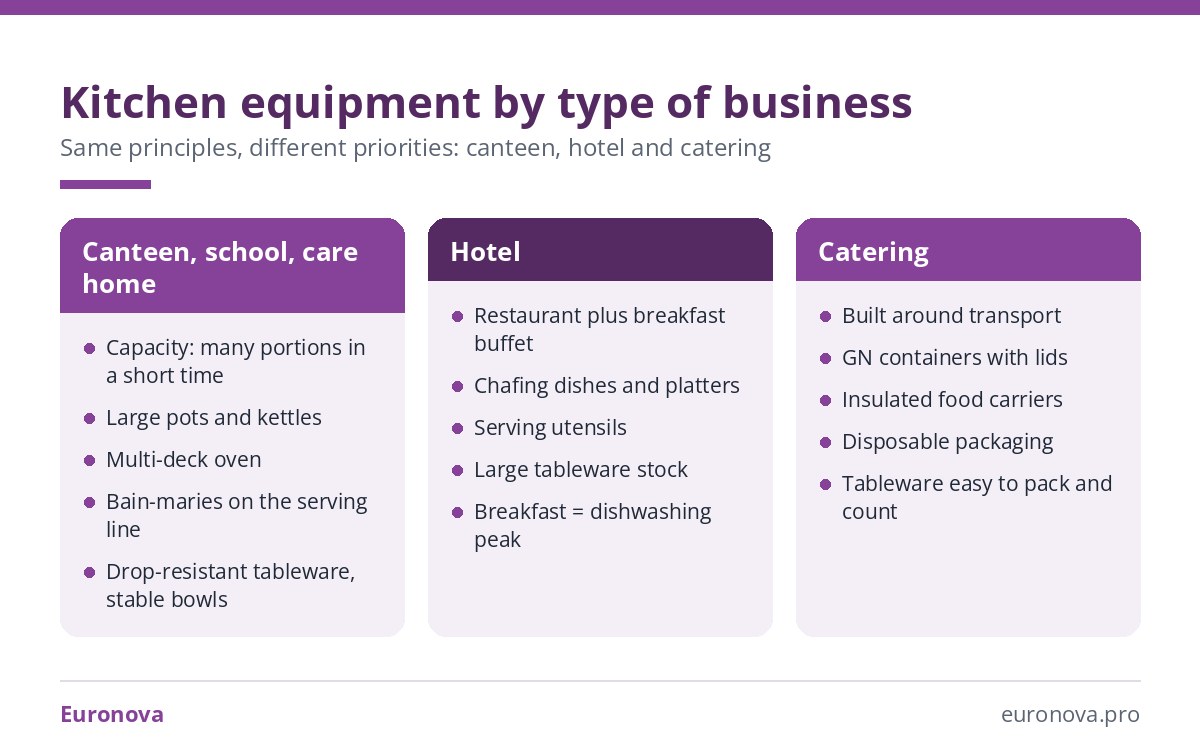
The principles are the same, but the priorities differ. A school kitchen, nursery or care home serves many portions in a short time, so capacity counts: large pots and kettles, a multi-deck oven, bain-maries on the serving line and drop-resistant tableware. In nurseries and care homes, hard-to-break tableware and cups and bowls with a stable base work well.
A hotel combines a restaurant with a breakfast buffet. It needs chafing dishes, platters, serving utensils and a large tableware stock, as breakfast is the peak load for the dishwashing area. Catering lives on transport: GN containers with lids, insulated food carriers that hold temperature, disposable packaging and tableware that is easy to pack and count after the event.
What to buy for opening and what can wait
Opening a restaurant swallows a lot of money, so it makes sense to split purchases into two waves. For opening you need everything without which you cannot safely serve a single dish. The rest you can add once you see which dishes on the menu sell best.
Buy before opening
Can be added later
refrigeration and freezing matched to your stock
an additional cold room
basic cooking equipment for your menu
specialised machines (vacuum packer, blast chiller, pasta machine)
dishwasher and washing-up sink
a second glasswasher behind the bar
work tables, chopping boards, knives, pots, pans
an extended set of bakeware and pastry equipment
plates, glasses and cutlery with a reserve for breakages
decorative tableware for seasonal menus
GN containers, storage containers, labels
insulated food carriers and catering equipment once you start delivering
hand-wash basins, soap dispensers, detergents
spare utensils for replacement
For tableware, plan a reserve above the number of seats. Plates go into the dishwasher, some break, some wait at the pass. Better to have a few extra sets than to wait on a Friday evening for a clean batch to come back.
Hygiene requirements for a commercial kitchen
Equipment is not just a matter of convenience. A restaurant is a food business, and the food business operator must register it with the competent food safety authority before starting operations. Inspectors then check whether the layout and equipment allow hygienic working. The basic requirements come from Regulation (EC) No 852/2004 on the hygiene of foodstuffs, which requires, among other things:
food-contact surfaces that are easy to clean,
adequate ventilation,
hand-wash basins with hot and cold running water,
separation of clean and dirty routes,
toilet facilities for staff.
The regulation also states that toilets must not open directly into rooms where food is handled, and that wash basins must have materials for washing hands and hygienic drying. In practice, this means a soap dispenser, a paper towel dispenser and a separate hand-wash basin are just as much a mandatory part of the equipment as the range.
The second part is procedures based on HACCP principles: fridge temperature records, cleaning checklists and a goods-in procedure. For smaller businesses the rules allow for proportionality, as the system must suit the type and size of the business. National guides to good hygiene practice for food service, prepared by industry associations, can help you here.
Before ordering expensive equipment, it is worth checking the kitchen layout and equipment list with a catering design specialist and your local food safety authority. Moving the dishwashing area or adding a hand-wash basin after installation costs far more than a correction on paper.
How much kitchen equipment costs and what drives the budget
There is no single figure, as a takeaway coffee shop and a 100-seat restaurant are completely different investments. The budget depends above all on the type of outlet and only then on floor area. Most of it goes on cooking and refrigeration equipment and dishwashing; less goes on smallwares, which are bought in large quantities and topped up regularly.
Costs are affected by:
Kitchen technology. A combi steamer is expensive but can replace several appliances and free up space.
Utilities. Gas or electricity, connection capacity, ventilation and the extraction hood often cost as much as part of the equipment.
Running costs.When buying, consider not only the price but also electricity, water and detergent bills, the energy class and the availability of service and spare parts.
New or used equipment. Used equipment can be cheaper but carries the risk of no warranty and an uncertain history. With refrigeration and dishwashers, a breakdown mid-season can cost more than you saved.
Smallwares. Plates, glasses, cutlery, containers and disposables are recurring items. Here, buying at wholesale prices from a single supplier pays off most.
The most sensible approach is a spreadsheet with three columns: purchase price, monthly running cost and service cost. This shows that a cheaper appliance is not necessarily cheaper after two years.
Most common mistakes when equipping a restaurant
Industry experience shows a few recurring pitfalls:
Buying before planning the space. An appliance that does not fit the workflow blocks a passage or stands next to the wrong connection.
Equipment “just in case”. A large fryer in an outlet selling a few portions of chips a day wastes oil and electricity.
Too little tableware. Owners count plates per seat and forget the dishwashing cycle and breakages.
No standardisation. Containers from different systems do not fit the bain-marie, oven and refrigerated cabinet. The GN standard solves this problem.
Forgetting service. Before buying a large appliance, check who will repair it in your area and how quickly you can get spare parts.
Buying from many suppliers at once. Every restock then means more orders, more deliveries and more invoices.
Our view on kitchen equipment
Every day we equip restaurants, hotels, bars, pizzerias, cafés and caterers, as well as kitchens in schools, nurseries and care homes. We see that when a restaurant opens, all the attention goes on the big appliances, while plates, containers and utensils end up at the bottom of the list and are bought in a rush the week before opening. Yet these are the items that work every minute of service, and the ones we top up most often.
So we recommend two things. First, choose one GN container system and one plate range that you can easily reorder after a year, when some of the plates have broken. Second, choose one supplier for smallwares, where you order plates, glasses, cutlery, pots, knives, containers and disposables in one basket. With every subsequent restock this saves time, which in food service is always worth its weight in gold. We continually adapt our range to changes in the food service market, as our customers run both newly opened outlets and long-established businesses.
For the bar, terrace and outdoor events, polycarbonate glasses work well, for example the Prisma glass 38 cl. If you are preparing a banquet or catering event and do not want to buy tableware for a single occasion, you can use our plate, glass and cutlery hire: the price is per item per day, a deposit is payable on hire, and collection is in Ljubljana or, by arrangement, at one of our branches.
Frequently asked questions
What is the basic equipment for a restaurant kitchen?
The basics are refrigeration, cooking equipment chosen to suit the menu, a dishwasher with a washing-up sink, stainless steel work tables and a hand-wash basin. Add pots, pans, knives, chopping boards, GN containers, and plates, glasses and cutlery with a reserve. Specialised machines can be added later.
Is domestic equipment suitable for a commercial kitchen?
Not for daily use. Domestic appliances are not built for running many hours a day or for intensive washing, and surfaces in contact with food must be easy to clean. Professional equipment also comes with service and spare parts available for years.
How many sets of tableware does a restaurant need?
More than it has seats. Count the guests at peak time, add the tableware that is in the dishwasher at that moment and a reserve for breakages. The slower the dishwashing, the more tableware needs to be in circulation.
Do I need a kitchen layout plan before buying equipment?
A kitchen layout plan shows the arrangement of zones, clean and dirty routes and the position of connections. It is advisable to have one before ordering larger appliances, as alterations after installation are expensive. Before starting operations, you must register your food business with the competent food safety authority, which can also explain the requirements for your premises.