GN Containers with Lids: Sizes, Lid Types, Stainless Steel
GN Containers with Lids: Sizes, Lid Types, Stainless Steel
A GN container with lid is the workhorse of every commercial kitchen. One and the same container is used for prep, chilling, cooking, hot holding, display and transport, and thanks to the Gastronorm standard it fits the fridge, the combi oven, the bain-marie and the buffet counter. For this to work, three things have to match: the right GN size, a depth that suits the job, and a lid that suits the use. We show you how to choose all three with confidence, why stainless steel is the first choice for most operations, and how to keep your containers in good condition for years.
Euronova
The right GN equipment for your kitchen
Euronova supplies catering equipment for commercial kitchens, including cookware, professional kitchen utensils and products for food storage and transport.
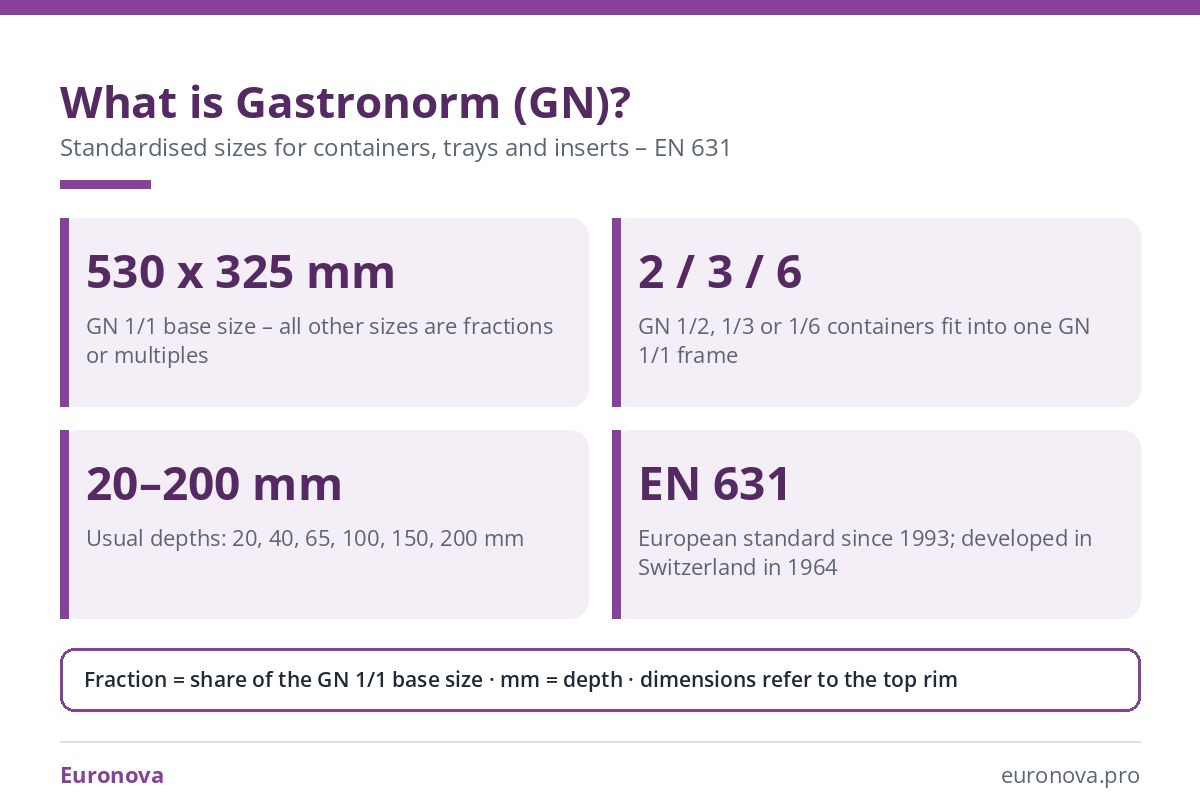
GN stands for Gastronorm, a standardised sizing system. The GN 1/1 base size measures 530 x 325 mm; all other sizes are fractions or multiples of it.
Depth determines use: 20 and 40 mm for cold dishes and garnishes, 65 and 100 mm for buffets and cooking, 150 and 200 mm for soups, sauces and large batches.
The lid follows the task: a flat lid for covering and stacking, a notched lid for a ladle when serving, a sealed lid for storage and transport.
Stainless steel is heat-resistant, durable and suitable for ovens and combi ovens. Plastic comes into its own mainly for chilling and seeing the contents at a glance.
Care: no steel wool, no abrasive cleaners, rinse chlorine-based products off thoroughly.
GN is short for Gastro-Norm, commonly called Gastronorm. The system defines the footprints of containers, baking trays and inserts so that they fit any compatible appliance and counter. According to the information sheet from the Swiss association for hospital, care-home and contract catering, the standard makes it easy to exchange food containers in large kitchens and food processing operations. It was developed on 17 November 1964 in Switzerland, with the association working together with the Swiss hoteliers' association and large food service providers.
So are GN containers standardised? Yes. In Europe, Gastronorm has been laid down since 1993 as European standard EN 631, which is adopted as a national standard across Europe. For you as a buyer, this means a GN 1/2 container from one manufacturer will in principle fit the bain-marie or refrigerated counter of another. Where things still don't fit, it is almost always down to details such as rim shape, stacking lugs or the lid flange. We come back to this under lid fit.
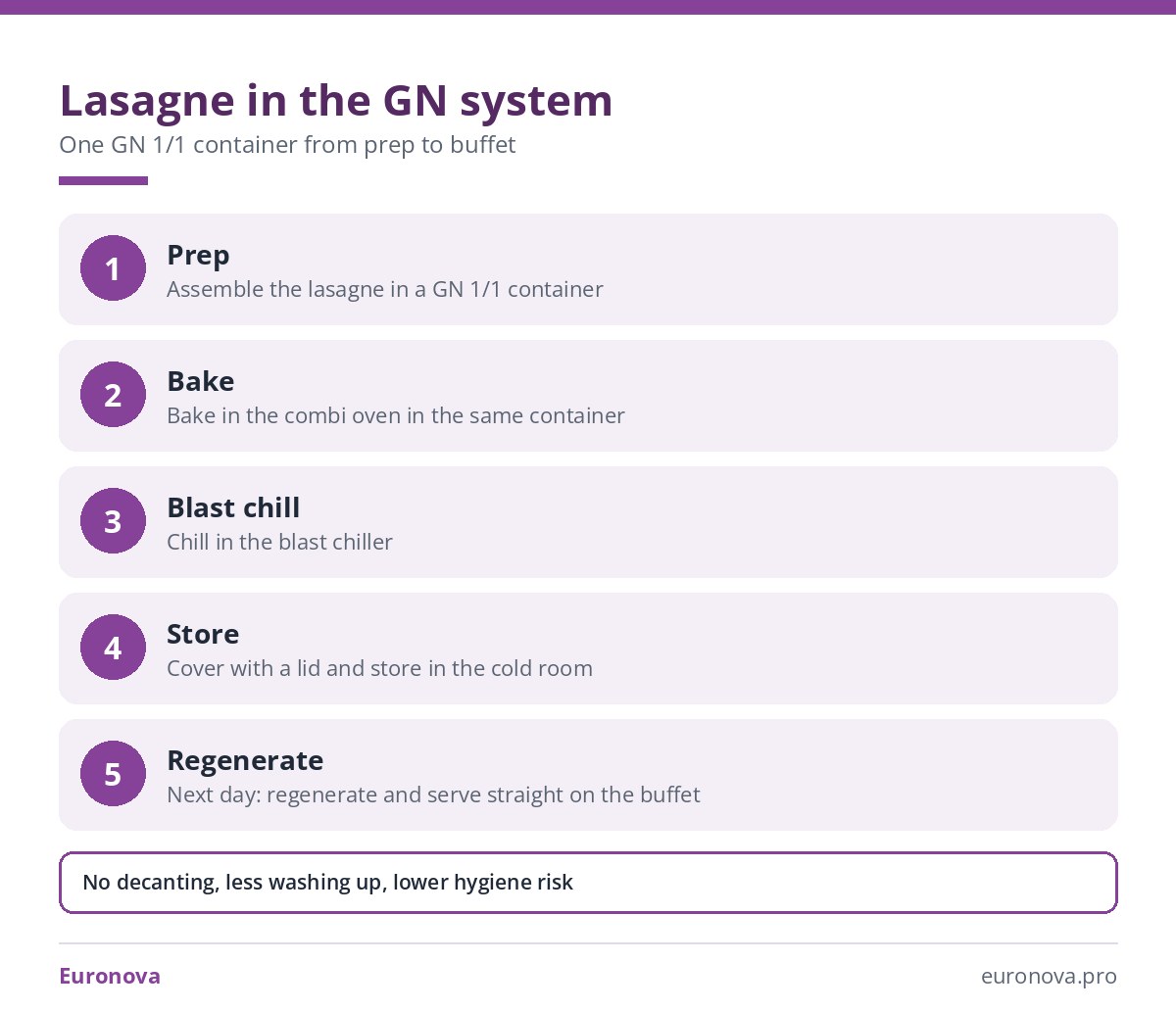
In practice, the standard above all means speed. You prepare lasagne in a GN 1/1 container, bake it in the combi oven, chill it in the blast chiller, store it covered in the cold room and regenerate it the next day straight on the buffet. No decanting, less washing up, lower hygiene risk.
Sizes and depths at a glance
All sizes are derived from the GN 1/1 base size. The overview below lists the common formats according to the Gastronorm size chart and shows how many containers fit into a 1/1 frame.
GN size
Dimensions in mm
Fit in GN 1/1
Typical use
GN 2/1
650 x 530
equals 2 x 1/1
large kitchens, transport trolleys, large quantities
GN 1/1
530 x 325
1
oven, combi oven, main dishes on the buffet
GN 2/3
355 x 325
1 x 2/3 + 1 x 1/3
side dishes, combined with 1/3
GN 2/4
530 x 162
2
long, narrow counters, salad bar
GN 1/2
325 x 265
2
buffet, hot holding, mise en place
GN 1/3
325 x 176
3
pizza prep counter, side dishes
GN 1/4
265 x 162
4
sauces, toppings, dressings
GN 1/6
176 x 162
6
sandwich station, herbs, garnishes
GN 1/9
176 x 108
9
spices, small-quantity ingredients
How big is GN 1/1? The base size is 530 x 325 mm. Standard dimensions refer to the top rim, i.e. the size at which the container sits in the appliance or counter. The actual interior is slightly smaller because of the tapered sides.
Which depth for what
According to the Gastronorm information sheet, GN containers are usually made in depths of 20, 40, 65, 100, 150 and 200 mm. Each depth has its place:
20 mm: cold cuts, cheese, garnishes, desserts for service. A GN 1/4 container, 20 mm deep, is ideal for herbs or toppings at the serving station.
40 mm: fish, gratins, pastries, roasting meat. A GN 1/1 container, 40 mm deep, is the classic tray for ovens and combi ovens.
65 mm: an all-round depth for vegetables, rice, potatoes and bakes.
A rule of thumb from kitchen practice: the shallower the container, the faster food cools down and heats up. For rapid cooling after cooking, shallow containers are therefore usually a better choice than a deep pot full of ragu.
Which lid types exist and when you need which
A lid turns an open container into a system for storage, transport and serving. When buying, focus above all on what you will use the container for most.
Lid type
Advantages
Limitations
Ideal for
Flat stainless steel lid
durable, stackable, heat-resistant
not airtight
covering in the cold room, hot holding
Lid with ladle notch
ladle stays in the container, lid stays closed
not for storage and transport
bain-marie, buffet, serving
Sealed lid (with gasket)
closes tightly, protects against drying out and odours
gasket needs care, limited heat resistance
storage, marinating, transport
Hinged or flip lid
one-handed opening, lid isn't left lying around
more expensive, more parts to clean
guest-facing buffets, front cooking
Plastic lid
lightweight, often transparent
not for ovens and combi ovens
chilling, mise en place
For most operations, a combination has proved its worth: sealed lids for everything that stays in the cold room for longer or is transported, and notched lids for serving. A GN 2/3 sealed lid, for example, is the right addition if you are fitting out a refrigerated counter with 2/3 and 1/3 inserts.
A note on sealed lids: silicone or rubber gaskets are generally not designed for the oven. The manufacturer states how high the temperature may be. So bake with a flat lid or without one, and fit the sealed lid only once the food has cooled.
Lid fit: what to look out for
The same size is a must: a 1/3 lid goes on a 1/3 container. Depth does not matter for the lid, as it rests on the rim.
Check the rim shape: manufacturers shape the container rim differently. A sealed lid seals most reliably on a container from the same range. If you buy mixed brands, order a test lid first.
Think about stacking: flat lids without a raised handle are easier to stack in the cold room. Check whether containers and lids are designed for this.
Handles and serving: lids with a recessed handle lie flatter, while lids with a fitted handle are easier to grip with gloves.
Stainless steel or plastic
If you are looking for stainless steel GN containers, you are right for most tasks. Stainless steel copes with the oven, combi oven and bain-marie, is taste-neutral, does not absorb odours and lasts for years in the dishwasher. Most of what is on the market is chrome-nickel steel, often labelled CNS or 18/10. Then there is the look: a gleaming stainless steel container on the buffet looks professional and suits almost any counter.
Plastic containers, mainly polycarbonate or polypropylene, have other advantages. Clear versions show at a glance what is inside and how much, and they are lighter. They are generally not intended for oven baking. Many kitchens therefore combine the two: stainless steel for anything involving heat, plastic for purely cold storage.
Criterion
Stainless steel
Plastic
Oven and combi oven
yes
generally no
Hot holding in a bain-marie
yes
only if heat resistance is specified
Seeing the contents
no
yes, with clear models
Weight
heavier
lighter
Service life with proper care
very long
shorter, scratches and clouding possible
Look on the buffet
high quality
better suited to back of house
Kitchen use: storing, cooking, baking, serving
Can you bake in a GN container? Yes, stainless steel containers can go in convection ovens, combi ovens and conventional ovens. Shallow depths of 20 to 65 mm suit tray bakes, bakes, gratins, roast vegetables and roasts. For pastries and bread, GN baking trays are also available alongside containers, flat and some with a non-stick coating. Perforated containers are the right choice for steaming vegetables, potatoes or fish, as the steam reaches the food from all sides.
Typical uses in the operations that buy from us:
Restaurant and hotel: mise en place in 1/6 and 1/9 at the station, sauces in a deep 1/4, main dishes in 1/1 straight from the combi oven to the breakfast or banquet buffet.
Pizzeria: toppings in 1/3, 1/6 and 1/9 in the refrigerated prep counter, into the cold room with a lid at night, back to the station in the morning without decanting.
Catering: food is prepared in 1/1, transported under a sealed lid in an insulated food carrier and served from a chafing dish. One container, three stations.
Schools, nurseries, care homes: portioned quantities in 1/2 or 1/1, covered in transport trolleys so food arrives on the ward hot and covered.
A practical example
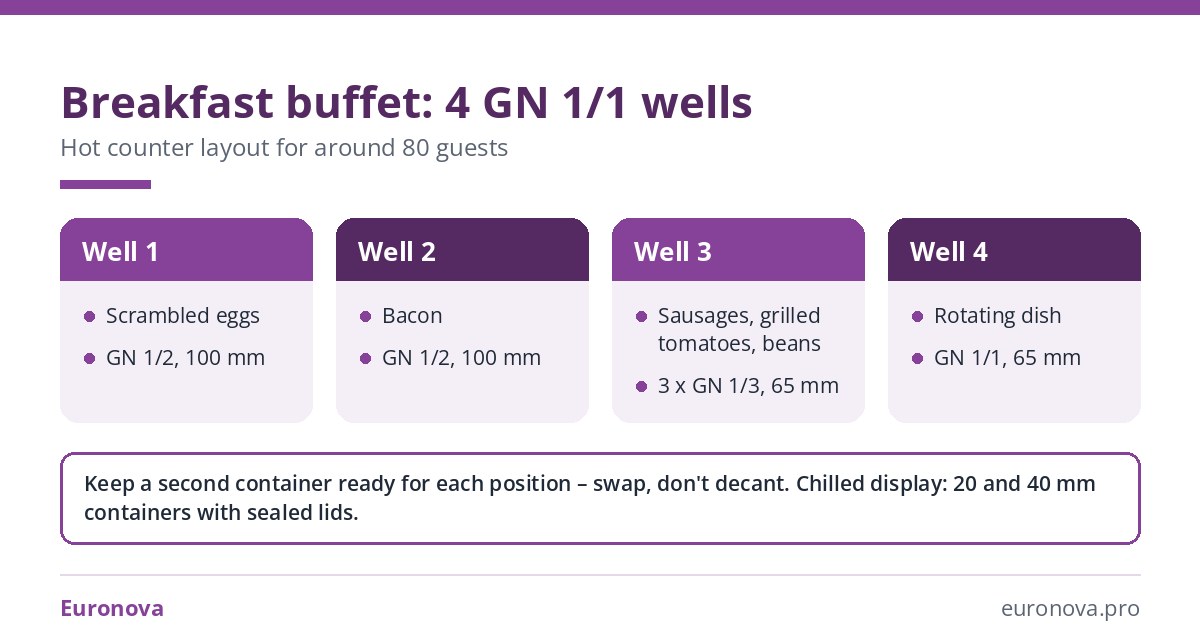
Take a hotel with a breakfast buffet for around 80 guests and a hot counter with four GN 1/1 wells. A proven layout looks like this: scrambled eggs and bacon each in a GN 1/2, 100 mm deep, two wells in total. Sausages and grilled tomatoes in GN 1/3, 65 mm deep, one well with three containers including beans. One well remains for a rotating dish in a GN 1/1, 65 mm deep. Keep a second container ready for each position so you swap containers when replenishing instead of decanting. In the chilled display cabinets there are also shallow 20 and 40 mm containers with sealed lids for cold cuts, cheese and fruit.
So when ordering, don't just count the counter positions, but also the reserve stock and the containers that are in the dish room at any given moment. In many operations, double the counter capacity is a realistic starting point.
Use soft cleaning tools: sponges and cloths instead of steel wool. Abrasive cleaners and wire brushes not made of stainless steel can damage the surface.
Avoid contact with ordinary iron: particles of carbon steel, for example from wire brushes, can damage the protective passive layer and trigger local corrosion. So don't store stainless steel containers in direct contact with rusting tools.
Take chlorides seriously: according to the centre, chloride ions are the most common cause of pitting corrosion. Brines, very salty food and chlorine-based cleaners should not stand in the container for hours; thorough rinsing is a must.
Rinse off disinfectants: products with oxidising agents or quaternary ammonium compounds can attack stainless steel. Observe the contact time stated by the manufacturer, then rinse thoroughly with clean water.
Sealed lids need special attention: if the gasket is removable, take it out regularly and clean the groove, otherwise residue builds up there. A cracked or hardened gasket no longer seals reliably and must be replaced.
Our view: fewer formats, more system
In conversations with head chefs and purchasing departments, we keep seeing the same pattern: over the years, containers pile up in many sizes and depths from different manufacturers, and in the end no lid fits the container you need right now. That is why we recommend starting with a lean core range. For most restaurants, GN 1/1, 1/2, 1/3 and 1/6 in two to three depths are enough, supplemented by 2/3 or 1/4 where the counter calls for it.
We always plan the lid together with the container. If you buy containers without lids, you will soon be covering them with cling film in the cold room, which costs time, material and ultimately freshness. For sealed lids, we recommend containers and lids from the same range so that they match. And one more point from practice: it is better to place one targeted larger order than to keep topping up with individual pieces. That way your stock stays uniform and you save on delivery too.
— Rok
GN containers and lids from Euronova
In our online shop for the food service trade you will find stainless steel GN containers in various sizes and depths with matching sealed lids, as well as cookware, kitchen utensils and products for food storage and transport. This lets you put together your Gastronorm system in a single order, from a shallow 1/4 for garnishes to a deep 1/2 for soups.
GN stands for Gastro-Norm or Gastronorm, the sizing system for containers, baking trays and inserts used in food service. The fraction, for example 1/3, shows what share of the GN 1/1 base size the container takes up. The number in millimetres is the depth.
How big is a GN 1/1 container?
The GN 1/1 base size is 530 x 325 mm. That footprint holds, for example, two GN 1/2, three GN 1/3 or six GN 1/6 containers. Depths usually range from 20 to 200 mm.
Does every GN lid fit every GN container?
The base sizes are standardised, so a 1/2 lid will in principle fit a 1/2 container. However, rim shape and lid flange vary between manufacturers. For sealed lids, it is best to buy the container and lid from the same range.
Can stainless steel GN containers go in the dishwasher?
Yes, stainless steel containers are suitable for commercial dishwashers. Use detergents without abrasive particles and rinse off chlorine-based products and disinfectants thoroughly. On sealed lids, clean the gasket groove by hand regularly.
Are sealed lids ovenproof?
As a rule, no, because silicone or rubber gaskets have only limited heat resistance. The manufacturer states the permitted temperature. Bake without a lid or with a flat stainless steel lid, and fit the sealed lid only once the food has cooled.