Wine Glasses for Restaurants and Bars: Shapes, Fill Lines, Buying Guide
Wine Glasses for Restaurants and Bars: Shapes, Fill Lines, Buying Guide
Wine glasses for restaurants and bars have to do more than look good in the cupboard. They must present the wine properly, survive hundreds of wash cycles, fit your shelves and glass racks and, when wine is served by the glass, carry the fill line required by weights and measures rules. In this article you will learn which glass shapes a venue really needs, what to look for in material and stem, when a fill line is mandatory, how many glasses to plan for and how to reduce breakage in day-to-day service.
Euronova
euronova.pro
The right wine glasses for service
Euronova supplies professional glassware and catering equipment for restaurants, hotels, bars and other food service operations.
Most venues manage with two to three glass shapes: a universal or white wine glass, a larger red wine glass and a sparkling wine glass. Specialist shapes only pay off with a serious wine list.
If you serve wine by the glass and sell it by volume (e.g. 0.1 l or 0.2 l), the glass must have a fill line marked with the nominal volume.
In daily service, costs are driven by dishwasher resistance, break resistance and how well glasses stack and store, not by the price per piece.
Plan a reserve: glasses are on the tables, in the dishwasher and in the store room at the same time.
For terraces, pools and events, reusable plastic glasses with a fill line are a safe alternative to glass.
The world of wine knows dozens of glass shapes. For a restaurant or bar, however, what counts is what the guest notices at the table and what the staff can handle in service. Every additional shape means more storage space, more reordering and more room for mistakes when laying tables.
The universal glass as the backbone
A good universal glass has a medium-sized, tulip-shaped bowl that narrows slightly towards the top. This concentrates the aromas, and the wine can be swirled without spilling. Practice shows this is no stopgap: according to the wine tasting guide of the German state of Rhineland-Palatinate, universal glasses are also used at professional tastings because they combine the requirements for shape, stem length and material. For bistros, hotel banquets, cafés and pizzerias, a single universal glass is often the most economical choice.
Red wine glasses: Bordeaux and Burgundy
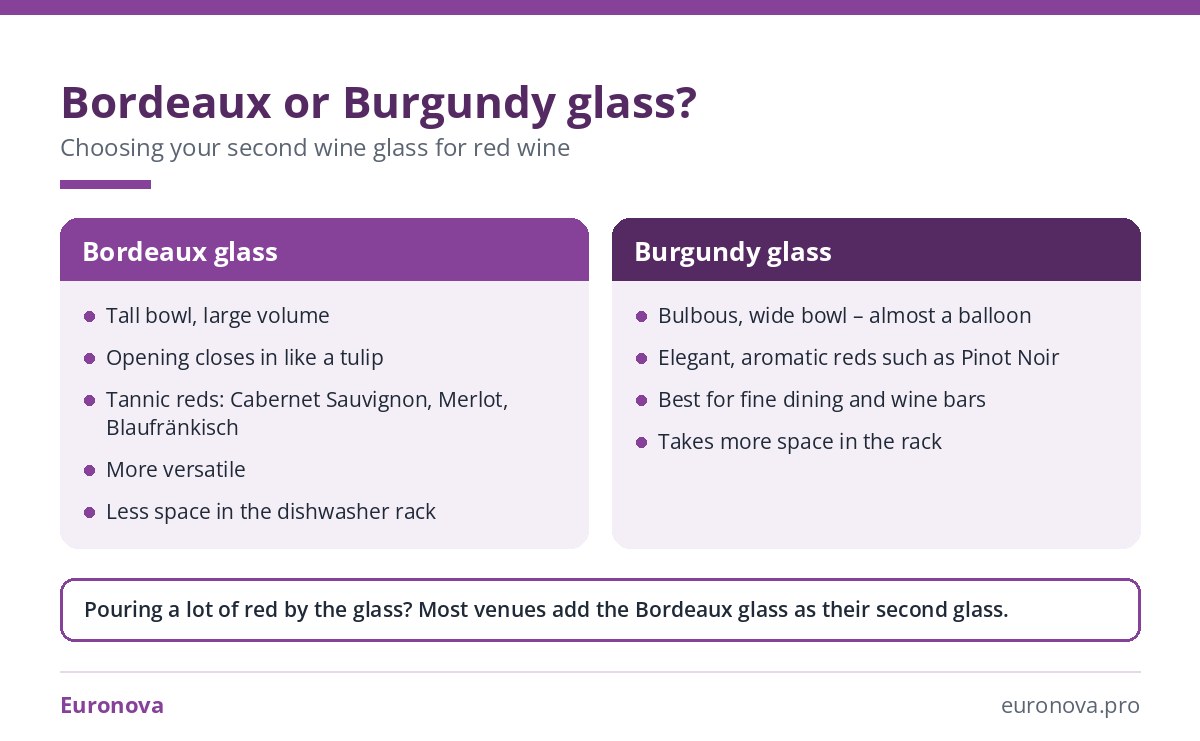
Red wine glasses are larger because full-bodied reds need air. The Bordeaux glass is tall and large in volume, with an opening that closes in like a tulip. It suits tannic wines such as Cabernet Sauvignon, Merlot or a full-bodied Blaufränkisch. The Burgundy glass is bulbous and wide, almost a balloon. It brings out elegant, aromatic reds such as Pinot Noir. If you pour a lot of red wine by the glass, add one of the two shapes as your second glass, most often the Bordeaux, because it is more versatile and takes up less space in the dishwasher rack than the balloon.
White wine and rosé glasses
White wine glasses are smaller and slimmer. The smaller surface keeps the wine cool for longer. For fresh, mineral wines such as Sauvignon Blanc or Welschriesling, an elongated bowl with a narrow opening is ideal. Oak-aged whites, such as a mature Chardonnay or Ribolla, can take a wider bowl. In practice, rosé is usually served in a white wine glass; only venues that actively market rosé as a highlight of their offer need a dedicated rosé glass.
Sparkling wine, dessert wine and spritzer
For sparkling wine, prosecco and champagne, the classic flute is still widespread because it shows off the bubbles nicely and is quick to pour at banquets. Many sommeliers, however, now prefer to serve quality sparkling wines in a white wine glass or a universal glass so the aromas can develop. Dessert and fortified wines such as port or a Beerenauslese-style sweet wine go into small glasses because the serving is small. A wine spritzer, a staple in many bars and taverns, is usually served in a stemless glass or a tumbler.
Glass shape
Bowl
Typical wines
Best for
Universal glass
medium-sized, tulip-shaped
almost all still and sparkling wines
every venue as the basic glass
Bordeaux glass
tall, large volume
full-bodied, tannic reds
restaurants with a range of red wines
Burgundy glass
bulbous, wide
Pinot Noir, aromatic reds
fine dining, wine bars
White wine glass
slim, smaller opening
Sauvignon Blanc, Riesling, Ribolla, rosé
venues serving white wine by the glass
Sparkling wine flute
narrow, tall
sparkling wine, prosecco, champagne
banquets, hotels, receptions
Dessert wine glass
small
port, Beerenauslese-style sweet wines
restaurants with a dessert menu
Stemless glass or tumbler
no stem, robust
spritzer, house wine by the glass
wine taverns, inns, agritourism farms, festivals
Choosing glasses by type of venue
How many shapes you need depends less on the size of the venue than on the wine list and service style. This breakdown has proved itself in practice:
Type of venue
Recommended shapes
Why
Café, pizzeria, bistro
1 universal glass, a spritzer glass if needed
few wines by the glass, fast service, little space
Inn, restaurant with traditional cuisine
universal or white wine glass, red wine glass, flute
clear red/white split, aperitif at the table
Fine dining, wine bar
white wine, Bordeaux, Burgundy, sparkling, dessert wine
wine pairing, guests expect the right glasses
Hotel with banqueting
universal glass in larger numbers, flute
uniform table setting, frequent washing
Catering and events
universal glass, flute, reusable glasses for outdoors
transport, quick top-ups, risk of breakage
A purchasing tip: choose all shapes from the same range. Glasses from one range look coordinated on the table, fit the same glass racks and can be reordered for years.
Fill line: when is it mandatory
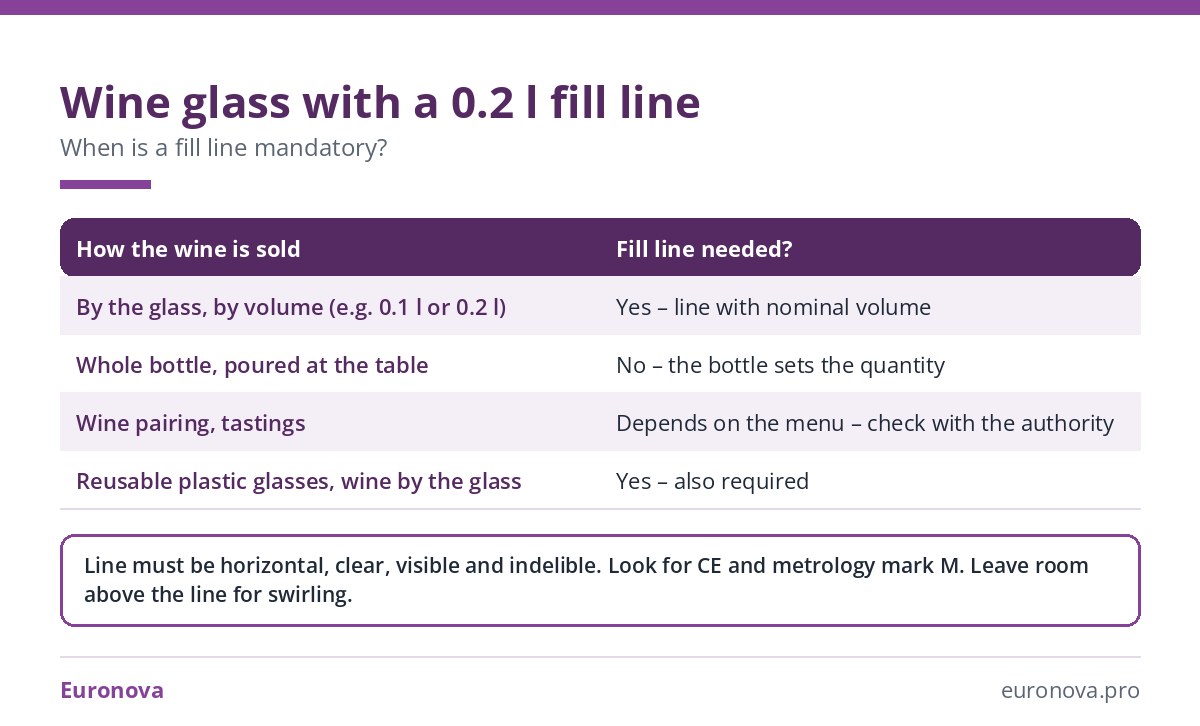
When you serve wine by the glass and sell it by volume, for example 0.1 l or 0.2 l at a fixed price, legal metrology (weights and measures) rules apply. In the EU, glasses used as serving measures can carry CE and metrology (M) marking under the Measuring Instruments Directive 2014/32/EU, while the detailed rules for serving drinks are set nationally. As a rule, a glass used as a serving measure must have a horizontal fill line indicating its nominal volume, and the line must be clear, visible and indelible in normal use. An unmarked glass poured by eye is therefore not enough for wine sold by the glass.
In practice, this means:
Wine by the glass, sold by volume: you need glasses with a fill line and the correct marking. When buying, check that the marking matches your menu. If your menu says 0.2 l, the glass must have a 0.2 l line. The permitted nominal volumes are set by national rules; common ones include 0.1 l, 0.2 l, 0.25 l and 0.5 l.
Pouring from the bottle at the table: if you sell a whole bottle and pour it at the table, the bottle determines the quantity. You can use glasses without a fill line, which is also the norm for quality wines.
Wine pairing and tastings: with wine pairing menus, you often charge an all-in price. Whether you need lined glasses depends on how you state quantity and price on the menu. If in doubt, check with your national metrology office or local market inspection authority before printing the menu.
Many venues therefore use two lines of glassware: lined glasses for wine by the glass and unlined glasses for bottled wine. This takes a little more space but avoids problems during inspections. A note on appearance: good catering glasses have the fill line placed so that there is room above it for swirling. A 0.2 l glass filled to the brim looks more like a spritzer than a carefully served wine. So for 0.2 l, choose a glass with enough capacity above the line.
The fill line requirement also applies to plastic glasses. If you use reusable glasses at festivals, on terraces or for catering, they need the marking too, for example our reusable Disco 30 cl glasses with a 0.2 l fill line (CE) made of Tritan.
Material, durability and the dishwasher
In everyday food service, the material decides how long a glass lasts. The price per piece is only part of the calculation: a cheap glass that breaks at the stem or turns cloudy after a few weeks ends up costing more than a durable glass that stays in circulation for years.
Crystal and tempered glass
Crystal glass is thin-walled, clear and brilliant, and conveys a sense of value on the table. For the trade, there are versions made specifically for frequent machine washing. There is also tempered glass with a reinforced rim or stem, which better withstands knocks during clearing, polishing and sorting. For banquets, hotels and catering, this durability is often more important than the last touch of finesse.
When buying, look out for:
Dishwasher resistance: the glass must be explicitly suitable for commercial dishwashers. Domestic glasses turn cloudy faster because of the higher temperatures and more aggressive detergents.
Rim and stem: a reinforced rim and a one-piece stem, without a glued or fused joint, break less often.
Stability: a wide foot stops the glass from tipping over during service or on a tray.
Height: check that the glass fits your racks, shelves and the space under the bar. A large Burgundy glass may need a rack with an extender.
Reorder availability: glasses from a range in regular production can be reordered without your tables later looking like a collection of odd pieces.
Plastic for outdoor areas
By the pool, in the garden, on the terrace or at events with many guests, glass is a risk: shards in grass or water are dangerous and expensive to clear up. Reusable polycarbonate or Tritan glasses are a practical solution here. For a sparkling wine reception there are plastic flutes such as the reusable 18 cl Tritan champagne glass, and for wine by the glass there are lined glasses such as the reusable Disco 22 cl glass. They don't replace a crystal glass in the restaurant, but they make outdoor areas safer.
Stemmed or stemless?
Stemless wine glasses look modern, stand steadily and fit low shelves and racks well. They are a good choice for relaxed wine bars, spritzers and tapas concepts. The drawbacks show in service, though: because the guest holds the bowl directly, the wine warms up faster and fingerprints remain clearly visible on the glass. For chilled whites, rosés and sparkling wines, this is a strong argument against stemless glasses.
Stemmed glasses therefore remain the standard in restaurants. The guest holds the glass by the stem, the bowl stays clean and the wine stays cool. A compromise for venues with a lot of breakage is glasses with a shorter, sturdier stem: they look elegant but tip over less often and break less at the joint between bowl and stem.
How many glasses do you need
You notice you have too few glasses on the first busy Saturday, when the dishwasher can't keep up. So don't calculate per seat, but per cycle. A glass in a venue is always in one of three places: on the table, in the dishwasher or on the shelf. Add a reserve for breakage.
Sample calculation for a 60-seat restaurant serving wine by the glass and by the bottle:
Basic need on the tables: let's say that on a full evening roughly every second guest drinks wine, and some guests get a fresh glass during the evening. With 60 seats and two sittings, this quickly means 60 to 80 wine glasses used per evening.
Washing cycle: while some glasses are on the tables, others are going through the machine, cooling down and waiting to be polished. Plan roughly the same quantity again for this.
Breakage reserve: keep an extra carton of each shape in the store room so you can replace losses immediately and don't have to order in the middle of the season.
In this example, you arrive at around 120 to 160 glasses, split across the shapes. Adjust the figures to your own: your till data shows how many glasses of wine you actually sell on a busy evening. For banquets and events, a simpler rule applies: at least one glass per guest for each type of drink, plus a reserve for guests who put their glass down and take a new one.
Washing, storage and less breakage
Glasses rarely break at the table; they break more often when clearing, in the dishwasher rack and when sorting. A few habits will extend their life considerably.
Don't overload racks: glasses that touch in the rack knock against each other during washing. The damage shows up as fine scratches and chips on the rim. Use compartment racks that match the height of the glasses.
Wash glasses separately: don't wash them together with crockery and cutlery. Grease and food residue settle on the glass as a film, sparkling wine loses its bubbles and red wine looks dull.
Let them cool down: a hot glass straight out of the machine, immediately filled with cold wine, puts stress on the material. Wait until the glasses have cooled.
Polish correctly: polish with a lint-free cloth and hold the glass by the bowl, not just the foot. Twisting the bowl against the foot snaps the stem.
Don't store them upside down in cartons: glasses can pick up the smell of cardboard, and the guest will notice it in the wine. Open shelves or glass racks with covers are better.
Don't nest them: never stack stemmed wine glasses inside one another. Even stackable glasses should not be stacked too high.
Check water and detergent: if glasses quickly turn milky despite new equipment, the cause is often water hardness or incorrectly dosed detergent. Have a service technician check the dishwasher's glass settings.
When serving wine at the table, chilling is also part of the care: a champagne and ice bucket keeps the bottle cold, so you don't have to keep topping up and the glasses don't fog up. For banquets and bars, a clear 26 x 35 cm champagne and ice bucket, which holds several bottles, is a good choice.
Our view: fewer shapes, better glasses
Every day we talk to restaurants, hotels, bars and caterers who are restocking glassware. And we keep seeing the same pattern: venues that start with too many glass shapes have a real mix on their shelves after a year, because some of each shape has broken and the replacements no longer come from the original range.
So our advice is: start with a few really durable shapes from a range you can reorder for a long time. Invest the money saved in a good stock and quality glass racks rather than a fifth specialist glass that reaches the table twice a month. Separate lined glasses for wine by the glass from unlined glasses for bottled wine early on. And don't forget your outdoor areas: if you have a terrace, a pool or events, reusable plastic glasses save you not just shards but also time when clearing up.
For one-off events such as weddings, corporate parties or seasonal peaks, you don't need to buy glasses at all. You can also hire glasses, plates and cutlery, so your store room isn't overflowing for the sake of three evenings a year.
— Rok
Wine glasses and catering equipment from Euronova
At Euronova you will find glasses and glassware for restaurants, hotels, bars and catering, plus wine service equipment: champagne and ice buckets, reusable lined glasses for outdoor areas, as well as porcelain, cutlery and buffet equipment, all in one place.
Planning an event and only need glasses for a short time? In Slovenia you can hire glasses, plates and cutlery from Euronova. The price is per piece per day, a deposit is payable on hire, and collection is in Ljubljana or, by arrangement, at one of our branches. Browse our range for restaurants and hotels and put together your equipment.
FAQ about wine glasses in food service
Do I need a different glass for every wine?
No. Most venues manage with a universal or white wine glass, a red wine glass and a sparkling wine glass. Specialist glasses such as a Burgundy glass or a dessert wine glass pay off mainly in wine bars and fine dining restaurants, where guests expect wine pairing.
Does every wine glass need a fill line?
No. A fill line marked with the nominal volume is required on glasses in which you serve wine by the glass and sell it by volume. If you sell a whole bottle and pour it at the table, ordinary unlined glasses are the norm. For special cases such as wine pairing, check with your national metrology office.
Are crystal glasses too fragile for restaurants?
Not necessarily. There are crystal and tempered glasses made specifically for commercial dishwashers and demanding everyday use. Look for commercial dishwasher suitability, a reinforced rim and a seamless stem.
What should I use on terraces, by the pool and at events?
Reusable polycarbonate or Tritan glasses are the safe choice there because they don't shatter into shards. For wine sold by the glass, they also need a fill line. For sparkling wine receptions, special plastic flutes are available.
Can I hire wine glasses for an event instead of buying them?
Yes, in Slovenia you can hire glasses, plates and cutlery from Euronova. The price is per piece per day, and a deposit is payable on hire. Hiring pays off mainly for one-off events and seasonal peaks for which your own stock would not be worthwhile.