Takeaway Food Packaging: How to Choose the Right Container
Takeaway Food Packaging: How to Choose the Right Container
Choosing good takeaway food packaging starts with the dish, not the catalogue. What matters is whether the food is hot or cold, dry or saucy, whether it reaches the customer in 10 or 40 minutes and whether the customer will reheat it later. Then there are the regulations: the material must be intended for food contact, specific obligations apply to single-use plastic cups and food containers, and from 2026 the EU rules on packaging composition are getting stricter too. Below you will find a practical way to choose, an overview of materials, a "dish and packaging" table and answers to the questions food service operators ask us most often.
Euronova
euronova.pro
Choose your takeaway packaging
At Euronova you will find takeaway food packaging and catering supplies to equip your venue.
First pin down four things: the temperature of the food, the amount of liquid and fat, the delivery time and how it will be reheated. Only then choose the material and shape.
Hot dishes with sauce are safest in polypropylene (PP) or aluminium, fried food in boxes with ventilation holes, salads and desserts in clear PET.
Paper and bagasse perform very well with dry and greasy foods, less well with soups and prolonged contact with liquid.
Under the EU Single-Use Plastics Directive, consumption of single-use plastic cups and food containers must be reduced, and packaging made of expanded polystyrene is banned.
Test every new container in a real delivery before you order a full carton.
Most complaints – "it leaked", "it went soggy", "it arrived cold" – come from packaging chosen for its looks rather than for the conditions the food travels in. Before comparing prices, answer five questions.
What is the temperature of the food when packed? Dumplings straight out of the water, goulash from the kettle or fries from the fryer put a completely different load on a container than a salad from the fridge. Not every material can handle high temperatures without deforming.
How much liquid and fat is there? Soup, curry, ramen and sauces need a tight seal. Greasy foods (breaded chicken, kebab, fritters) soak through thin uncoated paper.
How long will the food be on the way? Collection takes a few minutes. Delivery by an app courier often takes 20–40 minutes in an insulated bag, tilting on a bike or scooter. The longer the journey, the more important sealing and venting steam become.
Will the customer reheat the food? Office lunches and diet meal plans often end up in the microwave. In that case the container must be marked as suitable, and aluminium is out.
Where will the food be eaten? On a park bench, convenience and included cutlery matter. In a conference room or at celebration catering, presentation, a clear lid and a portion you can put straight on the table count.
The answers to these questions determine the material. Only in the second step do you choose the volume, shape and number of compartments.
Takeaway packaging materials in practice
In food service, takeaway packaging is mostly made of plastic (PP, PET, PLA), paper and board, bagasse (sugar cane fibre) and aluminium. Each material has its strengths and limitations.
Material
Where it works best
Limitations
Reheating
Polypropylene (PP)
hot dishes, saucy dishes, soups, lunches
single-use plastic subject to consumption reduction measures
usually yes, if the manufacturer marks it as microwave-safe
PET / APET
salads, desserts, fruit, sandwiches, cold dishes
not for hot food
no
PLA (plant-based plastic)
cold food and drinks, cups for cold drinks
softens at high temperatures
no
Coated paper and board
pasta, wok dishes, burgers, fries, sandwiches
can lose strength with prolonged contact with liquid
PP is the workhorse of takeaway food. It handles hot dishes, and a tight snap-on lid protects soups and sauces. If customers reheat their food, choose containers with a clear microwave marking.
PET gives the best presentation for cold dishes. A clear box shows the layers of a salad or dessert and sells the dish right from the chilled display.
Paper and bagasse build your image but need testing. With very saucy dishes, check how the container holds up after 30 minutes in the bag.
Aluminium rules hot catering. A tray with a lid goes straight into the convection oven or an insulated food carrier and holds its temperature.
Packaging chosen by dish
The same material can be ideal for one dish and a disaster for another. This is how we choose containers for the most common types of dishes.
Hot dishes with sauce
Goulash, curry, pasta with sauce, risotto, Asian dishes: here a tight lid and heat resistance are what count. Snap-on PP containers and aluminium trays with lids work well. For dishes with sides (meat, rice, salad), choose a container with two or three compartments so the sauce doesn't soak the side dish or the fries.
Soups and drinks
Soup is the biggest complaint risk. Choose round PP bowls with a lid that seals all the way round and, for delivery, secure them with film or a tamper seal sticker. Don't fill to the brim: leave a centimetre or two of headspace, because steam and vibration take their toll. For hot drinks, use cups designed for hot liquids with a matching lid; for cold drinks, use PET or PLA cups.
Fried and greasy food
Fries, breaded chicken, onion rings, fritters, fish and chips: the biggest enemy is steam. If the container is sealed tight, steam condenses and turns crispy breading into a sponge. Choose paper or bagasse boxes with ventilation holes or with a lid that does not close fully. The paper must be grease-resistant, otherwise a greasy stain appears at the bottom of the bag after a quarter of an hour.
Salads, desserts and cold dishes
Here presentation wins. Clear PET containers show off the product, and tall cups with lids are excellent for layered desserts, porridge and yoghurt with fruit. Pack salad dressings separately in small cups with lids so the leaves don't wilt on the way.
Pizza, burgers and street food
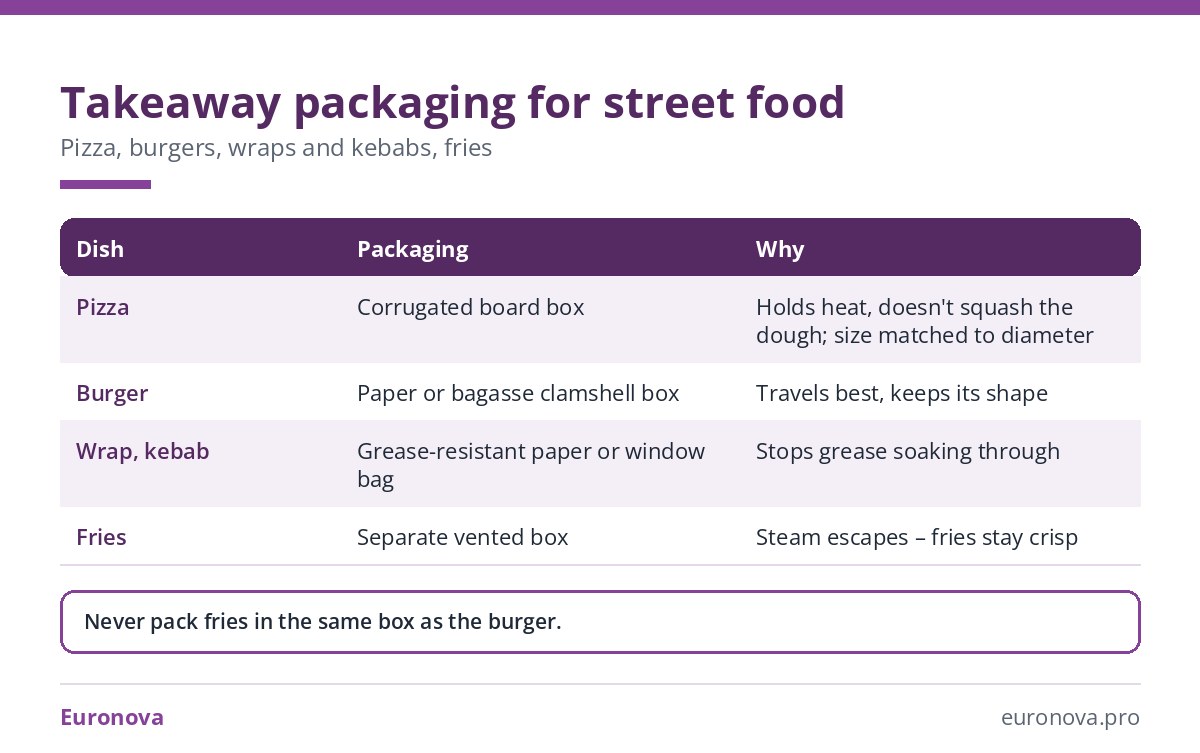
Pack pizza in corrugated board boxes, which hold the heat and don't squash the dough. Burgers travel best in paper or bagasse clamshell boxes, and wraps and kebabs in grease-resistant paper or window bags. For fries, choose a separate vented container – don't pack them in the same box as the burger.
Finger food and event catering
At receptions, conferences and banquets, packaging becomes part of the service. Small round containers with lids let you prepare portions in advance, transport them without risk and put them straight on the table. Larger quantities of hot food are transported in GN containers placed in insulated food carriers.
Dish
Recommended packaging
What to watch
Soup, beef broth, bean stew
round PP bowl with a tight lid
don't fill to the brim, tamper seal for delivery
Lunch main course
2–3 compartment container in PP or bagasse
sauce kept apart from the salad
Pasta, wok dish
coated paper box or PP
PP is better with lots of sauce
Fries, breaded food
vented box, grease-resistant paper
avoid airtight closure
Salad, dessert
clear PET, cup with lid
dressing separately
Pizza
corrugated board box
size matched to the diameter
Bake, lasagne
aluminium tray with lid
not for the microwave
Finger food
small containers with lids
a uniform size makes stacking easier
Leak-proofing, safety and easy transport
Even the best-chosen material fails if the container closes poorly or doesn't fit the bag. Before introducing new packaging, check:
Closure. The lid must snap shut all the way round. Do a simple test: fill the container with water, close it and turn it upside down over the sink for a few seconds.
Rigidity when filled. A container with hot food must not flex when a staff member carries it in one hand.
Stacking. The courier wants to know whether boxes can be stacked in the insulated bag. Containers from one range with compatible lids save space and nerves.
Intended use marking. Packaging must be intended for food contact. You can expect your supplier to provide information on the product's intended use and conditions of safe use, including the permitted temperature.
Traceability. Record who you buy packaging from and which batches. Your business is responsible for what it serves food in, and Regulation (EC) No 1935/2004 on food contact materials requires these materials to be traceable.
Keeping hot and cold apart. A salad next to hot soup in the same bag is no longer fresh. Pack separately or use bags with a divider.
Regulations that apply to food businesses in the EU
Takeaway packaging is not just a question of convenience. Several sets of rules apply, and it is worth knowing them before you put together your price list.
Single-use plastic cups and food containers. The EU Single-Use Plastics Directive (EU) 2019/904 requires member states to achieve a measurable reduction in the consumption of single-use plastic cups for beverages and food containers by 2026 compared with 2022. Depending on national implementation, food and drink outlets may have to take measures such as offering alternative products, allowing customers to use their own containers and raising consumer awareness. Food containers and cups made of expanded polystyrene are already banned. Before deciding on a container, check with your supplier whether paper packaging has a plastic layer or coating, as such packaging also counts as a plastic product.
Environmental claims. The European Union is tightening the rules on generic environmental claims. If you want to write "eco" or "compostable" on packaging or on the menu, back it up with a specific certificate or manufacturer's declaration rather than a vague wording.
Material safety. Packaging must not transfer substances into food in quantities that could endanger health or change the taste or smell of the dish. In practice, this means buying only products intended for food contact and using them within the stated temperature range. If you are unsure about the requirements for your business, contact your local food safety authority.
What VAT applies to takeaway packaging
This is one of the most common accounting questions in food service. VAT rates for takeaway food and for restaurant services differ between EU countries, so the rate itself depends on where you operate. A widely applied principle, however, is that packaging handed over together with a meal is part of a single supply and is treated the same way as the meal. If you sell packaging on its own, it is usually taxed at the standard rate.
Example: takeaway soup in a PP container. The container is part of the sale, so you charge VAT on the full amount at the rate that applies to the soup. The details for your situation (e.g. sales via a delivery app) are best agreed with your accountant, who is responsible for the correct presentation on the invoice and in your records.
How to calculate stock without tying up cash
Ordering "by eye" ends either with running out of containers on a Friday night or with cartons gathering dust in the store room. A simple method:
List your takeaway dishes and assign packaging to each. Ideally, limit yourself to 4–6 types of container that cover the whole menu. Fewer types mean simpler ordering and fewer packing mistakes.
Calculate the average weekly sales for each type. Take the data from your till system for the last four weeks.
Add safety stock. With weekly deliveries, 30–50% above average is usually enough; more in season and before holidays.
Don't forget the extras. Sauce pots, cutlery, napkins, bags, tamper seal stickers and order printer rolls run out just as fast as boxes.
Review your range once a quarter. A menu change often means one container type is no longer needed while another runs short.
For example: a bistro that sells around 300 soups and 500 takeaway main courses a week should, with weekly deliveries, keep around 400–450 soup bowls and 650–750 lunch containers in stock, plus a matching number of lids if they are packed separately.
Our view on takeaway packaging
We equip restaurants, pizzerias, cafés, hotels and catering companies throughout Slovenia, as well as the kitchens of schools, nurseries and care homes. From this vantage point we see one recurring thing: the venues with the fewest takeaway problems don't have the most expensive packaging, but the best thought-out range. A few proven containers from one range, with matching lids, chosen for specific dishes on the menu.
The second insight: it makes sense to plan takeaway packaging together with the kitchen equipment as a whole. The container must match the portion you serve from the GN container, the ladle, the counter space at the packing station and the insulated food carrier in which catering travels. When you buy plates, equipment and packaging in one place, it is easier to keep everything compatible and to top up stock.
Third: test. Order a small quantity of the new container, send the dish out on a real delivery and open it after 30 minutes. It costs little and saves you whole cartons of unsuitable packaging and bad reviews in the apps.
We also offer GN containers, insulated food carriers, pots and kitchen utensils – everything you need for food to reach the customer in good condition. We work at wholesale prices and equip both newly opened venues and businesses with many years of experience. Browse Euronova's range and current offers.
FAQ
Which takeaway packaging is best for soup?
The safest option is a round polypropylene bowl with a lid that seals all the way round. Leave some headspace under the lid and, for delivery, secure the container with a tamper seal sticker or film. Paper and bagasse can soften with a lot of liquid.
What do food businesses in the EU need to consider with single-use plastic cups and food containers?
Under the EU Single-Use Plastics Directive, member states must reduce the consumption of single-use plastic cups and food containers, and national rules may require outlets to offer alternative products, accept customers' own containers and inform consumers. Food containers and cups made of expanded polystyrene are banned. With paper packaging, check whether it has a plastic layer.
How do I stop fries going soggy during delivery?
Use boxes with ventilation holes or packaging that does not close airtight, and pack fries separately, not together with the burger or sauce. The paper must be grease-resistant. Also shorten the time between the fryer and packing.
What VAT applies to takeaway food packaging?
Packaging handed over together with a meal is, as a rule, treated the same way as the meal itself. VAT rates for takeaway food differ between EU countries. Packaging sold separately is usually taxed at the standard rate. Check the details with your accountant.
Can PP packaging be heated in the microwave?
Polypropylene withstands high temperatures well and many PP containers are designed for the microwave, but the manufacturer's marking on the product is what counts. Lids may be made of a different plastic from the container, so remove them before heating unless they carry their own marking.