Commercial Blender for Professional Kitchens: How to Choose the Right One
Commercial Blender for Professional Kitchens: How to Choose the Right One

The right commercial blender for your kitchen depends on three questions: what you blend, how much and how many times a day. For soups blended directly in the pot, you need a stick blender (immersion blender). For smoothies, sauces, cream soups and crushed ice, you need a countertop or high-performance blender. Behind the bar, a drink mixer is often added. After that, motor power, jug size and material, resistance to continuous load and, above all, how quickly the machine can be cleaned hygienically during service are what count. This guide works through each point, shows what a commercial countertop blender may process, and finally explains how to wash glasses at the bar so that the beer head and taste are right.
In brief
- Choose the machine by task: a stick blender for large pots, a countertop blender for fine textures, a high-performance blender for ice, frozen ingredients and nut butters, a bar blender for shakes and cocktails.
- Match power to ingredients: soft ingredients need less power, ice and hard ingredients considerably more. Professional machines run at up to 38,000 revolutions per minute.
- Material matters: BPA-free or stainless steel jugs, stainless steel blades, parts that can be quickly taken apart and washed.
- Hot liquids and ice only if approved: whether a countertop blender can handle hot liquids or ice cubes is stated in the manufacturer's instructions, not in the brochure.
- Never polish beer glasses: fibres and microbes from the cloth kill the head. It is better to wash them in a glasswasher and let them air-dry.
Contents
- Which blender for which task?
- Power and speed: how much motor you really need
- Jug, blades and material
- Ice, hot, frozen: what a countertop blender can handle
- Continuous operation, noise and service
- Hygiene: cleaning a blender under HACCP
- How to wash beer glasses properly: bar hygiene
- From blender to table: the right equipment
- Our view: see equipment as a system
- FAQ: commercial blenders in food service
- Sources
Which blender for which task?
In a professional kitchen there is rarely one blender for everything. Most operations work with two, sometimes three types of machine, because each task makes different demands.
| Blender type | Typical tasks | Advantages | What to look for |
|---|---|---|---|
| Stick blender (immersion blender) | soups, sauces and purées directly in the pot, dressings, emulsions | no decanting, works with large pots, ready in seconds | shaft length relative to pot height, detachable shaft for cleaning, adjustable speed |
| Countertop blender | cream soups, sauces, smoothies, spreads, batters in smaller quantities | even, fine texture, hands free while blending | jug capacity, approval for hot liquids and ice, programmes |
| High-performance blender | crushing ice, frozen drinks, nut butters, very fine purées, sorbets | very high speeds, creamy results, short blending times | motor rated for continuous operation, noise, spare jugs |
| Bar blender and shake mixer | milkshakes, frappés, cocktails, protein shakes | compact, designed for mixing cups, fast during service | cup holder, timed operation, cleaning between drinks |
| Food processor (cutter) | fillings, herb pastes, chopping larger quantities | powerful with solid masses | a complement to, not a replacement for, a blender for liquid dishes |
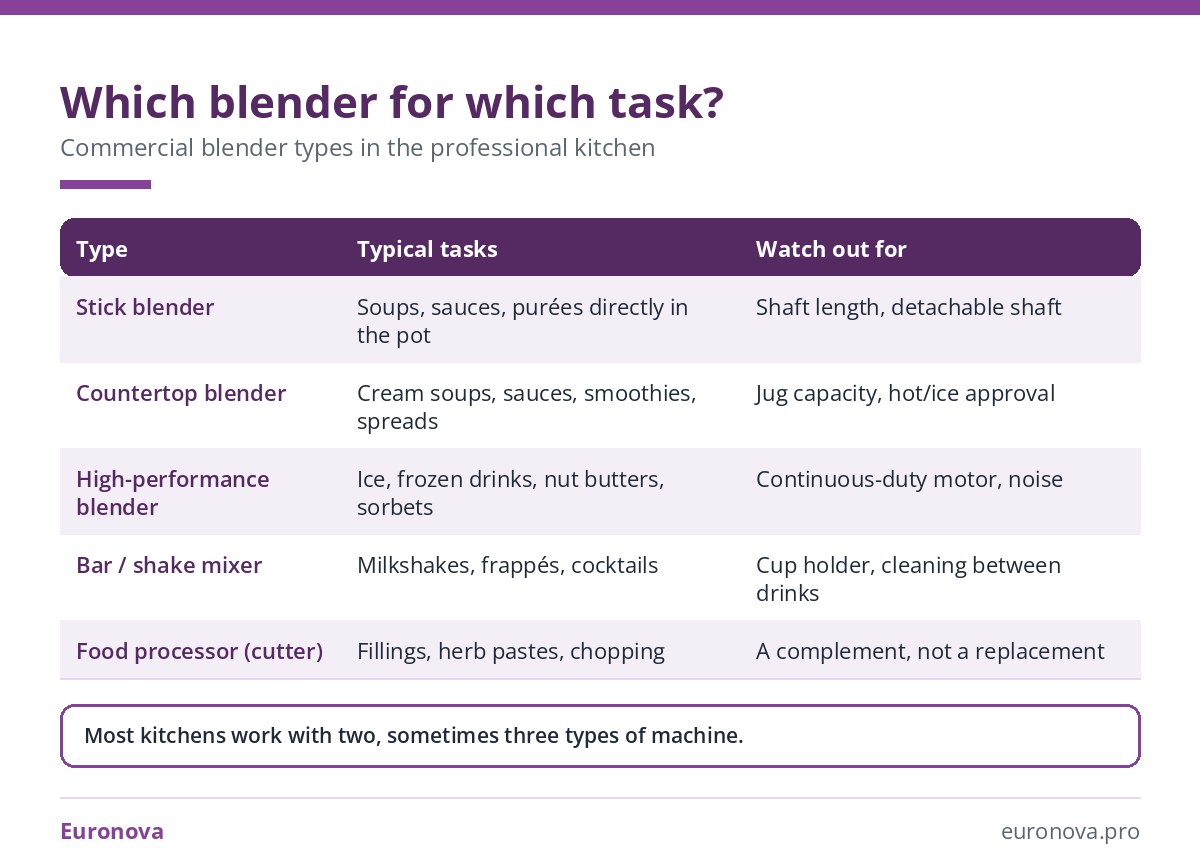
A restaurant with soups on the menu will get a long way with a good stick blender and a countertop blender. A café serving smoothies and frappés, however, needs a high-performance blender with several jugs, so staff do not have to wash up every time they switch between fruit drinks and milkshakes. For catering, it also matters how robust the machine is in transport and whether shafts and jugs can be stored in a space-saving way.
Power and speed: how much motor you really need
The wattage on the box says little on its own. What counts is what the motor can sustain under load over longer periods. According to Gastronomie News, high-speed blenders in professional kitchens run at up to 38,000 revolutions per minute to give smoothies, sauces and cream soups a creamy, even texture.
As a rule of thumb:
- Soft ingredients such as cooked vegetables, fruit, yoghurt or soup put little strain on the motor. Here, fineness and ease of use are what matter.
- Hard ingredients, ice and frozen produce need considerably more power and a motor that does not slow down under load. If you serve frozen drinks or sorbets every day, deliberately buy one power class higher.
- Tough mixtures such as nut butters, hummus or thick spreads put a particularly long load on the drive. A tamper that pushes the ingredients towards the blades while blending is almost essential here.
Also look for variable or finely stepped speed control. Sauces and emulsions turn out better if you start slowly and only then increase the speed. Programmes with a fixed run time help during service, because staff can start the blender and turn to other tasks while the texture stays the same in every portion.
Jug, blades and material
The jug is the part you handle most often, and often the first that needs replacing. Three points decide.
Material
Blender jugs should be BPA-free and the blades made of stainless steel; stainless steel jugs are considered particularly durable and stable. Jugs made of BPA-free plastic have the advantage that you can see the texture while blending. Stainless steel does not break and withstands the rough everyday life of a kitchen, but you have to stop briefly to check.
Capacity
Choose the capacity according to your typical batch size, not the largest one. A jug that is too large blends small quantities poorly, because the blades do not catch the ingredients properly. One that is too small forces you to blend the soup in three batches. Many operations therefore work with two jug sizes on the same motor base: a smaller one for dressings and bar preparations and a larger one for soups and sauces.

Lid and seals
A tight-fitting lid with a filler opening lets you add oil for emulsions or liquid without stopping the machine. Check whether the seals can be removed. Otherwise residues collect there that are missed during normal cleaning.
Ice, hot, frozen: what a countertop blender can handle
This is the question food service operators ask most often, and the honest answer is: the manufacturer of your machine decides. Not every countertop blender is made for ice cubes, and not every jug is suitable for hot soup straight from the stove. The approval is stated in the operating instructions or technical data sheet, and that is where you should check it before buying.
The following rules have proved themselves for safe everyday use:
- Hot liquids should only be blended if the manufacturer explicitly allows it. Blending creates steam and therefore pressure in the jug. Respect the stated maximum fill level for hot liquids, which is often lower than for cold ingredients, and start on a low speed.
- Always secure the lid with hot food and place a hand with a cloth on it if the instructions say so. If you purée soups in large quantities, a stick blender directly in the pot is often faster and safer.
- Ice cubes and frozen produce should only be processed with a blade and jug approved for this. Put liquid in the jug first, then soft ingredients and finally ice or frozen produce, so that the blades can turn freely.
- Dry blending, for example of grains or coffee beans, puts heavy strain on the blades and jug. Some manufacturers offer special dry jugs for this.
If you check these points when buying, you avoid cracked jugs, burnt hands and motors that fail after a few months.
Continuous operation, noise and service
A domestic blender runs for a few minutes a day. Behind the bar on a Saturday night or at a hotel breakfast buffet, it runs every minute. So pay attention to:
- Overheating protection and cooling: the motor should handle longer run times without overheating. Thermal protection switches the machine off before the winding is damaged.
- Noise: in an open bar area or open kitchen, loud machines disturb guests. Sound enclosures reduce noise noticeably.
- Spare parts and service: blade assemblies, seals and jugs are wear parts. Before buying, check whether they can be obtained individually and quickly.
- Controls: large, clearly visible buttons or rotary knobs that work with wet hands save time and mistakes under pressure.
Hygiene: cleaning a blender under HACCP
In a food business, the blender belongs in your cleaning schedule. As part of your HACCP system, you define when, how and with what you clean the blender, jugs, blades and tamper, and you record it.
A practical routine looks like this:
- Rinse immediately after use: pour warm water and a drop of detergent into the jug, run the machine briefly and empty it. Dried-on smoothie or sauce residues are hard to remove later.
- Dismantle: remove the blade assembly, sealing ring and lid if the machine is designed for it. For a stick blender, detach the shaft from the motor unit.
- Clean thoroughly: put parts that the manufacturer marks as dishwasher-safe in the dishwasher. Clean everything else by hand with a suitable professional detergent. Never immerse the motor base in water; only wipe it with a damp cloth.
- Mind allergens: after nuts, milk or other allergens, clean the jug completely before putting the next dish in it. A separate jug for allergen-free preparations makes this much easier.
- Dry and record: let the parts air-dry completely and tick off the cleaning in the schedule.
Machines with smooth surfaces, few gaps and removable blades save minutes every day and reduce the risk of residues building up.
How to wash beer glasses properly: bar hygiene
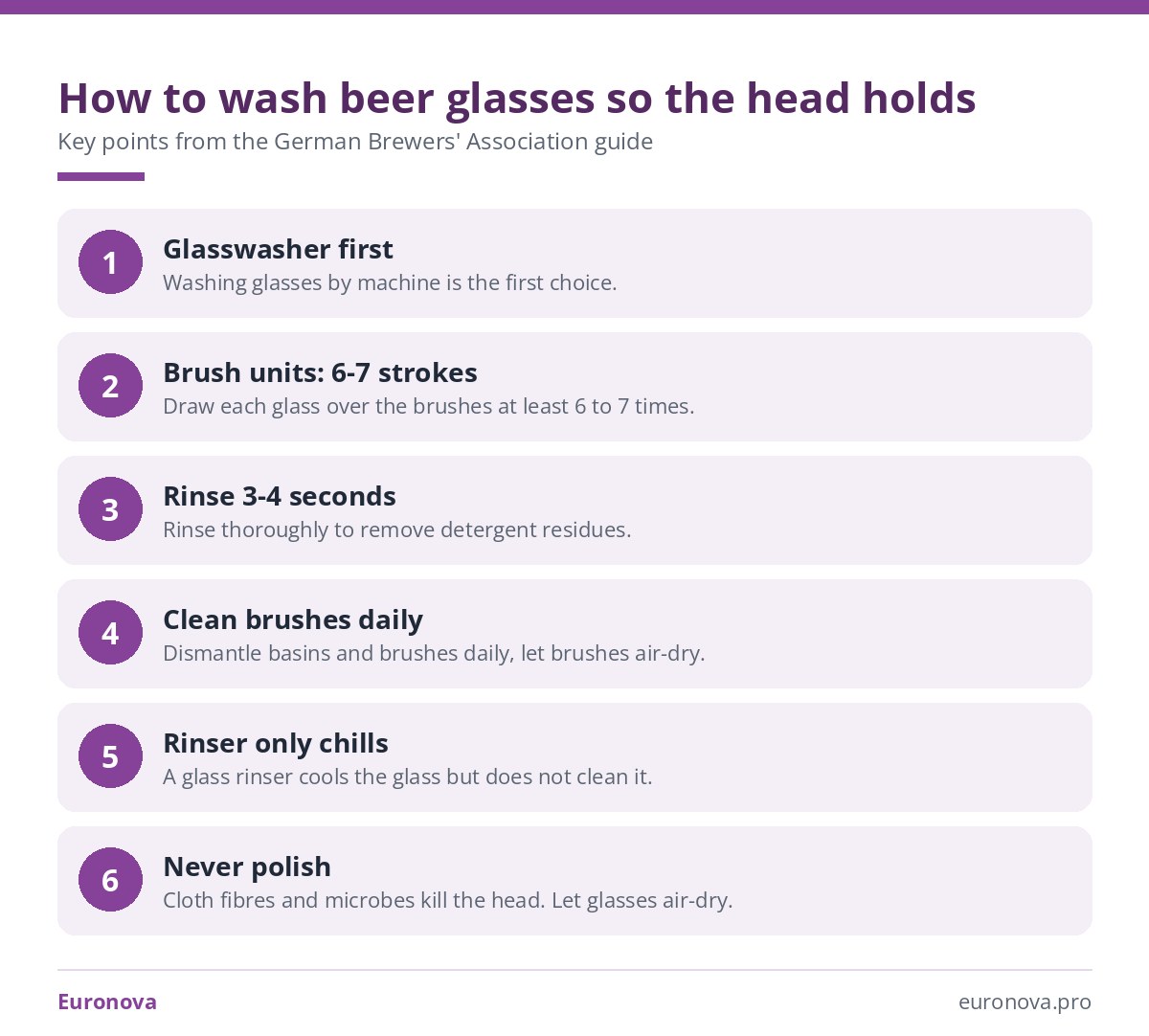
Anyone who mixes shakes and cocktails behind the bar usually pours beer too. And few things reveal poor glass washing hygiene as quickly as a beer whose head collapses after a few seconds. The German Brewers' Association (Deutscher Brauer-Bund) has published a guide to glass washing. The key points:
- A glasswasher is the first choice. The guide generally recommends washing glasses by machine.
- Use manual glass washing units correctly. With a brush-type glass washing unit, washing is hygienic if the glass is drawn over the brushes at least 6 to 7 times and rinsed for 3 to 4 seconds.
- Dismantle and clean wash basins and brushes daily. Let the brushes air-dry when not in use.
- Glass rinser for chilling only. A glass rinser on the bar cools the glass before pouring, but does not clean it.
- Do not polish. Textile cloths can transfer microbes, and fibres make the head break down prematurely and affect the taste.
Common mistakes that kill the beer head
According to the brewers' association, the wrong detergent, insufficient rinsing or too much rinse aid make the beer head collapse quickly. Grease and surfactant residues form an invisible film in the glass on which the foam literally bursts. A simple test: if bubbles rise along the side of the glass after pouring and stay stuck to it, residues are usually to blame.
What hygiene standards require
The German Federal Institute for Risk Assessment (BfR) has studied the hygienic effectiveness of glass washing machines. According to its findings, water temperature, contact time and correct dosing of detergents and disinfectants are crucial. Wash times that are too short encourage biofilms. Set the dosing and temperature of your glasswasher according to the instructions of the manufacturer and your detergent supplier, and check the values regularly. If in doubt, contact the machine's service team or your local food safety authority.
The glass itself also matters: glasses with a smooth, scratch-free inner surface can be cleaned more thoroughly. For draught beer, our Draft beer glass with a 0.3 l fill line is a good choice, and for wine the Refine red wine glass 53 cl.
From blender to table: the right equipment
A good blender is only half the job. A velvety cream soup only comes into its own in the right bowl, a smoothie shot only in the right shot glass. At Euronova, alongside catering appliances, you will find everything that comes next: porcelain for soups and bowls, glassware for the bar and draught service, finger food dishes for desserts, mousses and shots, and cleaning products for kitchen and bar.
For soups and purées, for example, the Gourmet bowl 400 ml or the Aqua Gourmet deep plate are a good fit. For mousses, smoothie shots and finger food in catering, the finger food dishes with lids are ideal. Browse the full Euronova range here.

Our view: see equipment as a system
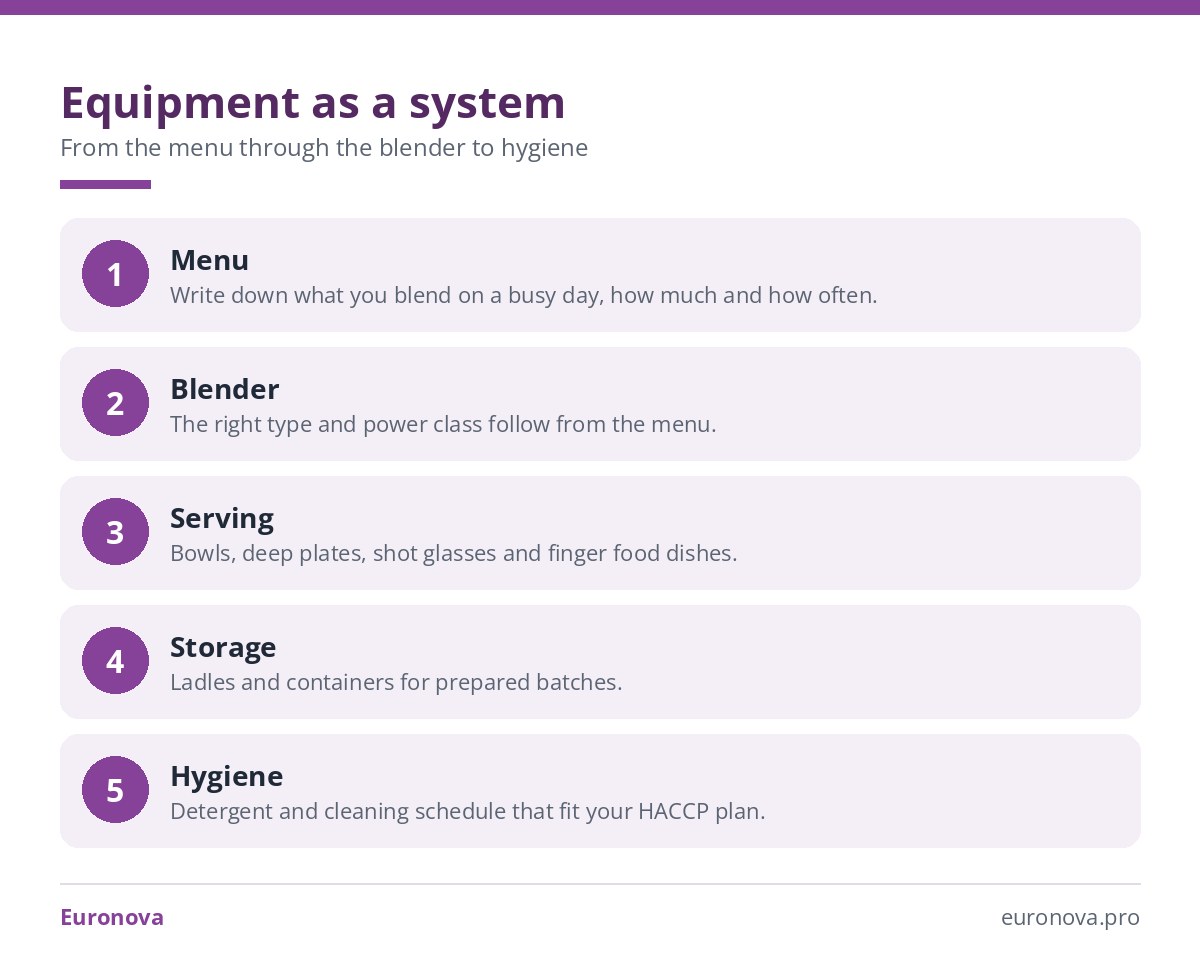
Every day we see how food service operators buy, and a pattern stands out: the blender is often treated as a stand-alone decision, separate from the rest of the kitchen. Yet it is connected to everything else. Anyone planning a new soup menu needs not only a machine that purées reliably, but also bowls of the right size, ladles, containers for storing prepared batches and a detergent that fits the hygiene plan.
That is why we have built our range so that you get the whole chain in one place: catering appliances, cookware, kitchen utensils, food storage and transport products, porcelain, glassware, cutlery and cleaning products. For events, you can also hire plates, glasses and cutlery from us instead of buying them. Our expert articles and catalogues help hotel purchasing departments just as much as the café owner who orders everything personally.
Our advice: buy your blender according to your menu, not the data sheet. Write down what you blend on a busy day, in what quantities and how often. The power class then becomes almost self-evident, and you can plan the equipment around it at the same time.
— Rok
FAQ: commercial blenders in food service
Is a domestic blender good enough for a restaurant or café?
As a rule, a domestic blender is not designed for continuous professional use. Its motor, bearings and jug are built for short run times and overheat sooner when used frequently. A commercial blender is designed for longer operation, easy cleaning and readily available spare parts.
Stick blender or countertop blender: which do I need first?
If you make a lot of soups and sauces in large pots, start with a stick blender, because you do not have to decant anything. If smoothies, frozen drinks or particularly fine purées are on the menu, start with a countertop or high-performance blender. In the long run, most kitchens use both.
Can I blend hot soup in a countertop blender?
Only if the manufacturer of your machine explicitly allows it. Respect the maximum fill level for hot liquids, secure the lid and start on a low speed, because blending creates steam and pressure. For large quantities, a stick blender in the pot is often the safer option.
Why does the beer head collapse in a freshly washed glass?
Usually there are residues in the glass: the wrong detergent, insufficient rinsing or too much rinse aid. Fibres from a polishing cloth also destroy the head. Wash beer glasses in a glasswasher or with enough strokes over the brushes, rinse them thoroughly and let them air-dry.
How often should I clean the brushes of a glass washing unit?
Every day. The German Brewers' Association recommends dismantling and cleaning the wash basins and brushes daily and letting the brushes air-dry when not in use. This prevents microbes and biofilms from becoming established.
Sources
- Gastronomie News: Profiküche, den richtigen Mixer finden
- Deutscher Brauer-Bund: Leitfaden zur Gläserreinigung
- BfR: Hygienische Wirksamkeit von Spülgeräten zum Reinigen von Trinkgläsern in der Gastronomie