Chef Aprons for Restaurants: Types, Materials and Hygiene
Chef Aprons for Restaurants: Types, Materials and Hygiene

The right chef apron for your restaurant depends on where it is worn. At the stove, a long bib apron made of durable fabric that can be washed at high temperatures has proved its worth. Front of house, a long waiter's apron (bistro apron) is the norm; behind the bar and at the coffee machine, a short waist apron or a model with pockets. Anyone kitting out a cold kitchen, dishwashing area or meat preparation chooses waterproof aprons. Quantity also matters: plan enough aprons per person so that every shift starts with a clean one and can change it during work. Below you will find how to decide on type, material, length and number of aprons, and how to keep them hygienic.
In brief
- Kitchen: a long bib apron covering chest and thighs, made of durable cotton or a blend that can be washed at high temperatures.
- Front of house and bar: a waiter's apron to the knees or calves, or a short waist apron with pockets for order pad, wallet and pen.
- Wet and greasy workstations: waterproof or coated aprons that can be wiped and disinfected.
- Hygiene: store work clothing separately from personal clothing, change it immediately when soiled and wash it separately from personal clothing at the highest temperature the label allows.
- Quantity: allow several aprons per person to cover the washing cycle, changes during a shift and a reserve.
Contents
- Which apron for which workstation
- Material: what suits what
- Length, cut and features
- Hygiene: cleaning, changing and storage
- How many aprons per employee?
- Aprons for pastry, banquets and table setting
- Logo, colour and a consistent look
- Our view from practice
- Chef clothing and catering equipment in one place
- FAQ: chef aprons
- Sources
Which apron for which workstation
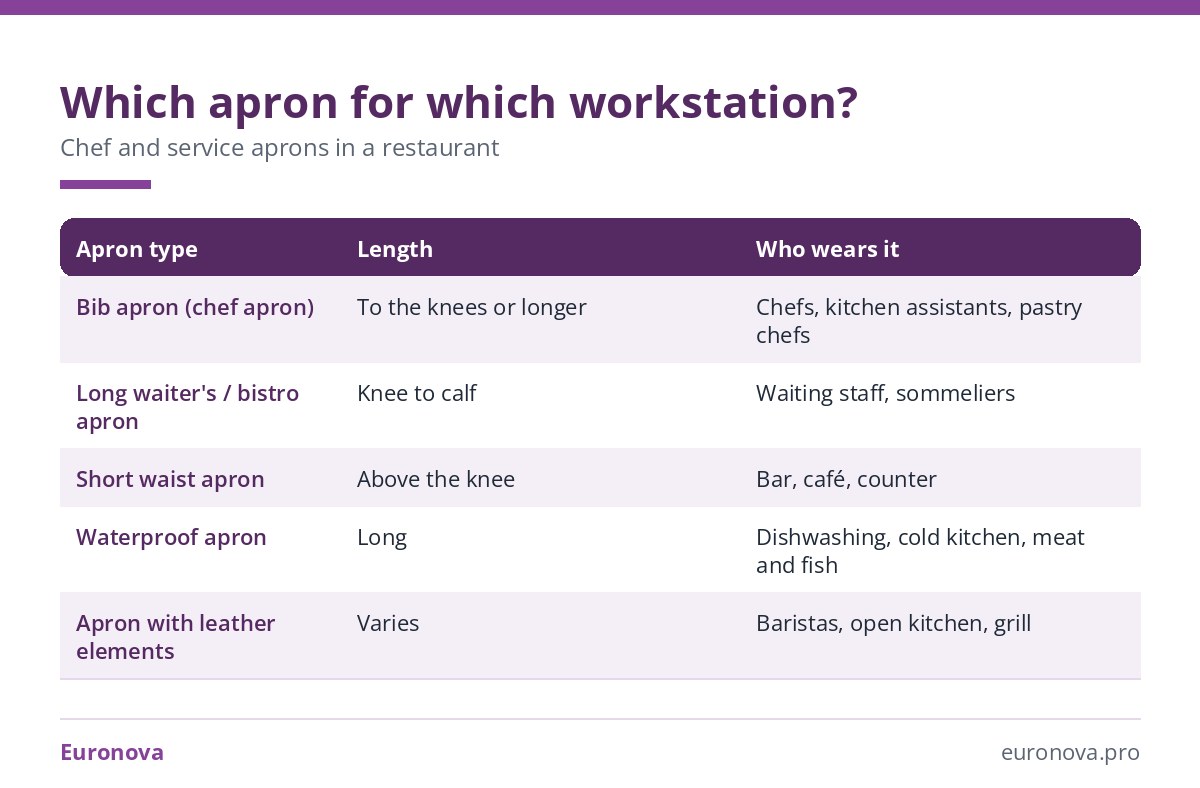
Not everyone in a restaurant wears the same apron, and for good reason. At the stove, protection from splashes, heat and grease is what counts. In the dining room, what counts is how the team looks and whether everything is to hand. In the dishwashing area, what counts is that water does not soak through. The following overview sorts the usual apron types by task.
| Apron type | Typical length | Who wears it | Advantages |
|---|---|---|---|
| Bib apron (chef apron) | to the knees or longer | chefs, kitchen assistants, pastry chefs | protects torso and legs, a professional kitchen classic |
| Long waiter's apron / bistro apron | knee to calf length | waiting staff, sommeliers | elegant look in the dining room, protects trousers during service |
| Short waist apron | above the knee | bar, café, counter | freedom of movement, pockets for work tools |
| Waterproof apron | long | dishwashing area, cold kitchen, meat and fish | can be wiped clean, keeps out moisture and blood |
| Apron with leather elements | varies | baristas, open kitchen, grill | robust, distinctive look |
Bib apron for the stove and station
The bib apron is the workhorse of the kitchen. It reaches from the breastbone to at least the knees and catches whatever splashes during searing, deglazing and plating. Look for an adjustable neck strap so that the bib sits correctly at any height, and for ties long enough to be knotted at the front. A bow tied at the front can be undone more quickly when the apron needs changing during work.
Waiter and bistro apron for front of house
In the dining room, the apron is part of what the guest sees. A long waiter's apron in black, anthracite or white looks classic and understated and, combined with a shirt or blouse, creates a consistent look. For fine dining and banquets, the calf-length version is common; in a bistro it can be shorter. A pocket for an order pad or a wine opener saves trips.
Waist apron for the bar and café
Behind the bar you bend, turn and reach a lot. A short waist apron does not get in the way and carries a bar spoon, pen and waiter's wallet in divided pockets. In cafés and pizzerias with an open counter, it is often the most practical choice.
Waterproof aprons for wet areas
In the dishwashing area, when filleting fish or preparing vegetables, a cotton apron quickly gets soaked. Coated or plastic aprons keep out moisture and can be wiped down in between. They complement the textile apron but rarely replace it at a hot stove.

Material: what suits what
The material determines how long an apron lasts, how it wears and how it can be cleaned. Your choice should be based on where it is used, not just on price.
Cotton is breathable, comfortable in hot kitchens and can generally be washed at high temperatures. A dense twill weave is more hard-wearing than thin fabric and creases less. The everyday drawback: depending on the finish, pure cotton shrinks slightly and takes longer to dry after washing.
Cotton-polyester blends combine wearing comfort with shape retention. They dry faster, keep their colour and are easy to care for despite frequent washing. For businesses with their own washing machine and a lot of laundry, this is often the best compromise.
Coated fabrics and plastic belong in wet areas and where there is blood. They are not intended for contact with open flames; check the manufacturer's information on this.
Denim, canvas and leather are on trend, especially in open kitchens, burger restaurants and cafés where the team works in full view of guests. Here it pays to look at the details: detachable straps make hygienic washing easier when a component such as leather cannot be washed at a high temperature. The textile part then goes into the machine on its own.
A tip on choosing colours: food hygiene guidance commonly recommends light colours for work clothing in the food sector, because dirt is noticed immediately. In the kitchen that is an advantage, since nobody overlooks a dirty apron. Dark aprons front of house hide minor stains, but must be changed just as consistently.
Length, cut and features
An apron that fits poorly shifts, rides up under pressure or simply does not get worn. That is why the details are worth attention.
- Choose the length according to the task. At the stove, the apron should reach at least to the knees. Front of house, the length depends on the house style.
- Check the width. The apron should reach far enough to the sides that the sides of the trousers are protected when working at the counter.
- Adjustable neck strap or crossed back straps. Crossed straps spread the weight over both shoulders and relieve the neck during long shifts.
- Ties and fastenings. Long ties can be knotted at the front; press studs or buckles save time when changing.
- Use pockets wisely. Front of house, pockets are useful. In the kitchen, they should be placed so that food residues do not collect in them, and emptied regularly.
- Quality workmanship. Reinforced seams at the strap attachments and pocket corners decide whether an apron survives many washes.
The team benefits from this care too. According to the trade magazine Gastgewerbe-Magazin, high-quality, durable aprons are a sign of respect for employees and at the same time fit the sustainable approach of modern businesses. An apron that people like wearing is also worn properly.
Hygiene: cleaning, changing and storage
In the kitchen, the apron is part of food hygiene. It keeps dirt away from clothing, but can itself become a source of microbes if worn too long or stored incorrectly.
What the rules require
Regulation (EC) No 852/2004 on the hygiene of foodstuffs requires every person working in a food-handling area to maintain a high degree of personal cleanliness and to wear suitable, clean and, where necessary, protective clothing. Good hygiene practice adds that the food business operator should provide staff with work clothing and footwear, and that work clothing should be stored separately from personal clothing and washed separately from it. In production, kitchens and pastry areas, staff should also wear head coverings. The German draft standard DIN 10524 sets out these requirements in detail for work clothing in food businesses.
For purchasing, this means: aprons must be cleanable in the way your hygiene plan provides for, and the house rules should clearly define when they are changed. In its hygiene rules for communal catering, the German Federal Institute for Risk Assessment (BfR) also warns against a common habit: an apron is not a towel. Anyone who wipes their hands on their apron spreads microbes onto a surface that is constantly close to food.
Practical house rules for your team
- Every shift starts with a freshly washed apron.
- Change the apron when heavily soiled, after working with raw meat, fish or eggs, and before moving on to ready-to-eat food.
- Take the apron off before going to the toilet, the break room or outside.
- Clean and used aprons have separate places, for example a shelf for clean linen and a closed container for soiled items.
- Wash according to the care label at the highest permitted temperature and separately from personal clothing. If you are unsure which temperature your hygiene plan requires, agree it with a food hygiene specialist.
How many aprons per employee?
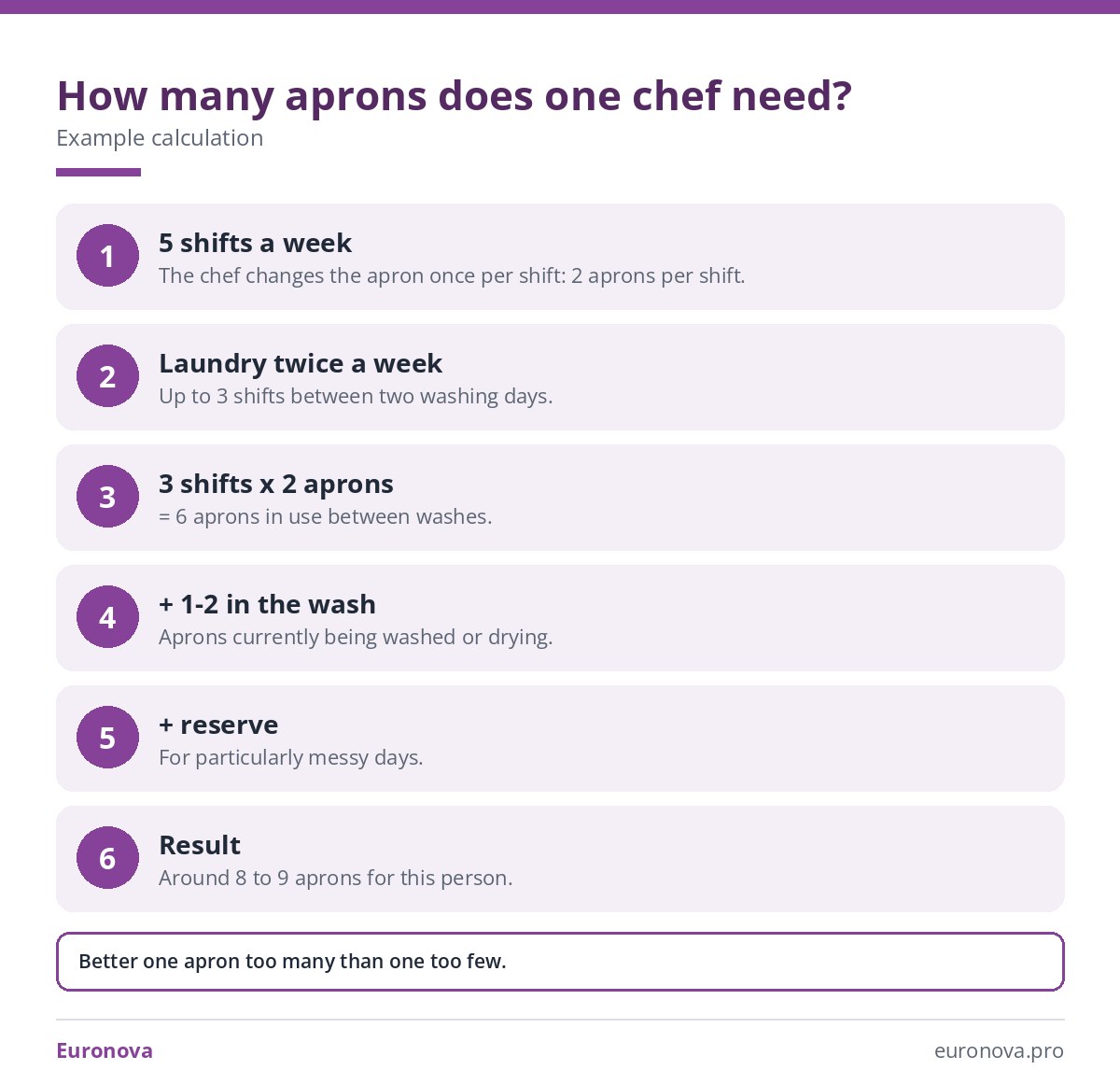
No regulation sets a fixed number. A sensible calculation is based on three values: shifts per week, changes per shift and washing frequency.
Example calculation: a chef works five shifts a week and changes the apron once per shift on average, so uses two aprons per shift. Laundry is done twice a week. Between two washing days there are up to three shifts, so six aprons. Add one or two that are currently being washed or drying, plus a reserve for particularly messy days. That brings you to around eight to nine aprons for this person.
Front of house, the figure is usually lower because aprons are changed less often. In the dishwashing area, add waterproof aprons that are wiped down in between. If you work with an external laundry, also plan for the days when the linen is in transit.
Our advice: better one apron too many than one too few. If there is no clean apron, the team keeps wearing the old one, and that is exactly what the hygiene rule is meant to prevent.
Aprons for pastry, banquets and table setting
Aprons are not just for cooking. In pastry, you work with cream, ganache, fondant and food colourings. Anyone who wants to decorate cakes cleanly needs an apron that protects against colour splashes and does not shed fibres, as well as clean piping bags, spatulas and work surfaces. The basic rules are the same as in the hot kitchen: a fresh apron, washed hands, covered hair, tools cleaned after every use. Keep separate aprons for the pastry section so that odours or residues from the meat kitchen do not transfer to desserts.
Aprons are also in use for table setting and decoration. Staff who lay tables, fold napkins and polish glasses before an event should already wear the waiter's apron they will later show during service. That way everything matches: apron colour, table linen and tableware form a whole. Plan the table decoration starting from the tableware. A dark plate such as the Notte Gourmet flat plate calls for different table linen and apron colours than a light, pearlescent plate such as the Nacrous flat plate. Choose plates and glasses first, then table linen and decoration, and finally service clothing in a matching colour.
Logo, colour and a consistent look
In open kitchens and in the dining room, the apron becomes a calling card. An embroidered logo, a uniform colour and the same cut for the whole team show guests that care is taken here. Three points help with planning:
- Colour by area: some businesses mark areas by colour, for example white for the kitchen and black for front of house. This makes it easier to keep track of who works where.
- Embroidery instead of print: embroidery generally withstands frequent high-temperature washing better than printed designs. Check with the manufacturer which finish suits the washing temperature you need.
- Reorder availability: choose models you will be able to reorder later. A team in three different shades of black looks untidy.
Our view from practice
Every day we see how businesses equip their kitchens and front of house. Aprons are often bought last and in too small a quantity, even though they are worn and washed every day.
Our experience: those who plan aprons together with tableware, cutlery, glassware and kitchen utensils get a more coherent result. Service clothing then matches the table, and chef clothing matches the processes in the kitchen. That is why we carry chef clothing in the same range as porcelain, glassware and catering appliances.
For choosing, we recommend a simple order: first list the workstations, then define the apron type for each workstation, and finally calculate the number of aprons based on shifts and washing frequency. With this list you order correctly once instead of topping up three times.
— Rok
Chef clothing and catering equipment in one place
At Euronova, restaurants, hotels, cafés, bars, pizzerias, caterers and canteen kitchens find chef clothing together with everything the kitchen and dining room need: porcelain and serveware, glassware, cutlery, cookware, knives, kitchen utensils, food storage products, buffet and bar equipment, cleaning products and pastry equipment.

This makes it easy to combine an apron order with restocking plates, glasses or consumables. Put your equipment together directly in the Euronova online shop for catering equipment.
FAQ: chef aprons
What kind of apron do chefs wear in a restaurant?
In the kitchen, the standard is a long bib apron, because it protects the torso and legs from splashes and grease. It should reach at least to the knees and be washable at high temperatures. In wet areas, it is supplemented by a waterproof apron.
What is the difference between a waist apron and a bib apron?
A waiter's waist apron is tied only around the hips and has no bib. It is common front of house because it looks elegant and leaves the shirt or blouse visible. A bib apron also covers the chest and therefore offers better protection when cooking.
How often should a chef's apron be changed?
At least every shift, and additionally whenever it is visibly dirty or after working with raw meat, fish or eggs. Take the apron off before going to the toilet and during breaks. Set out the rules in your establishment's hygiene plan.
Can staff wash their aprons at home?
That depends on your hygiene plan. Regulation (EC) No 852/2004 requires clean, suitable work clothing; what matters is that aprons are washed at a sufficient temperature separately from personal clothing and stored separately from street clothes. Many businesses therefore wash in-house or use a laundry service so that control stays within the business.
Are leather aprons hygienic in the kitchen?
They can be, if the textile parts can be separated from the leather and washed separately at a high temperature. When buying, look for detachable straps and the manufacturer's care instructions. At a hot stove and in wet areas, washable textile or coated aprons are usually more practical.
Sources
- Regulation (EC) No 852/2004 on the hygiene of foodstuffs
- Gastgewerbe-Magazin: Die neue Rolle der Schürze im Gastgewerbe
- DIN Media: draft standard DIN 10524:2018-12
- BfR: Hygieneregeln in der Gemeinschaftsgastronomie